
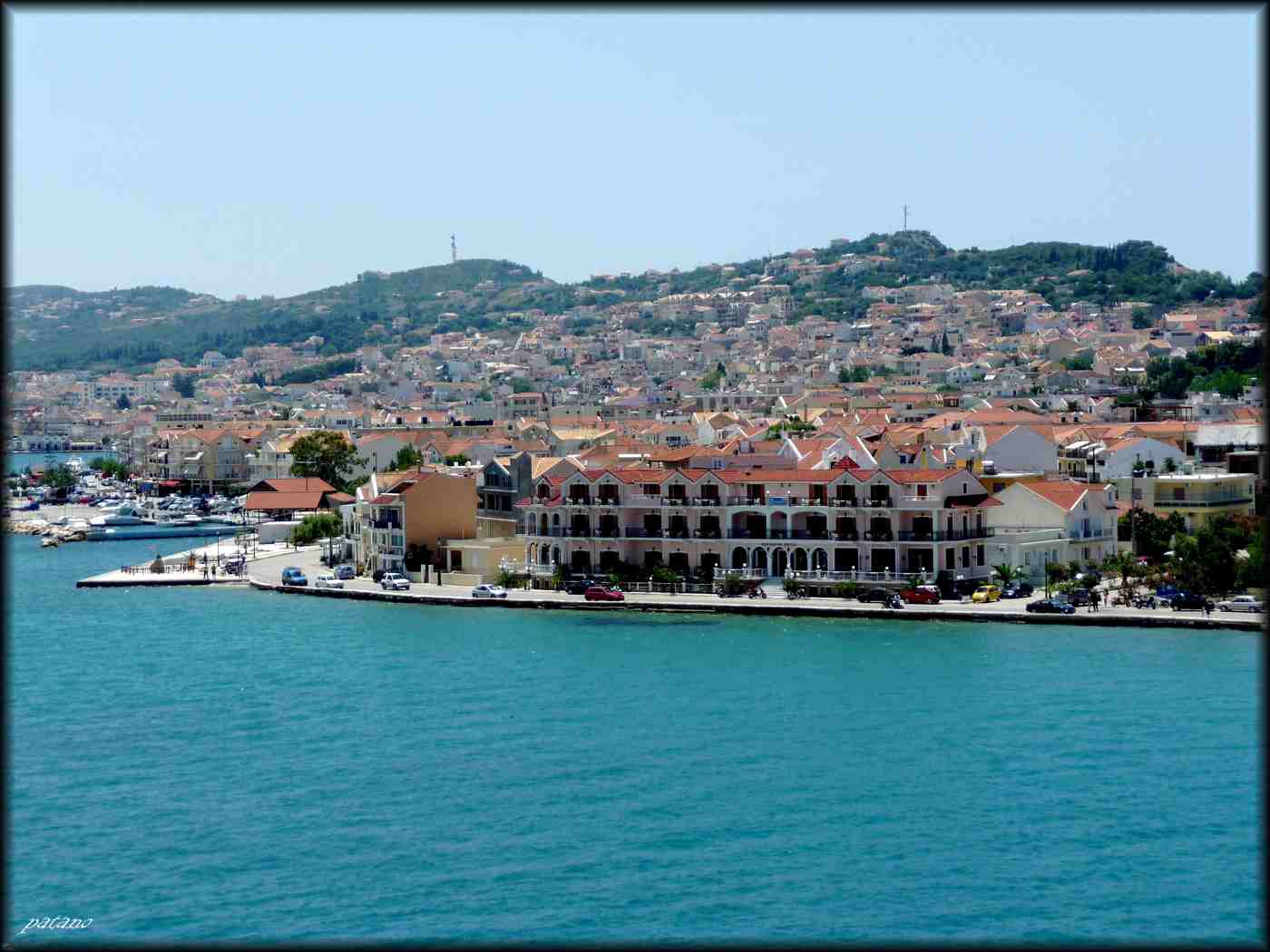
Lassi is the resort strip immediately southwest of Argostoli, and it works as the closest holiday base to the island capital. The centre of Argostoli sits about 3 km away, and Kefalonia Airport lies roughly 7 km from the same strip. Hotels, apartments, tavernas, bars and shops line one main road along a wooded ridge, and steps and lanes drop from that road to the sand below. The ridge faces west across the Ionian Sea, so the strip takes the sunset every evening of the season without a drive to another coast. Plan the whole trip with Greece Tours.
Two sandy beaches define the resort. Makris Gialos and Platis Gialos lie side by side, separated by a low rocky spur, and both shelve gently into clear water that suits families with young children. Sunbeds, umbrellas and watersports operate on each bay through the summer. Smaller coves sit within walking distance, among them Kalamia and Gradakia, for travellers who want less organised sand. A coastal road and path run north into town in about 30 to 40 minutes on foot. Past the Katavothres sea mills and the round Fanari lighthouse on the headland at Agioi Theodoroi.
Where is Lassi in Kefalonia and what kind of place is it?
Lassi occupies the wooded ridge immediately southwest of Argostoli on Kefalonia, roughly 3 km from the town centre and about 7 km from the island airport, and it functions as a compact beach resort rather than a village.
The resort spreads along a single main road that climbs and curves over a low headland southwest of the capital. Pine and cypress cover the slopes on both sides, and the buildings sit among them rather than in a dense grid. That layout gives Lassi its shape: one long spine of accommodation, food and shops, with short side lanes and stairways dropping west to the water. Walking the full strip end to end takes about 25 minutes at an easy pace, which keeps the whole resort within reach of anyone staying on it.
Lassi grew as a purpose-built holiday area rather than an old settlement, so the architecture runs low and modern. Most buildings stand two or three storeys high, a pattern repeated across the island after the great Ionian earthquake flattened the older towns. The result is a resort with wide pavements, easy parking bays and clear sightlines to the sea, but without a historic square or harbour of its own. Travellers who want stone lanes and a Venetian waterfront find them at Fiskardo in the far north, about 50 km away by road.
The strip’s position on the west-facing slope shapes daily rhythm across the whole of Kefalonia‘s southwest corner. Mornings stay bright and calm on the sand, afternoons bring a light onshore breeze off the Ionian, and the sun drops straight into open water ahead of the ridge. Restaurant terraces on the seaward side of the road are built to face that view. The same orientation means the beaches hold their light late, so swimming past six in the evening remains comfortable through the summer months.
Administratively and practically, Lassi belongs to the Argostoli side of the island rather than to the east-coast ports. Sami, the second port and the gateway to Ithaca, sits about 24 km east across the mountain road. Lixouri lies across the bay on the Paliki peninsula, reached by a short ferry from the Argostoli waterfront rather than from Lassi itself. That places the resort at the hinge of the island’s southwest, close to the capital’s services and within a day’s driving of Myrtos, Assos and the caves near Sami.
What are Makris Gialos and Platis Gialos beaches like at Lassi?
Makris Gialos and Platis Gialos form the two main beaches of Lassi, sitting side by side below the resort ridge, separated by a low rocky spur, both sandy, both organised, and both shelving gently into clear water.
Makris Gialos is the longer and busier of the pair, a broad curve of pale sand backed by a low cliff with steps and a ramp down from the road. The bay divides visually into two arms around a small rocky outcrop, and sunbeds with straw umbrellas cover most of the frontage through the season. Water depth increases slowly for about 20 metres out, which keeps the swimming zone shallow enough for children. A beach bar sits above the sand at the access point, and showers and changing cabins stand at the back of the bay.
Platis Gialos lies immediately north, reached either from its own access off the main road or on foot around the rocky spur when the sea is calm. The bay is shorter and slightly more sheltered, with the same pale sand and the same gradual entry into the water. Sunbeds fill the central section, while the northern end stays quieter for travellers who bring a towel. Boats for watersports launch from a marked corridor, keeping the swimming area clear. The two beaches together give Lassi about 500 metres of organised sand within a 10-minute walk of most accommodation.
Watersports operate on both bays in summer, and the standard line-up covers pedalos, canoes, stand-up paddleboards and towed inflatables. Operators set up at the water’s edge and run from mid-morning until late afternoon, when the onshore breeze usually strengthens. Lifeguard towers stand on the main sections during peak weeks. The sand holds its texture at the waterline rather than turning to shingle. Which separates these two bays from the white pebbles of Myrtos on the northwest coast, about 30 km away over the mountain road.
Comparison with the rest of the island matters when planning beach days. The bays at Lassi win on convenience and gradient, while the famous names among Kefalonia beaches win on drama and scale. Antisamos near Sami has clear deep water below green slopes, Petani and Xi sit on the Paliki peninsula across the bay, and Skala runs for kilometres in the south. Basing yourself at Lassi means daily swimming on foot and the bigger beaches as drives of 30 to 60 minutes.
Which smaller coves near Lassi are worth walking to, such as Kalamia and Gradakia?
Kalamia and Gradakia sit within walking distance of the Lassi strip, north of the two main bays toward Argostoli, and both give small pockets of sand and shingle with fewer sunbeds and quieter water.
Gradakia lies closest to the northern end of the resort, a compact cove reached by a signed path and a flight of steps down from the coast road. The sand runs mixed with fine shingle, and low rocks close both ends of the bay, which cuts the swell on breezy afternoons. A limited number of sunbeds occupies the centre, leaving space at the edges for towels. The cove faces west like the rest of Lassi, so it holds sun until the end of the day and stays warm for late swimming.
Kalamia sits a short distance further north along the same coast, closer to the outskirts of the capital, and it draws as many local swimmers as visitors. The bay is small, sheltered and backed by trees, with a narrow strip of sand and shallow entry over a sandy bed. Parking near the top is restricted to a handful of spaces, so arriving on foot from the Lassi strip in about 20 minutes removes the problem entirely. Facilities stay minimal, which is the point of coming here rather than to Makris Gialos.
The walk between coves follows the coast road and its pavements, with occasional cut-throughs to the shoreline. Distances are short: Gradakia sits about 1 km from the centre of the strip, and Kalamia about 2 km. Both walks run mostly downhill on the way out and uphill on the return, so carrying water matters in July and August heat. Travellers with a car find roadside parking easier before ten in the morning, after which the spaces above each cove fill quickly.
These coves change the character of a beach day at Lassi. The two big bays give organisation, watersports and beach bars, while Gradakia and Kalamia give quiet water and space. Families often split the difference, spending mornings on the sand at Platis Gialos and late afternoons at a cove where the crowd thins. Snorkelling works better over the rocky edges of the small bays, where fish gather around the stone rather than over open sand.
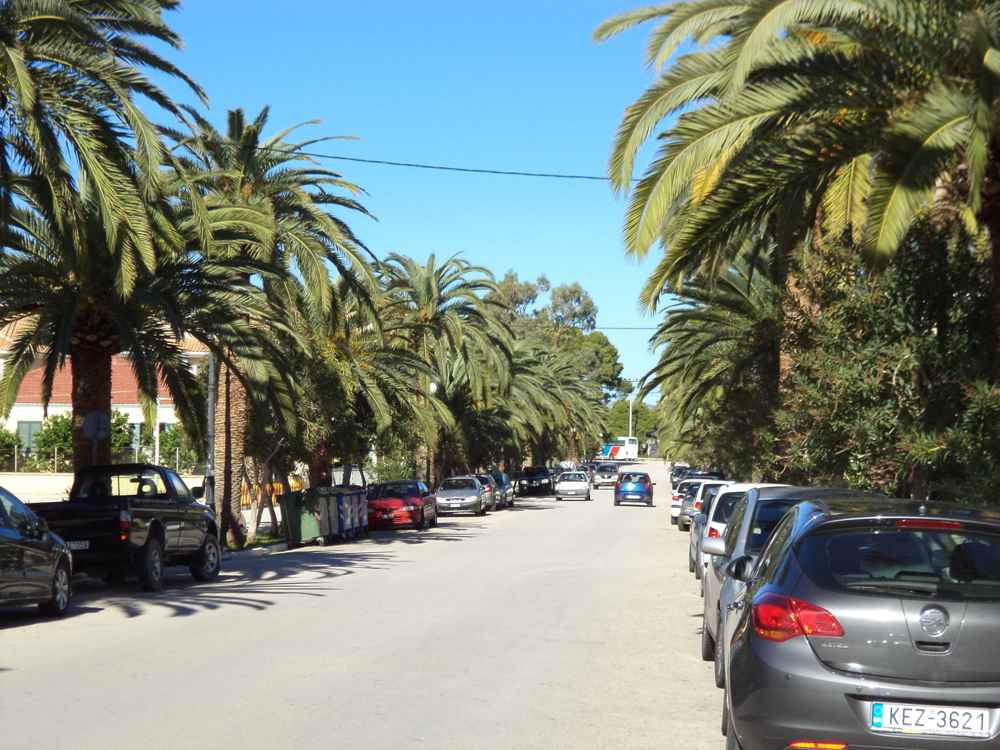
How do you get from Lassi into Argostoli on foot or by car?
A coastal road and path run north from Lassi into the island capital in about 30 to 40 minutes on foot, or about 5 minutes by car, passing the Katavothres sea mills and the Fanari lighthouse on the way.
The walking route leaves the northern end of the Lassi strip and follows the shoreline road toward the headland of Agioi Theodoroi. The gradient stays gentle, the surface is paved throughout, and the sea sits on the left the whole way. Most walkers cover the 3 km in 30 to 40 minutes without hurrying, and the same route works in reverse after dinner in town. Street lighting covers the section closest to the capital, so an evening return remains straightforward as far as the lighthouse.
The Katavothres sea mills mark the first landmark on the route, roughly halfway between the resort and the town. Seawater flows into a channel in the rock here and disappears underground, a phenomenon that once drove a water mill on the spot. Dye tests traced the water across the island to the Melissani cave and the springs near Sami, which showed that the sea crosses beneath Kefalonia. The restored mill wheel and the channel stay open to view beside the road, and the stop adds about 15 minutes to the walk.
The round Fanari lighthouse of Agioi Theodoroi stands a short distance further on, at the tip of the low headland. Its white circular colonnade of Doric columns sits on a rock platform with open water on three sides. The structure was rebuilt in the same form after the earthquake destroyed the original. The point catches the sunset directly, which makes it the standard evening stop for anyone staying on the strip. Parking runs along the road beside it, and the walk from Lassi takes about 25 minutes.
Arrival in Argostoli brings a different scale of place. The capital wraps around a lagoon crossed by the long De Bosset stone bridge, with a paved waterfront where fishing boats tie up and loggerhead turtles gather beside the quay. The main square, the pedestrian shopping street and the Napier Garden sit within a few hundred metres of each other. Supermarkets, banks, pharmacies and the bus station cluster here, which is the practical reason many Lassi guests walk in at least twice during a week.
What is along the main road through Lassi and what happens in the evening?
The main road through Lassi carries the resort’s hotels, apartments, tavernas, bars, mini markets, car-hire desks and travel agencies along about 2 km of ridge, and it fills with foot traffic from early evening until late.
Accommodation dominates the road, ranging from large hotel complexes with pools to small apartment blocks set behind gardens. Buildings on the seaward side hold the sunset view and the direct stairways to the sand, while those on the inland side sit quieter and usually cost less. Ground floors along the busiest section carry the shops: mini markets for beach supplies, bakeries, souvenir stores, a pharmacy and desks selling boat trips and coach excursions. Car and scooter hire operates from the same stretch, which removes any arrange a vehicle in town.
Eating options run the length of the strip and cover Greek tavernas, grill houses, pizzerias and international menus aimed at a mixed summer crowd. Terraces on the western side open to the water and fill first at sunset, so tables there go early in July and August. Prices sit close to the Argostoli average rather than above it, since the capital lies within a short drive and keeps the market honest. Breakfast places open from around eight, and most kitchens serve dinner until about eleven at night.
Evenings follow a steady pattern. Swimmers leave the sand between six and seven, the terraces fill for sunset, and dinner runs from about eight thirty. Bars along the road stay busy afterwards, with music kept at a volume that suits families rather than a club scene. The busiest concentration sits near the top of the ridge, and accommodation two or three lanes back from that point stays quiet enough for early nights. Travellers who want louder nightlife drive the 3 km into the capital, where the waterfront bars run later.
Practical services on the strip cover most needs without a trip to town. Cash machines stand outside the larger mini markets, laundry services operate near the middle of the road, and pharmacies handle sunburn and prescriptions. Excursion agencies sell the standard island circuits, including Melissani and Drogarati caves near Sami and the run north to Myrtos, Assos and Fiskardo. Booking a day earlier is normal in high season, and pick-up points sit along the main road so guests board close to their accommodation.
Who does Lassi suit as a base, and how does it compare with quieter parts of Kefalonia?
Lassi suits families, first-time visitors and travellers without a car, because sand, food, shops and the capital all sit within walking distance, while the north and the far south of the island trade that convenience for quiet.
Families gain the most from the layout. Two shallow sandy bays sit below the accommodation, both organised with sunbeds and shade, and the walk between room and water rarely exceeds 10 minutes. Mini markets sell nappies, sun cream and beach toys, and restaurant menus carry simple dishes alongside Greek cooking. Pushchairs work on the main road, though the stairways down to the sand demand carrying. Evening entertainment stays low-key, which fits families who eat early and want quiet by eleven.
Travellers weighing options for where to stay in Kefalonia measure Lassi against the alternatives on distance rather than atmosphere alone. Fiskardo in the far north gives a Venetian harbour and yacht traffic, about 50 km from the airport. Skala and Lourdas in the south give long beaches and a slower pace, 35 to 40 km out. Sami on the east coast puts the caves and ferries at the door. Lassi is closest to both the capital and the runway, which shortens transfers and shortens every supply run.
The trade-off is character. Lassi has no old square, no fishing harbour and no village life independent of tourism, so travellers seeking a working Greek settlement look elsewhere. The compensation is that Argostoli, a genuine island town with a market, a bridge across the lagoon and a year-round population, sits 3 km up the coast. Staying at Lassi effectively splits the difference: a purpose-built beach base by day, a real capital within walking distance for dinner, shopping and the ferry to Lixouri.
Non-drivers find Lassi one of the places on the island that works without a hire car. Beaches, food and shops need no transport at all, the capital is walkable, and the bus station in town connects to Sami, Skala, Poros and Fiskardo. Excursion coaches pick up on the strip for the main sights. Planning the rest of the things to do in Kefalonia around those departures keeps a week busy without a rental, though a car still opens the mountain roads to Ainos and Assos.
How do you reach Lassi from Kefalonia Airport and get around once you arrive?
Kefalonia Airport lies about 7 km from Lassi, a drive of roughly 15 minutes by taxi or transfer, and the resort works on foot for daily needs, with buses, taxis and hire cars covering the rest of the island.
Transfers from the airport run north on the main road toward the capital, then west onto the ridge. Taxis wait outside the terminal on arrival and the fare is fixed by zone rather than metered on that route. Pre-booked hotel transfers and tour-operator coaches use the same road, and the journey takes about 15 minutes in normal traffic. Hire-car desks sit inside and beside the terminal, so collecting a vehicle on landing removes any need for a taxi at either end of the stay.
Ferries give the other way in. Boats from Kyllini and Patras on the mainland dock at Poros and Sami, and services also link Kefalonia with Ithaca, Zakynthos and Lefkada. Poros sits about 40 km from Lassi and Sami about 27 km, both on winding but well-surfaced roads. Drivers arriving with a vehicle reach the resort in around 45 minutes from either port. The Argostoli waterfront also runs the short crossing to Lixouri on the Paliki peninsula, boarding 3 km from the strip.
Local buses connect the resort area with the capital during the summer season. The service runs frequently enough to cover a morning in town and an afternoon on the sand. The main island network departs from the Argostoli bus station near the waterfront, with routes to Sami, Skala, Poros, Lixouri and Fiskardo. Timetables thin outside high season, so checking departures at the station on arrival day saves a wasted morning. Taxis from the strip to the town centre cost little given the 3 km distance.
Driving from Lassi opens the whole island within day-trip range. Myrtos beach sits about 30 km north, Assos about 36 km, and Fiskardo about 50 km on the coastal route. The Melissani and Drogarati caves near Sami are about 27 km east, and the Omala valley with the Robola vineyards and the monastery of Agios Gerasimos about 15 km southeast. Mount Ainos, at about 1,628 metres the highest peak in the Ionian Islands, is reached by a mountain road that climbs from the Argostoli side in about 45 minutes.
Frequently Asked Questions
How far is Lassi from Argostoli?
Lassi sits about 3 km southwest of the centre of Argostoli, which makes it the closest resort to the island capital. The walk along the coastal road takes 30 to 40 minutes at an easy pace on paved surfaces the whole way. Passing the Katavothres sea mills and the Fanari lighthouse at Agioi Theodoroi. Driving covers the same distance in about 5 minutes, and a taxi costs little on that short run. Local buses link the two in summer, and excursion coaches pick up on the Lassi strip before heading through town. The short distance is the practical argument for the resort: guests reach the capital’s supermarkets, pharmacies.
Bus station, waterfront tavernas and the ferry to Lixouri without a hire car, then return to sand within minutes.
Which Lassi beach is better for families, Makris Gialos or Platis Gialos?
Both beaches suit families, and the choice comes down to size and crowd rather than safety. Makris Gialos is longer and busier, with more sunbeds, more watersports and a beach bar above the sand, so it works for older children who want activity. Platis Gialos is shorter, slightly more sheltered behind the rocky spur and generally calmer, which suits toddlers and anyone who wants a quieter stretch of towel space. Both are sandy, both are organised with umbrellas and showers, and both shelve gradually, keeping the water shallow for roughly 20 metres out.
Families staying on the strip often use one in the morning and the other after the afternoon breeze picks up, since the two bays sit within a 10-minute walk of each other.
Can you stay in Lassi without hiring a car?
Lassi works without a car better than most bases on Kefalonia. Two sandy beaches sit below the accommodation, and the shops, tavernas, bars, bakeries and pharmacies all line the same main road, so daily life needs no transport. Argostoli lies 3 km north, walkable in 30 to 40 minutes or reachable by summer bus and taxi. Which puts the island bus station, the market and the Lixouri ferry within reach. Excursion agencies on the strip sell coach and boat trips to Melissani cave, Myrtos, Assos and Fiskardo, with pick-up points along the road.
A hire car still helps for Mount Ainos, the Omala valley and remote beaches on the Paliki peninsula, but a week without one remains comfortable here.
How long does the transfer take from Kefalonia Airport to Lassi?
The drive from Kefalonia Airport to Lassi covers about 7 km and takes roughly 15 minutes in normal conditions. Taxis wait outside the terminal on arrival, pre-booked transfers meet guests inside, and tour-operator coaches drop along the main road through the resort. The route runs north toward Argostoli, then turns west onto the wooded ridge above the beaches. Hire-car desks operate at the terminal, so collecting a vehicle on landing works for travellers who plan to explore the island. Lassi is the closest resort to the airport, which shortens both the arrival transfer and the departure run. An advantage on early flights when a 50 km drive from Fiskardo mean leaving in darkness.
Does Lassi get the sunset?
Lassi faces west across open water, so the resort takes the sunset directly through the whole season. The ridge above Makris Gialos and Platis Gialos looks out over the Ionian Sea with no land in the way. Restaurant terraces on the seaward side of the main road are built to hold that view. Beaches keep their light late, which makes swimming after six in the evening comfortable in summer. The Fanari lighthouse at Agioi Theodoroi, about 25 minutes north on foot, is the standard sunset viewpoint for anyone staying on the strip. With its white circular colonnade on a rock platform surrounded by water on three sides.
The small coves at Gradakia and Kalamia share the same western aspect.
Is Lassi noisy at night?
Lassi runs busy in the evening rather than loud. Bars along the main road stay open late and play music. The volume suits a family resort rather than a club strip. And the busiest concentration sits near the top of the ridge. Accommodation two or three lanes back from that section stays quiet, and rooms on the inland side of the road escape most of the foot traffic. Restaurants serve until about eleven, after which the strip thins gradually. Travellers who want later nightlife drive or walk the 3 km into Argostoli, where waterfront bars run longer.
Guests booking for sleep ask for a room away from the central junction and above the ground floor, which cuts both street noise and pool noise.