
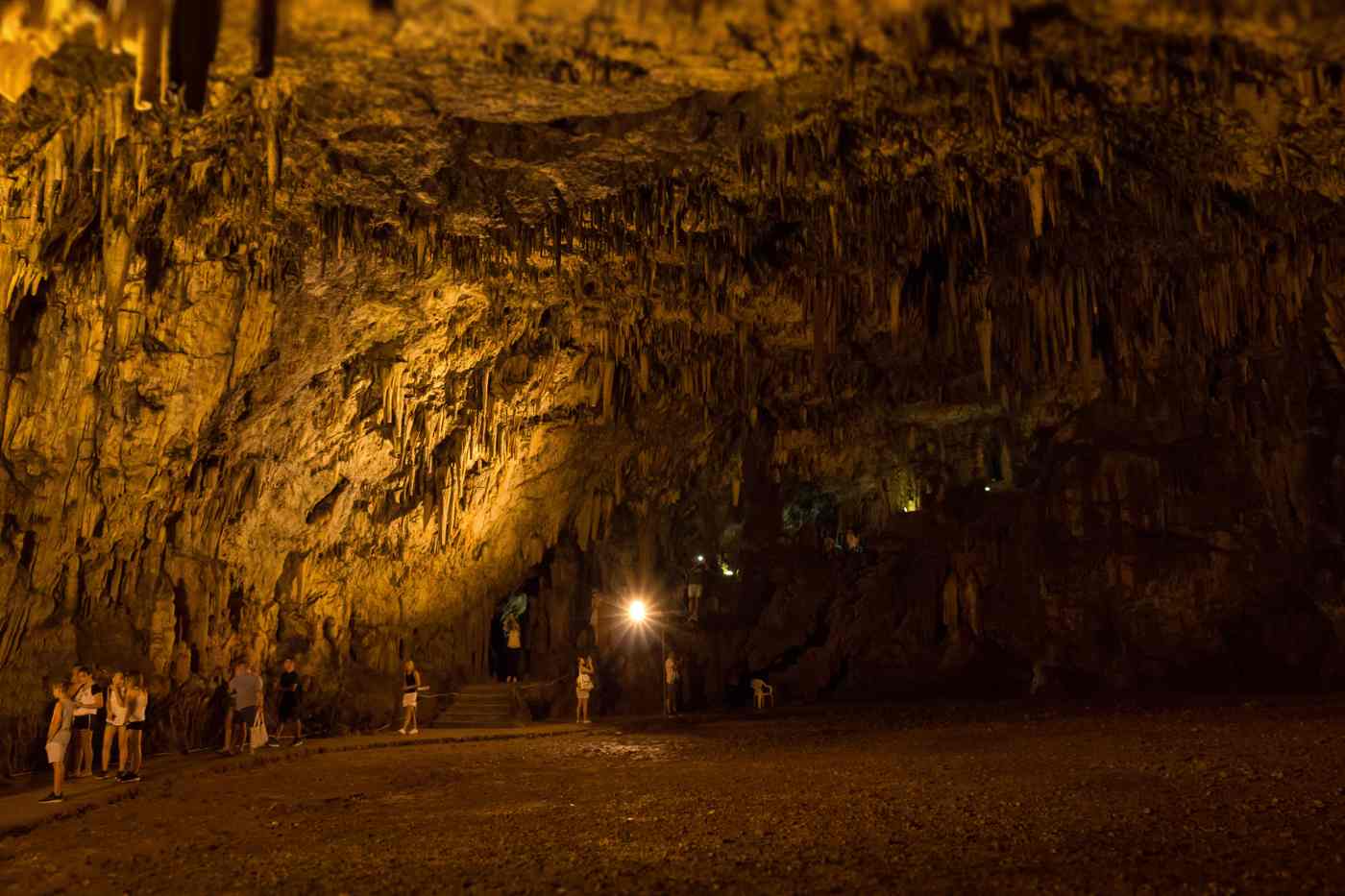
Drogarati cave sits in the low hills above Sami, on the east coast of Kefalonia. The entrance stands about 3 kilometres from the port town and around 25 kilometres from Argostoli. A stairway drops through a narrow opening into one great chamber hung with stalactites. Stalagmites rise from the floor to meet them, and columns mark the points where the two have joined. The air inside stays cool and damp in every season. The chamber holds the same heavy stillness in August that it holds in March. Plan the whole trip with Greece Tours.
The main hall carries the name Chamber of Exaltation, written in Greek tradition as the Sala of Apotheosis. The name comes from the way sound travels between the walls and the domed roof. Concerts have been staged on a platform built inside the chamber. Island tradition links the singer Maria Callas with performances under this rock. An earthquake opened the entrance and exposed the interior, and the cave was later fitted with steps, railings and lighting. Sections beyond the lit hall stay closed so the formations keep growing undisturbed.
What is the Drogarati cave and where does it sit on Kefalonia?
Drogarati is a large stalactite cave in the hills above Sami, on the east coast of Kefalonia. The entrance stands about 3 kilometres from the town and around 25 kilometres from Argostoli by road.
The cave lies inland from the Sami waterfront. Drivers reach it by a short climb through olive groves and grey limestone slopes. Signposts on the road between Sami and Argostoli point to the entrance. The gate stands beside a small car park and a ticket kiosk. Drogarati counts as one of the two underground attractions on the east coast of Kefalonia. The second is the flooded chamber at Melissani, around 4 kilometres north on the same network of side roads. The drive up from the port takes about five minutes.
The name Drogarati attaches to the whole hillside above the bay. The cave itself sits under a shallow ridge covered in scrub and low pines. Nothing on the surface hints at the size of the space below. The opening is narrow and framed by a concrete forecourt with a handful of benches. The port of Sami lies within sight of the approach road. Ferries to Ithaca load at the quay below the hillside. The bay of Antisamos stays hidden behind the eastern headland, about 4 kilometres away.
Drogarati belongs to the limestone spine that runs down the eastern side of the island. The same rock produces the sinkholes and underground channels around Sami. Rainwater carrying dissolved carbon dioxide works through joints in that limestone. The water hollows out chambers across spans of time measured in hundreds of thousands of years. The result under this ridge is a single great hall rather than a network of passages. The cave therefore reads as one room instead of a maze of tunnels. Water still moves through the rock above the ceiling after heavy rain.
Visitors treat the cave as a half-hour stop rather than a full excursion. The site handles a steady flow of people through the middle of the day. Coach groups arrive from Argostoli and from the cruise berth down at Sami. The stairway fills and empties in waves as those groups come and go. Early arrivals and late afternoon visits meet fewer people on the steps. That matters in a chamber where the walkway is narrow and the descent runs single file. Guides working the site plan their own groups around the same pattern.
What does the descent into the great chamber of Drogarati involve?
A concrete stairway with metal handrails drops from the entrance through a narrow shaft. The flight carries visitors about 60 metres below the surface, into the single great chamber, in one continuous descent that lasts under five minutes.
The stairway starts under a low roof and turns twice before the walls open out. Daylight fades within the first ten steps, and electric lamps set into the rock take over. The descent runs steeply enough that the handrail earns its place on the way down. The treads carry a film of moisture that never dries, even at the height of summer. Visitors coming back up climb the same flight, which takes longer than the way down. A slow pace suits the return better than a rush behind a coach group.
The chamber opens without warning at the foot of the stairs. Floodlights pick out a ceiling covered in stalactites and a floor broken by rising stalagmites. Columns stand where the two have already met and fused into single shafts of calcite. The hall covers roughly 900 square metres by common measurement, and the far corners fall into shadow. Sound behaves differently the moment the space widens above the last step. Conversation on the stairway carries clearly across the whole room to the far wall. Groups behind announce themselves before they appear at the bottom.
A railed walkway loops through the lit part of the chamber and returns to the stairs. The route is short, on the order of 200 paces, and it keeps visitors clear of the formations. Barriers mark the point where the lit section ends and the unlit passages begin. Those deeper parts of the system stay closed to protect the calcite from traffic. The whole circuit occupies about fifteen minutes at a walking pace with stops for photographs. Guides use the wider platform halfway round for their explanation of the cave.
Photography inside works best without flash, because the floodlights already model the formations. A flash flattens the ceiling and burns out the wet surfaces closest to the walkway. The chamber holds enough light for a steady hand or a rail to brace against. Tripods crowd a walkway this narrow, so most visitors leave them in the car. The wet stone reflects the lamps and throws highlights across the calcite. Images taken from the platform hold up best, where the ceiling drops close overhead and the stalactites read against the lit rock behind them.
How did the stalactites and stalagmites inside Drogarati form?
Rainwater carrying dissolved carbon dioxide seeps through the limestone above the chamber and picks up calcium carbonate. The water then releases that mineral drop by drop, building stalactites downward from the ceiling and stalagmites upward from the floor.
Each stalactite starts as a ring of calcite left behind by a single hanging drop. The drop clings to the ceiling, gives up part of its mineral load, then falls. The ring thickens into a hollow straw, and the straw lengthens over centuries of dripping. Water still runs down a large share of the formations in Drogarati today. The process therefore continues while visitors stand on the walkway underneath it. Growth in caves of this kind is measured in fractions of a millimetre each year.
Stalagmites grow from the floor where those same drops land and splash. The splash spreads the calcite into a broader, blunter shape than the tapering forms above. The two are easy to tell apart from the walkway once the difference is pointed out. A stalactite and a stalagmite that meet fuse into a column of solid calcite. Drogarati holds columns thick enough to read as pillars supporting the roof. Curtains and sheets of flowstone spread across the walls where water runs rather than drips. Those sheets hang in folds that catch the floodlights from below.
Colour in the chamber comes from minerals carried down with the water. Iron and clay tint parts of the formations rust and ochre across large sections of wall. The freshest surfaces stay close to white and catch the floodlights directly. Wet calcite reads translucent under the lamps, almost like poured wax on the older columns. The difference between an active formation and a dry one shows plainly in that shine. Guides point out both kinds within 5 metres of each other on the loop. The contrast makes the chamber’s age legible from the walkway.
Protection of the formations drives the whole layout of the visit. Railings keep hands off the calcite, because skin oils seal the surface. That sealing stops the thin water film that feeds the growth of each formation. Warm breath and lighting also alter the chamber, so the lit section stays limited. Anyone planning a run of things to do in Kefalonia that includes caves meets the same rules at Melissani. The boats there keep their distance from the walls for exactly this reason. Both sites treat the calcite as a resource that regrows across centuries.
Why is the main hall at Drogarati called the Chamber of Exaltation?
The main hall earns the name Chamber of Exaltation, or Sala of Apotheosis, from its acoustics. Hard wet limestone and a high domed roof return sound with long natural reverberation, which turned the space into a concert venue.
Sound in the chamber behaves the way it does inside a stone church. The limestone absorbs almost nothing that reaches it from the floor of the hall. A note leaves the platform, crosses the room, and returns from the roof and far wall. The sound then hangs in the air for a moment after the source stops. Speech carries across the room at low volume, and a raised voice on the stairway reaches the walkway. Musicians describe the reverberation as long and even rather than sharp or metallic.
Concerts have been staged inside on a platform built at one side of the chamber. The audience sits on the rock terraces and the walkway level facing that platform. Events of this kind run rarely rather than as a regular programme. Heat from an audience and from stage lighting affects the growing formations. The cave also closes to normal visits while a performance is set up and cleared. The repertoire leans toward classical and choral work, which gains most from a room with this decay.
Island tradition links Maria Callas with singing under this roof. Guides repeat the association, and it appears in the way the site is introduced to arriving groups. The soprano’s Greek connections helped the story attach itself to the chamber. Treat the detail as tradition rather than as a documented concert programme. The underlying point still stands for anyone standing on the walkway below. Performers have been drawn here by the acoustics rather than by the setting alone. The hall carried a musical reputation on Kefalonia long before mass tourism reached Sami.
Visitors test the room themselves without waiting for a concert. A clap from the walkway returns after a clear pause of a fraction of a second. A held note keeps sounding in the roof once the singer has stopped. Guides sometimes ask a group to fall silent for half a minute. The drip of water from the ceiling then becomes audible across the whole chamber. That quiet reading of the space works best when the stairway is empty of arriving groups. The first hour after opening delivers that silence more reliably than any other window.
What conditions do visitors meet inside the Drogarati cave?
Drogarati holds cool, humid air throughout the year, far below the summer heat outside. Water drips from the ceiling onto the walkway, the concrete steps stay wet, and the surfaces turn slippery underfoot.
The temperature contrast hits hardest in July and August. The coast above runs hot while the chamber stays cool enough to raise goosebumps in a minute. Humidity sits near saturation, so the air feels heavier than the thermometer alone suggests. A light layer carried in a bag covers the whole difference without any bulk. Most visitors put that layer on halfway down the stairway as the air changes. They take it off again at the top of the steps on the way out, back in the heat of the forecourt.
Footwear decides how comfortable the descent feels from the first step onward. Closed shoes with a grip pattern hold well on the wet concrete treads. Smooth soles and flip-flops slide on those same steps, especially on the turns. The stairway carries a permanent film of moisture from the roof above it. Thin growth on the older sections makes the surface slicker still in places. Handrails run the length of the flight on at least one side. Using them counts as normal practice here rather than a precaution for difficult conditions.
Lighting is fixed and evenly spread, so no torch is needed on the walkway. The corners of the chamber stay dim by design, which protects the calcite from heat. The route is narrow, with passing places rather than a continuous double width. Pushchairs do not fit on the stairs and are left up at the entrance. Anyone with limited mobility finds the descent demanding, since the flight is long and steep. Bags stay on shoulders throughout, because the walkway offers nowhere to set them down.
The cave suits a break from the beach on a hot afternoon. Rain works against the visit, because it increases the drip inside and wets the steps further. Families pairing the cave with a swim run the two parts in either order. The coves near the port sit within twenty minutes of the entrance by car. The wider run of Kefalonia beaches along this coast opens up from the same road. Antisamos and the small bays north of Sami work well for the second half of the day.
How do you combine Drogarati with the Melissani cave and Sami?
Drogarati and Melissani stand around 4 kilometres apart on the same side roads out of Sami. Drivers cover both caves in a single morning and reach the town waterfront for lunch within ten minutes.
The two caves complement each other rather than repeat each other. Drogarati is a dry stalactite chamber entered on foot down a long stairway. By contrast, the Melissani cave is a flooded sinkhole crossed by rowing boat. Its roof collapsed long ago, which lets sunlight strike the water and light the lake blue. Visitors who do both in one outing see two ways limestone behaves on this coast. The order matters only for the light, since Melissani reads best around the middle of the day.
Melissani takes the shorter time on site once the boat queue has cleared. Drogarati absorbs a longer visit because of the stairway and the climb back out. A morning that starts at the stalactite cave near opening time avoids the worst of both queues. The move to the lake cave then lands close to noon, when the sunlight falls straight through the roof. Parking at each site is small, and cars circulate rather than wait for a space. An early arrival therefore saves more time than any other single decision.
The town of Sami sits at the foot of the same road, ten minutes downhill. Tavernas line the quay, and the ferry ramp for Ithaca stands in the middle of the waterfront. Antisamos, the pebble bay behind the eastern headland, lies about 4 kilometres from the port. The road there climbs over the ridge and drops to the shore in a series of bends. That bay takes the afternoon comfortably after a morning spent underground. Antisamos served as a filming location for the Captain Corelli’s Mandolin production.
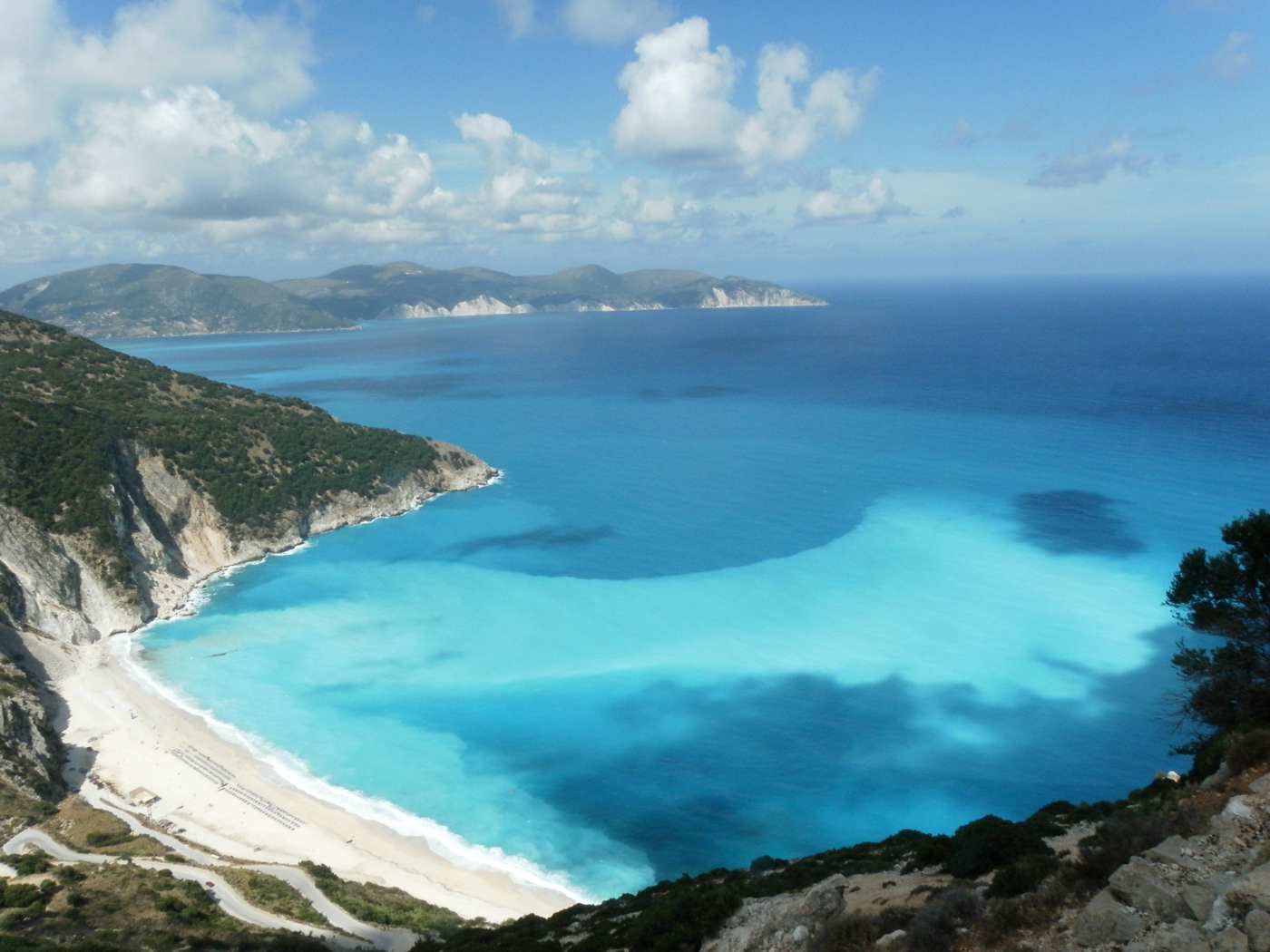
Drivers based further away build the same pair of caves into a longer loop. Argostoli lies about 25 kilometres west across the middle of the island. Myrtos beach sits north of the junction at Divarata, below steep white cliffs. Fiskardo closes the run at the northern tip of Kefalonia, about 50 kilometres from Sami. A day taking in Drogarati, Melissani and one northern stop covers around 120 kilometres of mountain road. Allow for slow sections and blind bends rather than motorway speeds between the points.
How do you reach Drogarati by car and plan the visit?
Drivers reach Drogarati on the signed side road that leaves the Sami to Argostoli route. The turning stands about 3 kilometres from the port, and the cave has free parking at the entrance beside a ticket kiosk.
Where to buy entry, how the online tickets work and who enters free are set out on the Drogarati Cave tickets page.
The approach from Sami climbs steadily and takes about five minutes at normal speed. Signs for both caves stand together at the junction with the main road. The turning for Drogarati comes before the one for Melissani when driving up from the port. The final stretch is a single-lane surface with passing bays cut into the verge. Meeting a coach on a bend there means reversing to the nearest widening. Parking at the cave is a compacted yard that fills in mid-morning and empties by late afternoon.
Argostoli lies about 25 kilometres away on the cross-island road through the mountains. The drive takes roughly 40 minutes, with slow sections over the pass and places to overtake. Kefalonia Airport sits about 9 kilometres south of Argostoli on the same side of the island. That puts the cave around an hour from arrivals once town traffic is included. Buses connect Argostoli and Sami, but the stop leaves a climb up the hill on foot. A hire car or a taxi from the port suits the visit better than the timetable.
The visit itself runs about 30 minutes from the ticket kiosk back to the car. That figure covers the descent, the loop through the chamber and the climb back out. Tickets are sold at the gate rather than online, and the queue moves quickly. The cave closes when weather makes the interior unsafe, which happens after heavy rain. Cruise days at Sami push the busiest window into the late morning hours. Travellers with a fixed schedule therefore aim for the first hour after opening, before the first coaches climb the hill from the port.
Bring water, a light layer and shoes with grip, and leave large bags in the car. Nothing at the site sells equipment for the descent, so arrive ready for wet steps. The kiosk area holds a small shop and shade rather than a full visitor facility. Drogarati works as the anchor of an east-coast morning on this side of the island. The road onward runs south to Poros or north to Divarata and the coast beyond. Either direction opens the rest of the day without doubling back through Argostoli.
Frequently Asked Questions
Where exactly is the Drogarati cave on Kefalonia?
Drogarati sits in the hills above Sami on the east coast of Kefalonia. The entrance stands about 3 kilometres inland from the port and roughly 25 kilometres east of Argostoli. The turning leaves the Sami to Argostoli road and is signed for both Drogarati and Melissani. The stalactite cave comes first when climbing from the port, and Melissani lies around 4 kilometres further north. That short distance is why the two caves are almost always visited on the same morning. Kefalonia Airport stands about 9 kilometres south of Argostoli, putting the cave around an hour from arrivals by car. The nearest beaches, including Antisamos behind the eastern headland, sit within twenty minutes of the gate.
How long does a visit to the Drogarati cave take?
Allow about 30 minutes from the ticket kiosk back to the car. The descent takes five to ten minutes on a steep stairway with handrails. The railed loop through the lit chamber runs about fifteen minutes with stops for photographs. The climb back out takes longer than the way down, especially in a queue. Coach arrivals stretch the whole figure, because the stairway runs single file in places. Travellers pairing Drogarati with Melissani plan on a half day for both caves. That budget covers the short drive between them and the parking at each site. Visitors who reach the gate in the first hour after opening meet the fewest people on the steps.
They finish fastest and drive on to Melissani before the boat queue builds.
Is the Drogarati cave suitable for children and older visitors?
Children walk the route without difficulty as long as they hold the handrail. The lit chamber holds their interest and carries them through the climb back out. The obstacle for everyone is the stairway itself, which is long, steep and permanently wet. No lift or ramp alternative exists, and no shortcut exists once at the bottom. Visitors with knee trouble or heart conditions find the ascent demanding on a warm day. Pushchairs do not fit on the steps and are left at the entrance instead. Small children therefore travel in a carrier or on foot. The chamber itself is level along the railed walkway, with barriers on both sides of the route.
The cool damp air suits a hot afternoon better than a full day outdoors.
What do visitors wear inside the Drogarati cave?
Closed shoes with a grip pattern rank as the single most useful item to bring. The steps and the walkway carry a permanent film of water from the roof above. Smooth soles slide on wet concrete, so flip-flops make the descent harder than it be. A light jacket or long sleeve covers the temperature drop inside the chamber. That drop feels sharp in July and August, when the coast above runs hot. Humidity sits near saturation, so clothing feels damp within minutes underground. Camera lenses fog on the way in and clear after two minutes at cave temperature. Large bags stay in the car, because the walkway offers nowhere to set anything down.
Can you visit Drogarati and Melissani on the same day?
Both caves fit comfortably into one morning on the east coast. They stand around 4 kilometres apart on the same side roads above Sami. A common order starts at Drogarati near opening time, when the stairway is quiet. The visit then moves to Melissani closer to midday, when sunlight falls through the collapsed roof. That light turns the water of the underground lake a deep blue. The two visits differ enough to justify doing both in one outing. One is a dry stalactite chamber entered on foot, the other a flooded sinkhole crossed by rowing boat. Sami lies ten minutes downhill for lunch, with Antisamos beach about 4 kilometres beyond the town.
Parking at both caves is limited and fills through the middle of the morning.
Why is the Drogarati cave known for its acoustics?
Hard limestone walls and a high domed roof give the main hall long, even reverberation. Almost nothing in the chamber absorbs sound once it leaves the floor. A note carries across the room, returns from the roof and the far wall, and hangs in the air. That quality earned the hall its name, the Chamber of Exaltation. Greek tradition also renders the name as the Sala of Apotheosis. Concerts have been staged on a platform built at one side of the chamber. The audience sits on the rock terraces facing it, and island tradition links Maria Callas with singing here. Performances run rarely, because audience heat and stage lighting affect the growing formations.
The cave works as a venue on isolated occasions rather than as a regular stage.