
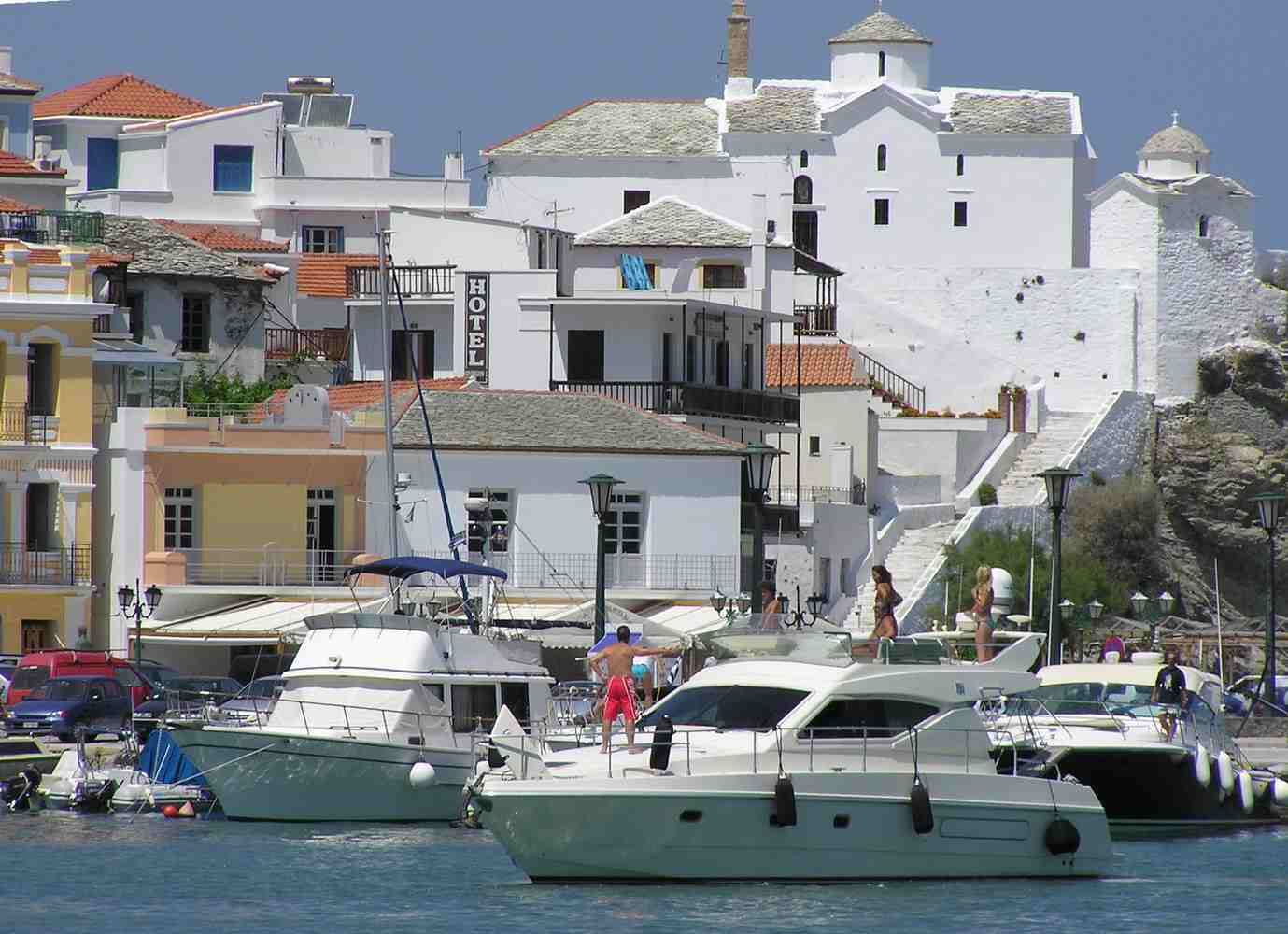
Skopelos is the greenest island in the Sporades, cloaked in Aleppo pine that reaches almost to the sea. Things to do in Skopelos combine swimming at pine-backed beaches such as Kastani and Milia, walking the alleys of the Venetian Kastro. Climbing to the Mamma Mia wedding church at Agios Ioannis Kastri. Tasting the island’s spiral cheese pie and dried plums. Plan the whole trip with Greece Tours.
This guide maps the beaches, villages, monasteries and boat trips that fill a Skopelos itinerary. It covers the southwest coast coves, the monastery-crowned Palouki hill, the northern village of Glossa. The Sendoukia rock-cut tombs. Day trips into the Alonnisos Marine Park, where the Mediterranean monk seal survives. Concrete routes and driving times help you plan each day around the island’s pine-covered interior.
What are the best beaches to visit in Skopelos?
Skopelos concentrates its best beaches on the sheltered southwest coast, where pine forest meets pebble bays. Kastani, Milia, Panormos, Stafylos, Limnonari, Velanio and Glysteri sit within about 30 minutes of Skopelos Town.
Beaches rank among the main things to do on Skopelos, and most line the southwest coast between Agnontas and the west. This shore faces away from the meltemi wind, so its bays stay calm through summer. The coast alternates fine pebbles and coarse sand, and Aleppo pine grows down to the shoreline at nearly every cove. A single coast road links the beaches, and the drive from Skopelos Town to the farthest western bay takes about 30 minutes. Panormos sits roughly halfway, Milia lies past it, and Kastani follows. Each beach has a taverna or beach bar, and most rent sunbeds and umbrellas.
Renting a car or scooter opens the whole string of coves in one day, which makes the southwest coast the natural focus of a first beach outing.
Kastani is the largest sand-and-pebble beach on the southwest coast and the island’s headline Mamma Mia! location. Pine slopes frame the bay, the water shelves gently, and a beach bar and taverna sit behind the sand. Milia lies about 1 kilometre north and ranks as the longest beach on Skopelos, a 300-metre crescent of pale pebbles backed by a pine-covered islet offshore. Both bays face west, so the afternoon light lasts late and the sea stays clear. Sunbeds line the central stretch of each beach, while the ends stay quieter. Snorkelling works well over the rocky edges, where the water drops to depth quickly.
These two coves anchor most southwest-coast beach days and sit within a five-minute drive of one another along the main road.
Panormos occupies a deep, sheltered bay midway along the west coast and holds the island’s oldest organised resort area. The pebble beach curves around calm water, small jetties reach into the bay, and a rocky islet guards the entrance, which makes Panormos a base for sailing and windsurfing. Closer to Skopelos Town, Stafylos sits about 4 kilometres south and carries a Minoan history: a rock-cut tomb excavated here in the early 20th century held a gilded bronze sword. Linked to the mythical Cretan leader Staphylos. The Stafylos beach is a short pebble strip below the road. Over the headland to its east lies Velanio, the island’s unofficial naturist beach, reached on foot in about ten minutes.
A seasonal spring once fed this quieter cove, and pine shade covers its upper edge through most of the day.
Limnonari is a compact sandy cove near Agnontas, reached by a side road or by water taxi from the Agnontas jetty. Its shallow, enclosed water suits families, and a single taverna backs the sand. Glysteri lies about 3 kilometres north of Skopelos Town on the opposite coast, a small pebble beach in a pine-lined inlet with a taverna known for grilled octopus. Because Glysteri faces north, it stays sheltered when the southwest bays catch a swell. It pairs well with a Kastro walk earlier in the day, and its calm water suits an evening swim. Choosing a base near Panormos or Skopelos Town shortens the drive to most beaches.
The options for where to stay in Skopelos concentrate around these two areas and the northern port of Loutraki.
Why is Kastani called the Mamma Mia beach on Skopelos?
Kastani beach hosted the swimming and beach-party scenes of the film Mamma Mia!, shot along the pine-backed southwest shore of Skopelos. The bay draws film fans, and its name ties the island to the musical worldwide.
Kastani earned its fame as the main beach set for the film Mamma Mia!, whose production used the southwest coast of Skopelos for its outdoor scenes. The taverna and beach bar behind the sand appeared in sequences, and the wooden jetty built for filming stood on the bay for years afterward. Pine forest rises directly behind the beach, and the crescent of pale pebbles and sand runs for about 200 metres. The bay faces west into calm, clear water that shelves gradually from the shore. Film crews chose the site for its enclosed shape and green backdrop, which read on screen as an unspoiled Aegean cove.
A signboard marks the connection, and the beach fills through July and August with visitors retracing the film’s locations along the coast.
Reaching Kastani takes about 25 minutes by car from Skopelos Town along the coast road through Panormos. The final approach drops down a wooded slope to a parking area behind the sand. Buses on the Skopelos Town to Loutraki line stop on the main road above the beach, from where a short path descends to the shore. The beach bar rents sunbeds and umbrellas across the central stretch, and the taverna serves through the day. The southern end stays quieter and holds rockier ground that suits snorkelling. Because the bay faces the afternoon sun, it works best for a long lunch-to-sunset visit rather than an early morning swim.
Water shoes help on the pebble sections, and the gentle gradient makes the entry into the sea easy for children.
Kastani forms one stop on the wider Mamma Mia trail across Skopelos, which links the film’s beach, church and harbour scenes. The clifftop wedding chapel of Agios Ioannis Kastri lies on the northeast coast, about 40 minutes’ drive away, and pairs naturally with a Kastani swim as a single themed day. Damos, the tiny harbour used in the film’s closing scenes, sits near Skopelos Town. Fans often combine the three sites in one loop, driving north to the chapel in the morning and finishing at Kastani for the afternoon. The trail draws steady visitor numbers each summer and has shaped how Skopelos markets itself, though the island’s pine forest.
Monasteries and food culture extend well beyond the film connections across the whole of the island. Arriving by mid-morning at Kastani in high season secures both shade and a parking space.
Beyond its film history, Kastani functions as a full-service beach through the summer season. Watersports operators set up on the sand in July and August, offering paddleboards and kayaks for exploring the bay’s rocky edges. The pine canopy behind the beach gives natural shade in the late morning before the sun swings west. A freshwater rinse and basic facilities sit near the beach bar. The road above holds limited parking, so arriving before noon secures a space in high season. Snorkellers find small fish and clear visibility around the northern rocks, where the seabed stays sandy and shallow.
For visitors basing a trip around the southwest coast, Kastani, Milia and Panormos form a three-beach cluster that a single day of driving covers comfortably from a southwest base.
Where is Agios Ioannis Kastri, the Mamma Mia wedding church on Skopelos?
Agios Ioannis Kastri stands on a rock pinnacle on the northeast coast of Skopelos, near Glossa. About 110 carved steps climb to the chapel, which served as the clifftop wedding church in the film Mamma Mia!.
Agios Ioannis Kastri crowns a sheer rock that juts from the sea on the northeast coast of Skopelos. Roughly 40 minutes by car from Skopelos Town and about 10 minutes from Glossa. A small parking area sits at the base of the rock, and a flight of about 110 steps cut into the stone climbs to the chapel at the top. The whitewashed church is small, with a single nave and a bell, and it remains an active place of worship. Its full name, Agios Ioannis sto Kastri, means Saint John on the Castle, referring to the fortress-like rock.
The climb rewards visitors with a wide view over the strait toward Alonnisos and the open Aegean, and the site draws a steady stream of film fans throughout the season.
The chapel gained worldwide recognition as the wedding church in the film Mamma Mia!, whose closing ceremony was staged on the rock. Production teams used the exterior and the clifftop setting, while interior scenes were built on a set. Since the film, the site has become the single most photographed landmark on Skopelos, and couples now travel here to marry in the tiny chapel. The active church holds occasional services, so modest dress covering shoulders and knees is expected on the climb. No shops or cafes stand at the rock itself, so visitors carry their own water, especially through the hot months.
The nearest refreshments are in Glossa or at the port of Loutraki below, both a short drive from the turn-off to the chapel. Sturdy shoes help on the worn stone steps up the rock.
Reaching Agios Ioannis Kastri usually forms part of a northern loop of Skopelos, combining the chapel with Glossa village and the port of Loutraki. Drivers follow the main road north from Skopelos Town for about 30 minutes, then take a signed turn toward the coast and a narrow lane down to the parking area. Visitors arriving without a car can use the Skopelos Town to Loutraki bus and a taxi for the final stretch, or join an organised Mamma Mia tour. Details on ferries, buses and car hire appear in the guide to how to get to Skopelos.
Early morning and late afternoon bring softer light and thinner crowds, and the low sun over the strait suits photography from the top of the steps down toward the sea.
The rock of Kastri sits within a stretch of the northeast coast dotted with small coves and fishing shelters. Below the chapel, a pebble beach fills the base of the neighbouring bay, reachable on foot for a swim after the climb. The strait here separates Skopelos from Alonnisos, and boats crossing to the marine park often pass close to the rock. The climb of about 110 steps is steep but short, taking most visitors five to ten minutes, though the exposed stone grows hot by midday. Handrails guide the upper section. From the courtyard, the view spans the pine-covered slopes running down to the water and the outline of Alonnisos across the channel.
The site keeps no fixed timetable, but respectful behaviour is expected at the working chapel.
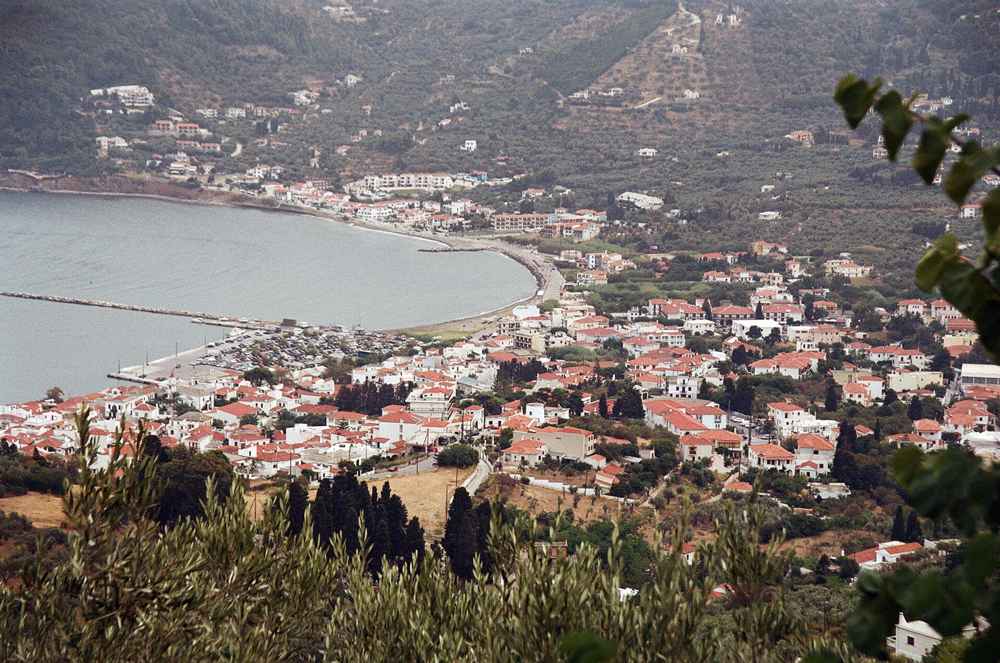
What can visitors see in Skopelos Town and its Venetian Kastro?
Skopelos Town rises in an amphitheatre of whitewashed houses above its harbour, crowned by a 13th-century Venetian Kastro. The old town holds a reputed 120-plus churches, cobbled lanes, and a waterfront of tavernas and shops.
Skopelos Town, known locally as Chora, wraps around the northern harbour in tiers of white houses with grey slate roofs and wooden balconies. Narrow stone lanes climb from the waterfront toward the Kastro at the summit, passing bougainvillea-draped courtyards and dozens of small churches. The town escaped the concrete building of the mid-20th century and keeps its traditional Sporadic architecture, protected as a listed settlement. Cars stay on the ring road, so the old town is explored entirely on foot. The waterfront holds tavernas, cafes and shops selling local plum sweets and ceramics, while the upper lanes stay residential and quiet.
Walking from the port to the Kastro and back covers the core of the town in about two hours, with a church at almost every corner.
The Venetian Kastro crowns the highest point of Skopelos Town, built in the 13th century by the Ghisi family. Venetian lords of the Sporades, on the foundations of the ancient acropolis of Peparethos. Sections of the original walls and a gateway survive, and the church of Agios Athanasios, one of the oldest on the island, stands just below the fortress. From the ramparts the view runs across the tiled rooftops to the harbour and the sea beyond. The climb through the lanes to the Kastro is steep but short. A small cluster of bars occupies the terraces just under the walls, busy at sunset when the light turns the town gold.
The fortress marks the historic core from which Chora grew downhill toward the modern waterfront over the centuries.
Skopelos Town is famous for its churches, with a figure of about 123 counted within the settlement and a reputed 360 across the whole island. Many are tiny private chapels tucked between houses, each with a single dome and a whitewashed bell wall, and most open only on their saint’s feast day. Notable examples include the seaward church of Panagitsa tou Pyrgou, standing white against the blue sea at the harbour’s edge. Christos, Zoodochos Pigi and Agios Michail in the upper lanes. The density of churches reflects the island’s long Orthodox tradition and the custom of families building private chapels.
Walking the alleys turns up a new chapel at almost every turn, and Panagitsa tou Pyrgou ranks among the most photographed spots on Skopelos.
The waterfront of Skopelos Town forms the island’s main hub for dining, shopping and evening strolls. Tavernas along the harbour serve the local spiral cheese pie and dishes built around Skopelos plums, while bakeries sell plum spoon sweets to take home. The Folklore Museum, set in an old mansion in the upper town, displays traditional costumes, embroidery and period furniture from the island. Small galleries and workshops sell ceramics and handmade goods along the lanes. In the evening the harbour fills as visitors and locals walk the volta between the two ends of the port. Boats for beach trips and excursions to the Alonnisos Marine Park depart from the town quay.
Making the waterfront both the cultural centre of the island and the launching point for days on the water.
Which monasteries can visitors explore on Palouki hill in Skopelos?
Palouki hill east of Skopelos Town holds a cluster of monasteries reached by a mountain road. Evangelistria, Metamorphosis and Prodromos are the main three, active or restored, with wide views over Chora and the sea.
Mount Palouki rises east of Skopelos Town and carries the island’s densest concentration of monasteries, several dating from the Byzantine and post-Byzantine periods. A paved then partly unpaved road climbs the pine-covered slope, linking the main foundations across about 8 kilometres from the edge of Chora. The route runs in around 30 minutes one way, or as a half-day hike on the old paths that predate the road. The monasteries sit at intervals up the hillside, each behind stone walls with a central church, cells and a courtyard. Some remain active religious communities, others are restored and open to visitors during set hours.
Modest dress covering shoulders and knees is required at all of them, and wraps are handed out at the gate where needed to enter.
Evangelistria, the Monastery of Panagia Evangelistria, is the best known and most visited foundation on Palouki, set on a terrace with a direct view across the valley to Skopelos Town. An active convent occupies the site, and the resident nuns weave textiles and sell handmade goods and their own produce at the gate. The katholikon holds a carved and gilded iconostasis and a revered icon of the Virgin. A walled courtyard and garden front the church, and the terrace gives the classic postcard view of Chora tumbling toward the harbour. The monastery lies about 4 kilometres from town by road, close enough for an easy morning visit. Its opening hours pause in the early afternoon.
Most visitors arrive before midday or in the later afternoon, and photography is allowed in the courtyard but not inside the church.
Higher up the hill, the Monastery of Metamorphosis tou Sotiros, the Transfiguration of the Saviour, sits near the summit of Palouki and counts among the oldest on the island. It served as the island’s main monastery in earlier centuries and comes alive for its feast on 6 August, when a service and celebration draw islanders up the hill. Further along stands the Monastery of Prodromos, dedicated to Saint John the Baptist, a walled complex with a restored church and a courtyard framing a wide sea view toward Alonnisos. Both sit within a short drive of Evangelistria along the ridge road.
Other foundations on Palouki include Agia Barbara, once fortified against pirate raids, and Taxiarches, so the hill works as an open-air record of the island’s monastic history. Several of these smaller chapels open only for their feast days.
Touring the Palouki monasteries works as a single half-day outing from Skopelos Town, combining three or four foundations with the views over the pine slopes. Drivers take the signed road east out of Chora and climb steadily, with pull-offs for photographs of the town below. Walkers can follow the older cobbled paths, part of the marked Skopelos trail network, which link the monasteries through the forest in about three to four hours. Water and sturdy shoes matter on the walking route, as shade thins near the summit. Visiting hours generally run morning and late afternoon with a midday closure, so planning around those windows avoids arriving at locked gates.
The circuit pairs the island’s religious heritage with its greenest scenery and ranks among the leading inland things to do on Skopelos.
What makes Glossa village in northern Skopelos worth visiting?
Glossa sits on a hillside above the northern port of Loutraki and keeps a traditional, quieter character. Stone houses, tavernas with sea views toward Evia, and access to the Mamma Mia chapel define the village.
Glossa is the second town of Skopelos, built on a hillside about 3 kilometres above its port of Loutraki in the north of the island. Roughly 30 minutes by road from Skopelos Town. The village steps up the slope in tiers of tall stone and plaster houses, many with wooden balconies, along narrow lanes closed to through traffic. Glossa kept more of its older architecture and dialect than the capital, and it feels quieter, with daily life centred on squares and family tavernas. From its upper edge the view reaches west across the strait to the island of Evia and the Pelion peninsula on the mainland.
The village serves as the base for exploring the northern beaches, the chapel of Agios Ioannis Kastri, and the surrounding pine hills.
Walking is the way to see Glossa, whose stepped lanes reward slow exploration between the church of Agios Ioannis and small neighbourhood chapels. Tavernas here lean on local produce, serving Skopelos cheese pie, dishes with the island’s plums, and vegetables from the surrounding gardens, their terraces overlooking the sea. The village stays cool in summer thanks to its altitude and the breeze off the strait. Below Glossa, the port of Loutraki holds a second harbour where ferries and hydrofoils dock, lined with fish tavernas and a small beach. A stepped path and a road connect the upper village to the port.
It appeals to visitors after a slower base within reach of the northern coast and its beaches.
Glossa anchors the northern half of Skopelos, and several of the island’s highlights sit within a short drive. The chapel of Agios Ioannis Kastri lies about 10 minutes northeast, making the village the natural lunch stop on a Mamma Mia loop. The hamlet of Atheato, and the beaches of the north coast, spread out from the village along quiet roads. Inland, walking trails run from Glossa through pine and olive terraces toward the interior plateau. The village also lies near the site of ancient Selinous, one of the three cities of classical Peparethos, the old name for Skopelos.
This northern position, paired with the port of Loutraki, gives Glossa a role as the island’s second gateway alongside Skopelos Town for arrivals by ferry and hydrofoil.
Staying in Glossa suits travellers who want a traditional village with sea views and easy reach of the north, though it lies farther from the southwest beaches than the capital. Rooms and small guesthouses occupy restored village houses, and the port of Loutraki adds beachfront options. Public buses link Glossa and Loutraki with Skopelos Town times a day in summer. The drive between the two towns runs about 30 minutes on a good road through the pine interior. Evening in Glossa is quiet, centred on the tavernas and the sunset over Evia. For visitors weighing where to base themselves.
Glossa balances calm and character against a longer daily drive to the film beaches and the monasteries of Palouki hill on the far side of the island.
Which hiking trails and the Sendoukia tombs can you explore in Skopelos?
Skopelos carries a marked network of hiking trails through pine forest, olive groves and old cobbled paths. The Sendoukia rock-cut tombs, four graves cut into a plateau near Karya, sit at the end of one panoramic route.
Hiking ranks among the leading inland things to do on Skopelos, thanks to a marked network of trails restored and maintained by a local volunteer group. The paths follow old cobbled kalderimia that once linked villages, monasteries and farms before the roads, threading through dense Aleppo pine, olive terraces and plum orchards. Routes range from short village links of about an hour to full traverses of hours across the interior. Signposts and coloured waymarks mark the main trails, and printed and online maps cover the network. The pine canopy gives shade on most routes, though water, sturdy shoes and an early start matter in summer heat.
Trailheads sit near Skopelos Town, Glossa, and the mountain villages, so most walks begin within a short drive of a base.
The Sendoukia, meaning the chests or coffins, are four rectangular tombs cut directly into the flat rock of a plateau in the island’s interior. Near the deserted uplands above Karya and Agios Konstantinos. Each grave was carved with a recess for a stone lid. Their origin is debated. Dated by scholars to the late Roman or early Christian era and linked by local tradition to earlier periods. The site sits at one of the highest accessible points on Skopelos. The plateau gives a sweeping view over the pine slopes to the sea on both sides of the island.
Reaching the tombs involves a walk of about 20 to 30 minutes from the nearest road along a marked path, and the exposed rock grows hot by midday.
A popular walking route pairs the Sendoukia tombs with the ridge road that crosses the centre of Skopelos, starting from a trailhead on the main Skopelos Town to Glossa road. The path climbs gently through pine to the plateau, passing dry-stone walls and abandoned terraces that trace the island’s farming past. From the tombs, the trail can continue toward the mountain villages or loop back to the road. The round trip takes about two to three hours at a steady pace. The interior here holds no shops or water sources, so walkers carry supplies.
The combination of an ancient burial site and long views across the greenest island in the Sporades makes this one of the more rewarding half-day walks on Skopelos for anyone leaving the beaches behind.
Beyond the Sendoukia route, the Skopelos trail network reaches most corners of the island on foot. Paths climb Palouki hill to its monasteries, cross the pine interior between Skopelos Town and Glossa. Drop to secluded coves such as Glysteri and the beaches below Agios Ioannis Kastri. Spring brings wildflowers and running streams to the routes, and autumn cools the walking after the summer heat. Guided walks led by local operators cover the harder-to-follow paths and add background on the plants, monasteries and history. For a self-guided outing, the marked village-to-village links offer the clearest routes. Walking the island reveals the pine forest, orchards and old stone paths that the coast road bypasses.
It fills the middle of a Skopelos itinerary between beach and boat days.
How do boat trips from Skopelos reach the Alonnisos Marine Park?
Boat trips leave the harbours of Skopelos Town and Agnontas for the National Marine Park of Alonnisos, Europe’s largest marine protected area. The park shelters the Mediterranean monk seal across a group of uninhabited islets.
Day boats from Skopelos cross the strait to the National Marine Park of Alonnisos and the Northern Sporades, the largest marine protected area in Europe. The park covers the sea around Alonnisos and a group of uninhabited islets to its northeast, including Piperi, Gioura, Kyra Panagia and Psathoura. It was established to protect the Mediterranean monk seal, Monachus monachus, one of the rarest marine mammals, along with dolphins, seabirds and the wild goats of Gioura. Excursion boats depart from the quay in Skopelos Town and from the fishing bay of Agnontas, usually as full-day trips. The crossing to Alonnisos takes under an hour. Boats then cruise the park’s inner zone.
Where landing is limited and the outer islets stay closed to protect the seals’ breeding caves from disturbance.
A typical marine-park trip from Skopelos combines a stop in Alonnisos with a cruise past the protected islets and swimming halts in clear coves. Boats call at Patitiri, the port of Alonnisos, and often at the old hilltop village of Chora, leaving time to walk and eat before the return. Some trips visit the Blue Cave on the northeast coast of Alonnisos, a sea cave entered by small boat, and the islet of Kyra Panagia with its Byzantine monastery. Sightings of monk seals are never guaranteed, as the animals stay hidden in remote caves, but dolphins often follow the boats across the strait.
The Marine Park information centre in Patitiri explains the conservation work and the biology of the seal for visitors between excursions along the waterfront.
Booking a marine-park excursion is straightforward in summer, with operators selling tickets at kiosks along the Skopelos Town waterfront and through hotels. Trips run days a week in the high season and less often in spring and autumn, weather permitting, as the open strait can turn choppy in the meltemi wind. Smaller boats carry a few dozen passengers and reach more coves, while larger vessels offer more shade and stability. Bringing a hat, water and reef-safe sun protection suits the long day on deck. Some operators pair the marine park with a circuit of Skopelos beaches accessible only from the sea, such as the coves below the northeast cliffs.
Independent travellers can also cross to Alonnisos on the scheduled ferry and join a park boat from Patitiri.
The Alonnisos Marine Park frames the eastern horizon from much of Skopelos. The crossing shows the island from the water. With the chapel of Agios Ioannis Kastri visible on its rock as boats round the north. Beyond the wildlife, the park protects a seabed rich in seagrass meadows and archaeological sites, including an ancient shipwreck off Peristera visited by licensed diving trips. Conservation rules keep the inner islets off-limits, so following the guides’ instructions on distance and noise protects the seals. A marine-park day balances the beach and village time on a Skopelos trip with a focus on the natural setting that makes the Sporades distinctive.
For visitors the boat trip ranks alongside the beaches and the Mamma Mia sites as a highlight of the island.
What local foods define Skopelos, from plums to cheese pie?
Skopelos is known for its plums and its spiral cheese pie. Dried plums, plum spoon sweets and plum-based dishes fill the island’s kitchens, while the coiled, fried tyropita of local cheese is the signature Skopelos dish.
The Skopelos cheese pie is the island’s signature dish, a long ribbon of thin phyllo pastry filled with local soft cheese, coiled into a flat spiral and shallow-fried until golden. Unlike the baked, square tyropita found elsewhere in Greece. The Skopelos version is shaped like a snail shell and cooked in a pan, giving a crisp outside and a soft, tangy centre. Tavernas across the island serve it as a starter, and bakeries in Skopelos Town sell it through the day. The cheese used is a local white variety close to feta, sometimes blended for a milder taste.
The pie appears on nearly every menu on the island and travels well as a quick meal, making it the first food most visitors try on Skopelos.
Skopelos is famous across Greece for its plums, grown in orchards through the pine-covered interior and dried in traditional stone ovens. The island turns its plum harvest into dried prunes, plum spoon sweets preserved in syrup, and plums stuffed with walnuts, all sold in shops in Skopelos Town and Glossa. Cooks fold plums into savoury dishes too, pairing the dried fruit with pork and chicken in slow-cooked stews that balance sweet and salt. The plum tradition dates back generations, when drying preserved the fruit for the winter and for export off the island. A plum sweet served with coffee is a common welcome in island homes and cafes.
Jars of plum products rank among the most popular edible souvenirs to carry home from Skopelos after a visit.
Beyond plums and cheese pie, Skopelos cooking draws on the sea, the orchards and the herds of the interior. Tavernas serve fresh fish and octopus from the harbours of Agnontas, Glysteri and Loutraki, often grilled simply over charcoal. Local honey, olive oil and cheeses fill the meze table, and wild greens gathered from the hillsides appear in pies and salads. The island also makes its own version of the Sporades almond sweet and produces small quantities of wine and tsipouro. Eating out concentrates on the waterfront of Skopelos Town, the squares of Glossa, and the beach tavernas of Panormos and Stafylos.
Dishes lean on what the island grows and catches, so a meal on Skopelos doubles as a tour of its farms, orchards and fishing bays.
Tasting the island’s food fits naturally into a wider Skopelos itinerary, linking the beaches, town and trails through its kitchens. A day can pair a morning swim at Kastani or Milia with a plum-stuffed lunch at a beach taverna. Then a cheese pie in the lanes of Skopelos Town at night. Food festivals and saint’s-day celebrations, held at the monasteries and village churches, put local dishes at the centre of island life through the summer. Cooking classes and orchard visits give a deeper look at the plum tradition for those staying longer. Carrying home a jar of plum spoon sweet or a bag of dried prunes keeps a link to the island after the trip.
The food, like the pine forest, sets Skopelos apart within the Sporades.
Frequently Asked Questions
How days do you need to see the main things to do in Skopelos?
Four to five days cover the main things to do in Skopelos at a relaxed pace. One day suits the southwest beaches of Kastani, Milia and Panormos, exploring the pine-backed coves and swimming through the afternoon. A second day fits Skopelos Town, walking the lanes to the Venetian Kastro, the seaward church of Panagitsa tou Pyrgou, and the harbour tavernas. A third day pairs the Mamma Mia chapel of Agios Ioannis Kastri with the northern village of Glossa and the port of Loutraki. A fourth day takes a boat trip into the Alonnisos Marine Park in search of the Mediterranean monk seal.
Adding a fifth day allows a hike to the Sendoukia tombs or the monasteries of Palouki hill, plus time to taste the island’s plum products and cheese pie. A shorter three-day trip covers the beaches, the town and the film sites but leaves out the boat trip or the inland walks. Renting a car for two or three of those days reaches every corner of the island with ease.
When is the best time of year to visit Skopelos?
The best months to visit Skopelos run from late May to late September, when the sea is warm and the tavernas and boats operate in full. July and August bring the hottest weather, the busiest beaches and the fullest excursion schedule, along with the meltemi wind that can affect boat trips to the Alonnisos Marine Park. June and September offer warm swimming with thinner crowds and easier accommodation. May and October suit walkers, as the pine trails stay cool and the interior turns green, though some beach bars and boat operators wind down. Spring brings wildflowers and running streams to the hiking routes, while autumn cools the walking after the summer heat.
Winter is quiet, with reduced ferry links and many seasonal businesses closed, better suited to travellers wanting a working island rather than a beach holiday. For a balance of warm sea, open services and space, June and September stand out on Skopelos. These shoulder months also bring calmer seas for the crossing to the marine park.
How do you get around Skopelos to reach the beaches and villages?
Renting a car or a scooter is the most flexible way to reach the beaches, monasteries and villages of Skopelos, as the island’s highlights spread along the coast and through the interior. A single road links Skopelos Town, the southwest beaches, Agnontas, Panormos, Glossa and the port of Loutraki, and the drive from end to end takes about 45 minutes. Public buses run along this main route times a day in summer, stopping near the popular beaches and connecting the two towns, though services thin in spring and autumn. Taxis operate from Skopelos Town and Glossa for shorter trips and for reaching the Mamma Mia chapel. Water taxis link some southwest coves, such as Limnonari, from Agnontas.
The old town and village lanes are pedestrian, so walking covers the sights within each settlement. Because beaches sit down side roads, a car or scooter opens far more of the island than the bus network alone.
Is Skopelos a good island for families with children?
Skopelos suits families, with sheltered beaches, short driving distances and a safe, walkable main town. The sandy, shallow coves of Limnonari and Milia, and the calm bay of Panormos, work well for young children, and beaches have tavernas and sunbeds close to the sand. The pedestrian lanes of Skopelos Town let children explore the churches and harbour without traffic. Boat trips to the Alonnisos Marine Park add a wildlife day. With the chance of spotting dolphins from the deck and the story of the Mediterranean monk seal to hold attention. Gentler sections of the hiking network, such as the paths around Palouki hill, give short walks in the shade of the pines.
Distances between beaches and towns are short, so days do not involve long drives. The local cheese pie and plum sweets tend to please younger eaters. Shade, calm water and a compact layout make Skopelos a manageable island for a family trip.
What is the Mamma Mia trail on Skopelos?
The Mamma Mia trail links the locations on Skopelos used in the film Mamma Mia!, whose outdoor scenes were shot across the island. The clifftop chapel of Agios Ioannis Kastri, on a rock off the northeast coast. Served as the wedding church and is the trail’s centrepiece, reached by a climb of about 110 steps. Kastani beach on the southwest coast hosted the swimming and beach-party scenes, and its taverna and jetty appeared on screen. The small harbour of Damos, near Skopelos Town, featured in the closing sequences. Visitors follow the trail by car or on organised tours, often pairing the northern chapel with a swim at Kastani in a single day.
Signboards mark the main sites, and local operators run themed excursions. The trail draws steady numbers each summer, though the film covered only part of the island. Most itineraries combine the Mamma Mia sites with the beaches, monasteries and food of Skopelos.
Where can you see the Mediterranean monk seal near Skopelos?
The Mediterranean monk seal lives in the National Marine Park of Alonnisos and the Northern Sporades, the protected sea area reached by boat from Skopelos. The park was created to safeguard this rare seal, which shelters in remote sea caves on the uninhabited islets northeast of Alonnisos, such as Piperi and Gioura. Access to these breeding areas is restricted, so close sightings are uncommon and never guaranteed on an excursion. Day boats from Skopelos Town and Agnontas cruise the park’s permitted zones, and the guides explain the seal’s biology and the conservation work along the way. Dolphins are seen far more often, following the boats across the strait.
The Marine Park information centre in Patitiri, the port of Alonnisos, displays exhibits on the seal and the park’s ecology. Respecting the rules on distance and noise protects the animals. A boat trip into the park offers the best chance of encountering the wildlife that defines the Sporades.
What souvenirs and local products can you buy on Skopelos?
Plum products top the list of things to buy on Skopelos, sold in shops across Skopelos Town and Glossa. Dried prunes, plum spoon sweets preserved in syrup, and plums stuffed with walnuts pack well and keep the island’s most famous flavour for the journey home. Local honey, olive oil and herbs gathered from the pine hills fill the shelves alongside them. Handmade ceramics, woven textiles and religious icons come from workshops in the old town, and the convent of Evangelistria on Palouki hill sells goods made by its resident nuns. The spiral cheese pie is best eaten fresh on the island rather than carried home, but the recipe travels as a memory of the local kitchen.
Small producers offer tsipouro and island wine in limited quantities. Shopping concentrates on the waterfront and upper lanes of Skopelos Town and the squares of Glossa. Where family-run stores stock the plum sweets, oils and crafts that reflect the island’s orchards and traditions.