
Top archaeological sites in Greece: see Acropolis, Delphi, Knossos & more with practical tips on timing, tickets, heat, and crowds for an epic ruins trip.
Some places in Greece don’t just tell history, they make you feel it in your feet and in the heat bouncing off marble. We’ll be walking a dusty processional road where athletes once paraded into the first Olympic Games, climbing citadels that inspired Homer, and stepping through cities that were buried, argued over, rebuilt, and, somehow, still standing.
We’ve spent a lot of summers doing exactly this: island hopping and touring across Greece, from Athens to Crete and the Aegean, chasing the best ruins, the best museums, and the best “wait…this is that place?” moments. In this guide, we’re focusing on the top archaeological sites in Greece, the ones that deliver real wow-factor, context, and variety, plus the practical planning details that make the difference between an epic day and a sweaty, crowded shuffle.
Key Takeaways
- Plan your itinerary around the top archaeological sites in Greece that match your interests—mythology (Knossos, Mycenae, Delphi), temples (Acropolis, Olympia, Sounion), museums, and dramatic landscapes.
- Balance mainland clusters (Athens, Peloponnese, Delphi) with islands (Delos, Santorini, Rhodes) to avoid losing too much time to ferries and transfers.
- Prioritize iconic anchors like the Acropolis and Museum, Delphi and Museum, and Knossos to get both wow-factor ruins and the context that makes them memorable.
- Beat heat and crowds by arriving at opening, taking a midday break, and returning late afternoon, especially for high-demand stops like the Acropolis, Delphi, and Sounion.
- Pack for uneven stone and minimal shade with grippy walking shoes, extra water, sun protection, and a light layer for windy sites like Cape Sounion and exposed islands.
- Visit responsibly by staying on marked paths, not climbing or taking “souvenirs,” and giving each site enough time to slow down and actually feel the history.
How To Choose Which Sites To Visit
Greece is packed with ruins. That sounds like a “nice problem,” until we’re staring at a map with ten pins for every day of our trip. The trick is to pick a mix that matches what we actually love, myths, temples, museums, landscapes, while staying realistic about time, ferries, and summer heat.
Match Sites To Your Interests (Mythology, Architecture, Museums, Landscapes)
If we choose sites based on our interests (not just famous names), the whole trip clicks.
- Mythology and epic storytelling: We’ll want Knossos for Minoan legends of the Minotaur, Mycenae for the world behind Homer’s Bronze Age kings, and Delphi, because the Oracle is basically Greece’s ancient “decision engine.”
- Architecture and temples: The Parthenon on the Acropolis is the headline act (built 447–432 BCE), but we’ll also get that clean, powerful Doric vibe at Olympia, Corinth, and Sounion.
- Museums (for context, not just stones): Some sites are good; some are unforgettable because the museum completes the story. The Acropolis Museum, Delphi Museum, and Olympia Museum are worth planning around.
- Landscapes that do half the talking: Delphi on Mount Parnassus, Sounion at sunset, Dion under Olympus, or Ancient Thera on Santorini’s ridge, these places are as much about setting as ruins.
A small, honest point: not every visitor loves every era. If Roman cities don’t thrill us, we shouldn’t force three of them “because we’re in Greece.” We can swap in what we’ll remember.
Balance Mainland And Islands For Time And Logistics
For logistics, Greece is really two trips in one: mainland clusters versus island chains.
- Mainland Greece is efficient for archaeology. Athens + day trips (Sounion), then a loop through the Peloponnese (Mycenae, Epidaurus, Olympia, Corinth) and Delphi is a classic route.
- Crete is its own chapter, bigger than many people expect. If we want Knossos, Phaistos, and Gortyn, we should give the island proper time rather than squeezing it between ferries.
- The Aegean islands are magical, but ferry time adds up. If we’re planning Delos + Santorini + Rhodes in one short trip, we’ll spend more hours moving than exploring.
As a rough planning reality check: if we want a broad “greatest hits” archaeology trip without rushing, 7–10 days is usually the minimum.
Know What To Expect On-Site (Terrain, Shade, Accessibility, Timing)
Ruins are romantic, until we’re climbing uneven stone in midday sun.
- Terrain: Some sites are hilltop climbs (Acropolis, Mycenae, Acrocorinth, Lindos, Ancient Thera). Others are more level (Knossos, parts of Olympia, Agora). Expect uneven surfaces almost everywhere.
- Shade: Often minimal. Greece doesn’t “do” shade at most archaeological parks, especially in summer.
- Accessibility: It varies widely. Athens has improved access routes, but many citadels and ridge-top sites remain challenging.
- Timing: In peak season, our best move is simple: arrive at opening or go late afternoon. The difference in temperature and crowds can feel like a different country.
If we plan with those realities in mind, we’ll enjoy more, see more, and complain less (which our travel companions will appreciate).
Athens And Attica Highlights
Athens isn’t just a “start here because the airport is here” city. It’s a dense archaeological layer cake: classical temples, Roman add-ons, Byzantine traces, and a modern capital built around them. We can see world-class sites without ever leaving the metro lines, then finish with a coastal temple that feels like the perfect full stop.
Acropolis Of Athens And The Acropolis Museum
If we’re choosing the single most iconic archaeological site in Greece, it’s the Acropolis of Athens, and it earns the hype.
The centerpiece is the Parthenon (447–432 BCE), a masterclass in proportion and optical refinement. Even with scaffolding or restoration work (common and necessary), the impact is immediate: this was a statement of power, artistry, and belief, set above the city like a crown.
But the Acropolis is more than one building. We’ll also want time for:
- The Erechtheion, famous for the Caryatids (and the odd, sacred complexity of the site)
- The Temple of Athena Nike, compact and elegant
- The theater slopes below (the context matters; Athens performed its identity as much as it debated it)
Then we do the smart thing: we go straight to the Acropolis Museum. Seeing original friezes, statues, and everyday finds changes the Acropolis from “beautiful ruins” into a living place with politics, religion, and real human choices behind it.
Ancient Agora And The Temple Of Hephaestus
The Ancient Agora is where Athens starts to feel less like a postcard-classical and more like a functioning city.
This was the civic heart, marketplace, administrative center, social crossroads, where figures like Socrates taught and argued. We’re not just looking at foundations: we’re walking through the space where ideas about citizenship, law, and public life were tested.
And then there’s the Temple of Hephaestus, one of the best-preserved classical Greek temples anywhere. It’s a quiet flex: sturdy Doric columns, good lines, and a setting that lets us appreciate how temples relate to their surroundings. If we only have time for one extra Athenian site beyond the Acropolis, the Agora is often the best “value for time.”
Temple Of Poseidon At Sounion
Cape Sounion is the day trip we recommend even to people who “aren’t that into ruins.” Why? Because it’s not just a temple, it’s a scene.
The Temple of Poseidon sits above the Aegean, exposed to wind and light in a way that makes the columns feel like they’re part of the coastline. We can visit in the afternoon and stay for sunset, when the marble warms and the sea turns almost metallic.
A practical note we’ve learned the hard way: Sounion can be breezy even in summer. That breeze feels great…until we realize we didn’t bring a light layer for later. Add it to the bag.
Peloponnese: Mycenaeans, Classical Sanctuaries, And Roman Cities
The Peloponnese is where we go when we want Greece in big, bold chapters: Bronze Age citadels, healing sanctuaries, the birthplace of the Olympics, and trade cities that made the ancient Mediterranean feel connected.
It’s also wonderfully road-trip friendly. With a car (or well-chosen buses/tours), we can string together sites that cover more than a thousand years of history without sleeping in a different hotel every night.
Mycenae Archaeological Site
Standing at Mycenae, it’s easy to understand why people connect it to Homeric epics. This was a fortified Bronze Age powerhouse, traditionally linked to Agamemnon, set on a rocky ridge with commanding views.
What to look for:
- The Lion Gate, the iconic entrance that still feels like a warning
- The Cyclopean walls, massive blocks that look “impossible” in a very satisfying way
- The Treasury of Atreus (a tholos tomb), which delivers one of the best “ancient engineering” moments in Greece
Mycenae is also a reminder that Greece isn’t just Classical Greece. The Bronze Age story, palaces, trade, and collapse make the later periods feel like a rebirth, not a beginning.
Epidaurus (Sanctuary Of Asclepius And Theater)
Epidaurus is where archaeology meets something surprisingly modern: healthcare.
The Sanctuary of Asclepius was an ancient healing center, drawing pilgrims who wanted cures, rituals, and rest. Even if we don’t know every detail of the cult practices, the overall idea, traveling for wellness, feels familiar.
And then the star: the Theater of Epidaurus. It’s famous for acoustics, yes, but also for balance. Sitting high in the seats and looking down at the orchestra, we can see how Greek theaters used landscape as part of the architecture.
If there’s a performance while we’re in Greece, it can be worth planning around. Not mandatory, but memorable.
Ancient Olympia
Olympia isn’t just ruins: it’s a concept that outlived its own stones.
This is where the ancient Olympic Games began, and walking the site feels like moving through a sacred sports complex: temples, training spaces, and monuments celebrating victory, devotion, and city-state rivalry.
Highlights we shouldn’t skip:
- The remains of the Temple of Zeus (even in fragments, we can picture the scale)
- The stadium area, where we can literally walk into the space where competitions happened
- The Archaeological Museum of Olympia, which ties the scattered remains back into a coherent story
Olympia also teaches a useful travel lesson: some sites are better when we slow down. Give it time, sit for a moment, and let it click.
Ancient Corinth And Acrocorinth
Corinth was ancient Greece’s commercial sweet spot, sitting on a land bridge with two seas within reach. That geography made it rich, cosmopolitan, and historically important.
At Ancient Corinth, we’ll see the Temple of Apollo and the broader urban footprint: agora spaces, Roman-era additions, and the sense of a working city rather than a single sanctuary.
Then we go up to Acrocorinth. This climb (or drive most of the way, depending on access) pays off with sweeping views and fortifications layered across centuries. It’s not “just another hill.” It’s a strategic place that different powers kept reusing because the location is that good.
If we’re trying to understand how terrain shapes history in Greece, Corinth is one of the clearest lessons.
Delphi And Central Greece
Central Greece can feel quieter than Athens or the islands, but it’s where we get some of the deepest atmosphere. Mountains close in, myths get darker and stranger, and sanctuaries feel less like “tourist stops” and more like places people truly believed in.
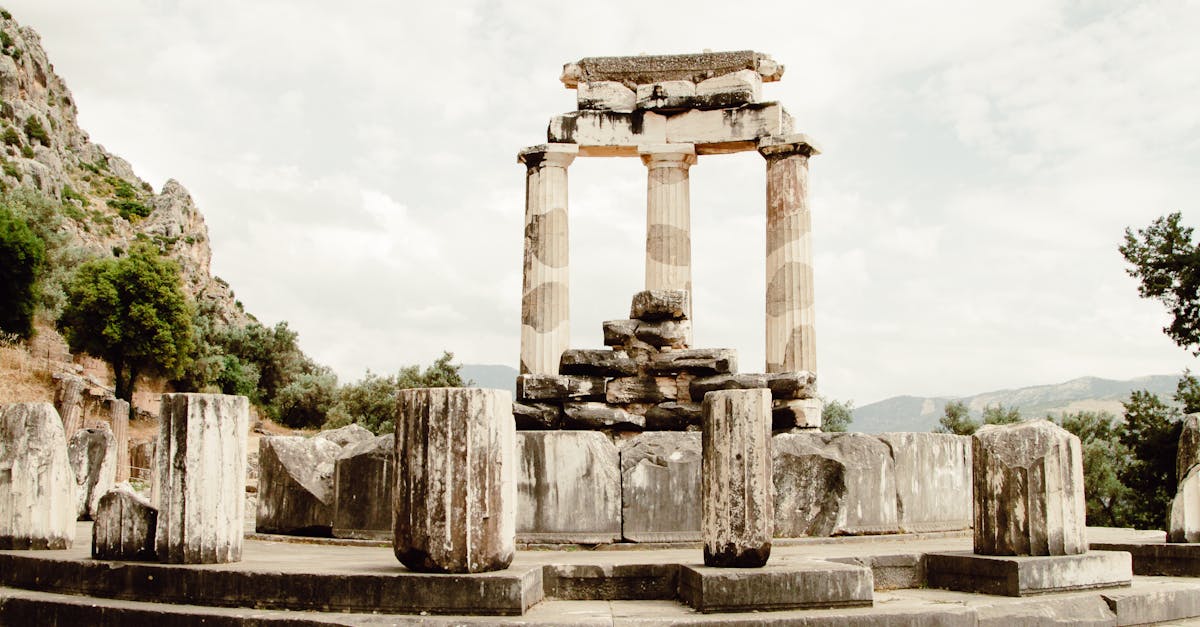
Delphi Archaeological Site And Museum
Delphi is one of those places where we arrive and immediately understand why it mattered.
Perched on the slopes of Mount Parnassus, Delphi was considered the navel of the world in ancient Greek thought, the home of Apollo’s oracle, where city-states and individuals came seeking guidance. The sacred road winds upward through terraces and treasuries, and the setting is so dramatic it almost does the storytelling for us.
What usually sticks with us:
- The way the site climbs, Delphi makes us walk the pilgrimage
- The theater and stadium above, with views that feel unreal on a clear day
- The museum finds that put flesh on the bones (especially major sculptures and offerings)
If we’ve ever wondered how “belief” becomes politics, Delphi is the case study.
Hosios Loukas Monastery (For Byzantine Context)
When we only chase Classical ruins, we miss a huge part of Greek history: the Byzantine world.
Hosios Loukas Monastery offers a powerful change of texture, gold mosaics, brickwork, and a different sense of sacred space than open-air temples. It’s not an “archaeological site” in the same way as Delphi, but it’s an essential context.
If our itinerary includes Delphi, Hosios Loukas can be the perfect pairing: we move from Apollo’s sanctuary to a medieval Christian masterpiece and see continuity and change in one day.
Thermopylae And The Hot Gates Landscape
Thermopylae is less about standing ruins and more about standing in a landscape with a famous story.
This is the “Hot Gates,” associated with the Spartan-led stand against Persia. The geography, a narrow passage between mountains and sea (historically narrower than what we see today), is the point. Even with modern roads and an altered coastline, we can still read the strategic logic of the place.
If we go, we should go with the right expectations: it’s a history-and-imagination stop rather than a monumental ruin stop. But as a narrative anchor in Central Greece, it works.
Northern Greece And Macedonia: Royal Tombs And Great Cities
Northern Greece often gets skipped by first-timers rushing between Athens, Santorini, and Crete. That’s a mistake if we love archaeology with a slightly different flavor: Macedonian power, royal burials, big-city layers, and sites set in greener landscapes.
Vergina (Aigai) Royal Tombs
Vergina (Aigai) is one of the most astonishing museum-site experiences in Greece.
Here we visit the royal Macedonian tombs, most famously associated with Philip II, father of Alexander the Great. The experience is intentionally hushed and subterranean, with displays that emphasize how these burials were meant to communicate power.
Even if we’re not specialists, the takeaway lands: Macedonia wasn’t a footnote. It was a force, and the material culture here proves it.
Pella: The Macedonian Capital
Pella adds the city-scale perspective.
Where Vergina feels like a royal culmination, Pella feels like administration, daily life, and urban design. The mosaics are often what people remember most, art that feels surprisingly playful and modern in its movement.
If we’re tracing the story of Alexander’s world, Pella helps us picture the environment that formed it.
Dion Archaeological Park
At Dion, the setting is half the magic: an archaeological park beneath Mount Olympus.
This is where we can walk through ruins with water channels, greenery, and a sense of space that’s different from the sun-baked hilltops of the south. It’s a good site for travelers who like to wander slowly, spot details, and imagine a lived-in city.
And yes, being near Olympus adds a mythic buzz. We feel it.
Thessaloniki’s Roman And Byzantine Layers
Thessaloniki is not a single “site,” it’s a layered city where Roman and Byzantine history sit right in our path.
We can build an archaeology-heavy day around:
- Roman-era monuments and urban traces
- Byzantine churches and remnants that show how the city evolved as a major medieval hub
If Athens is the classical showcase, Thessaloniki is the lived-in timeline, messier, richer, and still very much a working city.
Crete: Minoan Palaces And Coastal Ruins
Crete deserves its own category because it’s not “just another Greek region.” It’s the heartland of the Minoan civilization, one of Europe’s earliest complex societies, plus a crossroads island that kept accumulating layers afterward.
We’ve spent plenty of time on Crete, and the pattern is consistent: people come for beaches, then accidentally fall in love with archaeology.
Knossos Palace Complex
Knossos is the headline, and for good reason.
Dating back nearly 4,000 years in its earliest major phases (broadly the Minoan palace era around ca. 2000–1400 BCE), Knossos is where we get that “wait, this is Bronze Age?” feeling. The site is linked in popular imagination to the Minotaur myth, but what makes it special on the ground is the complexity: multi-story architecture, courtyards, storage areas, and traces of vivid frescoes.
A quick expectation-setting note: parts of Knossos include reconstructions that some visitors love, and others debate. Our approach is simple: use them as interpretation tools, then look for what’s genuinely ancient and what it tells us about scale and layout.
Phaistos And The Messara Plain
If Knossos feels busy (and it often is), Phaistos can feel like breathing out.
Set above the Messara Plain, Phaistos has a calmer, more open atmosphere with big views. The palace layout helps us understand Minoan planning and how these centers related to agricultural landscapes.
It’s also the kind of site where the sun can be relentless, so we plan for early hours and bring water.
Gortyn And The Great Law Code In Stone
Gortyn is where Crete’s story jumps forward in a fascinating way.
The standout here is the law code inscription, carved in stone, one of the most famous legal texts from the ancient Greek world. Seeing law presented this publicly is a reminder that “civilization” isn’t only palaces and art: it’s rules, rights, obligations, and who gets protected.
Gortyn also gives us Roman-era layers, making it a strong stop for travelers who like continuity across periods.
Spinalonga And Eastern Crete Fortifications
Spinalonga is often framed as a later historical site (and it is), but it fits beautifully into a broader ruins-focused trip because it shows how strategic islands and fortifications remained crucial for centuries.
Eastern Crete is full of defensive landscapes, coastal positions, watchful routes, and walls that make immediate sense once we stand there. Spinalonga adds a dramatic, sea-bound setting that contrasts nicely with the inland palace sites.
Practical note: boats, sun, and wind can all factor into the visit. We pack accordingly and build flexibility into the day.
Islands And The Aegean: Sacred Centers And Lost Cities
The islands aren’t just for swimming and sunsets (though we’re not skipping those). The Aegean is also where we find sacred centers, maritime power, and entire settlements preserved in ways the mainland rarely offers.
If our trip includes islands, we can use archaeology as the backbone of the itinerary, then let beaches and tavernas fill in the happy gaps.
Delos: Sanctuary Island Of Apollo
Delos is one of the most important archaeological sites in Greece, and it feels like a whole ancient world laid out in the open.
Traditionally sacred as the birthplace of Apollo, Delos later became a major commercial hub. Walking the island, we get sanctuaries, houses, streets, and a waterfront context all in one. It’s not a “single monument” site: it’s a cityscape.
A key planning detail: Delos is typically visited by boat (often from Mykonos). We aim for an early departure, bring sun protection, and don’t underestimate how exposed the island is.
Akrotiri, Santorini: Bronze Age City Preserved In Ash
Akrotiri on Santorini is the kind of site that rewires our mental image of the Bronze Age.
This settlement was preserved under volcanic ash, and the experience is intimate: streets, buildings, and an urban feel that’s rare in ancient remains. We’re not just looking at temples, we’re looking at a town.
Akrotiri pairs beautifully with Santorini’s natural drama. After we visit, the caldera views hit differently because we’ve just seen what the island was before the eruption changed everything.
Lindos Acropolis, Rhodes
The Lindos Acropolis is proof that “acropolis” doesn’t only mean Athens.
Set above a brilliant coastline, Lindos combines archaeology with one of the most striking island settings in Greece. We climb, we look out, we understand instantly why this hill mattered.
We also get a layered feel, Greek, later additions, and the broader story of Rhodes as a strategic island with deep history.
Ancient Thera, Santorini: Hellenistic City On The Ridge
Ancient Thera is Santorini’s other archaeological personality: a Hellenistic city set on a ridge.
The drive and climb up already feel like an adventure, and then the site opens into streets and foundations with sweeping views. It’s less “museum-perfect” than Akrotiri and more windswept, rugged, and quietly impressive.
If we want a Santorini day that goes beyond the usual Oia-Fira photos, combining Akrotiri (earlier) and Ancient Thera (later) gives us a surprisingly complete timeline, plus a lot of altitude.
Practical Tips For Visiting Greece’s Archaeological Sites
The difference between a great archaeology trip and an exhausting one usually comes down to planning details we think we can wing. Greece is forgiving in many ways, but heat, crowds, and stone paths don’t negotiate.
Tickets, Passes, And Typical Opening Hours
Ticketing in Greece can be straightforward, but it varies by site and season.
- In major hubs (especially Athens), there are often combined tickets/passes that make sense if we’re visiting multiple sites.
- Many sites run on seasonal hours, with longer days in summer and shorter hours in winter.
- Last entry can be earlier than we expect, so we check official listings before we commit to a late-afternoon plan.
For the most current details, we rely on official sources when possible, like the Greek Ministry of Culture’s Odysseus portal for site information.
Best Seasons And Best Times Of Day To Avoid Heat And Crowds
If we want pleasant temperatures and a calmer feel, spring (April–May) and fall (September–October) are the sweet spots.
In summer, we can still have an amazing trip; we just need a smarter rhythm:
- Start at the opening for the top sites (Acropolis, Knossos, Delphi)
- Plan a midday break (museum, lunch, swim, or nap, no shame)
- Return late afternoon, where it works (Sounion is perfect for this)
Crowds also follow cruise schedules in some places. If we’re sensitive to that, we plan major sites early.
What To Pack And How To Walk Sites Comfortably
Archaeological comfort is mostly about feet, water, and sun.
Our non-negotiables:
- Proper walking shoes with grip (stone can be slick, especially polished steps)
- Water, more than we think
- Hat + sunscreen (shade is often minimal)
- Light layer for windy capes or cooler evenings (Sounion, islands)
- Small daypack so our hands stay free on climbs
If we’re doing ridge sites like Ancient Thera or citadels like Acrocorinth, we also bring a snack. Hunger makes history less poetic.
Etiquette And Conservation: How To Visit Responsibly
These places have survived earthquakes, invasions, weather, and time. They don’t need us adding wear.
A few simple rules keep sites intact:
- Don’t climb on walls or sit where it’s clearly restricted
- Stay on marked paths (it protects both ruins and plant life)
- Don’t take stones, pottery shards, or “souvenirs” (even small ones)
- Keep voices respectful in museums and sacred spaces
And one more: we take photos, yes, but we also take five minutes to just look. Sometimes the best memory is the one we don’t rush.
Conclusion
If we’re planning our first (or fifth) archaeology-focused trip, we don’t need to “do all of Greece.” We need to choose the right mix: a couple of world-famous anchors (Acropolis, Delphi, Knossos), a few places that match our personal obsessions (Mycenaean fortresses? sacred islands? Byzantine mosaics?), and enough breathing room to actually feel each site.
The best part about exploring the top archaeological sites in Greece is how quickly the abstract becomes real. A Lion Gate isn’t a textbook illustration anymore. The Sacred Way at Delphi isn’t just a line on a map. And a windy temple above the sea at Sounion isn’t “another stop”, it’s the moment we remember when we’re back home, scrolling photos and thinking, okay, when are we going again?
Frequently Asked Questions About the Top Archaeological Sites in Greece
What are the top archaeological sites in Greece for a first-time trip?
For a first trip focused on the top archaeological sites in Greece, prioritize the “anchors”: the Acropolis (and Acropolis Museum) in Athens, Delphi and its museum, and Knossos on Crete. Then add one Peloponnese cluster—Mycenae, Epidaurus, and Olympia—for a fuller timeline.
How do I choose which top archaeological sites in Greece to visit if I have limited time?
Match sites to what you actually love—mythology (Knossos, Mycenae, Delphi), temples (Acropolis, Olympia, Corinth, Sounion), museums (Acropolis/Delphi/Olympia Museums), or landscapes (Delphi, Sounion, Dion, Ancient Thera). For logistics, mainland clusters are fastest; islands add ferry time.
When is the best time to visit the top archaeological sites in Greece to avoid heat and crowds?
Spring (April–May) and fall (September–October) usually bring the most comfortable weather and fewer crowds. In summer, visit major sites at opening time or late afternoon, and plan a midday break. Many parks have minimal shade, so timing makes a huge difference.
What should I pack for visiting archaeological sites in Greece comfortably?
Bring grippy walking shoes (stone can be slick), more water than you think, a hat and sunscreen, and a small daypack to keep your hands free on climbs. Add a light layer for breezy spots like Cape Sounion or exposed islands such as Delos, plus a snack for ridge-top sites.
Can you visit Delos without staying on Mykonos, and how does it work?
Yes. Delos is typically visited by boat on a day trip, most commonly from Mykonos, but seasonal routes may also run from nearby islands. Plan an early departure, confirm schedules in advance, and prepare for a very exposed site with strong sun and little shade.
Is Knossos worth it if I’ve heard parts are reconstructed?
Knossos is still one of the top archaeological sites in Greece because it powerfully conveys Minoan scale and complexity (roughly 2000–1400 BCE). Some reconstructions are debated, but they can help interpret the layout. Go in with that expectation and focus on what the remains reveal.
See more in My Greece Tours:
- Delos
- Ephesus Tours: Explore Ancient Ephesus Adventures with Ephesus Tour Packages
- Epidaurus Day Tour – Self-Guided Epidaurus Tours to Ancient Epidaurus
- Explore Delphi, Greece: Ultimate Guide to the Archaeological Site of Delphi
- Folegandros
- Greece Tours: Explore the Best Tours in Greece
- How to Get to Olympia, Greece and What to See: Explore the Archaeological Site of Olympia
- Hydra
- Ikaria Travel Guide: Visit Ikaria Greece – Ikaria Island Adventure & Nature Guide
- Ios Greece Guide: Exploring One of The Best Cyclades Island
- Ithaca Ithaki