
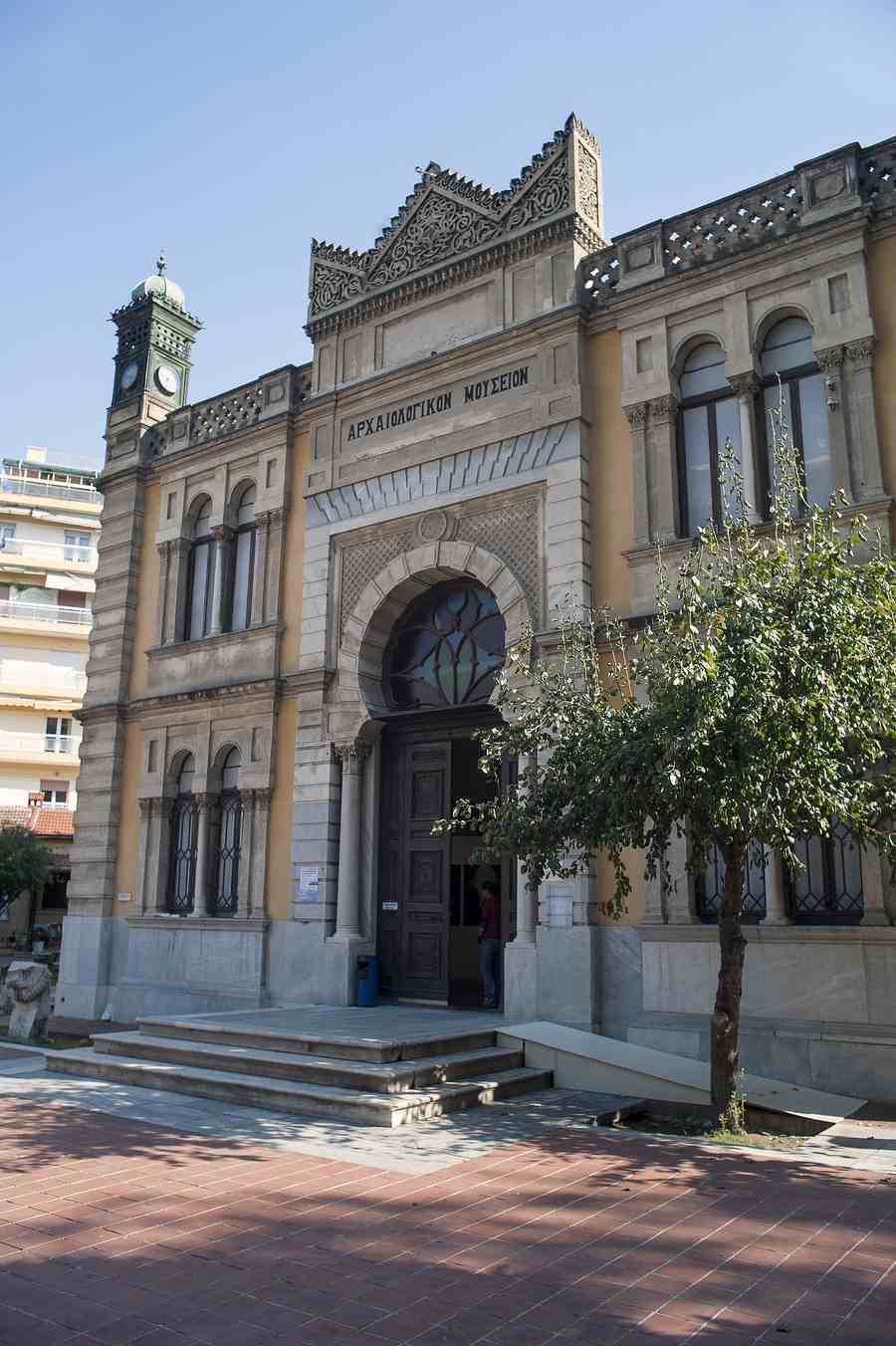
The Yeni Cami, meaning ‘New Mosque’, stands as a testament to Thessaloniki’s rich and diverse history. This early twentieth-century structure was designed by the renowned architect Vitaliano Poselli for the Dönmeh community. The mosque’s eclectic style combines neoclassical, Islamic, and revival elements, creating a visually striking façade. Its symmetrical marble design, featuring horseshoe and pointed arches, is complemented by a clock set into the front and a minaret rising to one side. After the population exchange, the building served as an archaeological museum and now functions as a municipal exhibition hall, surrounded by the historic villa mansions of the eastern quarter. Discover the multifaceted history of Thessaloniki with My Greece Tours.
The Yeni Cami in Thessaloniki offers a unique glimpse into the city’s multicultural past. Originally constructed for the Dönmeh community, the building’s design reflects a blend of architectural styles under the guidance of Vitaliano Poselli. Its transformation from a mosque to an exhibition hall mirrors the city’s evolving identity. The sections below cover the architectural details, historical context, and cultural significance of this landmark. For more insights into Thessaloniki’s heritage, visit Thessaloniki tours. Explore how the Yeni Cami fits into the broader tapestry of the city’s history and its role today.
What is the architectural significance of the Yeni Cami?
The Yeni Cami’s architecture is significant due to its eclectic blend of styles, showcasing neoclassical, Islamic, and revivalist elements.
The design of the Yeni Cami reflects a harmonious blend of divergent architectural traditions. Architect Vitaliano Poselli successfully integrated neoclassical symmetry with Islamic motifs, creating a unique visual identity. The façade’s marble finish and arches exemplify this eclectic style, while the clock and minaret add to its distinct silhouette. This fusion of styles not only distinguishes the Yeni Cami architecturally but also symbolically represents the cultural confluence in Thessaloniki during the late Ottoman period. Visitors are often captivated by the intricate details that highlight the building’s historical and architectural significance, making it a must-see for those interested in Thessaloniki’s diverse architectural landscape.
The location of the Yeni Cami in Thessaloniki’s eastern quarter adds to its architectural significance. This area, known for its historical importance, enhances the mosque’s role as a representative of a historical era marked by diversity and transformation. The use of neoclassical elements, such as the symmetrical arrangement and decorative detail, contrasts with the traditional Islamic features like the horseshoe arches. These design choices reflect the broader cultural exchanges that were prevalent in Thessaloniki at the time, making the Yeni Cami a microcosm of the city’s multicultural identity. Its presence in the eastern quarter symbolizes a bridge between different architectural eras and styles.
The minaret of the Yeni Cami, rising prominently beside the entrance, serves as an architectural focal point. This feature is not only a nod to traditional mosque architecture but also a symbol of the building’s original religious purpose. The minaret stands as a historical marker, reminding visitors of the Yeni Cami’s origins and the Dönmeh community it once served. The integration of diverse architectural styles makes the Yeni Cami a valuable study for those interested in the intersections of culture and architecture in Thessaloniki. The building remains a testament to the city’s rich historical tapestry and architectural innovation, drawing scholars and tourists alike.
How did the Yeni Cami serve the Dönmeh community?
The Yeni Cami was built as a place of worship for the Dönmeh, a community of Sabbatai Zevi followers.
The Dönmeh community, followers of the Jewish mystic Sabbatai Zevi who outwardly practised Islam, found a spiritual home in the Yeni Cami. This mosque, constructed specifically for them, provided a sacred space where they could maintain their unique religious identity amidst the prevailing cultural dynamics of Thessaloniki. The architectural style of the Yeni Cami served to embody the Dönmeh’s dual religious identity, merging Islamic and other stylistic influences. The mosque’s design offered both a place of worship and a symbol of cultural resilience. The Dönmeh’s practices were uniquely integrated into the city’s religious fabric, enhancing Thessaloniki’s multicultural atmosphere.
Members of the Dönmeh community utilised the Yeni Cami as a centre for worship and community gatherings. The building allowed them to practice their faith while blending into the predominantly Muslim society of Thessaloniki. The mosque’s design, incorporating both Islamic and revivalist features, mirrored the Dönmeh’s syncretic beliefs and practices, making the Yeni Cami not just a place of worship but a symbol of their cultural heritage. The community’s presence in the city was marked by this architectural landmark. Their rituals and social gatherings were integral to the mosque’s function, fostering a sense of unity and cultural continuity.
The location of the Yeni Cami in Thessaloniki’s eastern quarter was strategic for the Dönmeh community. Situated away from the Byzantine core, the mosque offered a degree of privacy and autonomy. This positioning allowed the Dönmeh to engage with the broader society while preserving their distinct religious identity. The mosque’s role extended beyond religious functions, becoming a cultural hub where the Dönmeh could celebrate their traditions and maintain their community bonds. The mosque’s historical significance continues to resonate in the city’s cultural landscape. Its strategic location enhanced its role as a community centre, contributing to the area’s rich cultural tapestry.
What role does the Yeni Cami play in Thessaloniki today?
The Yeni Cami now functions as a municipal exhibition and events hall, hosting cultural activities through the year.
The Yeni Cami serves as a vibrant cultural venue, hosting exhibitions and events that celebrate Thessaloniki’s diverse artistic heritage. This transformation from a religious site to a public cultural space reflects the city’s ongoing evolution and adaptation. Visitors to the Yeni Cami today can experience a variety of events, ranging from art exhibitions to community gatherings, all set within the mosque’s historically rich environment. The building’s unique architectural features enhance the experience of cultural engagement and exploration, offering a dynamic space that bridges Thessaloniki’s past and present.
The adaptation of the Yeni Cami into a municipal exhibition hall highlights its architectural versatility and enduring relevance. By repurposing the mosque for contemporary cultural use, Thessaloniki honours its historical significance while making it accessible to a broader audience. This shift allows both locals and tourists to engage with the space, providing insights into the city’s past and present cultural dynamics. The mosque’s unique architecture adds a layer of depth to the events held within its walls, offering a blend of history and modernity that enriches Thessaloniki’s cultural scene.
The Yeni Cami stands among the old villa mansions of Thessaloniki’s eastern quarter, a picturesque backdrop for its current function as an exhibition hall. This area, known for its historical significance, enhances the mosque’s appeal as a cultural destination. Visitors exploring things to do in Thessaloniki will find the Yeni Cami an enriching stop, offering a blend of history, architecture, and contemporary culture in one location. The mosque continues to be a focal point for cultural activities and community connections, serving as a bridge between historical heritage and modern cultural expression.
Why did the Dönmeh leave Thessaloniki?
The Dönmeh left Thessaloniki due to the compulsory population exchange between Greece and Turkey.
The departure of the Dönmeh from Thessaloniki was a direct result of the compulsory population exchange between Greece and Turkey. This event, which involved the relocation of populations based on religious identity, forced the Dönmeh community to leave their homes and the Yeni Cami. The exchange significantly altered the demographic and cultural landscape of Thessaloniki, with the mosque’s original congregation moving to Turkey alongside other Muslim communities. The impact of this exchange is still felt in the city’s cultural memory, as the population shift changed the social fabric of Thessaloniki, leaving lasting effects on its cultural and historical identity.
The population exchange marked a profound shift in Thessaloniki’s social fabric. The Dönmeh, with their unique religious and cultural identity, had been an integral part of the city’s diverse community. Their departure left a void in the cultural tapestry of Thessaloniki, reflecting the broader impacts of the exchange on both individual lives and the city’s collective identity. The Yeni Cami, once a bustling centre of Dönmeh life, stood as a poignant reminder of this lost community. The mosque’s history is a testament to the city’s changing dynamics, serving as a symbol of Thessaloniki’s resilience and adaptability in the face of significant demographic changes.
The departure of the Dönmeh community led to a redefinition of the Yeni Cami’s role and significance. Initially repurposed as an archaeological museum, the mosque continued to serve the city in different capacities. This transition from a religious site to a cultural and historical venue underscores the adaptability of Thessaloniki’s architectural heritage. The mosque’s history provides a narrative thread connecting past and present, illustrating the city’s resilience and capacity for reinvention in the face of significant demographic changes. The building remains a symbol of Thessaloniki’s evolving identity, reflecting its ability to adapt and thrive amidst historical transformations.
Who was Vitaliano Poselli, the architect of the Yeni Cami?
Vitaliano Poselli was an Italian architect renowned for his work in Thessaloniki, blending various architectural styles.
Vitaliano Poselli, an Italian architect, left a lasting impact on Thessaloniki’s architectural landscape. Known for his eclectic style, Poselli successfully integrated diverse influences into his designs. His work on the Yeni Cami exemplifies this approach, blending neoclassical, Islamic, and revivalist elements. Poselli’s ability to harmonise different styles made him a prominent figure in Thessaloniki’s architectural history, contributing significantly to the city’s urban development during the late Ottoman period. His designs continue to influence architectural studies in the region, serving as a testament to his innovative approach and lasting legacy.
Vitaliano Poselli’s architectural philosophy was characterised by a commitment to aesthetic harmony and cultural sensitivity. His designs often reflected the multicultural environment of Thessaloniki, where various cultural influences intersected. The Yeni Cami stands as a testament to his skill in combining these influences into a cohesive whole, creating a building that not only served its intended religious function but also enriched the city’s architectural heritage. Poselli’s legacy is evident in numerous structures that continue to define Thessaloniki’s cityscape. His work remains a subject of admiration and study, attracting architects and historians interested in the evolution of architectural styles.
The design of the Yeni Cami highlights Poselli’s architectural vision and expertise. His ability to meld neoclassical symmetry with Islamic motifs resulted in a unique building that resonated with the Dönmeh community’s identity. Poselli’s work extended beyond religious architecture, impacting various sectors of Thessaloniki’s urban fabric. The legacy of his designs continues to attract visitors and scholars interested in the architectural evolution of Thessaloniki, providing insights into the city’s historical and cultural development. His influence is a cornerstone of the city’s architectural identity, showcasing the enduring impact of his innovative design philosophy.
How does the Yeni Cami fit into Thessaloniki’s historical narrative?
The Yeni Cami fits into Thessaloniki’s historical narrative as a symbol of the city’s multicultural past and architectural innovation.
The Yeni Cami occupies a significant place in Thessaloniki’s historical narrative by embodying the city’s multicultural heritage. Constructed for the Dönmeh community, the mosque’s design reflects the diverse cultural influences that have shaped Thessaloniki over the centuries. Its eclectic architectural style serves as a visual representation of the city’s history, where different cultures, religions, and traditions have intersected. This blending of styles and histories makes the Yeni Cami a key landmark in understanding Thessaloniki’s past. The mosque’s story is intertwined with the city’s cultural evolution, highlighting its role as a bridge between different epochs and traditions.
The transformation of the Yeni Cami from a mosque to a municipal exhibition hall mirrors the broader historical shifts within Thessaloniki. Originally a centre for the Dönmeh community, the building now serves as a venue for cultural events, symbolising the city’s adaptability and resilience. This evolution highlights Thessaloniki’s capacity to repurpose its historical structures, ensuring they remain relevant and accessible to contemporary audiences. The mosque’s history offers insights into the city’s complex identity and its journey through time. The building continues to be a focal point for cultural exchange, reflecting the dynamic nature of Thessaloniki’s historical narrative.
The Yeni Cami’s location in the eastern quarter places it within a context of historical significance. This area, with its collection of old villa mansions, offers a glimpse into Thessaloniki’s architectural evolution. Visitors exploring Ottoman Thessaloniki will find the Yeni Cami an essential stop, providing a deeper understanding of the city’s Ottoman past. The mosque’s architectural and historical significance positions it as a pivotal site in Thessaloniki’s ongoing narrative, bridging the past and present. Its story is a vital part of the city’s heritage, emphasizing the interconnectedness of cultural and architectural history.
What are some architectural features of the Yeni Cami?
The Yeni Cami features a symmetrical marble façade, horseshoe and pointed arches, and a prominent minaret.
The architectural features of the Yeni Cami are a testament to its eclectic design. The symmetrical marble façade provides a neoclassical element that contrasts with the Islamic influences found in the horseshoe and pointed arches. These arches are not only decorative but also functional, supporting the structure while enhancing its visual appeal. The façade’s design reflects the blend of styles that characterise the building, making it a standout example of early twentieth-century architecture in Thessaloniki. The building’s features continue to attract architectural enthusiasts, offering insights into the innovative design principles of its era.
A clock set into the front of the Yeni Cami adds a unique aspect to its design, integrating functionality with aesthetics. This feature, along with the minaret rising beside the entrance, highlights the mosque’s original purpose as a place of worship. The minaret, a traditional element of Islamic architecture, serves as both a visual anchor and a historical marker. These features showcase the mosque’s architectural innovation, blending religious and stylistic elements into a cohesive whole. The building remains a subject of study for its architectural significance, drawing scholars and tourists interested in Thessaloniki’s architectural diversity.
The design of the Yeni Cami demonstrates the architectural prowess of Vitaliano Poselli, who successfully combined neoclassical and Islamic elements. The mosque’s eclectic style reflects the diverse cultural influences that Thessaloniki has absorbed over the centuries. Visitors interested in the museums of Thessaloniki will find the Yeni Cami an intriguing architectural study, offering insights into the city’s complex cultural and historical layers. The mosque’s features continue to captivate architects, historians, and tourists alike, serving as a bridge between different architectural traditions and the vibrant cultural heritage of Thessaloniki.
Frequently Asked Questions
What is the historical significance of the Yeni Cami?
The Yeni Cami holds historical significance as a symbol of Thessaloniki’s multicultural past and the Dönmeh community’s unique religious identity. Its eclectic architecture reflects the city’s diverse cultural influences, making it an important landmark in understanding Thessaloniki’s history. The mosque’s story is integral to the city’s heritage.
Can visitors enter the Yeni Cami today?
Visitors can enter the Yeni Cami today as it functions as a municipal exhibition and events hall. The building hosts various cultural events and exhibitions, allowing guests to explore its unique architecture and learn about its historical significance within Thessaloniki. The mosque remains accessible for cultural exploration.
What makes the Yeni Cami’s architecture unique?
The Yeni Cami’s architecture is unique due to its blend of neoclassical, Islamic, and revivalist elements. Designed by Vitaliano Poselli, the mosque features a symmetrical marble façade, horseshoe and pointed arches, and a minaret, reflecting the city’s cultural diversity. The building’s architectural features continue to draw interest.
How did the Yeni Cami become an exhibition hall?
The Yeni Cami was repurposed as an archaeological museum after the Dönmeh community left in the population exchange. It later transitioned into a municipal exhibition hall, hosting cultural events and maintaining its historical significance within Thessaloniki’s urban landscape. The building’s adaptability reflects the city’s cultural evolution.
Who were the Dönmeh community?
The Dönmeh were followers of Sabbatai Zevi, a Jewish mystic, who outwardly practiced Islam. They formed a unique religious community with a complex identity, and the Yeni Cami was built as a place of worship for them in Thessaloniki. The community’s presence shaped the city’s cultural landscape.
What other attractions are near the Yeni Cami?
Near the Yeni Cami, visitors can explore the old villa mansions in Thessaloniki’s eastern quarter. The area provides a historical backdrop for the mosque and offers insights into the city’s architectural evolution. It’s a perfect addition to a Thessaloniki itinerary. The surroundings enhance the cultural experience.