
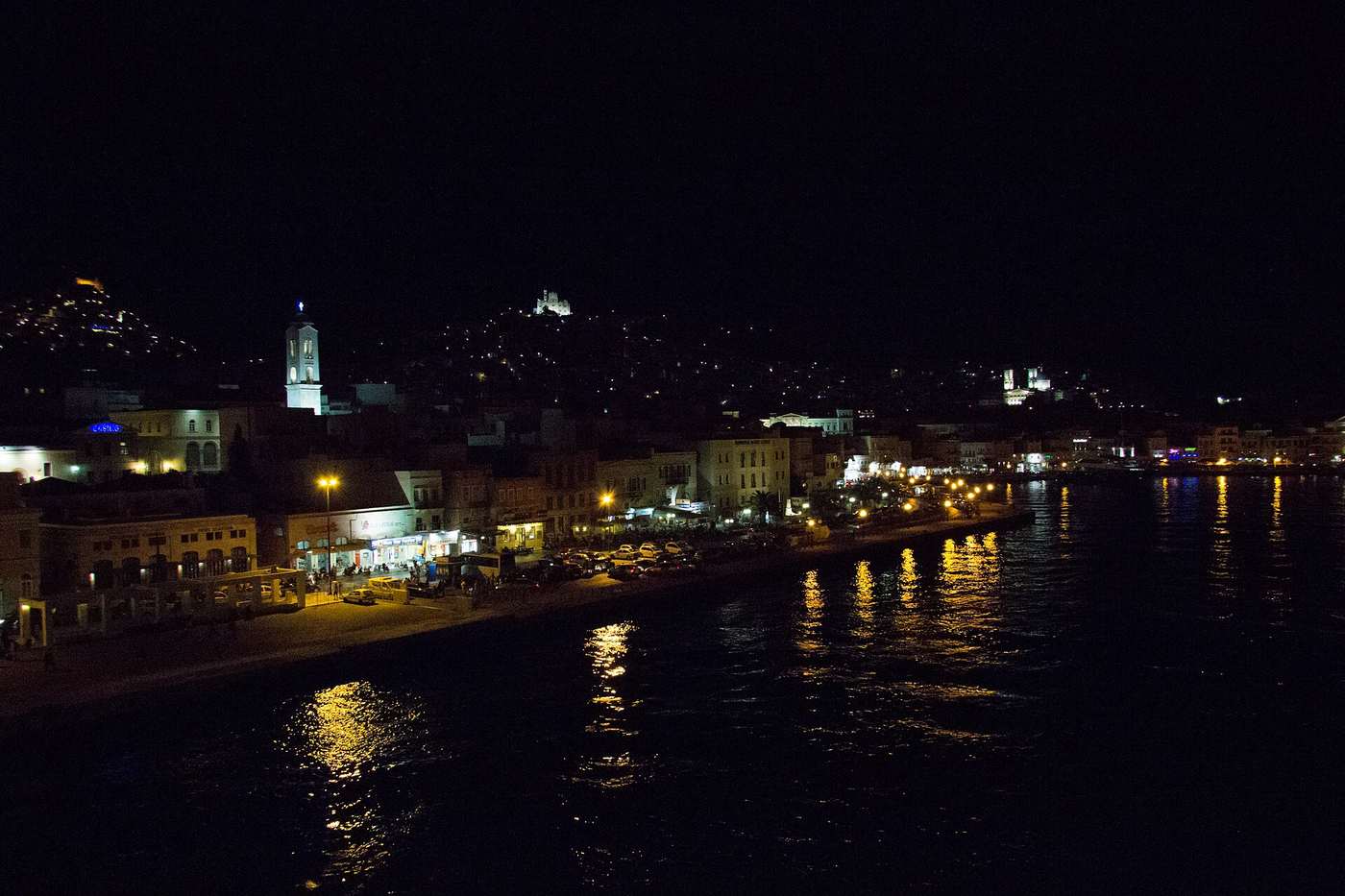
Syros nightlife centres on Ermoupoli, the capital of the island and of the wider Cyclades, and it runs through the whole year rather than a short summer season. The town works as a regional administrative and shipping capital, so the cafes, bars, and tavernas serve residents in every month, not only visitors in August. An evening usually starts with the volta, the slow promenade along the waterfront and across the marble expanse of Miaouli Square, then moves to wine bars, cocktail bars, and ouzeri in the neoclassical lanes. Tavernas with live rebetiko and laika music carry the night on, honouring Markos Vamvakaris, the rebetiko composer born on the island. The mood stays relaxed and local rather than the loud club scene of the party islands nearby. Plan the whole trip with Greece Tours.
The evening scene spreads across a compact centre, so visitors walk between the square, the harbour front, and the back lanes on foot within minutes. The wider island of Syros adds summer beach bars at Galissas, Kini, Vari, and Agathopes, where the daytime scene runs from the sunbeds into the sunset and on into the evening. A handful of clubs and open-air events run late in the peak weeks of July and August, but they stay the exception rather than the rule. Ferries from Piraeus reach Ermoupoli in about two and a half to four hours, docking at the central quay below the town. This guide covers where the night begins, the music, the bars and beach bars, the seasons, and how the scene compares with Mykonos and Ios.
What is nightlife like in Ermoupoli on Syros?
Nightlife on Syros centres on Ermoupoli and runs all year, because the town works as a regional capital rather than a summer resort; the evening opens with the volta promenade and cafes on marble Miaouli Square, then moves to bars and tavernas.
Ermoupoli holds the nightlife of Syros in a compact centre that a visitor crosses on foot in about ten minutes. The harbour front runs along the quay where the ferries dock, lined with cafes, bars, and ouzeri that fill from late afternoon. Behind it, Miaouli Square opens as a wide marble civic space ringed by cafes under the arcades of the town hall. The narrow lanes of the Agora, the old commercial quarter, thread between the square and the shore, holding wine bars and small tavernas. The layout keeps the whole evening within a short walk, so a night moves from a cafe to a bar to a taverna without a car. This concentration marks the scene as a town nightlife rather than a scatter of beach clubs.
The evening in Ermoupoli builds slowly rather than starting late and loud. Families and older residents take the volta, the promenade, from the early evening, filling the square and the waterfront before dinner. Cafes serve coffee, then wine, ouzo, or tsipouro as the light fades, and the same tables carry drinkers through to the night. Dinner in the tavernas runs from about nine, later in the summer heat, and the music and bars follow after. This ordered rhythm, from promenade to cafe to dinner to bar, shapes the night across the whole town. The pattern repeats through the year, since the residents who set it live in Ermoupoli in every season, not only in the tourist months.
The cultural life of the town extends the Ermoupoli night beyond its bars and tavernas. The Apollon Theatre, a marble opera house on Miaouli Square modelled on European halls, stages concerts, plays, and film screenings through the year. Festivals fill the summer calendar, including a rebetiko festival, a film festival, and classical and jazz programmes in the squares and courtyards. The Carnival before Lent brings street parades, music, and masked events to the town in the colder months. These fixed points give the nightlife a cultural spine that a resort scene lacks, tying the evening to the theatre and the festival calendar. A night out here can begin at a concert or a screening before the drinks and the music start.
Ermoupoli keeps the night local in scale and tone, aimed at residents and not at visitors alone. The bars and tavernas hold townspeople through the winter, so they run to a steady standard rather than a summer surge. Prices sit below the levels of the party islands, in keeping with a working town that lives on shipping, administration, and its shipyard rather than on tourism alone. The crowd mixes ages, from students to older residents taking the volta, across the same square and waterfront. This grounding in a year-round population gives the scene its character, closer to a Greek provincial capital than a holiday strip. The result draws visitors who want an evening among locals rather than a club night packaged for tourists.
Why does Syros nightlife stay alive through the whole year?
Syros nightlife survives the winter because Ermoupoli is a working capital, the administrative seat of the South Aegean region and a shipping town, so its resident population fills the cafes, bars, and tavernas in every month rather than only through the summer season.
Ermoupoli serves as the capital of the South Aegean region and the historic capital of the Cyclades, so it carries offices, courts, schools, and a hospital that keep people in the town all year. The island holds a resident population of roughly twenty thousand, most of them in and around Ermoupoli, a base that no purely tourist island matches. These residents live, work, and go out through the winter, so the cafes and bars stay open and busy when the summer visitors leave. The Neorion shipyard, one of the oldest in Greece, adds a working payroll to the town beyond its administrative role. This mix of jobs and institutions gives Syros an economy that runs on more than beaches, which is why its nights do not close in October.
The contrast with the neighbouring party islands explains the difference in the calendar. Mykonos and Ios build their nightlife around a short, intense summer, then most bars and clubs close for the winter as the visitors and seasonal staff leave. Ermoupoli instead runs a steady scene set by residents, so the same tavernas and cafes serve locals through the cold months. The volta on the square and the waterfront happens in December as in July, with heavier coats and fewer tables outside. This year-round base means a visitor in spring or autumn still finds an open town rather than a shuttered resort. The pattern rewards travellers who come outside the peak weeks and want a place that is genuinely inhabited.
The cultural institutions of the town reinforce the year-round night. The Apollon Theatre programmes concerts, plays, and screenings across the seasons, drawing audiences into the centre on winter evenings. The Carnival before Lent, one of the liveliest in the Cyclades, fills the streets with parades and music in the coldest weeks of the year. University departments, including a section of the University of the Aegean, keep a student population in the town through term time. These threads add an audience and an occasion to the winter calendar, so the bars and tavernas have a crowd to serve. The nightlife therefore rests on culture and institutions and not on summer tourism alone.
The working-town character shapes the tone of the scene as well as its calendar. Because residents set the standard, the bars and tavernas aim for a regular local trade rather than a one-off tourist night. This produces steady prices, familiar staff, and a mix of ages at the tables through the year. The summer brings extra visitors and a handful of late clubs, but the core of the scene stays the same in every season. A traveller therefore joins an existing town life rather than a stage set built for a short season. This continuity, driven by a real resident economy, is the single reason Syros nightlife stays alive all year.
Where does an evening out in Ermoupoli on Syros begin?
An evening in Ermoupoli begins with the volta, the slow promenade along the harbour front and across the marble expanse of Miaouli Square, where cafes under the arcades serve coffee, wine, and ouzo from the late afternoon into the night.
The volta sets the start of the night in Ermoupoli, a habit shared across Greek towns and kept strongly on Syros. Residents walk the waterfront and cross Miaouli Square in the early evening, meeting neighbours and settling at cafe tables as the light drops. The square, paved in marble and ringed by the town hall, the statue of Admiral Miaoulis, and neoclassical facades, forms the natural centre of this promenade. Children run in the open space while older residents take the slower circuit around its edge. Cafes set their chairs out under the arcades and along the harbour, filling from about six in the evening. This ordered start, from a walk to a seat, opens almost every night in the town.
The cafes of the square and the waterfront carry the first hours of the evening. Tables serve coffee and soft drinks early, then shift to wine, ouzo, tsipouro, and beer as dinner approaches. Small plates of mezes, from cheese and olives to seafood, come with the drinks in the ouzeri along the quay. The pace stays slow, with a single table often held for two or three hours of talk. The waterfront position gives a view over the moored boats and the ferries entering the harbour, a backdrop tied to the shipping town. This café stage of the night, unhurried and social, is where residents and visitors settle before dinner or a later bar.
The neoclassical lanes behind the square add a second layer to the early evening. Narrow streets in the Agora, the old market quarter, hold wine bars, small cafes, and the fronts of tavernas preparing to open. Marble kerbs, painted facades, and iron balconies line these lanes, lit softly once the sun sets. Visitors drift from the open square into these streets as the night moves on, following the sound of talk and music. The compact scale keeps the walk short, so a group covers three or four cafes and bars in one evening on foot. This movement, from the wide square to the tight lanes, marks the shift from the promenade to the drinking and dining part of the night.
The timing of an Ermoupoli evening runs later than a northern European night. The volta and the first drinks fill the hours from six to nine, when the heat of a summer day has eased. Dinner in the tavernas starts from about nine and often runs past eleven, so the bars and music follow from there. This late schedule shifts back further in July and August, when the warm nights keep the square busy past midnight. Outside the summer, the same pattern holds on a shorter clock, with dinner and drinks a little earlier in the cold. The steady sequence, promenade then cafe then dinner then bar, gives the night its shape whatever the season.
What music plays in the tavernas and bars of Syros nightlife?
Syros nightlife favours live rebetiko and laika, the urban Greek music tied to Markos Vamvakaris, the composer born on the island; tavernas and small venues host bouzouki players, while bars mix Greek songs with jazz, wine-bar sets, and quiet electronic music.
Rebetiko sits at the centre of the island’s musical identity through Markos Vamvakaris and rebetiko. Vamvakaris, born in the medieval quarter of Ano Syros above Ermoupoli, became the leading figure of the genre and a master of the bouzouki. A square, a bust, and a small museum in Ano Syros mark his memory, and the town holds a rebetiko festival in his name. Tavernas and small music halls host live rebetiko and laika evenings, where a bouzouki and a guitar lead songs the whole room knows. The audience often sings along, and the music runs late once it starts. This living tradition ties the nightlife of Syros directly to the history of Greek urban song.
Laika, the popular Greek song that grew out of rebetiko, fills the tavernas alongside the older style. Bands of bouzouki, guitar, and voice play sets that mix classic laika with rebetiko standards, and the tables join the choruses. These evenings run in the tavernas of Ermoupoli and in the lanes of Ano Syros, part seated for dinner and part closer to a music hall. The music starts after dinner, from about ten or eleven, and carries the night through to the early hours. Wine, tsipouro, and mezes come with the songs, and the mood grows as the room warms. This taverna music, live and shared, forms the core of a traditional night out on the island.
The bars of Ermoupoli widen the range beyond the traditional tavernas. Wine bars pour Greek labels, including wines from the Cyclades, with quiet background music suited to talk. Cocktail bars along the waterfront and in the lanes mix Greek pop, funk, soul, and jazz, a number with a resident DJ on summer weekends. A jazz scene surfaces around festivals and in certain bars, in keeping with the town’s cultural bent. Electronic and dance music appears in a handful of late venues in the peak weeks, but at a lower volume than the party islands. This spread, from wine-bar calm to a late DJ set, lets a visitor choose the tone of the night rather than face a single club sound.
The festivals of Syros put its music on a public stage each year. The rebetiko festival, tied to the memory of Vamvakaris, brings players from across Greece to Ano Syros and Ermoupoli for concerts and street sessions. Classical concerts and recitals fill the Apollon Theatre and the churches, while a jazz and world-music programme uses the squares and courtyards in summer. The Carnival before Lent adds brass bands and street music to the winter calendar. These events lift the music out of the tavernas and into the open town, drawing residents and visitors together. The festival schedule therefore turns the island’s musical tradition into a fixed part of its nightlife across the year.
Where are the wine bars, cocktail bars, and ouzeri in Ermoupoli on Syros?
The bars of Ermoupoli cluster along the harbour front and through the neoclassical lanes behind Miaouli Square; ouzeri and mezedopoleia line the quay, wine bars and cocktail bars fill the Agora, and rooftop terraces look out over the port.
The harbour front holds the most visible run of bars and ouzeri in Ermoupoli. Tables spread along the quay where the ferries dock, so drinkers sit with a view over the moored boats and the water. Ouzeri and mezedopoleia serve ouzo, tsipouro, and small seafood plates in the traditional style, filling from the late afternoon. Cafes on the same stretch turn into bars as the night draws on, keeping their tables through the evening. The open waterfront catches the breeze in summer, which draws crowds to the front on warm nights. This quayside line, easy to find straight off the boat, is where most visitors start their drinking on the island.
The lanes of the Agora behind Miaouli Square hold the wine bars and cocktail bars of the town. Narrow marble streets between neoclassical buildings carry small bars, a number in restored ground floors with high painted ceilings. Wine bars pour Greek and Cycladic labels by the glass, paired with cheese and cured meats, in a quiet setting suited to talk. Cocktail bars nearby mix drinks to Greek pop, jazz, or soul, busier and later than the wine rooms. The compact grid keeps these bars a short walk from the square and from each other, so a group moves between three or four in one night. This back-lane cluster forms the heart of the after-dinner scene in Ermoupoli.
Rooftop and terrace bars add a further layer above the streets. A number of bars and hotels open roof terraces that look over the harbour, the marble square, and the amphitheatre of neoclassical houses climbing the two hills. These spots draw an early-evening crowd for the sunset and a later one for cocktails under the lights of the town. The raised view takes in the domes of Agios Nikolaos in the Vaporia quarter and the ferries entering the port. Prices on the terraces sit a little above the street bars, in line with the view. This vertical layer gives the nightlife a set of vantage points over the town that the waterfront tables cannot match.
The spread of venues suits a night that moves rather than settles in one place. A group can start with ouzo on the quay, cross to a wine bar in the Agora, take cocktails in a lane, and climb to a roof terrace for a last drink. The short distances make this circuit easy on foot, without a taxi or a car. The mix of styles, from a traditional ouzeri to a modern cocktail bar, covers a wide range of tastes in a small area. Because the town lives all year, most of these bars stay open through the winter on a shorter clock. This variety within a compact centre defines the drinking side of Syros nightlife.
What beach bars and summer nightlife does Syros offer beyond Ermoupoli?
Beyond Ermoupoli, Syros adds summer beach bars at Galissas, Kini, Vari, and Agathopes, where the scene runs from daytime sunbeds through sunset drinks; a handful of clubs and open-air events run late in July and August near the town.
The west-coast resorts carry the summer beach nightlife of Syros, led by Galissas beach about nine kilometres from Ermoupoli. Galissas holds a sandy bay ringed by tavernas and beach bars, where sunbeds and cocktails run through the day and into the evening. As the sun drops behind the headland, the beach bars shift to music and drinks, drawing a younger crowd than the town square. The resort keeps a relaxed pace even at its busiest, closer to a beach taverna scene than a club strip. Buses from Ermoupoli reach Galissas in about twenty minutes, so visitors move between the town and the beach without a car. This bay forms the main summer alternative to the Ermoupoli waterfront.
Kini, on the northwest coast, adds a second beach-bar scene built around its west-facing bay. The sheltered beach looks straight into the sunset, so its tavernas and bars fill in the evening for the view over the water. Sunbeds and drinks run through the day, and the bars carry the crowd on after dark in the summer weeks. The village stays small, so the nightlife keeps to a handful of seafront venues rather than a strip. A bus or a short drive of about nine kilometres links Kini to Ermoupoli. This quiet, sunset-facing resort suits an evening drink by the sea more than a late night, drawing families and couples from the town.
The southern beaches of Vari and Agathopes complete the summer map of the island’s coastal nightlife. Vari, a sandy bay on the south coast, holds tavernas and beach bars that run from the sunbeds into the evening, popular with families staying nearby. Agathopes, near the resort of Posidonia and its neoclassical villas, adds an organised beach with bars and a shallow bay, busy through the summer day. These southern spots keep the same relaxed pattern, from daytime beach service to sunset drinks, rather than a late club scene. Roads and buses link them to Ermoupoli within about fifteen to twenty minutes. Together with Galissas and Kini, they give the summer visitor a set of beach bars spread around the coast.
The late, louder side of Syros nightlife stays small and seasonal. A handful of clubs and late bars in and around Ermoupoli open in the peak weeks of July and August, running music into the early hours. Open-air events, from concerts to occasional dance nights, appear on the summer calendar, part tied to the festivals in the town. These venues serve the extra visitors of the high season, then close or scale back once September arrives. Even at their busiest they keep a lower volume and a smaller scale than the clubs of the party islands. This limited late scene confirms the character of Syros as a town for a relaxed night rather than a club holiday.
How does Syros nightlife compare with Mykonos and Ios?
Syros nightlife stays relaxed and local, built on year-round cafes, tavernas, and live rebetiko in Ermoupoli, whereas Mykonos and Ios run loud, seasonal club scenes aimed at summer visitors; Syros trades the late party for a steady town evening.
The core difference lies in who the nightlife serves. Ermoupoli runs its evenings for a resident population of a working capital, so the scene aims at locals across the year. Mykonos and Ios instead build their nightlife around a short, intense summer of visitors, with clubs, beach parties, and international DJs at the centre. This produces a loud, late, and expensive scene on the party islands that closes through the winter. Syros keeps a quieter register, with cafes, wine bars, and tavernas rather than large clubs. A traveller therefore chooses between a packaged party and a lived-in town night. The islands sit close together in the Cyclades, but their evenings run on entirely different models.
Volume, scale, and price separate the scenes as clearly as their calendars. Mykonos carries famous clubs, expensive beach clubs, and a nightlife that draws an international crowd at high prices. Ios centres its summer on a compact village of bars packed with young travellers, loud and late through the season. Ermoupoli, by contrast, spreads a modest number of bars and tavernas across a marble town, at prices set for residents. The music runs to live rebetiko and laika, wine-bar sets, and cocktail bars rather than stadium-scale DJs. This gap in scale and cost makes Syros the calmer and cheaper choice among the three. Visitors seeking a big club night head to Mykonos or Ios, not to Syros.
The cultural depth of Ermoupoli gives its nightlife a character the party islands lack. The Apollon Theatre on Miaouli Square, the summer festival calendar, and the Carnival before Lent tie the evening to concerts, screenings, and street events across the year. The rebetiko tradition of Markos Vamvakaris, born in Ano Syros above the town, roots the music in the island’s own history rather than an imported club sound. This grounding turns a night out into part of the town’s cultural life, not a self-contained party staged for one season. Mykonos and Ios offer spectacle and scale, but little of this year-round cultural texture built on a working town. A traveller who values the setting and the music over the volume finds a clear advantage on Syros.
The choice between the islands comes down to the kind of night a visitor wants. Mykonos and Ios reward those after a loud, social, high-energy summer party among crowds of other visitors. Syros suits travellers who prefer a relaxed evening among residents, with the volta, a taverna dinner, live music, and a quiet drink by the sea. The two models can even combine on a single trip, since ferries link Syros to Mykonos in under an hour. A common pattern pairs two or three nights of the party islands with the calmer town scene of Ermoupoli. This complementary role, rather than direct competition, marks the place of Syros nightlife within the Cyclades.
Frequently Asked Questions
Does Syros have nightlife in winter?
Syros keeps its nightlife through the winter, unlike most Cycladic islands. Because Ermoupoli is a working regional capital with a resident population of around twenty thousand, its cafes, bars, and tavernas stay open all year rather than closing after the summer. The volta on Miaouli Square and the waterfront continues in the cold months, and the Apollon Theatre programmes concerts and screenings across the seasons. The Carnival before Lent brings one of the liveliest street celebrations in the Cyclades to the town in winter. A visitor in spring, autumn, or winter therefore finds an open, inhabited town rather than a shuttered resort.
Where is the main nightlife on Syros?
The main nightlife on Syros sits in Ermoupoli, the island capital, concentrated around Miaouli Square, the harbour front, and the neoclassical lanes of the Agora behind them. Ouzeri and cafes line the quay, wine bars and cocktail bars fill the back streets, and tavernas host live music after dinner. In summer the beach resorts of Galissas, Kini, Vari, and Agathopes add beach bars from the daytime into the evening. The whole town centre is walkable in about ten minutes, so a night moves easily from cafe to bar to taverna on foot.
What kind of music is played in Syros bars and tavernas?
Music on Syros leans on rebetiko and laika, the urban Greek styles tied to Markos Vamvakaris, the rebetiko composer born in Ano Syros above Ermoupoli. Tavernas and small music halls host live bouzouki players, and the tables often sing along late into the night. A rebetiko festival in his memory brings players from across Greece each year. Beyond the tradition, wine bars and cocktail bars mix Greek pop, jazz, soul, and light electronic music, and the Apollon Theatre stages classical concerts. The range runs from live rebetiko to a quiet wine-bar set rather than a single club sound.
Is Syros a party island like Mykonos or Ios?
Syros is not a party island in the mould of Mykonos or Ios. Its nightlife stays relaxed and local, built on year-round cafes, wine bars, tavernas, and live rebetiko in Ermoupoli rather than large seasonal clubs. Mykonos and Ios run loud, expensive summer club scenes aimed at visitors, which mostly close for the winter. Syros keeps a quieter, cheaper evening set by its resident population, with a handful of late bars only in the July and August peak. Travellers after a big club night head elsewhere, while those wanting a calm town evening choose Syros.
What are the best beach bars on Syros?
The main beach bars on Syros sit on the west and south coasts, away from the town. Galissas, about nine kilometres from Ermoupoli, holds a sandy bay with beach bars and tavernas that run from the sunbeds into the evening. Kini, on the northwest coast, faces the sunset and fills its seafront bars for the view. Vari and Agathopes on the south coast add family-friendly beaches with bars from the daytime into the sunset. Buses link all four to Ermoupoli within about fifteen to twenty minutes, so visitors reach them without a car.
How do you get around Syros at night?
Getting around Ermoupoli at night needs no transport, since the square, the harbour front, and the Agora lanes all sit within a ten-minute walk of each other. For the beach bars at Galissas, Kini, Vari, and Agathopes, buses run from the central station on the Ermoupoli waterfront, and taxis wait near the port. A rental car or scooter gives more freedom to reach the coastal resorts late, as evening buses thin out. Ano Syros, above the town, is reached by a steep climb or a short bus ride for its tavernas and rebetiko venues. Distances on the island stay short, within about twenty minutes of the capital.