
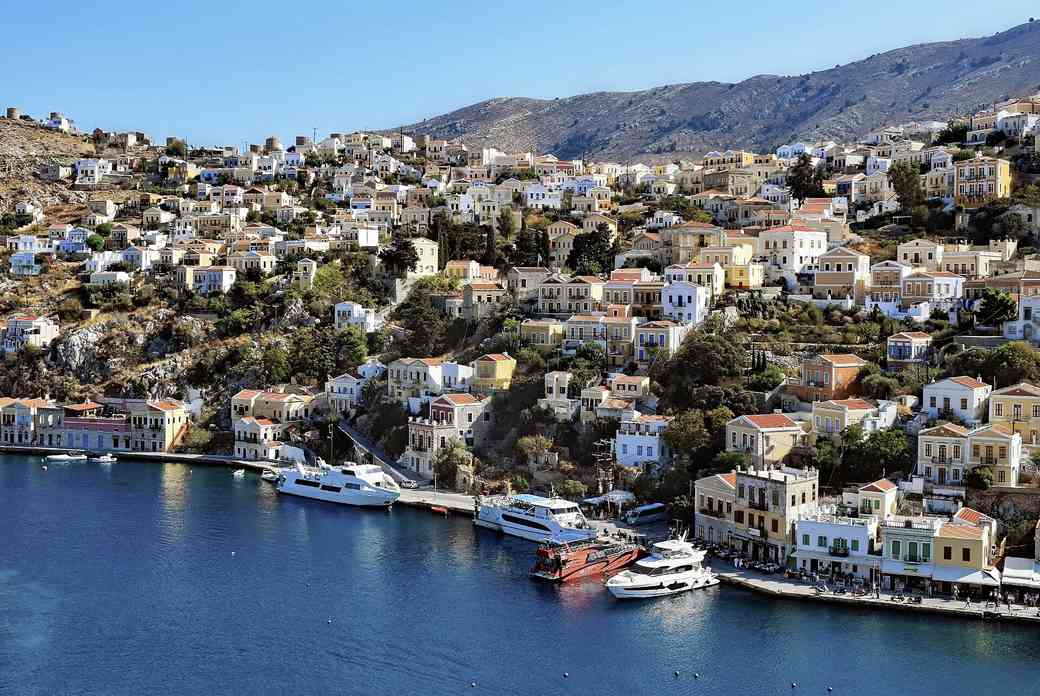
The Symi Festival is the summer cultural programme of Symi, a small Dodecanese island set between Rhodes and the Turkish coast. The festival runs across the warm months, roughly from July into September, and fills the island’s evenings with free events. Music, theatre, dance, film screenings and art exhibitions make up the core of the programme. Open-air venues in the harbour town of Gialos and the upper town of Chorio host the performances. This guide walks through what the festival is, when it runs, where it happens and how to attend.
The festival grew as a way to extend the island’s cultural life beyond daytime sightseeing and to draw visitors into the evening. Entry to most events stays free and open to residents and holidaymakers alike. A fresh programme comes out each summer, printed and posted around the town and online. The events sit alongside the religious feasts and village panigyria that mark the island’s calendar. Anyone planning a stay on Symi gains an extra reason to book across the peak festival weeks, when the harbour and the squares turn into stages.
What is the Symi Festival?
The Symi Festival is a summer cultural programme held across the island each year. It presents free evening events of music, theatre, dance, film and art in open-air venues, drawing Greek and international performers to Gialos and Chorio.
The Symi Festival gathers the island’s summer culture into one running programme. Concerts, plays, dance shows, film screenings and art exhibitions fill the calendar from early summer into autumn. Each night carries its own event, staged in a square, a courtyard or on the harbour front. The festival treats the whole town as its stage rather than a single hall. Greek artists form the backbone of the line-up, joined by performers from abroad. The mix ranges from classical and traditional music to jazz and contemporary work. Local groups, choirs and school ensembles also take the stage during the season. This breadth gives the festival a civic character, tying the island’s residents and its visitors into the same run of evenings.
The programme rests on a simple idea: bring performance into the open air of a historic port. Neoclassical mansions rise in tiers around the bay, and the festival uses that setting as a backdrop. Stone squares, church courtyards and the quay each turn into an auditorium after dark. The sea, the lit facades and the night air replace the walls of a theatre. This staging suits an island with no large concert hall of its own. The festival adapts each event to the space it occupies, from a full stage to a bare platform. The result folds the town’s architecture into every show. Audiences sit under the stars, framed by the harbour that gives the island its shape.
The festival’s roots lie in a wish to give the island a cultural life beyond its monuments and beaches. Sightseeing fills the daytime, and the evening once emptied as day-trippers sailed back to Rhodes. Organisers built the programme to hold visitors into the night and to serve residents through the quiet weeks. A cultural association and the local authority run the events together, backed by sponsors and volunteers. Free entry sits at the centre of the plan, keeping every show open to all. The festival now counts as a fixture of the island’s summer, listed beside its feast days. This civic purpose, rather than commercial gain, shapes the choice of acts and the open-door policy.
The festival’s identity comes from its range rather than a single headline act. One evening offers a symphony concert; the next brings a shadow-puppet show for families. Traditional music from the Dodecanese shares the season with jazz, choral works and modern dance. Painters and photographers show their work in halls and old mansions across the same weeks. Screenings put films on a wall or a portable screen under the night sky. This spread lets the festival speak to residents, families and travellers at once. No single genre defines it, and the programme changes shape from one summer to the next. That variety keeps the festival close to the whole community rather than one narrow audience.
When does the Symi Festival take place?
The Symi Festival takes place across the island’s warm months, running roughly from July into September. Events unfold on most evenings through the peak of summer, with the programme concentrated in the weeks when the port stays busiest after dark.
The festival season tracks the island’s tourist calendar closely. Warm, dry evenings from high summer into early autumn suit open-air staging, so the programme fills those weeks. July and August carry the densest run of events, when the harbour holds its largest crowds. Shows continue into September as the heat eases and the light softens over the bay. Planning a trip around the shows pairs well with a look at the best time to visit Symi. The festival adds a strong reason to favour the July-to-September window over the quieter shoulder months. Long, mild nights let audiences sit outdoors until late, which underpins the whole open-air format of the programme. Ferries from Rhodes run at their fullest through this stretch, easing evening arrivals.
The festival keeps to the summer because its venues sit outdoors under the open sky. Rain stays rare on the island through these months, so evening events run with little disruption. Cooler air after sunset makes long concerts and plays comfortable for performers and audiences. The season also matches the return of the island’s diaspora, when families come home for the holidays. Their presence swells the crowds at the squares and the harbour front. The festival thus lands at the point when the island’s population and its visitor numbers both peak. This timing lets each event draw a full audience, which suits the free, open format. The warm-month window frames the entire run of the programme year after year.
The exact run shifts from summer to summer, set by the organisers each year. A start in early July and a close in September marks the usual span. Certain editions stretch events into late June or early October around the core weeks. The precise dates depend on the line-up, the venues and the visiting artists’ schedules. Publication of the full calendar each summer settles the timing for that edition. The rhythm within the season varies too, with clusters of events on certain weeks and gaps on others. Feast days and national holidays often anchor the busiest nights. Checking the current programme fixes the exact evenings, since the framework holds while the details move from one year to the next.
The timing rewards visitors who plan an evening-focused stay rather than a single day trip. Day boats from Rhodes reach the harbour by late morning and leave in the afternoon, before the shows begin. Catching a performance therefore calls for a night on the island, in Gialos or Chorio. Sunset falls late through the peak weeks, so events often start around nine in the evening. The mild night air lets audiences linger at the tavernas before and after each show. Booking a room ahead pays off in July and August, when beds fill fast. An overnight stay turns the festival from a rumour heard on the quay into a full evening under the stars. This after-dark focus defines how the season works.
Where does the Symi Festival stage its events?
The Symi Festival stages its events in open-air venues across Gialos and Chorio. The harbour front, the main square, church courtyards and mansion terraces each host performances, turning the neoclassical port and the upper town into a set of outdoor stages.
The festival spreads its stages across both halves of the town. Symi Town and Gialos supply the busiest venues, from the quayside to the central square. The harbour front hosts open concerts within sight of the moored boats and the lit mansions. A raised platform or a cleared section of the promenade serves as the stage for larger crowds. Church courtyards and small paved squares hold the quieter, seated events. The upper town of Chorio adds venues higher on the ridge, reached by the stone steps. This spread lets the festival match each event to a fitting space and to move crowds around the town rather than pack a single site each night. Signs and printed sheets point audiences to the night’s venue.
Gialos offers the festival its signature backdrop of tiered neoclassical mansions. The harbour curves around a deep inlet, and the painted facades rise in rows behind the quay. Evening light and floodlit stone frame the stage without any built scenery. The main square near the waterfront holds seated concerts and plays. The promenade itself carries standing crowds for the larger open events. Fishing boats and yachts sit moored close to the performers. This setting ties each show to the working port that built the town’s wealth. The sea breeze, the lapping water and the lit houses give Gialos a stage that no indoor hall on the island can match for atmosphere or scale. Rows of chairs face the water on concert nights.
Chorio raises the festival onto the ridge above the harbour. Its paved squares and church courtyards host events among the stone houses of the old town. The venues here sit quieter and more intimate than the busy quay below. A courtyard shaded by a plane tree or a small platform beside a church makes the stage. Views open over the tiered rooftops toward the bay and the open sea. Reaching these venues means a climb up the Kali Strata, the broad stone stairway from Gialos. The effort filters the crowd and lends the upper events a calmer mood. Chorio suits recitals, chamber concerts and readings, where the setting and the silence carry the performance as strongly as the acoustics.
The open-air format shapes how each venue works. No permanent theatre exists in the town, so crews build a temporary stage for the run. Lights, a sound rig and rows of chairs turn a square into an auditorium for the night. Crews strike the setup afterwards, leaving the space clear for daily life by morning. Weather rarely interrupts, since dry summer nights hold across the season. A rare wet evening pushes an event to a covered hall or a later date. This flexible approach lets the festival use the town’s own fabric instead of a fixed building. Each venue keeps its everyday role by day and becomes a stage only after dark, which folds the events into the rhythm of the port.
What music does the Symi Festival present?
The Symi Festival presents music across a wide span, from classical and traditional Greek pieces to jazz and contemporary work. Orchestras, choirs, soloists and folk ensembles perform through the season, drawing Greek and international musicians to the open-air stages of the port.
Music forms the largest strand of the festival’s programme. Classical concerts anchor the calendar, with orchestras and chamber groups playing works from the European repertoire. Soloists on piano, violin and guitar give recitals in the squares and courtyards. Choral ensembles bring sacred and secular song to the church settings of Chorio. The line-up reaches beyond the classical core into other traditions across the weeks. Greek composers and performers feature strongly, alongside guests from abroad. The open-air acoustics favour acoustic instruments and voices over heavy amplification. This range lets the festival serve listeners who follow orchestral music and those who prefer song, keeping the programme broad rather than tied to one school or period. Concerts often run about ninety minutes without an interval.
Traditional Greek music holds a firm place in the line-up. Players of the bouzouki, lyra, laouto and violin bring the sound of the islands to the squares. Rebetiko, nisiotika and Dodecanese folk songs feature across the season. These evenings draw the strongest local turnout, since the music belongs to the island’s own culture. Dancing often breaks out at the edges of the crowd during the livelier sets. The festival treats this repertoire as a link to the community rather than a show for tourists alone. Singers and groups from the wider Dodecanese join island musicians on the same bills. This strand keeps the programme rooted in Greek tradition even as it opens the stage to classical and international acts.
Jazz and contemporary music widen the festival beyond its classical and folk core. Jazz trios and quartets play sets on the harbour stages during the warmer weeks. Modern Greek songwriters and bands bring current work to the same squares. World-music acts appear on the bill, blending styles from across the Mediterranean. These evenings pull a younger crowd and a strong share of the visiting audience. The relaxed, open-air setting suits the informal mood of a jazz or pop set. Performers adapt to the acoustics of a square or the quay rather than a concert hall. This modern strand signals that the festival tracks living music, not only the established repertoire, and keeps the programme fresh from one summer to the next.
The festival pairs its music with the setting to shape each concert. A symphony on the harbour front reaches a standing crowd along the quay. A recital in a Chorio courtyard holds a seated, attentive audience under the stars. Choirs use the churches and their stone acoustics for sacred programmes. Folk nights fill the main square, where dancing and singing spill into the crowd. This match of music to place gives each evening its own character. The absence of a fixed hall becomes a strength, since every concert borrows the atmosphere of its venue. Audiences move around the town across the season, following the music from the quay to the ridge and back, which keeps the festival woven through the whole settlement.
How does the Symi Festival feature theatre and dance?
The Symi Festival features theatre and dance alongside its concerts, staging plays, recitals and dance shows in the open air. Greek theatre companies and dance troupes perform in the squares and courtyards, adding drama and movement to the mainly musical programme.
Theatre brings spoken drama to the festival’s open-air stages. Greek companies tour productions to the island, staging them in the squares of the town. The repertoire spans ancient tragedy and comedy, modern Greek plays and adaptations of world drama. A cleared square or a courtyard serves as the stage, with rows of chairs for the audience. Performances run in Greek, so the strongest draw falls to local and Greek-speaking visitors. Ancient drama carries weight on an island with a deep classical past. Lighting and a spare set turn the venue into a theatre for the evening. This strand gives the festival a literary and dramatic core beside its concerts, broadening the range of the programme across the season.
Dance adds movement to the festival’s line-up each summer. Companies present classical ballet, modern dance and folk dance across the season. Greek folk troupes perform the dances of the islands in traditional dress, tied to the same roots as the folk-music nights. Contemporary groups bring modern choreography to the harbour stages. The open square gives dancers room that a small hall cannot offer. Live music or a recorded score carries each piece. Folk-dance evenings often end with the audience joining a circle dance in the square. This mix of ballet, modern and folk work lets the festival show dance as both a stage art and a living island custom, matching the breadth of its music.
Theatre and dance draw a different audience from the concerts. Ancient drama and Greek plays attract residents and Greek-speaking travellers who follow the text. Folk dance pulls the local crowd, since the steps and costumes belong to the island’s own tradition. Ballet and modern dance reach visitors who read movement across any language barrier. Families gather for the lighter shows, including puppet theatre and children’s pieces. The festival schedules these events to spread across the weeks rather than cluster on a single night. This planning gives residents and visitors a reason to return through the season. The variety of drama and dance, set beside the music, turns the festival into a full arts programme rather than a concert series alone.
Staging theatre and dance outdoors calls for the same flexible setup as the concerts. Crews raise a platform, hang lights and lay out chairs in a square for the run. A backdrop or a plain screen frames the action without a built set. Sound gear carries the voices and the score to the back rows. Warm, still nights let performers work outdoors without cover. The festival keeps productions lean, so a touring company travels light to the island. This economy fits an event built on free entry and public funding rather than ticket sales. The open-air staging turns each play and dance into a shared civic evening in the heart of the town, matching how the concerts use the same spaces.
What film and art events does the Symi Festival include?
The Symi Festival includes open-air film screenings and art exhibitions beside its live performances. Films play on a screen under the night sky, while paintings, photographs and sculpture fill halls and old mansions in the town across the weeks of the season.
Film screenings bring cinema into the festival’s open-air run. A screen goes up in a square or on the harbour front, and the audience watches under the stars. The selection mixes Greek films with international titles across the season. Documentaries about the island, the Dodecanese and the sea often feature on the bill. The open-air cinema echoes a long Greek summer tradition of screenings in the warm night. Chairs face the screen, and the sound carries across the still square. Entry stays free, in line with the rest of the festival. These evenings suit families and casual visitors as well as film enthusiasts, and they fold cinema into a programme otherwise built on live music, theatre and dance.
Art exhibitions run through the festival in the halls and mansions of the town. Painters, photographers and sculptors show their work over stretches of the season. A restored neoclassical mansion or a public hall serves as the gallery. Local artists exhibit beside guests from the mainland and abroad. Themes often draw on the island, the sea and the sponge-diving past that shaped the town. The shows stay open across daytime and evening, so visitors view them around the live events. Entry remains free, matching the festival’s open-door rule. These exhibitions give the visual arts a place beside the performing arts, and they let visitors fill the daylight hours with the festival before the evening concerts and plays begin on the squares.
Film and art extend the festival beyond the evening concerts. A visitor spends the afternoon at an exhibition, then moves to a screening or a concert after dark. This layering fills the whole day with the festival rather than one evening slot. The exhibitions also give the town a cultural draw through the daytime heat, when outdoor events pause. Screenings suit warm nights when a lighter programme fits better than a formal concert. Both strands lean on the same free-entry rule that governs the festival. They broaden the audience to include film-goers and gallery visitors beside concert and theatre crowds. The result turns the festival into a full-day, full-season cultural offer, not a run of isolated nightly shows on the harbour.
The film and art strands rely on the town’s own buildings and spaces. Screenings use a square or the harbour front, the same open venues as the concerts. Exhibitions occupy restored mansions and public halls that stand empty otherwise. This reuse of existing space keeps the festival light on cost and true to the town’s fabric. Curators hang the shows in rooms that themselves reflect the island’s neoclassical past. Projectionists rig a screen and a sound system for each film night, then clear it away. The approach mirrors the concerts and plays, where the town supplies the stage. Film and art thus sit fully inside the festival’s method: public spaces, free entry and a programme that borrows the setting of the port and the ridge.
Why is the Symi Festival free to attend?
The Symi Festival stays free to keep culture open to residents and visitors alike. Public funding, sponsors and volunteers cover the costs instead of ticket sales, so anyone on the island can attend the concerts, plays and screenings without payment.
Free entry sits at the heart of the festival’s design. The organisers built the programme as a public service for the island rather than a commercial venture. Every concert, play, screening and exhibition opens to all without a ticket. This rule keeps the events within reach of residents on a modest income and of families with children. Visitors gain the same open access as locals, which mixes the audience across the squares. The festival funds itself through the local authority, a cultural association, sponsors and volunteers. This model ties the events to the community and its guests rather than to box-office returns. Free entry turns each evening into a shared civic gathering, open to whoever walks up to the square.
The audience blends residents, Greek holidaymakers and international visitors. Local families fill the squares, treating the festival as part of the island’s summer life. Members of the island’s diaspora, home for the holidays, swell the crowds through July and August. Day-trippers who stay overnight join the evening events beside the guests in the hotels. Free entry lowers the barrier for everyone, so the crowd rarely splits by budget. Children attend the family shows and screenings alongside their parents and grandparents. This mix gives the festival a community feel rather than the atmosphere of a ticketed tour event. The blend of ages and backgrounds in the audience marks the festival as the island’s own, shared openly with its visitors.
Free entry brings practical benefits for the island beyond the shows themselves. Evening crowds fill the tavernas, cafes and shops of the harbour before and after each event. Visitors set to sail back to Rhodes instead stay a night for a concert. This extra custom supports the island’s economy through the summer. The festival thus repays its public funding through the trade it draws to the port. Residents gain a full cultural programme without leaving the island for the city. The open format also builds goodwill, tying the community to the events year after year. Free entry works as both a cultural policy and an economic one, drawing people into the town and holding them there through the evening.
The free format shapes how visitors plan an evening at the festival. No box office means no advance ticket to buy for most events. Arriving early secures a seat, since chairs fill before popular concerts and plays. Standing room along the quay holds the overflow for the larger shows. The programme sheet lists the night’s event, its venue and its start time. Turning up is enough for entry, which suits travellers deciding on the day. A donation box or a paid drink at a nearby taverna supports the events indirectly. This ease of access matches the festival’s open spirit, letting anyone in the town join a concert, play or screening on the night without cost or booking.
How does the Symi Festival fit the island’s summer calendar?
The Symi Festival fills the evenings of the island’s summer, sitting alongside religious feasts and village panigyria. It extends cultural life beyond daytime sightseeing, drawing residents and visitors into the squares after dark and marking the peak weeks of the tourist season.
The festival slots into a summer already rich with island tradition. Religious feasts fill the calendar, led by the great pilgrimage to Panormitis Monastery on the southwest coast. Village panigyria mark saints’ days with food, music and dancing in the squares. The festival adds a secular, arts-based layer over this religious and folk framework. Its concerts and plays run on the nights between the feast days across the season. Residents move from a church festival one week to a jazz concert the next. This blend of sacred and secular events fills the island’s summer evenings. The festival does not replace the traditional calendar; it works beside it, giving the season a fuller cultural range. Both draw the community into the same squares.
The festival marks the height of the island’s tourist season. Its densest weeks fall in July and August, when the harbour holds its largest crowds. The events give visitors a reason to stay into the evening rather than sail back to Rhodes by day. Hotels, guesthouses and tavernas gain custom from the overnight audience. The festival thus lifts the island’s summer economy at its busiest point. It also spreads life beyond the beaches and monuments that fill the daytime. Evening crowds gather in the squares that stand quiet through the afternoon heat. This role turns the festival into a fixture of the peak season, tying the island’s cultural life to its busiest tourist weeks year after year.
The festival balances the island’s daytime and evening life. Days on the island go to beaches, boat trips, monuments and walks through the town. The harbour empties of day-trippers in the late afternoon as the boats leave for Rhodes. The festival then fills the gap, turning the quiet evening into the busiest part of the day. Concerts, plays and screenings pull residents and overnight visitors back into the squares. This rhythm gives the island a full day-and-night cycle through the peak weeks. The pattern rewards travellers who base themselves on the island rather than visit on a day boat. The festival, in effect, builds the evening half of a Symi summer, complementing the beaches and sights of the daylight hours.
The festival strengthens the island’s identity as a cultural destination. Symi carries a name for its neoclassical harbour, its sponge-diving past and its monasteries. The festival adds a living arts programme to that heritage, drawing culture-minded visitors each summer. Word of the concerts and plays spreads through returning guests and the island’s diaspora. This reputation helps the island stand apart from purely beach-focused destinations in the region. The events also give the local cultural association and its performers a yearly platform. Schools, choirs and dance groups from the island take part beside visiting professionals. The festival thus feeds the island’s cultural life through the year, not only across the summer weeks when the concerts and plays fill the squares.
How can visitors find the Symi Festival programme and attend?
Visitors find the Symi Festival programme in a printed schedule posted around the town each summer and online through the organisers. Attending means turning up at the listed venue on the night, since entry stays free and open to everyone without a ticket.
The festival publishes a full programme at the start of each summer. Printed schedules appear around the town, posted at the harbour, the town hall and the tavernas. The sheet lists each event, its date, its venue and its start time across the season. The local cultural association and the municipality share the programme online as well. Notices at the harbour front flag the night’s event for arriving visitors. Hotel and guesthouse hosts often keep a copy for their guests. Checking the schedule on arrival fixes which evenings carry a concert, play or screening. This early publication lets travellers plan a stay around the events they want, rather than learn of a show only after it has passed.
Attending an event asks little of the visitor. Turning up at the listed venue on the night is enough, since entry stays free. Arriving early matters for the popular concerts and plays, where seats fill fast. The main venues sit within walking distance in Gialos, close to the harbour front. Events in Chorio call for a climb up the Kali Strata steps from the port. Comfortable shoes and a light layer suit an evening that runs late outdoors. The programme sheet gives the start time, usually after sunset in the cool of the night. This simple routine lets a visitor fold the festival into a stay without booking, planning around the printed schedule and the short walk to the square.
Planning a trip around the festival rewards a little forethought. Booking a room ahead secures a bed through July and August, when the island fills. Ferries from Rhodes run through the day, so an afternoon crossing lands a visitor in time for an evening show. Overnight stays open the full programme, which a day trip from Rhodes misses entirely. Basing in Gialos puts the harbour venues on the doorstep, while Chorio suits walkers who prefer the quiet ridge. Pairing beach days and monument visits with evening events fills the whole stay. The festival works best as one thread of a longer visit rather than a single-night stop. This planning turns a general island holiday into a stay shaped around the concerts, plays and screenings.
The festival stays open to spontaneous visitors as well as planners. A traveller who arrives without a schedule finds the night’s event posted at the harbour. Asking at a taverna or a hotel desk turns up the current programme quickly. Free entry means a change of plan costs nothing, so an evening concert fits a loose itinerary. Wandering into a square after dinner often lands a visitor in the middle of a performance. This openness suits the informal pace of an island holiday. The festival asks for no commitment beyond turning up, which lowers the barrier for casual attendance. Whether planned in advance or found on the night, the events stay within easy reach of anyone staying in the town through the summer.
Frequently Asked Questions
Is the Symi Festival free to attend?
The Symi Festival stays free for every event, from concerts and plays to film screenings and art exhibitions. Public funding, a local cultural association, sponsors and volunteers cover the costs instead of ticket sales. Entry opens to residents and visitors alike, with no box office for most events. Arriving early secures a seat at the popular concerts, since chairs fill before the start. Turning up at the listed venue on the night is enough to attend, which suits travellers deciding on the day.
When does the Symi Festival run?
The Symi Festival runs across the warm months, roughly from July into September each year. Events fill most evenings through the peak of summer, with the densest run in July and August when the harbour holds its largest crowds. The exact dates shift from year to year, set by the organisers and published each summer. The season tracks the island’s tourist calendar, since dry, mild nights suit the open-air venues. Checking the current programme fixes the precise evenings for a planned visit.
Where are the Symi Festival events held?
The Symi Festival holds its events in open-air venues across Gialos and Chorio. The harbour front and the main square in Gialos carry the larger concerts, plays and screenings within sight of the moored boats. Church courtyards and small squares in the upper town of Chorio host the quieter recitals and readings, reached by the Kali Strata steps. Art exhibitions occupy restored mansions and public halls. No permanent theatre exists in the town, so crews build a temporary stage in each square for the run of the season.
What kind of performances does the Symi Festival offer?
The Symi Festival offers music, theatre, dance, film and art across its season. Music forms the largest strand, spanning classical concerts, traditional Greek song, choral works, jazz and contemporary acts. Theatre companies stage ancient drama and modern Greek plays in the squares. Dance troupes present ballet, modern choreography and island folk dance. Open-air screenings put Greek and international films on a screen under the stars, while exhibitions fill halls with painting, photography and sculpture. This breadth serves residents, families and visitors within one programme.
How do you find the Symi Festival programme?
The Symi Festival programme comes out at the start of each summer in printed form and online. Printed schedules hang around the town, posted at the harbour, the town hall and the tavernas, listing each event with its date, venue and start time. The local cultural association and the municipality share the same programme on their channels. Notices at the harbour front flag the night’s event for arriving visitors, and hotel hosts often keep a copy. Checking the schedule on arrival fixes which evenings carry a concert, play or screening.
Can you reach the Symi Festival on a day trip from Rhodes?
A day trip from Rhodes reaches the island but misses the festival, since the events run in the evening. Day boats land at the harbour by late morning and sail back in the afternoon, before the concerts and plays begin after sunset. Catching a performance calls for an overnight stay in Gialos or Chorio. Ferries from Rhodes run through the day, so an afternoon crossing lands a visitor in time for an evening show. Booking a room ahead pays off in July and August, when the island fills.
How does the Symi Festival fit the island’s other summer events?
The Symi Festival sits beside the island’s religious and folk calendar rather than replacing it. Religious feasts, led by the pilgrimage to Panormitis Monastery, and village panigyria with food, music and dancing mark the summer alongside the festival’s concerts and plays. The festival adds a secular, arts-based layer over this traditional framework, running on the nights between the feast days. Residents move from a church festival one week to a jazz concert the next. This blend of sacred and secular events fills the island’s summer evenings from July into September.