
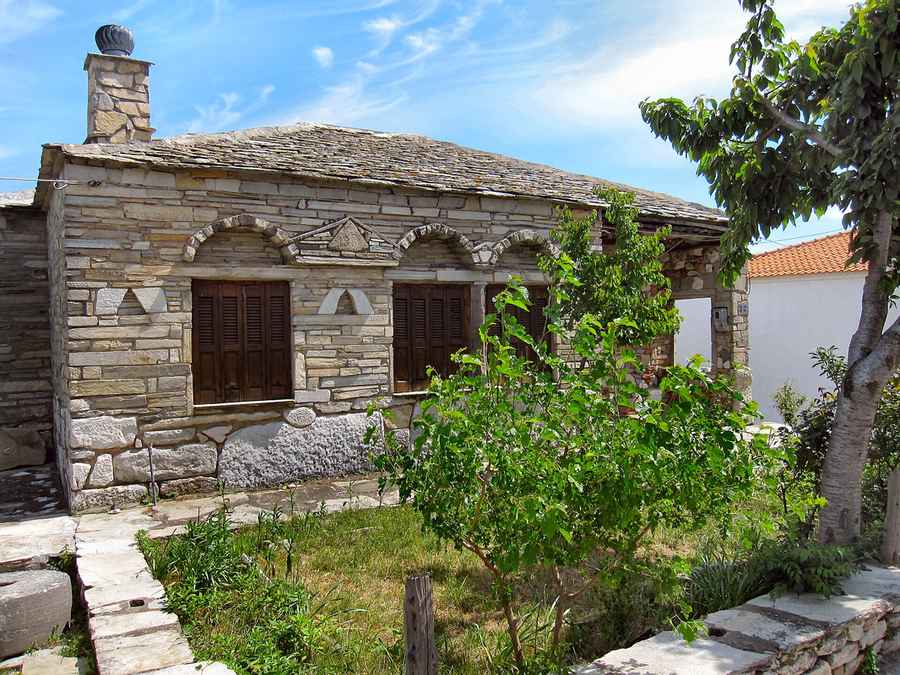
Skado sits high on the terraced slopes of northern Naxos, a hamlet of stone houses folded into the emery highlands above the Koronos valley. Few travellers reach it, and that is part of its appeal. The village clings to steep ground, its lanes climbing between springs, gardens and the ruins of a mining past that shaped the whole mountain. Panagia festivals still gather the scattered families, and one taverna keeps the old rhythm alive. This guide explains where Skado lies, how to get there, and what its silence rewards. Read on and plan your northern mountain days across Naxos with My Greece Tours.
Skado belongs to the emery country of northern Naxos, a cluster of villages that grew and then fell quiet on smyrida ore. Our Naxos travel guide places it within that highland world, one stop on a road that also passes larger, better-known settlements. Skado itself asks nothing of the visitor beyond patience and good walking shoes. The sections below cover its location and access, its mining heritage, its mountain setting and walks, its living traditions, and the traveller it best suits.
Where is Skado and how do you reach it?
Skado lies in northern Naxos, high above the Koronos valley near Koronida, roughly an hour by mountain road from Naxos Town. Reach it by hire car along the winding central highway through the emery villages.
Skado sits on the eastern flank of the northern massif, tucked between the larger villages of the smyrida country. The approach climbs from Chalki up through pine and terraced schist, then branches off the main road onto a narrow spur. The turning is easy to miss, marked only by a small sign and a chapel. Drivers who reach nearby Koronos have almost arrived, since the two villages share the same fold of mountain. The road is paved but tight, with blind bends and steep drops that reward slow, deliberate driving. Park at the village edge, because the inner lanes are steps and mule paths rather than streets.
The drive itself frames the visit, revealing the terraced amphitheatre that gives the northern highlands their character and quiet grandeur.
Public buses serve the northern route sparingly, and none stops directly in Skado, so a hire car is the practical choice. The nearest served village is Koronida, from which a short walk or a very brief drive completes the journey. Plan the day around the mountain distances, not the map kilometres, because the switchbacks stretch every leg. Fuel up in Naxos Town, since the highland villages hold no petrol station. The last stretch demands attention, yet the effort filters out the crowds and delivers you somewhere genuinely apart. Morning light suits the eastward slopes best, and afternoons bring cool mountain air even at the height of summer.
Reaching Skado is part of its meaning, a slow ascent into the oldest working landscape on the island.
What is Skado’s emery-mining heritage?
Skado grew within Naxos’s emery belt, where villagers mined smyrida, the abrasive ore that made the northern mountains famous. Mine galleries, loading ropeways and worker paths still scar the surrounding slopes, testament to a demanding industrial past.
Emery, or smyrida, is a dense natural abrasive that Naxos supplied to the world for generations. The northern villages, Skado among them, formed the labour heartland of this trade, their men descending into galleries cut deep into the mountain. The Naxos emery mines operated under a state monopoly, and mining rights passed down through village families as a form of inheritance. Work was hard and dangerous, paid by the sack, and it bound the whole community to the rock beneath it. Ore travelled down the slopes by hand, mule and later by aerial ropeway to the coast at Moutsouna.
The relics of that system, rusted pylons and cable stations, still trace lines across the ridges above Skado, quietly marking a vanished working world of ropes and stone.
The mining economy shaped how Skado looks and how its people lived. Stone houses rose in tight clusters to spare the terraced growing ground, and the springs that fed both gardens and miners defined where lanes ran. Nearby Apeiranthos preserves a small mining museum that explains the trade in fuller detail, a worthwhile pairing with any Skado visit. The monopoly’s decline through the last century emptied the galleries and thinned the villages, sending families to Athens and abroad. Those who stayed kept the houses, the festivals and the memory intact.
Walking Skado today means reading that history directly in the landscape, in the abandoned adits, the worn ore paths, and the elders who still recall the weight of a full smyrida sack hauled up from the dark galleries below the ridge line.
What is the mountain setting and what walks start here?
Skado occupies steep terraced slopes below the northern ridges, laced with old mule paths and mining trails. Walks link it to Koronos, Koronida and hidden springs, offering some of the island’s most authentic mountain hiking.
The village faces east across a deep ravine, its terraces stacked like an amphitheatre toward the emery ridges above. Old stone paths, the kalderimia that once carried miners and mules, radiate from the settlement in every direction. One favourite route contours across to Koronos, dropping through gardens and springs before climbing to that larger village’s square. Another traces the ore lines upward, past ruined loading stations, to viewpoints over the whole northern coast toward Moutsouna. The paths are rough, often overgrown, and sturdy footwear matters more than distance. Water flows from village springs and roadside fountains, a rare mountain luxury born of the same geology that holds the emery.
The walking here is slow and physical, but the reward is a landscape almost untouched by tourism, worked and shaped over centuries.
Serious walkers use Skado as a quiet base within the wider network of hiking in Naxos, which threads the northern villages together. Trails connect it to Koronida and onward toward the higher peaks and the plateau country. Spring brings wildflowers and rushing water across the terraces, while autumn offers clear air and gentle warmth. Summer walking suits the early morning, before the sun turns the exposed schist to a furnace. Carry a paper map or a downloaded track, because signage is thin and the paths fork often. The silence on these slopes is complete, broken only by goat bells, wind and distant water.
Skado’s setting rewards those who move on foot, unlocking a mountain Naxos that road travellers never see and hurried coach tours simply cannot reach.
What is village life and festival tradition like in Skado?
Skado keeps a slow, deeply traditional rhythm around its springs, gardens and single taverna. Panagia festivals draw scattered families home each year, filling the small square with music, food and the old communal spirit.
Daily life in Skado runs on the mountain’s terms, tied to gardens, animals and the turning seasons. The permanent population is tiny, weighted toward elders who never left the emery villages, yet the place feels tended rather than abandoned. A single taverna anchors social life, serving mountain fare, local wine and the kind of unhurried welcome that vanished from busier villages long ago. Stone houses stand close, their whitewashed doorways opening onto stepped lanes where cats doze and pots of basil line the walls. Water murmurs from public fountains, the same springs that once served the miners.
This is one of the most authentic among the villages of Naxos, precisely because so little has been staged for visitors. What you see is simply how the village lives and breathes.
Festivals restore Skado to full life, above all the summer panagia that honours the Virgin. Families return from Athens and abroad, the chapel fills, and the square becomes a stage for long tables, roasted meat and violin-led island music that runs deep into the night. These panigyria are communal rather than commercial, hospitality offered freely to anyone who arrives with respect. Smaller name-day and harvest gatherings mark the calendar too, each an excuse to share wine and remember the mining generations. Neighbouring Koronida holds its own celebrated feast, and villagers move between the two.
Attending a Skado festival, quietly and by invitation of the moment, offers a rare window into a mountain culture that still values gathering, memory and song above every modern distraction and passing tourist fashion.
Who should visit Skado and how does it fit a Naxos trip?
Skado suits walkers, culture seekers and travellers craving solitude over comfort. It fits best as a mountain day within a broader Naxos itinerary, paired with the larger emery villages and coastal escapes.
Skado is not a resort village, and it never pretends to be. It rewards the traveller who values silence, history and honest landscape over beaches, bars and easy convenience. Walkers find a rare trailhead into the emery country, and lovers of tradition find a living village largely untouched by mass tourism. Families with young children may find the steep lanes and thin services demanding, so it suits independent, curious visitors best. Pair Skado with the fuller amenities of Koronos for meals and lodging, treating the smaller hamlet as a walking and cultural stop. A morning here, a mountain lunch, and an afternoon path leave a lasting impression far out of proportion to the village’s size.
Come with patience, and Skado gives back a Naxos few visitors ever meet or remember.
Within a wider island plan, Skado belongs to a northern mountain day that also takes in the ridges, the ropeway relics and the sweeping coastal views toward Moutsouna. Combine it with time among the broader villages of Naxos and the beaches of the west coast for a trip that balances height and shore. Two or three unhurried hours cover Skado itself, leaving room for a longer walk or a neighbouring feast. Bring good shoes, water and an unhurried mindset, because the mountain sets the pace and rewards patience over speed. The village asks little and gives much to those who slow down, look closely and pay real attention to the terraced world around them.
Skado stays with you long after the drive back down to the coast. Plan your visit and tours through our Naxos travel guide.
Frequently Asked Questions
Is Skado worth visiting on a short Naxos trip?
Skado suits travellers who want depth over convenience, so its worth depends on your priorities. Visitors chasing beaches and nightlife will find little here, since the village offers stone lanes, springs and silence rather than resorts. Walkers, photographers and lovers of authentic mountain culture, however, rate it among the most rewarding stops in northern Naxos. On a short trip, fold Skado into a single mountain day alongside the larger emery villages, giving it two or three unhurried hours. That window covers a walk through the lanes, a taverna lunch and a stretch of old mining path with wide coastal views. The drive up is scenic in itself, framing the terraced highlands that define this corner of the island.
Come with good shoes, water and patience, and Skado delivers a genuine sense of place. Skip it only where your days are tightly packed with coastal plans and you cannot spare the mountain detour into the emery highlands above the coast.
Are there places to eat or stay in Skado?
Skado holds a single traditional taverna, which anchors village life and serves mountain fare, local wine and warm, unhurried hospitality. Opening hours follow the season and the owner’s rhythm rather than a fixed timetable, so a visit outside high summer may find it quiet. Formal accommodation within the village itself stays very limited, reflecting its tiny population and remote setting. Travellers who want to stay in the area base themselves in the larger neighbouring villages, which offer guesthouses, rooms and additional tavernas. That arrangement lets you enjoy Skado as a walking and cultural stop while sleeping and dining with more choice nearby.
Carry water and a snack for longer walks, because services on the mountain paths are essentially nonexistent. The taverna, when open, rewards the visit with honest cooking and conversation shaped by generations of emery-mining life. Treat any meal there as part of the experience, not merely refuelling, and you leave with a fuller sense of the resilient mountain village.
What connects Skado to the Naxos emery mines?
Skado is one of the core villages of the Naxos emery belt, the northern highlands where smyrida ore was mined for generations. Emery is a hard natural abrasive, and Naxos supplied it to the world under a long-standing state monopoly that shaped every village in the region. Skado’s men worked the galleries cut into the surrounding slopes, paid by the sack and bound by inherited mining rights passed through their families. Ore travelled down to the coast at Moutsouna, first by mule and hand, later along aerial ropeways whose rusted pylons still cross the ridges above the village. That industry dictated where houses stood, how springs were used and why the terraces climb so steeply.
The mines’ decline emptied the galleries and thinned the population, yet the relics endure across the mountain. Walking Skado’s paths, you pass abandoned adits and loading stations, reading a demanding working history directly in the landscape that surrounds this quiet, resilient village.