
Santorini E-Bike Tour
A Santorini e-bike tour is a guided ride on a pedal-assist electric bicycle through the villages, vineyards and volcanic coast of Santorini, the crescent-shaped island of the southern Cyclades. For travellers planning Greece Tours with an active day, a Santorini e-bike tour turns the climbs to Pyrgos and the caldera rim into an easy pedal, with a small motor adding push on every hill.
Santorini e-bike tours start from Megalochori, Fira, Perissa and Vlichada and cover the wine villages of the interior, the Akrotiri peninsula and the pumice cliffs of the south. Riders need the skill to ride a bicycle: the motor handles the hills, and the guide sets the pace, the route and the stops.
What is a Santorini e-bike tour?
A Santorini e-bike tour is a ride on a pedal-assist electric bicycle along the island’s village roads, vineyards and volcanic coast, led by a local guide who picks quiet roads, explains the sights and sets the pace, while the motor adds power on every climb.
Santorini, also called Thira, is a volcanic island shaped like a crescent around a flooded caldera in the southern Cyclades. The cliff-top villages of Fira, Firostefani, Imerovigli and Oia line the western rim, and the land slopes down east towards the black-sand beaches of Kamari, Perissa and Perivolos and south towards Vlichada and the Akrotiri peninsula. A Santorini e-bike tour works with that slope: riders climb through the interior villages with electric help and roll down towards the sea on side roads. The main Santorini page covers the wider island, its villages and its beaches.
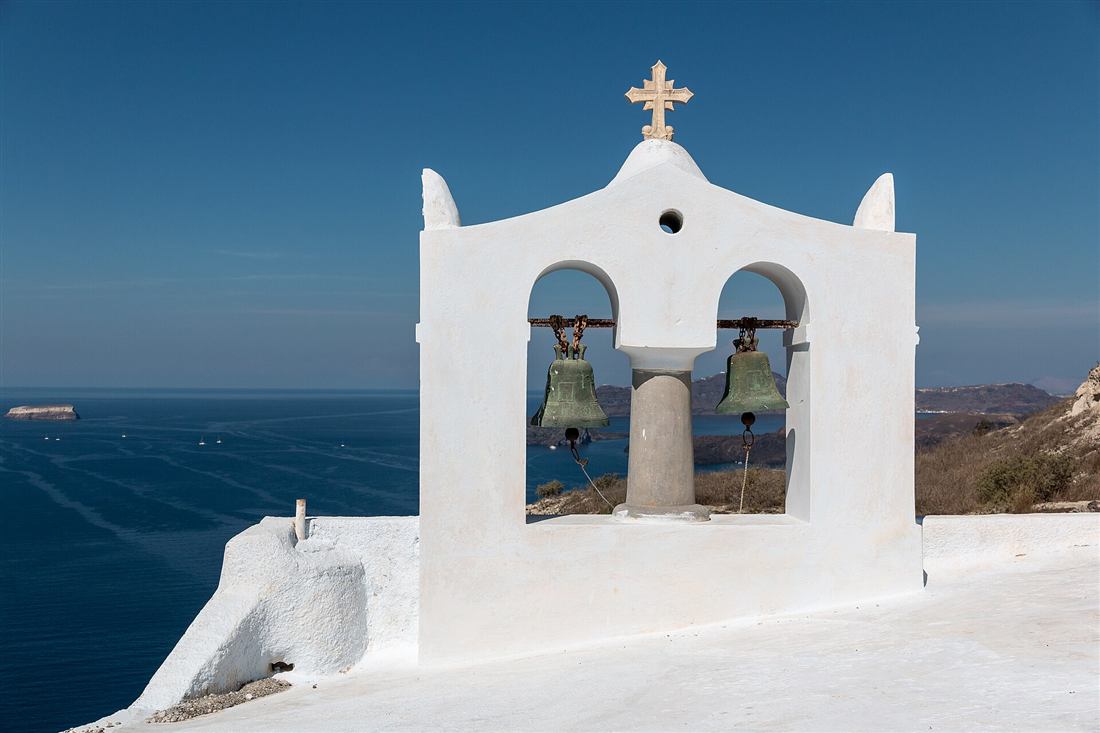
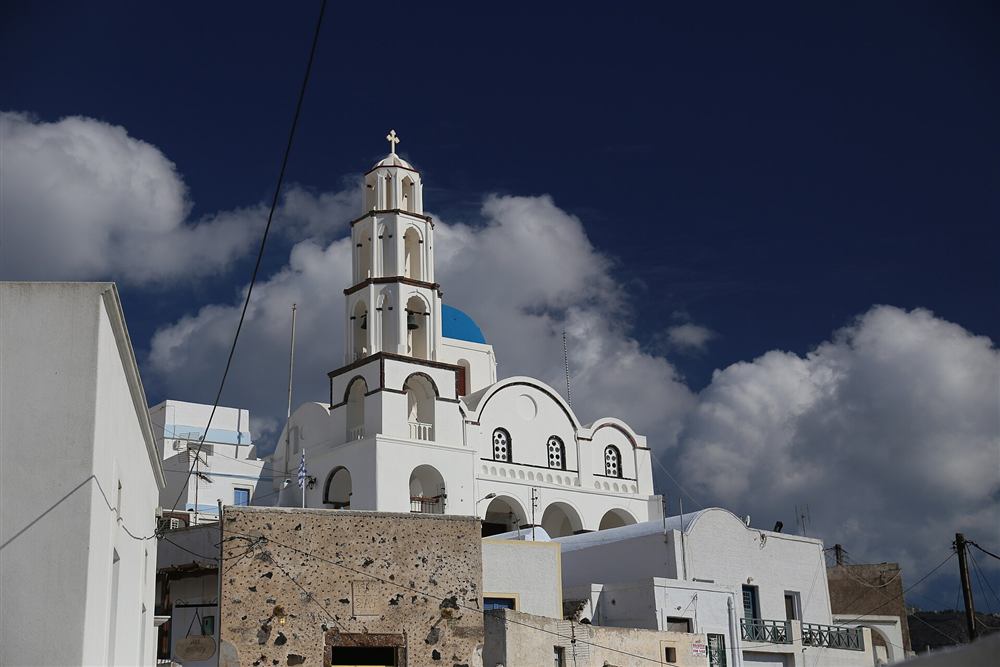
The format is simple. A guide meets the group at a base in a village, fits each rider with a bike and a helmet, explains the controls and leads the ride at a steady pace, with stops for photos, stories and water. The route of a Santorini e-bike tour passes bell towers, low-trained vineyards, Venetian castles and viewpoints over the caldera, the volcano islets of Nea Kameni and Palea Kameni and the island of Thirassia across the water. The electric assist keeps riders of mixed fitness together on hills where a standard bicycle splits a group apart within minutes.
The ride is a bicycle ride, not a motor ride. Riders pedal the whole way, feel the wind and the smell of the vineyards, and stop wherever the guide finds a view or a village lane worth a walk. That slower pace is the difference between seeing Santorini from a bus window and seeing it at the speed of the people who live there. The guide times each stop so riders rest in the shade of a church or a village square before the next climb.
How does a pedal-assist e-bike work?
The bikes on a Santorini e-bike tour are pedal-assist e-bikes, or pedelecs: a 250-watt motor adds power only while the rider pedals, the rider picks the assist level on the handlebar, and under EU rules the motor cuts out at 25 km/h.
A pedelec is not a scooter. There is no throttle to twist; a sensor reads the pedalling and the motor adds power in proportion to it. Stop pedalling and the motor stops. This keeps a Santorini e-bike tour a real bicycle ride, with the rider in control of speed on every descent and every corner. EU rules set the limits that define these bikes: a motor rated at 250 watts and assistance that ends at 25 km/h. Above that speed the rider pedals under their own power alone, which on a steep and busy island road is fast enough.
Assist levels sit on a small display or button pad on the handlebar. The lowest level gives a light push and saves battery; the highest level flattens steep climbs and drains the battery fastest. Level names differ between brands, so the guide runs through them in the briefing before every Santorini e-bike tour. A common pattern is a low or middle level on the flats and a higher level for the climbs to Pyrgos or the caldera rim. Gears still matter: shifting to a low gear before a climb keeps the pedalling smooth and lets the motor work efficiently.
An e-MTB, the electric mountain bike used on the south route and the adventure tour, adds wide knobbly tyres and suspension for dirt tracks and loose volcanic gravel. A city-style e-bike carries narrower tyres and an upright seat position for village tarmac. Both are heavier than a normal bicycle, so pushing one up a stepped lane or lifting it over a kerb takes more effort than riders expect. The motor, the battery and the frame together explain that extra weight.
Who is a Santorini e-bike tour for?
A Santorini e-bike tour suits riders who handle a bicycle with confidence, from regular cyclists to travellers with average fitness and couples of mixed ability who want to see the villages and coast without climbing the island’s hills unaided.
The motor removes most of the physical strain, but it does not remove the need for bike handling. Riders start and stop on slopes, brake on descents, hold a steady line on narrow roads with traffic passing and ride single file behind the guide. A rider who has not been on a bicycle for a long time gains from a few minutes of practice at the base before the group leaves. Guides on a Santorini e-bike tour watch the first stretch closely and adjust the pace to the slowest rider in the group.
Fitness needs depend on the route. A village loop from Megalochori or a two-hour private ride from Perissa suits riders of average fitness who ride at a gentle effort. The electric mountain bike adventure and the south route e-MTB tour add dirt tracks and loose surfaces, which ask for more balance and more confidence off tarmac. Age limits, minimum heights and rules for children are set by each operator, so check the tour listing before booking any Santorini e-bike tour for a family group.
The pedal assist also opens the ride to travellers who avoid cycling holidays on hilly islands. Riders with sore knees or a weaker back find each pedal stroke lighter, since the motor supplies part of the force. Any rider with a medical condition talks to a doctor before booking and tells the guide about it at the briefing, so the guide knows before the first climb. The same applies to any recent injury, a fear of traffic or little recent time on a bike.
Which Santorini e-bike tours are on sale?
Santorini e-bike tours on sale include an electric mountain bike adventure, a village tour from Megalochori, guided tours from Fira, a private two-hour wooden e-bike ride from Perissa, a sunset tour from Vlichada, a ride around the island and a south route e-MTB tour.
The seven tour types cover three styles of riding. Village rides on tarmac start from Megalochori and Fira and focus on the interior: bell towers, churches, vineyards and views over the caldera. Off-road rides use e-MTBs on the south route from Vlichada and on the electric mountain bike adventure, mixing quiet roads with dirt tracks across the volcanic landscape. Special formats include the sunset ride from Vlichada, the private wooden e-bike tour from Perissa on the black-sand east coast and the longer ride around the island with e-bikes.
Each Santorini e-bike tour listing states its own start point, duration, group format and inclusions. The start village shapes the day: a tour from Megalochori reaches the wine villages and Pyrgos first, a tour from Fira begins on the caldera side, and a tour from Vlichada heads for the pumice cliffs and the Akrotiri peninsula. Check the tour listing for the meeting point, the pick-up options and the exact route before booking.
The ride around the island covers the most ground of the seven formats, and the south route e-MTB tour from Vlichada suits riders who want loose surfaces and coastal tracks. Riders choose a Santorini e-bike tour by three things: the start point closest to their hotel, the surface they feel comfortable on and the time of day that fits the rest of their plans. The five formats below carry a fixed start point in their titles.
- Electric mountain bike adventure – an e-MTB ride that mixes quiet roads with dirt tracks.
- E-bike village tour from Megalochori – a ride through the wine villages of the interior.
- E-bike guided tours from Fira – a guided ride that starts in the island capital.
- Private wooden e-bike tour from Perissa – a two-hour private ride on a wooden-framed e-bike.
- Sunset e-bike tour from Vlichada – an evening ride on the south coast timed for sunset.
What does the village route from Megalochori show?
The Megalochori village tour rides the traditional interior of the island, where a Santorini e-bike tour links Megalochori’s bell towers and wineries with nearby villages such as Pyrgos, Emporio, Exo Gonia and Vothonas; check the listing for the exact stops.
Megalochori is a traditional village known for its bell towers, narrow lanes and the wineries that surround it. It sits away from the caldera-road traffic around Fira, which makes it a natural base for a Santorini e-bike tour. The roads out of the village run between vineyards and stone walls, with long views across the fields to the sea. Riders leave the base on quiet tarmac and reach open country within minutes, which gives time to settle into the bike before the first real climb.
Pyrgos is the highest village on Santorini, crowned by its Venetian Kasteli, with views over the whole island. The climb up to it is where the motor earns its place on a Santorini e-bike tour, turning a long gradient into a steady pedal. Emporio, the largest village, holds its own Kasteli and the Goulas tower. Exo Gonia, Mesaria, Vothonas, Vourvoulos and Karterados are further interior villages that appear on longer routes across the middle of the island.
The pace on the village route is slow by design. Guides stop at viewpoints above the vineyards, explain the basket-shaped kouloura vines and point out the chapels and bell towers along the lanes. Riders park the bikes at the edge of each village and walk the narrow streets, since the stepped lanes and tight corners inside the old centres are pedestrian ground. Check the tour listing for whether a winery visit or a tasting is part of the ride, since this detail differs between operators.
Where does the south route from Vlichada go?
The south route of a Santorini e-bike tour starts at Vlichada harbour, with its wind-carved pumice cliffs, and crosses the south of the island towards the Akrotiri peninsula, home to the Bronze Age excavations, Red Beach and the Akrotiri lighthouse.
Vlichada is a harbour on the south coast, framed by pale pumice cliffs that the wind has carved into ridges and hollows. It is the base for two formats: the sunset e-bike tour and the south route e-MTB tour. A Santorini e-bike tour from here runs on quieter roads than the caldera side, and the e-MTB version adds dirt tracks across the volcanic landscape. The south is the flatter, more open part of the island, with vineyards, small chapels and wide views of the sea on both sides of the peninsula.
The Akrotiri peninsula holds the island’s Bronze Age excavations, a prehistoric town preserved under volcanic ash and protected today under a roof. Red Beach sits close to the site, below red volcanic cliffs. At the far south-west tip stands the Akrotiri lighthouse, known as Faros, a sunset viewpoint facing the caldera. A Santorini e-bike tour in this corner of the island mixes archaeology, beaches and cliff views in one ride, and each stop sits within a short pedal of the next.
The sunset e-bike tour from Vlichada is timed for the evening, when the heat drops and the light turns warm over the sea. The lighthouse at Faros is the island’s south-west sunset viewpoint, and the Santorini sunset page lists the other viewpoints around the caldera. Check the tour listing for where the sunset ride stops and how riders return after dark, including the lights fitted to the bikes.
- Vlichada cliffs – pumice walls carved by the wind above the harbour.
- Red Beach – red volcanic cliffs above the shore.
- Akrotiri lighthouse – the south-west tip facing the caldera.
- Caldera edge – views of Nea Kameni, Palea Kameni and Thirassia.
Can riders reach Fira and the caldera rim by e-bike?
Yes, a Santorini e-bike tour reaches Fira and the caldera rim, and guided tours start from Fira itself, but the Fira–Oia caldera road carries heavy summer traffic, so tours favour quieter village roads and reach the rim at chosen viewpoints.
Fira is the island capital, set on the caldera rim with Firostefani and Imerovigli to its north and Oia at the northern tip. The guided e-bike tours from Fira start in the capital, which suits travellers staying on the caldera side of the island. From the rim, riders see the flooded caldera, the volcano islets of Nea Kameni and Palea Kameni, and Thirassia across the water. A Santorini e-bike tour that includes these viewpoints gives the classic caldera panorama from the saddle, with the villages of the rim spread along the cliff edge.
The Fira–Oia caldera road and the streets around Fira are the busiest on the island in summer, with buses, cars and ATVs sharing narrow roads that have no cycle lanes. Guides plan a Santorini e-bike tour to spend as little time as possible on these stretches, riding them early or late in the day and turning onto side roads through Karterados, Vourvoulos and the villages east of the rim. Check the tour listing for whether Oia is part of the route, since the northern tip sits at the far end of the busiest road.
The lanes inside Oia, Imerovigli, Firostefani and Fira are stepped pedestrian paths, not bike routes. Riders who want to explore those villages in depth leave the bike at the edge of town or visit them on foot on another day. The e-bike covers the interior, the east and the south, where the roads and the surfaces suit two wheels. A split plan works well on the caldera side: a morning ride from Fira through the inland villages, then an evening walk along the rim once the bike is back at the base.
Which vineyards and wineries sit along the routes?
A Santorini e-bike tour through the interior passes vineyards of Assyrtiko vines trained low in basket-shaped coils called kouloura, with wineries around Megalochori, Pyrgos, Exo Gonia and Vothonas; the listing states whether a stop includes a tasting of Assyrtiko or Vinsanto.
Santorini vines grow in volcanic soil and are trained low to the ground in round, basket-shaped coils known as kouloura. The shape shelters the grapes from the strong wind that crosses the island. From the saddle of a Santorini e-bike tour, the vineyards look like fields of green nests spread across the slopes between the villages. Guides explain the method at a roadside stop, where riders see the coils up close, the grapes sitting inside the basket and the dark volcanic soil around the roots.
Assyrtiko is the island’s main white grape, and Vinsanto is its traditional sweet wine, made from sun-dried grapes. Wineries dot Megalochori, Pyrgos, Exo Gonia and Vothonas, all within reach of the village routes. The Santorini wineries page lists the estates by village. On a Santorini e-bike tour with a tasting stop, riders taste a small amount and drink water alongside it, since the ride continues afterwards on roads shared with traffic.
The wine villages also give the ride its rhythm. Short climbs lead up to each village, a stop for a walk or a tasting follows, and a gentle descent through the vineyards leads on to the next. Riders who want a longer wine day book a winery visit separately after the ride and travel there by car or taxi. The four wine villages below sit on or near the interior routes, and each one makes a natural stop for a walk, a look at the vineyards and a refill of water.
- Megalochori – wineries around the bell-tower village.
- Pyrgos – wineries on the slopes below the highest village.
- Exo Gonia – wineries on the roads of the interior.
- Vothonas – wineries in a village of the inland plain.
How hard is the terrain on a Santorini e-bike tour?
The terrain on a Santorini e-bike tour ranges from rolling village tarmac to steep climbs towards Pyrgos and the caldera rim and, on e-MTB routes, dirt tracks and loose volcanic gravel; the motor handles the climbs, and the descents and surfaces set the difficulty.
Santorini rises from sea level at the eastern and southern beaches to the caldera rim in the west and to Profitis Ilias, the highest point on the island, topped by its monastery. Every route on a Santorini e-bike tour therefore includes climbs. On a pedelec the climbs feel moderate: the rider keeps pedalling at a gentle effort in a low gear with a high assist level, and the motor supplies the rest. The real skill lies in the descents, which are steep, winding and shared with traffic.
Mesa Vouno, the mountain that holds Ancient Thera above Kamari and Perissa, is reached by a steep switchback road with tight hairpins; check the tour listing for whether a route includes it. Village lanes in Pyrgos, Emporio and Megalochori are narrow, with tight corners and stretches of old paving where riders slow down or walk. The south route e-MTB tour adds dirt tracks, where loose pumice and gravel demand steady braking and a relaxed grip on the handlebar.
For a first Santorini e-bike tour, a village route on tarmac is the gentler choice. Riders comfortable off-road pick the e-MTB routes from Vlichada or the electric mountain bike adventure, where the surface changes every few minutes and the bike moves more under the rider. Riders unsure of their level book the tarmac route first and move to the e-MTB on a later day. The list below sums up the four surfaces riders meet on the island.
- Village tarmac – rolling roads with short, steep climbs between villages.
- Caldera climbs – long gradients up to the rim and to Pyrgos.
- Switchback roads – tight hairpins on the way up Mesa Vouno.
- Dirt tracks – loose volcanic gravel on the e-MTB routes.
How far does an e-bike battery last on Santorini hills?
Battery range on a Santorini e-bike tour depends on the assist level, the number of climbs, the wind, the rider’s weight and the tyre type, so no single figure applies; guides plan each route within the range of their bikes.
A battery drains fastest on long climbs at the highest assist level and into a headwind. Santorini combines all three: steep roads up to Pyrgos and the rim, and the meltemi, the strong north wind of July and August. A rider on a Santorini e-bike tour who keeps the top level on for every gentle slope spends charge that the last climb of the day needs. The display on the handlebar shows the remaining charge in bars or as a percentage, and a glance at every stop keeps the rider aware of it.
Heavier riders and e-MTBs with wide knobbly tyres draw more power than light riders on city e-bikes. Stop-start riding through villages also uses more energy than a steady pace on open road. On a guided Santorini e-bike tour, the operator matches the route to the bikes and sets the pace. On a self-guided rental, the rider plans the day around the charge, with the longest climb early while the battery is full and the flattest stretch at the end.
A flat battery does not stop the bike, but it turns a heavy e-bike into a hard ride on a steep hill. Riders who see the charge running low tell the guide at once, so the route or the assist level can change before the next climb. On a self-guided rental, turning back while a third of the charge remains keeps the ride home easy. The five habits below stretch the range on any island ride.
- Low level on flats – save charge where the road is level.
- High level on climbs – use full assist only on steep sections.
- Low gear early – shift down before the slope starts.
- Steady cadence – pedal smoothly rather than in bursts.
- Charge check – read the display at every stop.
Is a guided ride or a self-guided e-bike rental the right choice?
A guided Santorini e-bike tour suits first-time visitors, since the guide picks quiet roads, handles the navigation and explains the sights, while a self-guided e-bike rental suits confident riders who know the island and want to set their own stops and timing.
The guide on a Santorini e-bike tour knows which roads carry buses at which hour, where the climbs start and where the viewpoints and water stops sit. That local knowledge matters on an island with narrow roads and no cycle lanes. A guided ride also brings stories about the villages, the vineyards and the volcano, and it removes the navigation from the rider’s hands. The group rides single file behind the guide, who controls the pace and chooses the safe moments to cross or turn.
A self-guided rental hands the rider a bike, and the planning becomes the rider’s job. It suits travellers who want a full day of stops, a long lunch in a village or a ride at their own pace. It also asks for more: reading a map on the move, handling traffic without a leader and planning battery range across the island’s climbs. Check the rental listing for what comes with the bike, such as a helmet, a charger or a route map, and for the return time.
The seven listings above are tour formats rather than bare rentals; check each listing for whether a guide rides along. The private wooden e-bike tour from Perissa keeps the ride to one party, which suits couples and families who want the route to themselves. For a first visit, a guided Santorini e-bike tour gives the most from a short stay, since no time goes on route-finding and every stop has a reason.
What is included in a Santorini e-bike tour?
A Santorini e-bike tour includes the e-bike, a helmet and a briefing on the controls before the start; water, snacks, tastings, hotel pick-up and photos differ by operator, so check the tour listing for the full list of inclusions.
The core of every Santorini e-bike tour is the same: a fitted bike, a helmet and a safety and controls briefing at the start. The guide sets the saddle height, shows the assist levels, the brakes and the gears, and runs through the signals the group uses on the road. Riders then test the bike on a quiet stretch before the group leaves, which is the moment to raise any doubt about the controls or the fit of the helmet.
Beyond that core, listings differ on hotel pick-up, bottled water, snacks, wine tastings and meeting points. Read the inclusions, the start time and the cancellation terms on the Santorini e-bike tour listing before booking, and note any rules on minimum age, height or rider weight. The listing also names the bike type: a city e-bike for village tarmac, an e-MTB for the dirt tracks of the south, or the wooden-framed e-bike of the private ride from Perissa.
A short checklist of the listing details saves surprises on the day. Riders confirm the meeting point first, since the start villages sit in different parts of the island and a sunset departure from Vlichada ends far from a hotel in Oia. The bike type comes next, because an e-MTB on dirt tracks asks more of the rider than a city e-bike on tarmac. The five points below cover what riders confirm before they book.
- Meeting point – the start village or a hotel pick-up.
- Start time – a morning, afternoon or sunset departure.
- Bike type – a city e-bike, an e-MTB or a wooden e-bike.
- Inclusions – a helmet, water, snacks or a tasting.
- Rider rules – the age, height and weight limits.
What do riders wear and bring?
Riders on a Santorini e-bike tour wear light, breathable clothing, closed shoes with flat soles and sunglasses, and bring sun cream, a refillable water bottle, a light layer for wind or evening, and a phone in a secure pocket or small backpack.
Santorini summers are hot and the island has little shade, so clothing matters more on a Santorini e-bike tour than on a city ride. Light, breathable fabrics in pale colours keep the body cooler under the sun. Long, loose shorts or light trousers stop the saddle from rubbing. Closed shoes with flat, grippy soles hold the pedals; flip-flops and loose sandals slip off the pedals and leave toes exposed on a road with gravel at the edges.
The wind changes the feel of a ride. The meltemi blows strong from the north in July and August, and evening rides on the sunset tour cool quickly after dark, so a thin windproof layer earns its place in the bag. Sunglasses protect against glare, dust and insects. A thin cap or bandana under the helmet shades the forehead and soaks up sweat. On any Santorini e-bike tour, a small backpack or a zipped pocket keeps the phone and keys safe on the move.
- Sun cream – high-factor protection on face, arms and legs.
- Water bottle – a refillable bottle for every stop.
- Light layer – a windproof top for wind and evening.
- Closed shoes – flat soles that grip the pedals.
- Sunglasses – protection from glare, dust and insects.
How safe are Santorini roads for e-bike riders?
Santorini roads are narrow, have no cycle lanes and carry heavy summer traffic of buses, cars and ATVs, so a Santorini e-bike tour stays safe through quiet village routes, single-file riding, helmets, a guide in front and rides outside the busiest hours.
The busiest stretches are the Fira–Oia caldera road and the streets around Fira, where tour buses, rental cars and ATVs share roads with little room to spare. A Santorini e-bike tour avoids these where possible and uses village roads through the interior and the south instead. The group rides single file, close to the right edge of the road, with the guide in front setting the line through corners and junctions. Riders keep a steady gap to the bike ahead and follow the guide’s signals for stops and turns.
Descents need the most care. E-bikes are heavier than normal bicycles and build speed on steep slopes, so riders brake early before corners, use both brakes evenly and keep a gap to the rider in front. Loose pumice and gravel on the road edge and on e-MTB tracks cut grip in corners. Helmets are provided on every Santorini e-bike tour and stay on for the whole ride, including short stretches between villages at low speed.
Heat and wind are the other safety factors. Midday in summer is hot, with little shade on the open roads, so riders drink at every stop, reapply sun cream and tell the guide at once about dizziness or a headache. Strong gusts from the meltemi push a bike sideways on exposed ridges; riders hold the handlebar firmly, lower their speed in open ground and ride a little further from the road edge when a gust hits.
When is the best time for a Santorini e-bike tour?
The best months for a Santorini e-bike tour are April to June and September to October, when the heat is mild and the meltemi is calmer; in any month, early morning and late afternoon rides avoid the midday sun and the heaviest traffic.
Spring, from April to June, brings mild temperatures and quieter roads before the peak season. Autumn, in September and October, keeps the air warm and the evenings mild as the summer crowds thin. Both seasons suit a Santorini e-bike tour because the heat stays moderate and the strong wind of July and August has not yet started or has already eased. The best time to visit Santorini page sets out the months and the weather in detail.
July and August bring the strongest heat, the meltemi and the heaviest traffic of the year. A Santorini e-bike tour in high summer still works when it runs early in the morning or in the late afternoon. Midday rides in July and August expose riders to strong sun on roads with little shade, and the tarmac itself radiates heat. The sunset tour from Vlichada fits summer well, since it starts as the day cools and finishes in the evening air.
A simple heat plan keeps any summer ride comfortable: start early, drink before feeling thirsty, wet a cap or bandana at water stops and put the longest climb in the cooler first hour. Rides in the winter months depend on operators running tours out of season, and wind and rain decide the days; check the tour listing for the dates on offer. Spring and autumn rides need less of this plan, since the midday sun is gentler and a light layer covers the cool starts.
How long does a ride last, and when do riders book?
Ride length depends on the format: the private wooden e-bike tour from Perissa lasts two hours, while each other Santorini e-bike tour listing states its own duration and distance, and booking ahead secures a place in July, August and at sunset.
The only duration fixed in a tour title is the private two-hour wooden e-bike ride from Perissa. The village tour from Megalochori, the guided tours from Fira, the sunset ride and the south route e-MTB tour each set their own length, and the ride around the island covers the most ground of the group. Check the tour listing for the duration, the distance and the number of stops on each Santorini e-bike tour before planning the rest of the day around it.
Riding time and total time differ. A Santorini e-bike tour includes a fitting and briefing at the start, photo and water stops, village walks and any tasting, so the time in the saddle is shorter than the listed duration. Riders planning a day around the tour allow time for travel to the start village and a rest afterwards, above all after a summer ride in the heat, when a swim or a shaded lunch follows well.
Booking works through the tour listing, with a date, a start time and the number of riders. In July and August, and for sunset departures, booking ahead secures a place, since the number of bikes at each base sets the size of the group. Read the cancellation terms and the weather policy before confirming, since strong wind days can move or cancel a ride on an exposed island. A ride early in the stay leaves room to rebook if the wind forces a change.
How does an e-bike compare with a quad, a car or hiking?
A Santorini e-bike tour is quieter and slower than a quad or a car, reaches village lanes and viewpoints without parking trouble, and covers more ground than hiking; quads and cars suit long distances, and hiking suits the cliff-top caldera path.
A Santorini quad or ATV rental covers the whole island fast and handles climbs with no effort, but it adds engine noise, requires a driving licence and shares the busiest roads with buses. A rental car suits families and longer distances, with air conditioning in the summer heat, and faces tight parking in Fira and Oia. A Santorini e-bike tour sits between them: fast enough to link a chain of villages in one outing, slow enough to stop anywhere, and silent through the vineyards.
Santorini hiking suits the caldera path between Fira and Oia and the climbs to Ancient Thera and Profitis Ilias, where a bike does not belong. Walking covers less ground in a morning than a Santorini e-bike tour, so the two pair well: an e-bike day in the interior and the south, and a hiking day along the rim. Each shows a different face of the island, from the vineyards of the plain to the cliff edge above the caldera.
An e-bike ride also combines with other plans on the island: a swim at Kamari or Perissa after a morning ride, a visit to the Akrotiri excavations, a winery visit or a sunset at the lighthouse. Travellers who plan a car day, a hiking day and an e-bike day across one stay see Santorini at three different speeds. The e-bike day fits best early in the stay, when legs are fresh and the ride gives a map of the island for the days that follow.
Is a Santorini e-bike tour worth it?
Yes, a Santorini e-bike tour is worth it for travellers who want to see the villages, vineyards and south coast at a human pace, with a motor that removes the strain of the island’s climbs and a guide who knows the quiet roads.
Much of the island sits away from the caldera crowds: the bell towers of Megalochori, the Kasteli at Pyrgos, the Goulas tower at Emporio, the vineyards of kouloura vines and the pumice cliffs of Vlichada. A Santorini e-bike tour reaches these at a pace that lets riders notice the details, smell the vineyards and stop where they want. The electric assist makes that possible for riders of average fitness on an island built on slopes, where a standard bicycle turns every village into a hard climb.
The ride is not for every traveller. Riders who feel unsure on a bicycle, who dislike riding near traffic or who visit only in the midday heat of August get more from a car, a quad or a boat trip. For confident riders who pick the right month and time of day, a Santorini e-bike tour turns a hilly island into an active, open-air day between villages, wine and sea. Compare the tour types above, check each listing and book the route whose start point and surface match the group.
Frequently Asked Questions
Do riders need to be fit for a Santorini e-bike tour?
No special fitness is needed for a Santorini e-bike tour. The pedal-assist motor handles the climbs, and riders pedal at a gentle effort. Riders need to handle a bicycle with confidence, including braking on steep descents and riding single file on narrow roads with traffic.
How fast does an e-bike go on a Santorini e-bike tour?
The 250-watt motor on an EU pedelec assists up to 25 km/h and then cuts out. Riders on a Santorini e-bike tour stay well below that on narrow village roads, and the guide sets a steady group pace with stops for photos and water.
Are helmets provided on e-bike tours in Santorini?
Yes. Santorini e-bike tours provide a helmet with every bike and a briefing on the controls, the brakes and the assist levels before the start. Riders keep the helmet on for the whole ride, including short village stretches and every descent.
What is the best time of day for a Santorini e-bike tour?
Early morning and late afternoon are the best times for a Santorini e-bike tour. Both avoid the midday heat and the heaviest traffic on the island’s narrow roads, and the sunset tour from Vlichada rides as the day cools towards evening.
Can children join a Santorini e-bike tour?
Rules for children differ by operator, and some tours set minimum age, height or weight limits for riders. Check the Santorini e-bike tour listing for its rules before booking a family ride, and tell the operator the age and height of every rider.