
A Mykonos helicopter tour is a thirty minute private sightseeing flight over the windmills, Little Venice, the old and new ports and the south-coast beaches, with hotel pickup to the helipad included, and the same aircraft flies one-way transfers to Athens, Santorini and the other islands. Plan the rest of the island with Greece Tours.
This guide covers the whole picture: the sightseeing flight and its ground transfer, the aircraft and the seat count, the route over the town and the beaches and out towards Delos, the transfer legs and their flight times, the price ranges, the weight and luggage limits, the wind and the light, and how far ahead to book.
What is a Mykonos helicopter tour and what does the flight cover?
A Mykonos helicopter tour is a private thirty-minute sightseeing flight for up to three passengers. It lifts from the island helipad, tracks the west coast past Mykonos Town and the windmills, crosses the southern beaches, circles Delos and Rhenia, then returns to the same pad.
Booking a Mykonos helicopter tour ahead secures the aircraft through the summer weeks. A Mykonos helicopter tour runs thirty minutes in the air from the island’s helipad. The product sold on GetYourGuide is a whole-aircraft charter. The fare buys the helicopter, the pilot and thirty minutes of rotor time, not a single seat on a shared rotation. The group flies alone with the pilot, which is why the route bends to the passengers rather than to a timetable. Couples fly the same aircraft that carries a family of three, and the price does not change with the head count.
Every Mykonos helicopter tour opens with a pilot briefing and a headset check. A Mykonos helicopter tour reads the whole island in one pass, which no road can do. Ground handling sits inside the same booking. A minibus or an SUV collects the group from the hotel door or from an agreed meeting point in the centre, drives to the helipad beside the airport, and waits through the flight for the return leg. The published half hour counts airborne time only; the full door-to-door commitment runs closer to ninety minutes once the drive, the briefing and the boarding are added.
A Mykonos helicopter tour shows Delos and Rhenia lying offshore to the south-west. Luggage on a Mykonos helicopter tour is capped by weight and by the size of the hold. The flight is flown at low level under visual rules, inside airspace controlled by the airport tower, at a height that keeps the coastline sharp and the water readable. From that altitude the island reads as one object: a granite spine running north to south, dry terraced walls stitched across it, and a rim of pale bays cut into the south shore. A first-time visitor to Mykonos absorbs the whole geography in one pass, and the rest of the holiday makes sense afterwards.
Photographers take the window seat on a Mykonos helicopter tour for a clean frame. The same operators sell three further products from the same pad: a one-way private transfer to Athens or to any Greek island, a dedicated Mykonos to Santorini crossing, and a Bell 206 class hop between the two islands that runs twenty-five to thirty-five minutes in the air. The sightseeing flight and the transfers share aircraft, crews and weather rules, and differ in where the machine puts you down.
What happens minute by minute on the thirty-minute sightseeing flight?
The thirty minutes break into four legs: a climb out over the airport and the inland ridge, a coastal run north past Mykonos Town and the windmills, a southern beach sweep, and a wide arc over Delos and Rhenia before the approach back to the pad.
Couples book a Mykonos helicopter tour for proposals and for honeymoon flights. A Mykonos helicopter tour is rescheduled rather than flown when the cloud base drops. The sightseeing leg of a Mykonos helicopter tour passes the windmills and Little Venice. The first ninety seconds belong to the climb. The helicopter lifts into the hover, noses forward, and gains height over the dry inland plateau where the island’s reservoir, the wind turbines and the scattered chapels come into view. The pilot levels off at a cruise height that keeps buildings distinct and boats identifiable, and the intercom carries a running commentary through the headsets from that point onward.
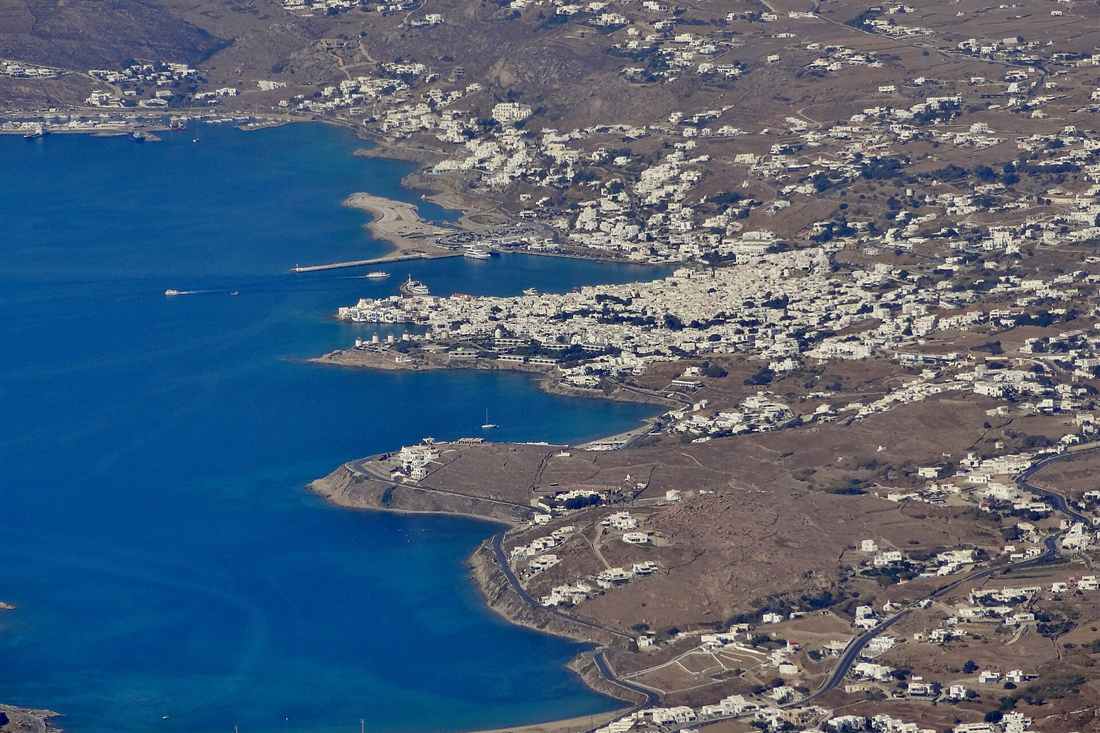
A Mykonos helicopter tour is weighed at check-in, since the load sets the fuel. Guests on a short stay pick a Mykonos helicopter tour over a full day at sea. The second leg turns the machine along the west coast. The Chora spreads out as a white delta pinned between the harbour and the hill, the row of windmills stands on its low crest, and Little Venice shows as a single line of balconies hanging straight over open water. Boats stack up in the old port and the new marina at Tourlos, and the causeway to the cruise terminal draws a hard grey line across the blue.
The meltemi wind moves a Mykonos helicopter tour to a calmer hour of the day. The Santorini leg of a Mykonos helicopter tour crosses the Aegean in half an hour. The third leg crosses the island’s waist to the south shore, where the beaches arrive in quick succession and the water changes colour every few hundred metres. The fourth carries the aircraft west over the strait to the sacred island, holds a slow turn around the ruins and the barren mass of Rhenia beyond, then sets up the return. Landing puts the group back at the pad with the driver waiting.
How does the included ground transfer to the helipad work?
A minibus or an SUV collects passengers from the hotel entrance or from a fixed meeting point in Mykonos Town, drives the short distance to the helipad, and stays parked for the return. The transfer is included in the tour price and is arranged from the booking details.
Every Mykonos helicopter tour opens with a pilot briefing and a headset check. Luggage on a Mykonos helicopter tour is capped by weight and by the size of the hold. Hotel pickup is built into a Mykonos helicopter tour, by minibus or by deluxe SUV. Pickup timing runs on the flight slot. The driver arrives forty-five to sixty minutes before the scheduled departure, which absorbs the island’s summer traffic on the ring road and the single-lane sections around Ano Mera. Villas on the north coast and properties above Agios Ioannis add fifteen minutes to that window, and the operator sets the collection time accordingly once the address is confirmed.
Photographers take the window seat on a Mykonos helicopter tour for a clean frame. A Mykonos helicopter tour runs thirty minutes in the air from the island’s helipad. The vehicle class follows the group size. Two passengers ride in a saloon or an SUV; a family of three or four travels in an air-conditioned minibus with room for camera bags and jackets. Luggage stays in the vehicle during the flight, which keeps the cabin weight down and removes the need to carry anything heavier than a phone into the aircraft.
Booking a Mykonos helicopter tour ahead secures the aircraft through the summer weeks. A Mykonos helicopter tour reads the whole island in one pass, which no road can do. Travellers who arrive on an inbound flight the same morning combine the two movements and hand the whole ground leg to one supplier, in the same way that standard Mykonos airport transfers handle arrivals from the terminal to the hotel door. The helipad sits within the airport perimeter road, so a passenger landing at midday takes the sightseeing flight in the late afternoon without a second crossing of the island.
Which helicopters fly these routes and what is the seat count on each type?
Three machines dominate the Cycladic charter fleet: the Bell 206 JetRanger with three passenger seats, the Airbus H125 with up to five, and the piston-engined Robinson R44 with three. The Bell 206 class aircraft flies the Mykonos to Santorini transfer in twenty-five to thirty-five minutes.
The meltemi wind moves a Mykonos helicopter tour to a calmer hour of the day. The Santorini leg of a Mykonos helicopter tour crosses the Aegean in half an hour. The aircraft on a Mykonos helicopter tour seats three to five passengers beside the pilot. The Bell 206 is a single-turbine helicopter with a bench for three behind the pilot and a wide bubble window on each side. It cruises near 110 knots, burns predictable fuel over water, and carries the cabin baggage of four adults on a short island hop. Greek operators run it as the standard machine for island transfers because its performance and its cost sit in the right place for a thirty-minute leg.
A Mykonos helicopter tour is rescheduled rather than flown when the cloud base drops. The sightseeing leg of a Mykonos helicopter tour passes the windmills and Little Venice. The Airbus H125, still called the Ecureuil by crews, is the larger option. Its cabin takes four or five passengers, its rear bench sits three abreast with clear glass at both hips, and its turbine gives it the payload margin to fly a full load in August heat without offloading bags. Operators put it on the Athens run and on any booking carrying four passengers with real luggage.
A Mykonos helicopter tour is weighed at check-in, since the load sets the fuel. Guests on a short stay pick a Mykonos helicopter tour over a full day at sea. The Robinson R44 is the light end of the fleet: two seats in front, two behind, and a low hourly cost that keeps short sightseeing flights affordable. Its glass is generous and its small size makes it the easiest of the three for photography, though its baggage volume is modest. The operator assigns the aircraft after the passenger count and total weight are confirmed, and states the type at the time of booking.
Where does the helipad sit in relation to Mykonos National Airport?
The helipad occupies a corner of Mykonos National Airport, three kilometres southeast of Mykonos Town and roughly eight minutes by road from the Chora. Helicopters share the airport’s controlled airspace, its fuel supply and its ground handling, and depart from a dedicated apron rather than the main runway.
Booking a Mykonos helicopter tour ahead secures the aircraft through the summer weeks. A Mykonos helicopter tour reads the whole island in one pass, which no road can do. A private Mykonos helicopter tour is chartered whole, so the cabin belongs to your party. That location settles the logistics. Passengers clear a light security check at the general aviation side instead of walking through the main terminal, which cuts the pre-flight formalities to a few minutes. There is no boarding queue, no gate, and no fixed check-in deadline beyond the operator’s own briefing window, and the walk from the vehicle to the aircraft covers a matter of metres.
Luggage on a Mykonos helicopter tour is capped by weight and by the size of the hold. Hotel pickup is built into a Mykonos helicopter tour, by minibus or by deluxe SUV. Sharing the field with fixed-wing traffic has one practical consequence: departures slot around scheduled arrivals. In high summer the tower sequences jets from Athens, Rome and London against the charter helicopters, so a lift-off holds for three to five minutes while a landing clears. Crews build that margin into the schedule, and the flight duration counted for the passenger begins at the hover, not at the vehicle.
Photographers take the window seat on a Mykonos helicopter tour for a clean frame. A Mykonos helicopter tour runs thirty minutes in the air from the island’s helipad. The same apron serves the transfer products. A passenger flying out to Santorini or Athens is driven to the identical spot, and anyone connecting to a scheduled departure walks from the helicopter to the terminal in under five minutes. Detail on the terminal itself, its runway and its access road sits on the Mykonos Airport page, and the helicopter operation runs alongside all of it.
What does Mykonos Town look like from a helicopter?
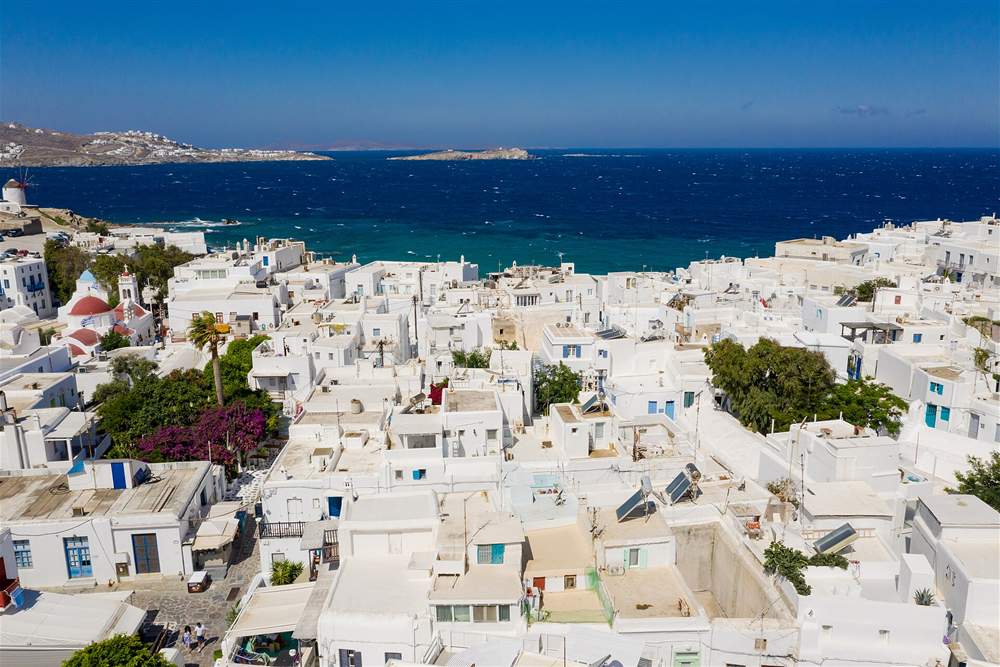
From 1,200 feet the Chora resolves into a white maze pressed against a curved harbour, with the five windmills on the ridge above it, Little Venice hanging over the water on the west edge, and the Paraportiani church standing as a pale rounded block at the seafront corner.
A Mykonos helicopter tour is weighed at check-in, since the load sets the fuel. Guests on a short stay pick a Mykonos helicopter tour over a full day at sea. The price of a Mykonos helicopter tour tracks the aircraft type and the minutes flown. The street plan is the revelation. On foot the lanes read as a deliberate labyrinth built to confuse raiders and break the wind; from the air the logic appears at once, with the alleys spiralling inward from the waterfront and the cubic houses locking together like set stones. Blue and red domes punctuate the white at intervals, and the flat roofs carry water tanks, vine canopies and the occasional turquoise pool.
The Santorini leg of a Mykonos helicopter tour crosses the Aegean in half an hour. The aircraft on a Mykonos helicopter tour seats three to five passengers beside the pilot. The waterfront reads as a working machine. Caiques cluster in the old port, the fish market awnings line the quay, and the pelican’s patch of shade sits at the corner where the tourist crowd thickens. Further north the Tourlos jetty pushes out to take cruise ships, and their tenders trace white wakes across to the town harbour throughout the middle of the day.
A Mykonos helicopter tour is rescheduled rather than flown when the cloud base drops. The sightseeing leg of a Mykonos helicopter tour passes the windmills and Little Venice. The windmill ridge photographs best on the outbound leg, when the pilot holds the aircraft south of the Chora and the sun sits behind the camera. Kato Mili’s whitewashed drums line up against the water with the town filling the frame behind them, a view no ground vantage point offers. Walkers exploring the same lanes afterwards find their bearings faster, and the streets of Mykonos Town stop being a puzzle.
Which beaches does the coastal leg of the flight pass?
The southern sweep runs over Psarrou, Platis Gialos, Paranga, Paradise, Super Paradise and Agrari, then turns back across Ornos and Agios Sostis on the return. Each bay shows its full sandbar, its reef line and its anchored yachts in a single frame from the air.
Photographers take the window seat on a Mykonos helicopter tour for a clean frame. A Mykonos helicopter tour runs thirty minutes in the air from the island’s helipad. Morning air gives a Mykonos helicopter tour the steadiest ride and the cleanest light. Psarrou opens first: a compact horseshoe of pale sand with a dense grid of loungers and a permanent line of tenders on the water. Platis Gialos follows immediately east, longer, busier, its beach clubs pushed hard against the sand and its water-taxi pier jutting out at the far end. From the air the two bays share one hillside, and the footpath linking them shows as a thin scar across the rock.
A Mykonos helicopter tour reads the whole island in one pass, which no road can do. A private Mykonos helicopter tour is chartered whole, so the cabin belongs to your party. Paranga, Paradise and Super Paradise arrive in sequence along the same exposed coast. The colour gradient off Super Paradise is the strongest on the island: a white sandbar, a band of turquoise, a sharp drop to deep blue where the seabed falls away. Yachts anchor along that line all summer, and their tenders cut visible arcs between the hulls and the shore.
Luggage on a Mykonos helicopter tour is capped by weight and by the size of the hold. Hotel pickup is built into a Mykonos helicopter tour, by minibus or by deluxe SUV. The return crosses Ornos, the most sheltered of the south bays, and passes Agios Sostis on the north coast, where there is no road down, no sunbed and no beach bar, only a red-brown cove and a taverna above it. Seen from the air the contrast between the developed south and the raw north is total, and it makes a practical planning tool for choosing between Mykonos beaches for the days that follow.
Why does Delos read differently from the air than from the sea?
From a boat Delos presents as a low brown island with broken columns on its shore. From the air the entire ancient city appears as one connected plan: the sanctuary, the theatre quarter, the sacred lake, the harbour moles and the grid of houses laid bare across the flat ground.
A Mykonos helicopter tour is rescheduled rather than flown when the cloud base drops. The sightseeing leg of a Mykonos helicopter tour passes the windmills and Little Venice. A Mykonos helicopter tour crosses Psarrou, Platis Gialos and the south-coast beaches. The island is uninhabited, unbuilt and treeless, which means nothing hides the archaeology. The Terrace of the Lions, the House of Dionysos with its mosaic floor, the theatre cut into the slope of Mount Kynthos and the long avenue of the Sacred Way all sit within one field of view. Visitors who have walked the site recognise the route they took; those who have not get the map before they arrive.
Guests on a short stay pick a Mykonos helicopter tour over a full day at sea. The price of a Mykonos helicopter tour tracks the aircraft type and the minutes flown. Rhenia lies immediately west, larger, emptier and split into two lobes joined by an isthmus. It held the necropolis of Delos after the ancient purification banned birth and death on the sacred island, and today it carries goats, a handful of chapels and a scatter of white sand coves reachable by boat alone. Together the two islands form the empty heart of the Cyclades, ringed by the busy ones.
The Santorini leg of a Mykonos helicopter tour crosses the Aegean in half an hour. The aircraft on a Mykonos helicopter tour seats three to five passengers beside the pilot. The helicopter does not land there. Delos permits access only through the licensed boat service from the old port, with a guide and a ticket, and the site closes to visitors in the late afternoon. The air pass is a reconnaissance rather than a substitute, and the natural pairing is to fly it first and then walk it on a Delos tour from Mykonos the following morning.
What does the private helicopter transfer service from Mykonos include?
The transfer product is a one-way private charter for up to four passengers from the Mykonos helipad to Athens or to any Greek island with a licensed landing site. It includes the aircraft, the pilot, landing fees at the destination and coordination with ground transport at both ends.
Hotel pickup is built into a Mykonos helicopter tour, by minibus or by deluxe SUV. The transfer version of a Mykonos helicopter tour flies on to Athens, Santorini or Paros. The distinction from the sightseeing flight is the destination. A sightseeing flight returns to its point of departure and prices thirty minutes of scenic routing. A transfer prices the direct track between two points, flies it at cruise altitude and speed, and puts the passengers down where they are staying next. The cabin is the same, the crew is the same and the safety brief is the same.
A Mykonos helicopter tour runs thirty minutes in the air from the island’s helipad. Morning air gives a Mykonos helicopter tour the steadiest ride and the cleanest light. Bookings run point to point across the whole Greek network. Athens Eleftherios Venizelos takes helicopters at its general aviation terminal, which puts a passenger inside the airport for an onward international departure. Paros, Naxos, Milos, Ios, Serifos, Syros and Crete each have an approved landing site, and private helipads at villas and hotels are used where the property holds a permit and the operator has surveyed the pad.
A Mykonos helicopter tour reads the whole island in one pass, which no road can do. A private Mykonos helicopter tour is chartered whole, so the cabin belongs to your party. The four-passenger ceiling is a combined limit on bodies and bags. Four adults with cabin-sized luggage fit the H125 comfortably; four adults with large checked suitcases push the payload, and the operator either splits the load across two rotations or upgrades the aircraft. Weights are declared at the time of booking so the decision is made on the ground rather than at the pad.
How long does each helicopter transfer leg from Mykonos take?
Flight times from Mykonos run twenty-five to thirty-five minutes to Santorini, fifteen minutes to Paros, twenty minutes to Naxos, forty to fifty minutes to Athens, and eighty to ninety-five minutes to Crete. Every figure counts airborne time between pad and pad.
The aircraft on a Mykonos helicopter tour seats three to five passengers beside the pilot. Yacht guests book a Mykonos helicopter tour to reach the island without the ferry queue. The short hops inside the Cyclades are the ones that transform an itinerary. Paros sits fifteen minutes away, Naxos twenty, Syros twelve, Ios thirty. Each of those legs replaces a ferry crossing that consumes half a day once the port transfer, the boarding window and the sailing are counted, and each lands the group close enough to the hotel for a ten-minute drive to finish the journey.
The sightseeing leg of a Mykonos helicopter tour passes the windmills and Little Venice. A Mykonos helicopter tour crosses Psarrou, Platis Gialos and the south-coast beaches. Athens is the longest routine leg, flown across the Kea channel with the Attic coast in view for the second half. Forty to fifty minutes covers the pad-to-pad time, and the arrival point is chosen at booking: the general aviation terminal at the international airport for a connecting flight, or a downtown helipad for a hotel in the centre. The Acropolis passes to the left on the standard approach.
Guests on a short stay pick a Mykonos helicopter tour over a full day at sea. The price of a Mykonos helicopter tour tracks the aircraft type and the minutes flown. Crete is a genuine crossing, flown in one hop of eighty to ninety-five minutes over open water to Heraklion or Chania. Operators plan it with a fuel stop available on Naxos or Santorini and require a firm weather window in both terminal areas. It is the leg where the meltemi matters most, and the one where crews reschedule with the least hesitation.
What does the Mykonos to Santorini helicopter transfer involve?
The Mykonos to Santorini helicopter transfer is a one-way private charter for up to four passengers, flown by a Bell 206 class machine in twenty-five to thirty-five minutes. It departs the Mykonos helipad and lands at Santorini National Airport, where a car meets the group airside.
A private Mykonos helicopter tour is chartered whole, so the cabin belongs to your party. A Mykonos helicopter tour shows Delos and Rhenia lying offshore to the south-west. The track runs southwest across open Aegean water, with Paros and Naxos to the right, Ios ahead, and the Santorini caldera rising at the end of the leg. The approach is the payoff. The helicopter crosses the outer rim of the volcano, the cliff face drops seven hundred red and black metres to the water, and Fira and Oia appear as two white smears strung along the top edge of the crater wall.
Hotel pickup is built into a Mykonos helicopter tour, by minibus or by deluxe SUV. The transfer version of a Mykonos helicopter tour flies on to Athens, Santorini or Paros. The alternative is a ferry that runs two to three hours in good conditions, sails from Mykonos New Port, and cancels or delays when the north wind stiffens. The helicopter removes the port queue, the vehicle deck and the swell entirely, and it collapses the transit into a single half hour. Couples on a seven-night trip recover an entire afternoon on the caldera by taking it.
A Mykonos helicopter tour runs thirty minutes in the air from the island’s helipad. Morning air gives a Mykonos helicopter tour the steadiest ride and the cleanest light. Booking runs one way in either direction, and returns are priced as two separate legs because the aircraft repositions between them. Groups splitting a week between the two islands compare the helicopter against the fast ferry and the scheduled hop with the full picture set out on the Mykonos to Santorini page, then book the leg that fits the day they have.
How does a helicopter transfer compare with the ferry and the scheduled flight?
The helicopter wins on door-to-door time and loses on cost. Mykonos to Santorini takes thirty minutes by air against two to three hours by fast ferry, and the helicopter carries no check-in, no port queue and no fixed departure other than the one the group sets.
The price of a Mykonos helicopter tour tracks the aircraft type and the minutes flown. Couples book a Mykonos helicopter tour for proposals and for honeymoon flights. Count the ferry honestly and the gap widens. A high-speed sailing asks passengers at the New Port thirty to forty-five minutes before departure, adds a twenty-minute drive from the Chora, runs two to three hours at sea, and lands at Athinios where the road up the caldera is a switchback that takes another twenty-five minutes. Door to door the crossing consumes four hours; the helicopter consumes ninety minutes including both drives.
The aircraft on a Mykonos helicopter tour seats three to five passengers beside the pilot. Yacht guests book a Mykonos helicopter tour to reach the island without the ferry queue. The scheduled aircraft is faster than the ferry and slower than it looks. Flights between the islands are seasonal, run through Athens on most days, and impose a full airport process at both ends: check-in, security, boarding, baggage reclaim. A one-hour flying time turns into a half-day movement once the connection is added, and a missed leg strands the group overnight.
The sightseeing leg of a Mykonos helicopter tour passes the windmills and Little Venice. A Mykonos helicopter tour crosses Psarrou, Platis Gialos and the south-coast beaches. Luggage is where the three diverge most sharply. The ferry takes anything a person can wheel aboard. The scheduled flight enforces a strict allowance and charges beyond it. The helicopter caps total load by weight rather than by piece count, which suits four people with soft bags and penalises four people with hard suitcases. Groups carrying real baggage send the heavy items ahead by ferry courier and fly light.
What do the sightseeing flight and the transfer legs cost in euros?
The thirty-minute private sightseeing flight sits between 1,300 and 1,800 euros for the whole aircraft. One-way transfers run 1,200 to 1,600 euros to Paros or Naxos, 2,200 to 3,200 euros to Santorini, 3,200 to 4,500 euros to Athens, and higher to Crete.
Morning air gives a Mykonos helicopter tour the steadiest ride and the cleanest light. Every Mykonos helicopter tour opens with a pilot briefing and a headset check. Every quoted figure prices the machine, not the seat. A couple and a family of four pay the same number for the same leg, which changes the arithmetic completely: a Santorini transfer at 2,600 euros is a heavy expense for two people and a defensible one for four with tight connections. Groups build the cost per person from the total rather than the other way round.
A private Mykonos helicopter tour is chartered whole, so the cabin belongs to your party. A Mykonos helicopter tour shows Delos and Rhenia lying offshore to the south-west. Four factors move the price. Aircraft type comes first, since an H125 costs more per hour than a Bell 206 or an R44. Distance comes second, priced on block time rather than on straight-line kilometres. Positioning comes third: a leg that starts where the helicopter is already parked costs less than one requiring an empty ferry flight from Athens. Season comes fourth, with August pricing above the shoulder months.
Hotel pickup is built into a Mykonos helicopter tour, by minibus or by deluxe SUV. The transfer version of a Mykonos helicopter tour flies on to Athens, Santorini or Paros. Landing fees, handling at the destination and the operator’s fuel surcharge appear inside the quoted total on reputable listings. Ground transport at the arrival end is quoted separately for transfers and is included for the sightseeing flight. Confirm before paying that the figure covers landing charges at the destination pad, because those vary from island to island and add a three-figure sum on the longer legs.
What weight, passenger and luggage limits apply on board?
The Bell 206 and the R44 carry three passengers, the H125 carries four to five, and every charter runs to a total payload ceiling rather than a seat count. Operators request individual weights at booking and cap luggage near ten kilograms of soft baggage per person.
A Mykonos helicopter tour crosses Psarrou, Platis Gialos and the south-coast beaches. The meltemi wind moves a Mykonos helicopter tour to a calmer hour of the day. Payload is the real constraint. A helicopter’s lifting capacity falls as air temperature rises and as humidity climbs, so the same aircraft that carries four adults and their bags in June carries four adults and less baggage during an August afternoon. Crews calculate the load sheet for the actual conditions on the day, which is why the operator asks for honest figures rather than estimates at the point of sale.
The price of a Mykonos helicopter tour tracks the aircraft type and the minutes flown. Couples book a Mykonos helicopter tour for proposals and for honeymoon flights. Baggage rules favour soft bags. A duffel or a holdall compresses into the rear compartment; a rigid four-wheel suitcase does not, and two of them fill the hold of a Bell 206 on their own. Passengers moving between islands with full luggage declare the pieces and their dimensions when they book, and the operator confirms the fit or moves the group to a larger machine.
The aircraft on a Mykonos helicopter tour seats three to five passengers beside the pilot. Yacht guests book a Mykonos helicopter tour to reach the island without the ferry queue. Balance matters as much as total mass. The pilot assigns seats to keep the centre of gravity inside limits, which overrides passenger preference on where to sit. On a three-seat bench the heaviest passenger goes where the load sheet puts them. Anyone above 120 kilograms tells the operator in advance, because a single heavy passenger changes both the seating plan and the fuel load.
How is safety handled and what does the pilot briefing cover?
Greek charter helicopters fly under an Air Operator Certificate issued by the national authority and audited to European rules. Commercial pilots hold a CPL(H) with a type rating on the aircraft, and every passenger receives a pre-flight briefing covering doors, harnesses, headsets and emergency equipment.
The transfer version of a Mykonos helicopter tour flies on to Athens, Santorini or Paros. Booking a Mykonos helicopter tour ahead secures the aircraft through the summer weeks. The briefing is short and specific. It covers the approach path to the aircraft, which stays in front of the pilot and clear of the tail rotor at all times; the operation of the door handle and the four-point harness; the location of the life jackets stowed under each seat; and the instruction to leave a landing helicopter only when the pilot signals. Crouching under a running rotor disc is not required and is not asked for.
Morning air gives a Mykonos helicopter tour the steadiest ride and the cleanest light. Every Mykonos helicopter tour opens with a pilot briefing and a headset check. Overwater legs carry additional equipment. Aircraft operating the island crossings carry life jackets for every occupant, a life raft on the longer sectors, an emergency locator beacon and a flotation-equipped skid configuration on part of the fleet. Pilots file a flight plan for each overwater leg, and the aircraft is tracked from departure to arrival by the operator’s own system as well as by air traffic control.
A private Mykonos helicopter tour is chartered whole, so the cabin belongs to your party. A Mykonos helicopter tour shows Delos and Rhenia lying offshore to the south-west. Headsets are issued to every passenger. They cut the rotor and turbine noise to a conversational level, carry the pilot’s commentary, and let passengers speak to each other and to the pilot through the intercom. Anyone flying with a hearing aid or with young children asks for the smaller headset sizes at the desk, and the crew fits them before the doors close.
When is the best time of day to fly for light and calm air?
The first two hours after sunrise and the last two before sunset give the calmest air and the strongest light. Morning flights find glassy water and clean shadows over the Chora; evening flights catch low gold on the windmills and warm colour across the western sea.
Yacht guests book a Mykonos helicopter tour to reach the island without the ferry queue. A Mykonos helicopter tour is weighed at check-in, since the load sets the fuel. Thermal activity drives the difference. The land heats through the morning, rising air produces bumps over the ridges by midday, and the ride roughens between noon and four in the afternoon. Dawn air is stable and cool, which improves both passenger comfort and the aircraft’s performance, since a colder mass gives the rotor more to bite on and lifts the payload ceiling.
A Mykonos helicopter tour crosses Psarrou, Platis Gialos and the south-coast beaches. The meltemi wind moves a Mykonos helicopter tour to a calmer hour of the day. Light behaves the same way. A midday sun sits overhead, flattens the whitewash into glare and kills the texture in the alleys and on the beaches. A low sun rakes across the same subjects, throws the windmills into relief, separates each cubic house from its neighbour, and turns the water from flat blue into a graded surface that shows depth. Photographers book the last slot of the day for that reason.
The price of a Mykonos helicopter tour tracks the aircraft type and the minutes flown. Couples book a Mykonos helicopter tour for proposals and for honeymoon flights. Operators sell the sunset slot first and it disappears earliest in high season. Groups that book late take a mid-morning departure, which still delivers good angles and smoother air than the middle of the day. Sunset flights carry one caveat: the helicopter lands before official last light under visual rules, so the slot moves through the season and the operator sets the exact time a day ahead.
How does the meltemi affect flights, and what happens when the weather closes in?
The meltemi is the dry northerly wind that blows across the Aegean through high summer, reaching force six to eight for days at a time. It roughens the ride, and a strong gust spread grounds departures until the wind eases, at which point the operator reschedules at no charge.
A Mykonos helicopter tour shows Delos and Rhenia lying offshore to the south-west. Photographers take the window seat on a Mykonos helicopter tour for a clean frame. Mykonos sits fully exposed to it. The wind funnels between Tinos and Naxos, accelerates through the strait, and hits the island’s north coast hardest, which is precisely why Agios Sostis and Fokos stay wild and why the south-facing bays fill up. A helicopter handles a steady wind without difficulty; the limiting factor is the gust differential and the crosswind component at the pad on landing.
The transfer version of a Mykonos helicopter tour flies on to Athens, Santorini or Paros. Booking a Mykonos helicopter tour ahead secures the aircraft through the summer weeks. Cancellations are the operator’s call and they are made on measured data rather than on the look of the sky. Crews check the terminal forecast, the actual wind at both pads and the trend through the flight window. A booking cancelled for weather is rescheduled to the next viable slot, and where no slot works before departure from the island, the fare is refunded in full.
Morning air gives a Mykonos helicopter tour the steadiest ride and the cleanest light. Every Mykonos helicopter tour opens with a pilot briefing and a headset check. Plan around it rather than against it. Book the sightseeing flight for the first available morning of the stay rather than the last, so there is room to move if the wind blows. For a transfer with a connecting international flight behind it, allow a full buffer day, or hold a ferry booking as the fallback. Nobody argues a helicopter into the air against a forecast.
How far ahead does a helicopter flight book, and what are the cancellation terms?
Peak-season flights book two to four weeks ahead, and the sunset slot goes first. Shoulder-season bookings clear at three to five days. Standard terms give a full refund for cancellation twenty-four hours before departure, and weather cancellations by the operator are refunded or rescheduled in full.
Couples book a Mykonos helicopter tour for proposals and for honeymoon flights. A Mykonos helicopter tour is rescheduled rather than flown when the cloud base drops. Availability is thin because the fleet is small. A handful of aircraft cover the whole Cyclades in August, each flying a chain of transfers between islands, and a sightseeing slot has to fit between two paid repositioning legs. Groups asking for a specific date and a specific hour in the first fortnight of August book a month out. A request made on the day is filled only when a transfer cancels.
Yacht guests book a Mykonos helicopter tour to reach the island without the ferry queue. A Mykonos helicopter tour is weighed at check-in, since the load sets the fuel. Confirmation runs in two stages. The booking secures the aircraft and the date; the operator then confirms the exact departure time twelve to twenty-four hours ahead, once the tower slots and the day’s traffic are known. That second message also carries the driver’s details and the pickup time, and it is the point at which a passenger’s phone number matters.
A Mykonos helicopter tour crosses Psarrou, Platis Gialos and the south-coast beaches. The meltemi wind moves a Mykonos helicopter tour to a calmer hour of the day. Read the terms on the specific listing before paying. The twenty-four-hour free cancellation window is standard on GetYourGuide for these products, and inside that window the fare is committed because the aircraft is held. Payment is taken at booking. Where a group cancels within the window and the operator refills the slot, a partial refund is negotiated, and that outcome is a courtesy rather than a right.
What do passengers wear and bring, and how do the window seats and photography work?
Wear flat shoes, trousers or shorts rather than a loose skirt or dress, and a light layer for the cabin. Bring a phone or a camera with the strap around the neck, sunglasses and nothing else. Every seat sits at a window, and photography through the glass is unrestricted.
Every Mykonos helicopter tour opens with a pilot briefing and a headset check. Luggage on a Mykonos helicopter tour is capped by weight and by the size of the hold. Loose clothing is the one genuine problem. The downwash from a running rotor lifts a skirt, a scarf or a wide-brimmed hat instantly, and hats leave the head the moment a passenger steps under the disc. Tie long hair back, leave the hat in the vehicle, and keep sunglasses on a cord. Flat shoes matter because passengers step up onto a skid or a footplate to board.
A Mykonos helicopter tour shows Delos and Rhenia lying offshore to the south-west. Photographers take the window seat on a Mykonos helicopter tour for a clean frame. The cabin is glazed to the hip on both sides, so there is no bad seat, and the pilot flies the scenic legs with the subject on the passengers’ side rather than on the nose. Front-seat passengers get a wraparound view through the chin bubble and the least reflection; rear passengers get the wider frame. On a three-person booking the operator rotates the front seat between legs on request.
The transfer version of a Mykonos helicopter tour flies on to Athens, Santorini or Paros. Booking a Mykonos helicopter tour ahead secures the aircraft through the summer weeks. Shoot through the glass with the lens close to the window to kill reflections, avoid resting the camera body against the airframe because vibration transmits straight into it, and set a fast shutter. Turn off the flash: it bounces off the perspex and blinds the pilot at dusk. Dark clothing photographs better than white for the same reflection reason, and a polarising filter cuts the haze over water.
Who does a helicopter flight suit, and how does it serve yacht guests, families and travellers with limited mobility?
The flight suits proposals, honeymoons, yacht and villa arrivals, photographers and travellers on a two-night stay who want the whole island in half an hour. It serves guests with limited mobility well, since boarding involves one step and no walking, and it carries children at the operator’s discretion.
The meltemi wind moves a Mykonos helicopter tour to a calmer hour of the day. The Santorini leg of a Mykonos helicopter tour crosses the Aegean in half an hour. Proposals are the single most common private booking. The pilot holds a slow orbit over the chosen bay at sunset, the intercom is muted on request, and the ground crew handles a bottle at the pad afterwards. Honeymoon couples take the same slot for the light. Yacht guests use the transfer product instead: the aircraft lands at the airport, a tender or a car covers the last leg, and a charter week starts hours earlier than a ferry allows.
Couples book a Mykonos helicopter tour for proposals and for honeymoon flights. A Mykonos helicopter tour is rescheduled rather than flown when the cloud base drops. Children fly, and the rules are practical rather than restrictive. An infant travels on a parent’s lap where the operator’s harness configuration permits it, and a child of five upward takes a seat with the harness adjusted and a small headset fitted. Announce every passenger’s age and weight at booking. Under-fives are refused on part of the fleet, so confirm the specific aircraft’s policy before paying.
Yacht guests book a Mykonos helicopter tour to reach the island without the ferry queue. A Mykonos helicopter tour is weighed at check-in, since the load sets the fuel. For reduced mobility the helicopter beats every alternative on the island. There is no gangway, no cobbled lane and no long terminal walk, and the vehicle stops beside the aircraft. Passengers who cannot manage the step onto the skid are lifted with a portable step supplied by the ground crew when the need is declared in advance. Guests who want three hours on the water instead take a boat trip, and those who prefer to stop, walk and eat book a private car tour.
Frequently Asked Questions
How long is a Mykonos helicopter tour?
Thirty minutes in the air on the sightseeing flight, with hotel pickup and the drive to the helipad on either side. Transfer flights run twenty-five to thirty-five minutes to Santorini and about forty-five minutes to Athens.
What does a Mykonos helicopter tour cost?
The private thirty minute sightseeing flight runs from about 900 to 1,800 euros for the aircraft. Island transfer legs price from about 1,900 to 3,500 euros one way, set by the aircraft type and the distance flown.
What is the passenger capacity of a Mykonos helicopter tour?
Three to five passengers depending on the aircraft, with a Bell 206 seating four beside the pilot. The operator weighs the party at check-in, because the total load sets the fuel and the seating plan.