
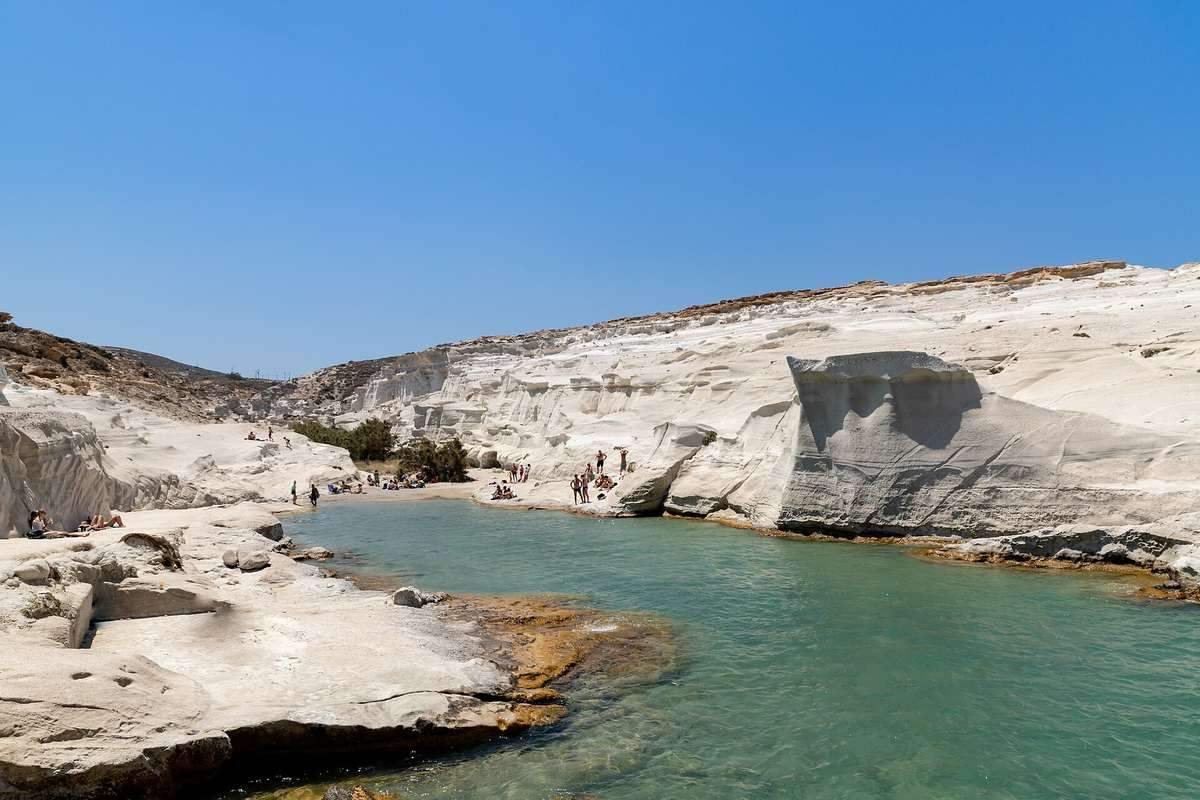
The best photography spots on Milos are the white moonscape of Sarakiniko, the sea caves of Kleftiko, the colourful village of Klima, the mineral cliffs of Firiplaka and the castle hill of Plaka. Plan photo trips and tours through My Greece Tours.
Milos is one of the most photogenic islands in the Milos travel guide. The sections below cover the top photo spots, why Sarakiniko leads them, the appeal of Klima and Kleftiko, the best sunset views, and tips for shooting the island.
What are the best photography spots on Milos?
The best photography spots on Milos are Sarakiniko, Kleftiko, Klima, Firiplaka and the castle hill of Plaka. Together they cover white moonscapes, sea caves, colourful villages, mineral cliffs and panoramic sunsets.
Milos packs huge variety into one island. Its volcanic past left white rock, coloured cliffs and sculpted caves along the coast. The villages add bright doors, painted boats and hilltop views. Few Greek islands offer such a range of scenes in such a small space.
Five locations stand out above the rest. Sarakiniko gives lunar white rock. Kleftiko gives towering sea caves. Klima gives a rainbow of fishing huts. Firiplaka gives streaked mineral cliffs, and Plaka gives the wide sunset panorama. Each delivers a distinct, striking image.
The spots suit different light and effort. Sites like Sarakiniko and Plaka need only a short walk. Others, like Kleftiko, require a boat. Planning around the sun and the crowds turns each into a standout shot. The list anchors any photographer’s things to do in Milos. The next section covers Sarakiniko.
The island packs huge visual variety into a small space. Its volcanic past left white rock, coloured cliffs and sculpted sea caves. The villages add bright doors, painted boat houses and hilltop views. The light shifts the scenes through the day, from soft dawn to blazing noon. A short drive links the moonscape, the colourful coast and the castle hill. Certain spots need only a walk, while others need a boat. That range lets photographers fill a memory card without travelling far. No other Greek island offers such a spread of distinct, striking scenes as Milos packs along its coast.
Why is Sarakiniko the top photo spot on Milos?
Sarakiniko is the top photo spot on Milos because its white volcanic rock looks like a lunar landscape. The smooth, blinding-white cliffs meet deep blue water on the northeast coast, creating the island’s most photographed scene.
Sarakiniko looks like another planet. Wind and waves have smoothed the white volcanic rock into rolling, bone-coloured ridges. The bare stone earns its nickname as the moonscape of Milos. Set against the deep blue sea, the contrast is startling in a photo.
The light shapes the shots. Midday sun bleaches the rock to a brilliant white, while dawn and dusk add soft pink and gold tones. The smooth curves create clean lines and bold shadows. Photographers find endless compositions among the ridges and inlets.
The fame brings crowds. Sarakiniko is the busiest attraction on the island, so it fills fast in peak season. An early start gives empty rock and the best light. Arriving at sunrise rewards you with the moonscape to yourself. Sarakiniko beach is the single must-shoot location on Milos. The next section covers Klima and Kleftiko.
Sarakiniko earns its place as the island’s signature shot. Wind and waves have smoothed the white volcanic rock into rolling ridges. The bare stone looks like the surface of the moon, set against deep blue sea. Midday sun bleaches the rock to a brilliant white. Dawn and dusk wash it in soft pink and gold. The smooth curves create clean lines and bold shadows for the camera. The site fills with visitors by mid-morning in summer. An early start gives empty rock and the best light. Sarakiniko is the single must-shoot location on the coast of Milos.
Sarakiniko changes character with the time of day. At dawn the white rock glows soft pink under a quiet sky. By noon the sun bleaches it to a blinding, lunar white. Late light warms the ridges to gold before sunset. The deep blue sea sets off the pale stone at every hour. Long shadows in the low sun reveal the sculpted curves. The bare rock holds no shade, so an early visit beats the heat. Photographers return at different hours to catch each mood. That shifting light makes Sarakiniko the most rewarding single subject on the whole coast of Milos.
What makes Klima and Kleftiko so photogenic?
Klima and Kleftiko are highly photogenic for different reasons. Klima offers rainbow-painted fishing huts reflected in calm water, while Kleftiko offers towering white sea caves and glowing blue water reached only by boat.
Klima is a riot of colour. The waterfront syrmata, the boat houses of the fishing village, wear boldly painted doors, windows and balconies in red, blue, green and yellow. The calm sea mirrors them at dawn and dusk. It is widely called the prettiest village on Milos.
Kleftiko delivers drama. Giant white cliffs plunge into some of the bluest water in Greece on the southwest coast. When the light hits right, the blue glows across the white rock inside the caves. The arches and stacks make bold, sculptural frames.
The two need different plans. Klima rewards a soft-light visit at sunrise or sunset on foot. Kleftiko is reachable only by boat, so a morning cruise gives calm water and clear light. Together they show the colourful and the wild sides of Milos. The next section covers panoramas.
Klima and Kleftiko show the colourful and the wild sides of Milos. Klima’s waterfront syrmata wear bold doors and balconies in red, blue and yellow. The calm sea mirrors the painted boat houses at dawn and dusk. Kleftiko’s giant white cliffs plunge into some of the bluest water in Greece. When the light hits right, the blue glows across the white rock inside the caves. Klima rewards a soft-light visit on foot. Kleftiko needs a morning boat for calm water and clear light. Together the two spots capture both the charm and the drama of the island.
Where do you get the best sunset and panorama shots on Milos?
The castle hill of Plaka gives the best sunset and panorama shots on Milos. From the Kastro at the top of the capital, a 360-degree view spans the gulf, the neighbouring islands and the sun setting into the Aegean.
Plaka crowns the island. The hilltop capital sits high on the west side, and its Venetian Kastro tops the whole village. From the summit the view sweeps a full circle over the gulf, the sea and the islands of Kimolos and Antimilos. It is the premier panorama on Milos.
Sunset is the prime hour. The west-facing position points straight at the setting sun, which floods the bay with gold. Photographers line the terrace by the church of Panagia Korfiatissa for the show. The whitewashed lanes below glow in the warm light.
The colourful south adds another option. The streaked mineral cliffs of Firiplaka catch warm afternoon light in reds and ochres. For the classic island sunset, though, Plaka leads the field. Our guide to the best Milos sunset spots maps the timing in full. The final section gives tips.
The castle hill of Plaka delivers the widest views. The Venetian Kastro tops the hilltop capital on the west side. From the summit a full circle takes in the gulf, the sea and the neighbouring islands. Sunset is the prime hour, when the west-facing terrace floods with gold. Photographers line the spot by the church of Panagia Korfiatissa. The whitewashed lanes below glow in the warm light. The streaked mineral cliffs of Firiplaka offer another warm-light option to the south. For the classic island panorama and sunset, the castle hill of Plaka leads every other spot on Milos.
What tips help for photographing Milos?
For the best photos of Milos, shoot at sunrise and sunset for soft light, arrive early at Sarakiniko to beat the crowds, and take a morning boat to Kleftiko for calm seas. Carry a polarising filter for the bright white rock.
Light is everything. The low sun of dawn and dusk softens the harsh contrast of the white rock and warms the colours. Midday glare flattens the scene and blows out the bright stone. Plan the key spots for the golden hours at each end of the day.
Timing beats the crowds. Sarakiniko and Plaka fill with visitors by mid-morning, so an early start gives clean frames. A morning boat to Kleftiko meets the calmest water and the best cave light. The shoulder months of spring and autumn bring quieter scenes.
The gear needs a few extras. A polarising filter cuts glare off the white rock and deepens the blue sea. A wide lens captures the sweeping moonscapes and panoramas. Pack a dry bag on boat trips to guard the camera. With these habits, Milos rewards every photographer.
A few habits sharpen every shot on the island. The low sun of dawn and dusk softens the harsh contrast of the white rock. Midday glare flattens the scene and blows out the bright stone. An early start beats the crowds at Sarakiniko and Plaka. A morning boat to Kleftiko meets the calmest water and best cave light. A polarising filter cuts glare and deepens the blue sea. A wide lens captures the sweeping moonscapes and panoramas. A dry bag guards the camera on boat trips. With these habits, Milos rewards every photographer who plans around the light.
A short checklist sharpens every shoot on the island. Charge batteries and clear cards the night before a dawn start. Pack a polarising filter to cut glare off the white rock. Carry a wide lens for the moonscapes and the castle-hill panorama. Bring a dry bag to guard the camera on the Kleftiko boat. Scout the spot in advance so you know where the sun sets. Respect the rock and the villages, and leave no trace behind. With a plan built around the light, every location delivers. These simple habits turn a day of sightseeing into a strong set of photographs from Milos.
Frequently Asked Questions
What is the most photographed place on Milos?
Sarakiniko is the most photographed place on Milos. Its smooth white volcanic rock looks like a lunar landscape, and the blinding-white cliffs against the deep blue sea make the island’s most striking image. The northeast-coast moonscape is the busiest attraction on Milos, so it fills fast in summer. Arriving at sunrise gives empty rock, soft light and the chance to shoot the scene without crowds.
When is the best light for photos on Milos?
The best light for photos on Milos comes at sunrise and sunset, the golden hours at each end of the day. The low sun softens the harsh contrast of the white volcanic rock and warms the colours of the villages and cliffs. Midday glare flattens the scene and blows out the bright stone. Planning Sarakiniko, Plaka and Klima around dawn or dusk gives the strongest and most atmospheric results.
Can you photograph Kleftiko without a boat?
No. Kleftiko sits on the roadless southwest coast of Milos, where white cliffs drop straight into the sea, so it is reachable only by boat. A morning cruise gives the calmest water and the clearest cave light, when the blue glows across the white rock. Most island boat tours stop there for swimming and photography, making a morning sailing the best way to capture this dramatic spot.