
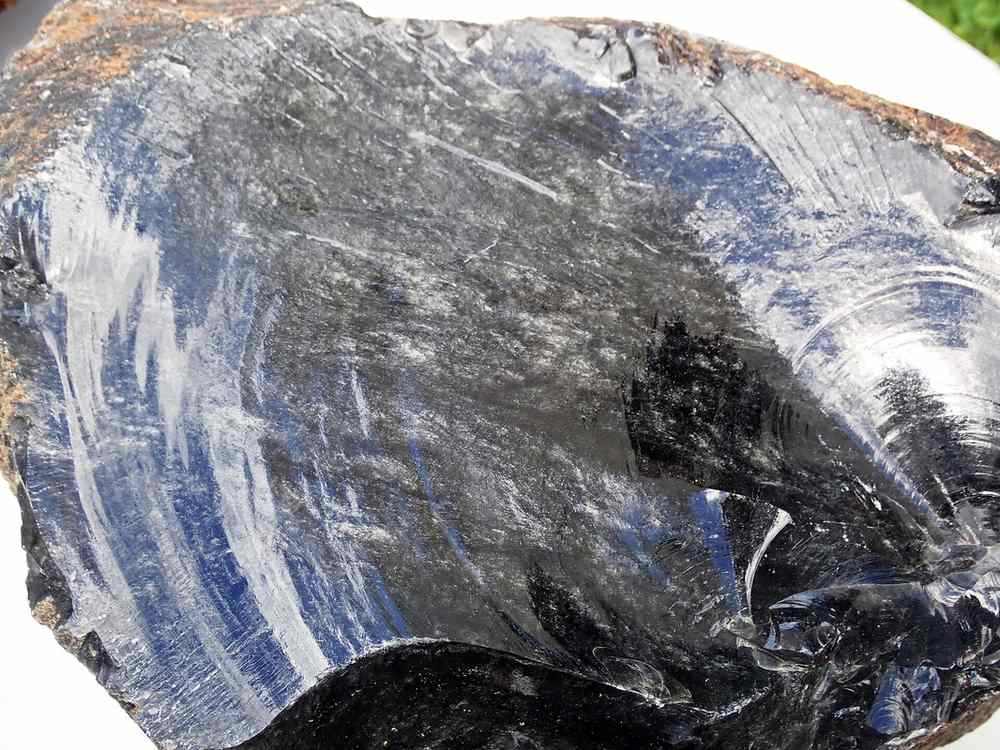
Milos obsidian, a black volcanic glass, was prized across the prehistoric Aegean for sharp tools and traded far and wide. Plan tours and history trips through My Greece Tours.
Obsidian is a cornerstone of the Milos travel guide. The sections below cover why Milos is famous for obsidian, what it was used for, where it was mined, whether you can see it today and why it mattered so much.
Why is Milos famous for obsidian?
Milos is famous for obsidian because its volcanic geology produced high-quality deposits of this black volcanic glass, which prehistoric people prized for making sharp tools.
Milos owes its earliest fame to obsidian, the black volcanic glass its volcano produced in unusual quality and quantity. Stone Age communities prized this glass because it fractured into razor edges. The island’s deposits became the raw material behind a sea trade that spread the stone long before the classical Greek world existed.
Obsidian is a natural volcanic glass, formed when silica-rich lava cools too fast for crystals to grow. The resulting stone is dense, black and glossy, and it breaks along smooth conchoidal fractures that leave an edge sharper than a modern steel blade. That property made it the finest cutting material available to people who had no metal, and Milos held some of the purest sources in the Aegean.
The island’s two great outcrops at Sta Nychia and Demenegaki yielded obsidian of consistent quality across roughly seven thousand years of use, from the Neolithic into the Bronze Age. The supply ran deep enough to serve distant communities as well as local toolmakers, and the reputation of Milos obsidian grew alongside the early sailing routes that carried it. Boats took the glass to the Greek mainland and beyond, and finds at sites such as Franchthi Cave in the Peloponnese record its reach across open water.
Milos is famous for obsidian because its volcanic origins gave it abundant, high-quality deposits of this natural black volcanic glass, formed when lava cooled very rapidly. Obsidian fractures into extremely sharp edges, which made it the prized raw material for cutting tools, blades and weapons in the era before metals, and Milos held some of the finest sources in the Aegean.
From deep in prehistory, in the Stone Age, people sought out Milos obsidian and carried it across the sea, making the island one of the earliest known centres of long-distance trade and seafaring in the region. This trade brought Milos wealth and importance long before classical Greece, and the prehistoric town of Phylakopi grew prosperous partly on the back of it. The obsidian story is the foundation of the island’s deep history. Our Milos history guide covers the wider past, and the next section covers what obsidian was used for.
What was Milos obsidian used for?
Milos obsidian was used to make sharp tools, blades, knives, scrapers and arrowheads in prehistoric times, before metal was available.
Obsidian served prehistoric people as the workhorse cutting material of daily life. The stone armed hunters with arrowheads and spear tips. It gave households the knives that prepared food, and supplied the scrapers that dressed hides and the blades that shaped wood and reed. Its edge did the work that metal would later take over, thousands of years before bronze or iron reached the Aegean.
Toolmakers worked the glass by a controlled process of knapping. A knapper first shaped a lump of obsidian into a prepared core, then struck it precisely to detach long, regular blades with two parallel cutting edges. These blades could be used as they came or trimmed into scrapers, sickle inserts, drills and points, and the flakes left over still served as small cutting tools. The technique was efficient enough that a single core produced many usable blades.
Demand for these tools drove the whole trade. Every community needed sharp edges, yet good obsidian outcropped in only a handful of places in the Aegean, so the Milos sources became a magnet. The glass moved from hand to hand and from island to island, and its distribution maps some of the earliest evidence of organised exchange and seafaring in Europe. The archaeological record shows that mainly cores and partly worked pieces left the island. The first stage of shaping happened at the source, while the finishing was done wherever the obsidian ended up.
In the long age before metal, obsidian was one of the most valuable materials available, and Milos obsidian was used to make the cutting tools that prehistoric life depended on. Its glass-like structure could be flaked into blades with edges sharper than surgical steel, ideal for knives, scrapers, sickle elements, arrowheads and other implements used for cutting, carving, preparing food, working hides and hunting.
Skilled toolmakers worked the raw obsidian into cores from which they struck long, regular blades, a craft that spread with the material itself. Because good obsidian was geographically rare but universally needed, communities across the Aegean and beyond sought out the Milos supply, making it a true prehistoric commodity. This practical, everyday importance is what made the island’s deposits so sought after for thousands of years. Our Milos mining museum covers the island’s mineral story, and the next section covers where obsidian was mined.
Where was obsidian mined on Milos?
Obsidian on Milos was sourced mainly at Sta Nychia and Demenegaki, on the northeast and east of the island.
Two main sources supplied the obsidian of Milos, and both lie on the eastern side of the island. Sta Nychia sits on the northeast near Adamas, while Demenegaki lies further east, and together they fed prehistoric communities for around seven millennia. Each outcrop exposed the volcanic glass in the bedrock, so people came directly to the rock to gather and shape it.
Sta Nychia drew toolmakers from the Neolithic onward, and the deposits there surface across the hillside where the glass weathered out of the volcanic dome. Workers gathered nodules, tested them and struck off the first blades on the spot, leaving a thick scatter of debris that still covers the ground. Demenegaki matched it as a second rich source, and its extraction traces survive in the same way, marking a landscape shaped by ancient industry rather than modern quarrying.
These were surface workings rather than deep mines, so the term extraction site fits better than quarry in the industrial sense. The floors of both areas are littered with waste flakes, rejected cores and the shattered by-products of blade-making, a record archaeologists read to reconstruct how the glass was worked. Walking such ground, a visitor treads a genuine prehistoric workshop where the same black glass has lain undisturbed for thousands of years.
The obsidian of Milos came from a small number of natural sources where the volcanic glass outcropped, the most important being Sta Nychia on the northeast of the island and Demenegaki to the east. At these prehistoric extraction sites, people gathered the raw obsidian and worked it on the spot, striking off blades and cores to be used locally or carried away for trade.
These were not mines in the deep, tunnelled sense but surface workings where the glass was collected and knapped, and the ground at such sites is still scattered with the waste flakes, cores and debris of that ancient industry, allowing archaeologists to identify them. They form part of the island’s rich archaeological heritage alongside the prehistoric town of Phylakopi, which thrived partly on the obsidian trade. Our guide to Phylakopi covers that ancient settlement, and the next section covers whether you can see obsidian today.
Can you see obsidian on Milos today?
Yes, you can see obsidian on Milos today as shiny black volcanic glass scattered at and around the old source sites, and in the displays of the island’s museums.
Obsidian still shows on Milos for anyone who knows where to look. Black glass glints in the ground around the old source areas, the museums display worked pieces, and the geology that produced the stone remains part of the island’s dramatic character. The material has never left the landscape that made it.
The source areas reveal it most directly. Around Sta Nychia in particular, fragments of shiny black glass litter the earth, catching the sun so that the past seems to surface underfoot. Seeing the raw obsidian in the very place it was gathered thousands of years ago is a quietly powerful link to the island’s prehistoric industry. A marked walking route through the Nychia area lets visitors read the geology on the ground.
Museums frame the wider story. Tools, cores and blades sit on show alongside finds from Phylakopi, with labels that explain the trade and its reach, so the history comes alive beyond the scattered fragments. Looking and photographing are welcome, but removing pieces is not. Both the source sites and the artefacts are protected archaeological heritage that stays intact only when every visitor leaves it in place.
Obsidian remains visible on Milos today for those who know where to look. Around the ancient source areas like Sta Nychia, pieces of the shiny black volcanic glass can still be seen scattered on the ground, glinting in the sun, a tangible link to the island’s prehistoric industry. Seeing the raw material in the landscape where it was gathered thousands of years ago is a quietly powerful experience.
The island’s museums also tell the story, displaying obsidian tools, blades and cores alongside finds from Phylakopi that illuminate the prehistoric trade. It is important to remember that both the obsidian sites and any artefacts are protected archaeological heritage, so visitors should look and photograph but never remove pieces, leaving them for others and for the historical record. Combining a museum visit with the dramatic geology of the island brings the obsidian story to life. Our Milos museums guide covers the collections, and the next section covers why the obsidian mattered so much.
For the curious, a little reading before a visit pays off. Knowing the story of Sta Nychia and Demenegaki, and what the flaked blades in the museum cases meant to the people who made them, turns a glance at a piece of black glass into a real connection with the deep past of the Aegean.
Why was Milos obsidian so important?
Milos obsidian was important because it was a high-quality, widely traded material in the age before metal, making the island a key early hub of Aegean seafaring and commerce.
Obsidian made early Milos matter far beyond its size. The glass supplied the tools prehistoric life depended on, drove long-distance trade across the Aegean, and built the island’s name as a source worth sailing to. That importance took hold thousands of years before Milos became known for its beaches.
The material was both rare and prized, an unusual combination that turned geography into power. Good obsidian outcropped in only a few Aegean locations, yet every community needed sharp edges, so demand reached far while supply stayed concentrated. Milos held one of the richest supplies, which made its sources a destination for the earliest seafarers. That supply gave the island a central place in the exchange networks of the Neolithic and Bronze Age.
Prosperity followed that trade directly. The prehistoric town of Phylakopi rose partly on the obsidian economy. It grew into a fortified settlement with a planned street grid and a drainage system by the early Bronze Age, a level of organisation that speaks to real wealth. The movement of Milos obsidian is some of the earliest evidence of organised commerce and open-water sailing in Europe. The black glass places the island at the very start of Aegean civilisation.
Milos obsidian mattered far beyond the island because it was one of the most valued materials of the prehistoric world, the best raw material for sharp tools in an age that had no metal. Because high-quality obsidian was geographically rare yet universally needed, the Milos sources became a magnet for trade, and the movement of the glass across the Aegean is some of the earliest evidence of long-distance seafaring and commerce in Europe.
This trade transformed Milos into an important early hub, bringing wealth and connections to the island and helping the prehistoric town of Phylakopi to flourish. The obsidian story places Milos at the very start of Aegean civilisation, thousands of years before classical Greece, and underpins the island’s long and rich heritage. Understanding it adds real depth to a visit, turning the dramatic volcanic landscape into the source of an ancient treasure. Plan a history-minded trip through our things to do in Milos guide.
The obsidian story gives Milos a depth that its dazzling beaches alone cannot convey. Long before it became a Cycladic holiday island, this was one of the most important places in the prehistoric Aegean, a source of the sharpest, most sought-after material of its age and a hub of the earliest seafaring trade in Europe. Carrying that knowledge as you explore the volcanic landscape, glimpsing black glass glinting at an ancient source or studying a flaked blade in a museum, connects the island’s geology to thousands of years of human history. For travellers drawn to the deeper past, the obsidian of Milos turns a beautiful island into a genuinely remarkable one.
How old is the obsidian trade on Milos?
The obsidian trade on Milos reaches back to the Neolithic, with the sources at Sta Nychia and Demenegaki worked for roughly seven thousand years from the Stone Age into the Bronze Age.
The obsidian story on Milos is one of the longest continuous industries known from the prehistoric Aegean. Evidence of Milos obsidian at mainland sites reaches back deep into the Stone Age. Finds at Franchthi Cave in the Peloponnese show the glass crossing open water in the earliest chapters of the record. From those first exchanges the trade continued through the Neolithic and across the Bronze Age, a span of thousands of years.
Across that long period the two Milos sources served an ever-widening network. The prehistoric town of Phylakopi grew into a major centre during the third and second millennia BC, and the obsidian economy underpinned its rise. The sheer time depth is part of what makes the material remarkable, because a single island supplied a vital raw material to a whole region for longer than most later civilisations lasted. That continuity turned Milos into one of the anchor points of early Aegean seafaring and exchange.
Where can you learn about Milos obsidian on the island?
You can learn about Milos obsidian at the island’s mining museum in Adamas, at the archaeological collection displaying Phylakopi finds, and on the marked geological walk through the Sta Nychia source area.
The clearest introduction comes from the island’s museums. The mining museum in Adamas sets obsidian within the wider story of Milos minerals. It explains how the volcanic geology produced the glass and how prehistoric people used it, with displays of tools and cores that make the abstract trade tangible. The archaeological collection adds the human context through finds from Phylakopi, where the obsidian economy left its mark on a whole settlement.
The landscape completes the picture. A signed walking route through the Sta Nychia area lets visitors reach one of the original source outcrops. There they see the black glass in the ground where it was gathered, reading the volcanic story on foot rather than through a case. Combining a museum visit with a walk to a source turns obsidian from a museum label into a real encounter with the island’s deep past. Our Milos mining museum guide covers the collections, and pairs naturally with the wider Milos history.
Frequently Asked Questions
What is Milos obsidian?
Milos obsidian is a natural black volcanic glass, formed when lava from the island’s volcano cooled very rapidly. It fractures into extremely sharp edges, which made it the prized material for cutting tools, blades and weapons in prehistoric times, before metal was available. Milos held some of the finest obsidian sources in the Aegean, at sites like Sta Nychia and Demenegaki, and from the Stone Age the glass was traded widely across the region. This trade made Milos an important early centre of seafaring and commerce, and the obsidian story is the foundation of the island’s deep and rich history.
Is there still obsidian on Milos?
Yes, there is still obsidian on Milos, visible as shiny black volcanic glass scattered at and around the ancient source areas such as Sta Nychia. Pieces glint on the ground there as a tangible link to the island’s prehistoric industry. Obsidian tools, blades and cores are also displayed in the island’s museums alongside finds from the prehistoric town of Phylakopi. However, both the obsidian sites and any artefacts are protected archaeological heritage, so visitors should look and photograph but never remove pieces, leaving them in place for others to see and for the historical record.
Why was obsidian valuable in prehistoric times?
Obsidian was valuable in prehistoric times because, in the long age before metal, it was the best material for making sharp tools. Its glass-like structure could be flaked into blades with edges sharper than surgical steel, ideal for knives, scrapers, arrowheads and other implements for cutting, hunting and everyday tasks. Good-quality obsidian was geographically rare but universally needed, so sources like those on Milos were highly sought after and the glass was traded over long distances. This made Milos obsidian a true prehistoric commodity, driving early seafaring and commerce across the Aegean and bringing prosperity to the island.
Where did the two Milos obsidian sources lie?
The two main obsidian sources of Milos lie on the eastern side of the island: Sta Nychia on the northeast near Adamas, and Demenegaki further east. Both are surface outcrops where the volcanic glass weathered out of the bedrock, and both were worked from the Neolithic through the Bronze Age, a span of roughly seven thousand years. People gathered the raw obsidian there and struck off the first blades and cores on the spot, leaving scatters of waste flakes that archaeologists still study. Sta Nychia is the more accessible of the two, and a marked walking route lets visitors reach the source and see the black glass in the ground where it was collected in prehistoric times.