
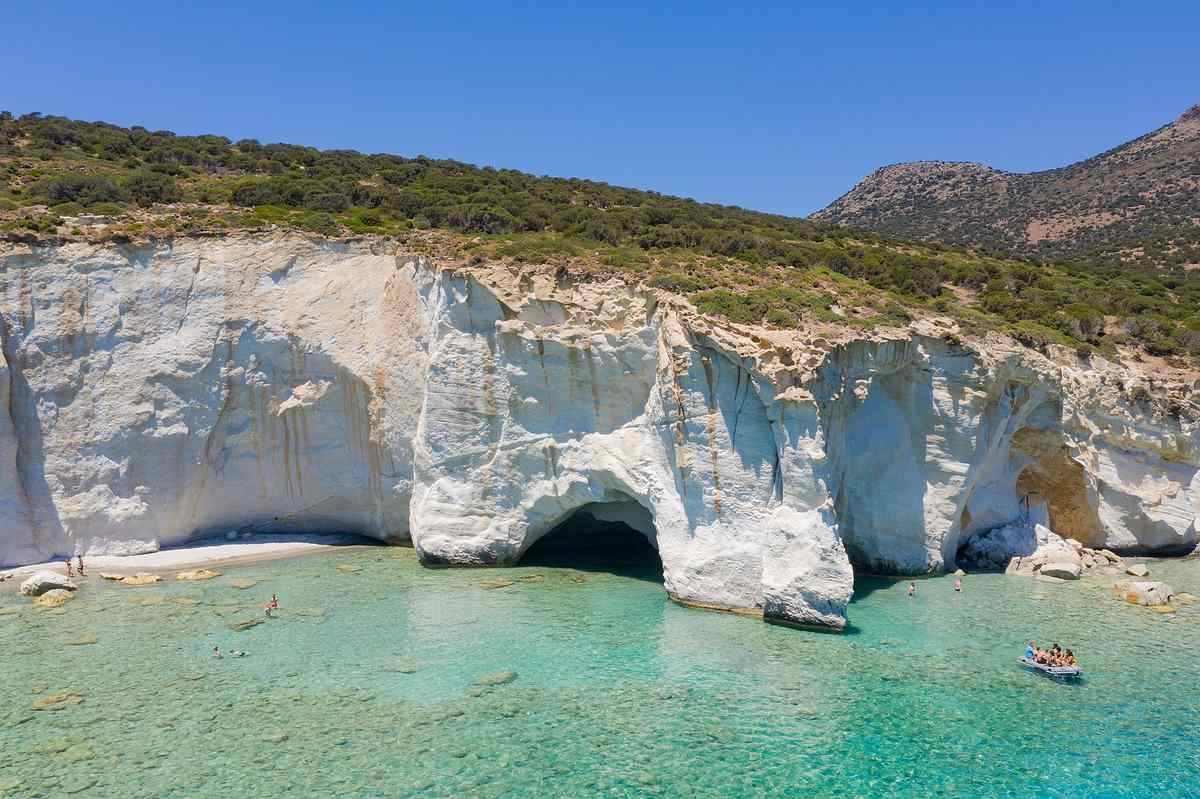
Milos caves range from the sea caves of Kleftiko and the collapsed cave of Sykia to Papafragas and the Glaronisia islets, carved by the volcanic coast. Plan boat trips and tours through My Greece Tours.
Caves are a dramatic chapter of the Milos travel guide. The sections below cover the main caves, the famous Kleftiko, the collapsed cave of Sykia, the Glaronisia islets and how to visit the caves.
What are the main caves on Milos?
The main caves on Milos are the sea caves of Kleftiko, the collapsed cave-beach of Sykia, the cave inlet of Papafragas and the sea caves of the Glaronisia islets. The volcanic coast has carved these striking caves, most reached by boat.
Milos hides caves along its coast. The volcanic rock carved them. The sea hollowed the cliffs. The boats reveal them.
Kleftiko leads the list. White rock towers above. Sea caves pierce the cliffs. Boats slip inside.
Sykia astonishes nearby. A collapsed cave forms a beach. Light pours through the roof. The scene amazes.
Papafragas and Glaronisia follow. An inlet cuts the rock. Basalt columns hide caves. The coast surprises.
The caves of Milos are a product of its volcanic geology, where soft, coloured rock has been hollowed and sculpted by the sea into a coastline riddled with caves, arches and inlets. The most spectacular cluster on the southwest coast at Kleftiko, a maze of white rock towers and sea caves once used by pirates, reached only by boat and the headline of any island cruise.
Beyond Kleftiko, the island offers a striking variety of caves. Sykia is a sea cave whose roof has collapsed, opening to the sky above a small beach, while Papafragas is a narrow cave inlet of turquoise water framed by rock, near the ancient site of Phylakopi. The volcanic Glaronisia islets, columns of hexagonal basalt, are pierced by caves of their own. The next section covers the most famous, Kleftiko.
What makes Kleftiko’s caves special?
Kleftiko’s caves are special for their towering white rock formations, tunnels and aquamarine water, set on the road-free southwest coast. The former pirate hideout is reached only by boat or kayak, letting visitors swim and paddle through its sea caves and arches.
Kleftiko crowns the Milos caves. White cliffs soar from the sea. Caves tunnel the rock. The water glows clear.
Pirates once sheltered here. The name means thieves. The caves hid their ships. The history adds romance.
Boats anchor in the cove. Swimmers explore the caves. Kayaks thread the arches. The blue water dazzles.
No road reaches it. The sea grants the only entry. The isolation keeps it pure. The reward runs deep.
Kleftiko is the most celebrated cave system on Milos and one of the most photographed spots in the Cyclades. Gleaming white volcanic rock rises in towers and arches straight from crystal-clear, aquamarine water, riddled with sea caves and tunnels that boats and kayaks can slip through. The cove takes its name from the Greek word for thieves, a nod to the pirates who once hid their ships in its sheltered, hidden waters.
What makes it unmissable is that you experience the caves from the water. Boats anchor in the cove and visitors swim, snorkel and kayak among the caves, arches and rock pools, with the white cliffs glowing overhead and the sea an unreal shade of blue. Because there is no road access, the only way in is by boat or sea kayak, which keeps the water pristine. A Milos cruise makes Kleftiko its centrepiece. The next section covers the collapsed cave of Sykia.
What is the cave of Sykia on Milos?
Sykia is a sea cave on the west coast of Milos whose roof has collapsed, opening it to the sky.
Sykia stuns with its open roof. A sea cave lost its ceiling. The sky pours light inside. The beach glows below.
Boats sail into the cavern. The entrance opens wide. The hull glides within. The walls rise around.
Light shafts onto the sand. The collapsed roof admits it. The effect turns magical. The cave dazzles.
The west coast hides it. No road reaches it. A boat trip finds it. The detour rewards.
Sykia is one of the most magical caves on Milos, a sea cave on the remote west coast whose roof has partly collapsed over time, opening the cavern to the sky. The result is a half-open grotto where a shaft of daylight pours down onto a small beach of sand inside, lighting the clear turquoise water in an almost theatrical way. Boats can sail directly into the wide entrance, gliding between the high rock walls.
Visiting Sykia is a highlight of many Milos boat trips, as the cave is reached only from the sea on the road-free coast. Inside, the combination of the open roof, the shaft of light, the small beach and the glowing water creates an unforgettable scene, ideal for a swim in a setting unlike anywhere else on the island. It pairs naturally with Kleftiko and the other southwest coast wonders on a full-day cruise. Our Milos boat tours guide covers the trips, and the next section covers the Glaronisia islets.
What are the Glaronisia caves on Milos?
The Glaronisia are small islets off the north coast of Milos, formed from columns of hexagonal basalt and pierced by sea caves.
Glaronisia rise in columns. Hexagonal basalt stacks the cliffs. Cooling lava shaped them. Caves cut the rock.
The islets sit off the north. Boats pause to marvel. The geometry astonishes. The geology impresses.
Sea caves pierce the stacks. The water laps inside. Snorkellers explore them. The rock glows dark.
A boat trip reaches them. The detour stays short. The columns reward a look. The coast amazes.
The Glaronisia, whose name means seagull islands, are a cluster of small uninhabited islets off the north coast of Milos, and they are among the island’s most remarkable geological sights. They are formed almost entirely of columns of hexagonal basalt, created as volcanic lava cooled and cracked into regular, geometric shapes, rising from the sea like a natural cathedral of dark grey rock, a formation rare enough to draw the curious.
The islets are pierced by sea caves that boats can approach and that snorkellers can explore, with clear water lapping at the foot of the columns. Most boat trips around the north of the island include a stop at the Glaronisia to admire the basalt and swim in the clear water beneath the cliffs, often combined with nearby Papafragas and the catacombs coast. The striking geometry makes them a favourite for photographs. Our Glaronisia guide covers them in detail, and the next section covers how to visit the caves.
How do you visit the caves of Milos?
You visit most Milos caves by boat, on a group cruise, a small private boat or a sea kayak, since Kleftiko, Sykia and the Glaronisia have no road access.
Boats unlock the caves. Cruises circle the coast. Kayaks slip inside. The sea grants access.
Kleftiko needs a vessel. Sykia does too. Glaronisia sits offshore. A boat reaches them all.
Group cruises cover the coast. A full day links the caves. Lunch comes included. Swimming stops follow.
Papafragas suits the land. A clifftop view reveals it. A scramble reaches the inlet. The coast opens up.
The great majority of the Milos caves are reached from the sea, so a boat trip is the way to experience them. A full-day group cruise is the most popular and affordable option, circling the coast to take in Kleftiko, Sykia and the Glaronisia with swimming stops along the way, while smaller private boats and sailing trips reach quieter spots, and a sea kayak lets you paddle right into caves the bigger boats cannot enter.
A handful of caves can be seen from land. Papafragas, on the north coast near Phylakopi, is a narrow cave inlet that can be viewed from the clifftop and reached by a steep scramble down to its turquoise water. For the spectacular sea caves of the southwest, though, there is no substitute for a day on the water, which is why a boat trip is an essential part of any Milos visit. Plan it through our things to do in Milos guide and book ahead in peak season.
Timing and a little planning make a cave trip on Milos truly memorable. Choosing a morning departure rewards you with the calmest seas and the softest light on the white rock, and booking the popular full-day cruises a few days ahead secures a place in the busy summer season. Keep an eye on the forecast too, as a strong meltemi can shorten a route or cancel a sailing for safety, so a calm day is worth waiting for. With a boat to reach them and the right conditions overhead, the sea caves of Milos deliver some of the most spectacular swimming and scenery anywhere in the Cyclades.
What is the Papafragas cave on Milos?
Papafragas is a narrow sea cave and inlet on the north coast of Milos near Pollonia, where the sea has carved a slot between tall white cliffs to a tiny beach. It is the rare Milos cave a road reaches.
The cave sits below the ancient site of Phylakopi on the island’s north shore, where a deep channel of brilliant turquoise water threads between towering pale rock walls into a sheltered pocket of sand. A steep, rough path drops from the roadside viewpoint to the water, so sturdy shoes and care on the descent matter, and the small beach fills quickly on a calm summer day. Divers and confident swimmers explore the connected caverns, while the clifftop view alone rewards the short stop for those who prefer to stay dry.
Papafragas is the easiest of the Milos caves to include on a self-drive day, unlike the boat-only wonders of the southwest coast, because a road runs right to the clifftop above it. The name recalls a local legend of a priest, papas, who is said to have used the hidden inlet as a private harbour, and the site pairs naturally with the nearby ancient ruins of Phylakopi and the fishing village of Pollonia a short drive away. Timing a visit for the morning beats both the heat and the crowds on the narrow path. Our Papafragas guide covers how to reach it, and the next section looks at the volcanic story behind the caves.
How did the caves of Milos form?
The caves of Milos formed through the island’s volcanic origin, where soft layers of pale volcanic rock and ash were carved over thousands of years by the sea, wind and waves into caverns, arches, tunnels and collapsed skylights along the coast.
Milos is a volcanic island, and its coastline is built from soft, light-coloured rocks such as tuff, pumice and perlite laid down by ancient eruptions. These yielding stones erode readily where the sea pounds the cliffs, so waves and wind have hollowed out the sea caves, sculpted the white towers of Kleftiko, and opened the huge collapsed roof of Sykia. The same geology gives the water its luminous colour, as pale rock and fine seabed reflect the light into vivid blues and greens. Different mineral deposits tint the cliffs too, streaking the coast with white, grey, ochre and rust-red bands that make the Milos shoreline one of the most colourful in the Cyclades and turn each cave into a frame for the water within.
The volcanic past also left the island riddled with caves inland and along the shore, and human history has used them. Early islanders quarried obsidian, the volcanic glass traded across the prehistoric Aegean, and later generations turned coastal caves into shelters, and even fishermen’s boat garages, the syrmata, cut into the soft rock at villages like Klima. The caves of Milos are the visible signature of a landscape shaped by fire and then by the sea. That volcanic heritage runs through the whole island, from the coloured cliffs of its beaches to the hot springs that still bubble along parts of the coast, and the caves are its most photogenic expression. Our things to do in Milos guide sets the caves in the wider island.
Frequently Asked Questions
What is the most famous cave on Milos?
The most famous caves on Milos are at Kleftiko, on the road-free southwest coast. Here gleaming white volcanic rock rises in towers and arches from crystal-clear aquamarine water, riddled with sea caves and tunnels that boats and kayaks can pass through. Once a pirate hideout, from which it takes its name meaning thieves, Kleftiko is the headline stop on almost every Milos boat trip, where visitors swim, snorkel and kayak among the caves. It is reached only by boat or sea kayak, which is part of what keeps the water so clear and the setting so pristine.
Can you visit Milos sea caves by boat?
Yes, visiting the sea caves by boat is the main way to see them, since the most spectacular caves, including Kleftiko, Sykia and the Glaronisia islets, have no road access. Full-day group cruises circle the coast taking in these caves with swimming stops, while smaller private boats, sailing trips and sea kayaks offer quieter or more adventurous ways to explore. Sea kayaks in particular can paddle into caves and arches that larger boats cannot enter. Boat trips depart from Adamas and Pollonia, and booking ahead is recommended in the busy summer season.
Is Sykia cave worth visiting on Milos?
Yes, Sykia cave is well worth visiting and is one of the most magical spots on Milos. It is a sea cave on the remote west coast whose roof has partly collapsed, opening it to the sky so that a shaft of light falls onto a small beach inside, lighting the clear turquoise water dramatically. Boats can sail straight into the wide, half-open cavern, making it a memorable swimming stop. As it is reached only from the sea on the road-free coast, Sykia is usually visited as part of a Milos boat trip, often combined with Kleftiko and the other southwest coast wonders.
Are there any caves on Milos you can reach without a boat?
Papafragas on the north coast is the main Milos cave you can reach without a boat, a narrow sea inlet between white cliffs with a short, steep path down from the roadside near Pollonia. The famous southwest caves at Kleftiko and Sykia have no road access and need a boat or sea kayak. Inland, the volcanic rock also holds worked caves such as the fishermen’s syrmata boat shelters cut into the shore at villages like Klima, which you can see on foot. For the dramatic sea caves, though, a boat trip remains the way in.
Are the caves of Milos safe to swim and snorkel in?
The sea caves of Milos are safe to swim and snorkel in under calm conditions, and swimming stops inside caverns like Sykia are a highlight of a boat trip. Crews anchor at sheltered spots and hand out snorkelling gear, and the clear, deep water is ideal for exploring the rocks and cave mouths. Conditions depend on the wind, so trips favour calm mornings and skippers avoid exposed caves when the meltemi builds. Following the guide’s directions, wearing water shoes on rocky landings and staying clear of low cave roofs keeps a visit safe.
How long does a Milos cave boat tour take?
A full-day Milos cave boat tour usually takes six to eight hours, looping the coast to take in Kleftiko, Sykia and other caves with several swimming and snorkelling stops, and often lunch on board. Shorter half-day trips of three to four hours cover a section of the coast and fewer caves. Tours depart from Adamas and Pollonia, typically in the morning when the sea is calmest, and return in the late afternoon. The exact route and timing depend on the operator, the boat and the sea conditions on the day. Private charters can lengthen or shorten the itinerary to suit, and sailing trips trade a slower pace for time under canvas between the caves.
Which caves does a Milos boat tour usually visit?
A Milos boat tour usually visits the road-free caves and rock formations of the southwest and north coasts, led by Kleftiko with its white arches, tunnels and pirate caverns. Most full-day trips also stop at Sykia, the collapsed sea cave lit through its open roof, and pass the basalt columns and low caves of the Glaronisia islets. Swimming stops at clear coves such as Kalogria break up the route. The precise line-up depends on the operator and the wind, though Kleftiko and Sykia anchor almost every cave-focused cruise from Adamas.