
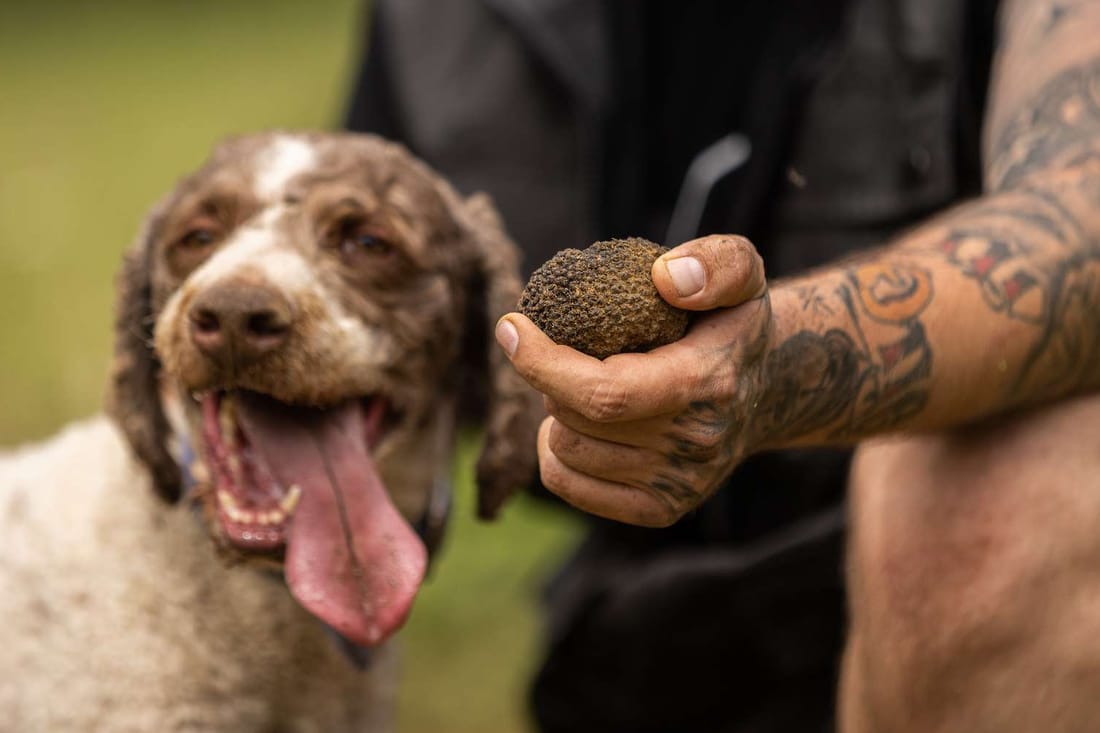
A Meteora truffle hunting outing lasts 3.5 hours, with a walk beside a truffle hunter and his dogs, pasta cooked as you watch and a museum visit, all for a private group of up to 10 people. The dog finds the truffle by smell and the hunter digs it by hand, because every truffle species gives off dimethyl sulfide.
Surveys of Greek truffles list four groups, the summer, whitish and white truffles and Tuber brumale, and a planted truffle orchard needs 7 to 10 years before it produces. Travellers building a longer trip around the rocks can find every region on the Greece Tours homepage.
What is Meteora truffle hunting, and how do trained dogs find the truffles?
Meteora truffle hunting means searching the woods near the rocks for truffles with a scent-trained dog. The dog smells the truffle under the soil and marks the spot. The hunter then digs it out by hand with a small tool.
Meteora truffle hunting targets the truffle. A truffle is the fruiting body of a subterranean ascomycete fungus, one of the species of the genus Tuber. Truffles are ectomycorrhizal fungi, so they are found in close association with tree roots. Truffle fungi produce their fruiting bodies underground. A hunter therefore looks for them among trees.
The partnership between fungus and tree is called an ectomycorrhiza. It is a non-penetrative association with plant roots. The fungal network helps the plant take up water and minerals. That is why Meteora truffle hunting follows the trees. Ectomycorrhizae form on the roots of around 2% of plant species, woody plants such as birch, beech, willow and pine.
Meteora truffle hunting borrows an animal’s job. A truffle grows underground, so wind and water cannot spread its spores. Animals that eat fungi do that instead, and the truffle’s volatile compounds attract them. Birds, deer, voles, squirrels and chipmunks are named carriers. Read the animals of the Meteora woods to see which live around the rocks.
Meteora truffle hunting follows a smell that draws animals too. Both truffle pigs and dogs recognise dimethyl sulfide, and every truffle species carries dimethyl mono-, di- and trisulfides. The sweaty-musky aroma is close to androstenol, a pheromone that humans also produce. A study of Greek Tuber aestivum and Tuber borchii found 45 volatile compounds in them.
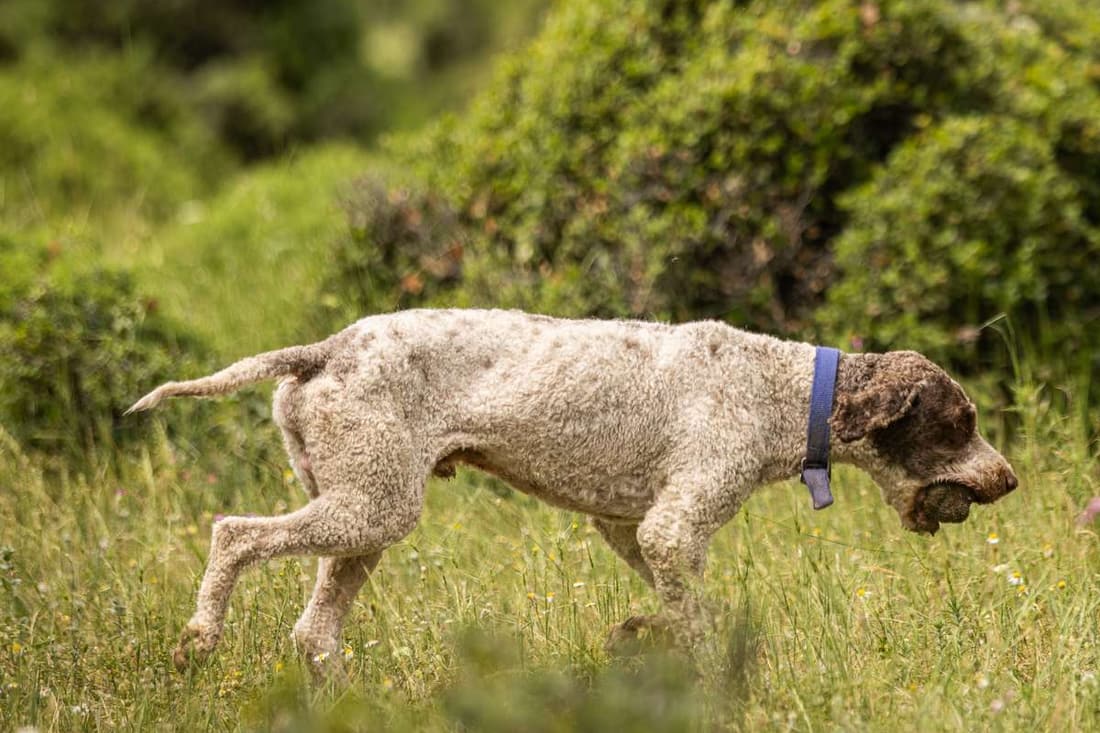
Training starts with scent. One handler pairs the smell with a click and then a treat: sniff, click, treat. Later lessons add competing odours and loud noises. A dog’s nose does the rest, since its sense of smell is much greater than ours. A walk for Meteora truffle hunting then runs in five steps:
- The dog works the ground with its nose down.
- It marks a find by gently pawing the ground, barking or sitting down.
- The hunter scrapes away the topsoil with a trowel, because a truffle lies an inch or two below the surface.
- The hunter removes the truffle with more precision and less damage than a pig’s rooting.
- The dog gets a treat for each find.
Meteora truffle hunting needs a trained nose, not a special breed. The Lagotto Romagnolo is an Italian breed recognised for its truffle-finding capability. Labrador Retrievers and Dobermans can learn the work too. Pigs find truffles from birth but eat them, while dogs have no appetite for truffles. Italy bans pigs for truffle hunting because their digging damages the fungus.
Which truffle species does Meteora truffle hunting look for in the Pindus woods?
Meteora truffle hunting takes place in Thessaly, in northwestern Greece. Surveys of Greek truffles record the summer truffle, the whitish truffle, the white truffle and the Tuber brumale group. Researchers call the Périgord black truffle not native to Greece.
Meteora truffle hunting works with the genus Tuber, and the summer truffle, Tuber aestivum, is found across Europe. Its Burgundy form, Tuber uncinatum, has brown or black skin with pyramidal warts 3 to 9 mm wide. Its aroma is hazelnut-like. The summer form has paler flesh and a weaker aroma. Molecular analysis shows the two are one species.
A truffle identification database lists the hosts of Tuber aestivum: oaks, hazel, beech, hop-hornbeam, lime and four pine species. The flesh at maturity runs from white-ochre to dark brown with thin veins. The smell is weak and mushroom-like, then more pleasant. The host list matters for Meteora truffle hunting because a truffle lives next to its host’s roots.
The Périgord black truffle, Tuber melanosporum, is round and dark brown, with black-brown skin and small pyramidal cusps. It reaches 10 cm across. Its flesh is white at first, then dark, with white veins. The scent recalls undergrowth, strawberries, wet earth or dried fruit with a hint of cocoa. Holm oak, hazel and cherry are among its hosts.
The white truffle, Tuber magnatum, grows with oak, hazel, poplar and beech and reaches 12 cm across. Its flesh is pale cream or brown with white marbling. The scent leans on 2,4-dithiapentane. It is found mainly in the Langhe and Montferrat areas of Piedmont. Greece is on the list of other countries where it has been found.
The whitish truffle, Tuber borchii, is also called bianchetto and measures 1 to 3 cm across. Young bodies are slightly velvety and white. Mature ones have a smooth, reddish ochre surface with brown markings, and the smell turns unpleasant, like kitchen gas. It grows in oak groves and, more rarely, under conifers. Its range runs from Finland to Italy.
Thessaly appears in the record of Tuber pulchrosporum, a black truffle described from Greece and Bulgaria. Its Greek finds include Koziakas Mt. in Trikala, the regional unit where Meteora truffle hunting takes place. The Pindus Mountains rise near Meteora, and the Meteora area guide covers the rocks and the towns. The paper reports the species from northern and central Greece.
- Tuber aestivum and Tuber borchii both appear among the Greek collections of the genus, and the Tuber borchii ones were identified by molecular methods.
- Tuber magnatum is one of the five Aestivum-clade species recorded in Greece.
- The Greek specimens of the Melanosporum clade fall in the Tuber brumale complex, the Muscat or winter truffle of Southern Europe, or are Tuber melanosporum, found near truffle orchards.
When does Meteora truffle hunting run, and in which months does each species ripen?
Meteora truffle hunting follows the species calendar. Summer truffles ripen in summer, and Burgundy and Alba white truffles in autumn. Black truffles ripen in winter. Bianchetto runs from winter into spring, so each species has its own window.
Wikipedia says Tuber truffles fruit throughout the year, depending on the species. They sit buried between the leaf litter and the soil. The season for Meteora truffle hunting therefore depends on which species a hunter wants.
- Summer truffle, Tuber aestivum: harvested from late spring to August.
- Burgundy truffle, Tuber uncinatum: harvested from September to late December, and sometimes until late January.
- Périgord black truffle, Tuber melanosporum: fruiting bodies develop from April to June, and the harvest runs from November to March.
- Alba white truffle, Tuber magnatum: fruits in autumn, and the Alba market is busiest in October and November.
- Bianchetto, Tuber borchii: fruits from December to June, with Italian collection from mid-January to the end of April.
A Greek study of summer truffles and bianchetto took its samples in April and July. It calls that the time when truffles mature in the region. Its April start is earlier than the range Wikipedia gives for the summer truffle.
The Alba white truffle forms its fruiting bodies in winter and needs at least 0.4 °C while they form. In the north, its range ends roughly where the mean winter temperature falls to 0 °C. A rugged slope can hold a warmer pocket beyond that line.
Wikipedia’s page on the Alba white truffle says it thrives at sites averaging about 13 °C a year. Spring averages about 12 °C and summer about 22 °C. Autumn averages about 14 °C and winter about 5 °C. Summer air above about 24 °C thins the mycelium in the topsoil.
Seasons come by species, and Meteora truffle hunting is no exception. An Oregon State University Extension guide to native truffles says each species fruits in its own season. That season marks the time to harvest.
The season tends to fall in the rainy period, though truffles turn up in almost any month. The guide advises looking when mushrooms of other species are abundant above ground.
The same guide says only ripening truffles give off aroma, so smell is the sign of ripeness. Truffles picked before they are mature never develop aroma or reach the quality chefs expect. Truffles picked at the right time keep ripening after harvest. In Meteora truffle hunting, the smell comes first and the digging second.
Poachers scoop away immature truffles before they are ready to be harvested, says Wikipedia. Truffles are protected by law and need years to grow.
A species calendar says when a truffle ripens, not when an outing runs. The dates of a booked Meteora truffle hunting outing sit on its listing page, so read them there.
How do oak woods, limestone soil and rain shape Meteora truffle hunting?
A truffle needs a living host tree, well-drained soil that is neutral or alkaline, and summer rain. These three needs decide where Meteora truffle hunting can search in the oak woods of Thessaly and the Pindus.
Truffles cannot live alone. The fungus partners with tree roots and cannot survive in the soil without its host. The host list on Wikipedia reads beech, birch, hazel, hornbeam, oak, pine and poplar. Each host tree marks a spot where Meteora truffle hunting can look.
The Pindus mixed forests hold deciduous oaks at the lower elevations. The list includes Quercus frainetto, Quercus pubescens, Quercus cerris, Quercus trojana and Quercus petraea. Evergreen oaks grow on dry, rocky, south-facing slopes. These oak woods form the backdrop for Meteora truffle hunting on the Pindus side of Thessaly.
A travel article says truffles grow in oak or chestnut forests at the foothills of mountains. It lists Crete, Meteora, Olympos and Komotini. A Greek news feature calls Kalambaka a city of truffles. It says the rich presence of the fungus draws global attention.
Black truffles grow 5 to 50 cm deep, in loose calcareous soil, close to the roots of their host. They suppress the plants around that host, which creates the impression of a burnt area. French calls it a brûlé. The fungus does this by parasitizing the roots of other plants.
Tuber truffles prefer clay-rich or calcareous soils that are well drained and neutral or alkaline. Calcareous soil is the ground rule for Meteora truffle hunting. The soil of the Alba white truffle averages a pH of about 7.7. Bianchetto grows well at pH 7 to 8.
Limestone appears in the Pindus. The Vikos-Aoos Geopark says limestone, dolomite and flysch form the Tymfi range. The rock under the pillars has its own story in the rock and soil guide to Meteora.
Thessaly occupies the east side of the Pindus watershed. The Trikala and Larissa lowlands form a central plain inside a ring of mountains. The main climate is hot summer Mediterranean, and summer rains add to the fertility of the plains. Meteora truffle hunting works inside that climate.
Rain is the third need behind Meteora truffle hunting. A study of 49 years of harvest data from Spain, France and Italy tied black truffle yield to summer rainfall. Wet summers gave bumper harvests the next winter. Dry summers gave meagre hauls. The University of Cambridge team links summer rain to the vitality of the host trees.
The Alba white truffle copes less well with short summer droughts than the black and Burgundy truffles. Its skin, the peridium, is less developed, so it loses more water. It tolerates summer rain up to 180% of normal.
Farming a truffle takes patience. Between 7 and 10 years pass before host trees build the fungal network and come into production. In Epirus, Greek truffle-tree work used local oaks and hazelnuts.
The Epirus case study cites the adaptability of imported plants, biodiversity protection and the risk of introducing unwanted truffle species. Meteora truffle hunting, by contrast, is a walk in natural woods.
Since the 19th century, truffle production has fallen by 97 to 99%, to 20 to 50 tonnes a year. Wikipedia names rural flight and the wars of the 20th century as reasons. Flocks and shepherds who pruned trees for feed and fuelwood vanished. Former truffle plantations then turned into closed forests that no longer produced truffles.
What does a Meteora truffle hunting listing include, from the woods to the table, and who does it suit?
One Meteora truffle hunting listing joins three parts in 3.5 hours. You walk the woods beside a truffle hunter and his dogs. A lunch of pasta made in front of you follows, then a museum visit. The group is private and holds up to 10 people.
The walk comes first. Woodland below Meteora is the setting, at the fringe of the Pindos mountains. Meteora itself stands near the Pineios river and those mountains. You walk beside the hunter and his dogs and search for truffles that the listing calls rare. Meteora truffle hunting on this listing is a walk with a search at its centre.
The meal is the second part. Meteora truffle hunting here turns the finds into lunch. According to the listing, you eat the truffles with pasta made right in front of you. The title calls the meal a lunch. Walk and meal sit in one booking, so you arrange nothing separately.
The third part is a museum visit, which the title of the listing names. It shares the 3.5 hours with the walk and the lunch. Our page on the museums and living traditions of Meteora covers that side of the area. For more food stops, see the wider tasting day below the rocks, a separate outing.
The listing gives 3.5 hours for all three parts together, so plan a half day. The format is a private group, and one booking covers up to 10 people. Your own party makes up the group. The listing also carries a skip-the-line label. A Meteora truffle hunting outing leaves the rest of the day free for other stops.
Meteora truffle hunting on this listing runs in two languages, English and Greek, with English as the default. Free cancellation applies, and a booking needs at least 20 hours of notice. A booking made at 18:00 can start no earlier than 14:00 on the next day. The calendar lists start dates on consecutive days, not only on set weekdays.
The listing is filed under Kalabaka. Meteora lies between Kalabaka and the village of Kastraki, in the Trikala regional unit. The same town is spelled Kalambaka, Kalampaka and Kalabaki, so search under all four. The listing shows 4.8 stars from 2 reviews, a small base to weigh before you book.
- Small private parties: one booking covers a group of up to 10 people, and the listing carries the private group label, so nobody outside your party joins.
- Families with children: the booking form sets no lower age limit.
- Dog lovers: Meteora truffle hunting here means a walk beside the hunter’s dogs through the woods.
- Visitors on a short stay: the outing takes 3.5 hours, carries free cancellation and needs 20 hours of notice.
- English and Greek speakers: both languages are offered on the listing.
- Visitors without a car: Kalabaka has a railway station on the Palaiofarsalos-Kalambaka line, and the municipality of Meteora has its seat there.
- People with mobility limits: the listing sets no fitness grade for the woodland walk, so ask the operator about the ground before you book.
What else do travellers ask about Meteora truffle hunting?
Cooks use a truffle sparingly because of its high price and strong aroma. Supplies come as fresh produce or preserved in a light brine. After Meteora truffle hunting, travellers ask about smell, serving, oil, storage, cost and the Greek words.
What does the truffle on a Meteora truffle hunting walk smell and taste like?
A truffle smells sweaty and musky, close to the pheromone androstenol, which also occurs in humans. The taste is savoury umami. Very aromatic white truffles are pungent enough to irritate the eye when cut or sliced.
How do cooks serve the truffle after a Meteora truffle hunting walk?
Cooks shave a truffle raw onto warm, simple food like buttered pasta or eggs. Heat drives off the aroma. Its aroma compounds mix well with fats like butter, cream and cheese. Thin slices also go into meats and stuffings.
How does truffle oil differ from the fresh truffles that Meteora truffle hunting finds?
Truffle oil adds truffle flavour and aroma to a dish. It can be made from any oil, and plenty of bottles hold no truffle. Oils infused with real truffle list its scientific name in the ingredients. Nearly all others use one synthetic compound, 2,4-dithiapentane.
How long does a fresh truffle keep in the fridge after a Meteora truffle hunting walk?
Wrap each cleaned truffle in kitchen paper and seal it in an airtight container. Keep it at 1 to 2 degrees Celsius, without letting it freeze. Change the paper every 24 hours. One supplier advises eating a fresh truffle within 4 to 5 days.
Why does a truffle from Meteora truffle hunting cost so much at the table?
A truffle grows underground, so hunters find it with an animal that has a refined sense of smell. Its high value rests on its rarity and its intense savoury flavour. The strong aroma means cooks use only a little of it in each dish.
What are the Greek words for truffle and mushroom on a Meteora truffle hunting day?
Truffle is troufa, written Τρούφα. Mushroom is manitari, written μανιτάρι, with the plural manitaria. Manitari names the fruiting body of a fungus, and Greek writing calls a truffle an underground mushroom. The listing offers Greek as well as English, so these words help on the walk.