
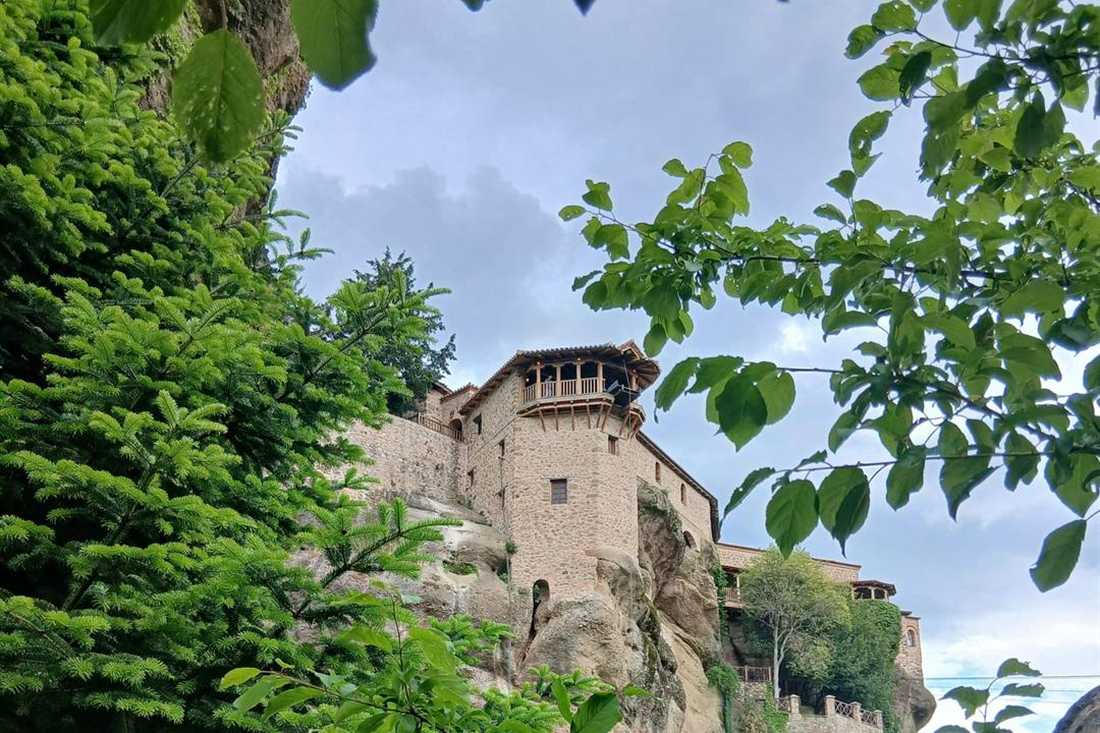
Meteora cultural experiences span six working monasteries: monks live at three, nuns at two, and the sources disagree on the sixth. Down in Kalambaka, you can enter a Byzantine church, a natural history museum and a 360 degree show that lasts one hour.
A Sunday service is the one item on the Visit Meteora list that is worship, and that blog gives it a three-hour morning window. If you are building a longer trip, the Greece Tours homepage lists every region we cover.
What are Meteora cultural experiences, and who are they for?
Meteora cultural experiences are the ways a visitor meets living Orthodox culture around the rocks. They include worship, chant, museums, a Byzantine church, a modern show, old books, icons, monastic life and guided visits. You take part as an observer, a listener or a reader.
Meteora cultural experiences stand on a mixed site. Wikipedia’s list counts three of Greece’s 21 World Heritage sites as mixed: Meteora, Mount Athos and Mount Olympus. Mixed means the listing rests on both natural and cultural value. Wikipedia says the name Meteora means “lofty” or “elevated”.
Meteora cultural experiences draw on 24 monasteries. Wikipedia says they were built on the rock pillars, mainly from the later fourteenth century. Six remain, and those six form the World Heritage listing. The Visit Meteora blog calls them the “6 active monasteries”. Wikipedia adds that locals rank the complex just behind Mount Athos in importance.
The Visit Meteora blog says the area offers more than a hasty visit to the monasteries and viewpoints. Wikipedia says Meteora lies between Kalabaka and Kastraki. These Meteora cultural experiences fall into distinct kinds, and each gives you a different part to play:
- Living worship: you are an observer of a community at prayer in a monastery.
- Sacred music: you are a listener to Byzantine chant.
- Museums: you are a viewer of what the monasteries and a museum in Kalambaka hold.
- A Byzantine town church: you step into an old church in Kalambaka itself.
- One modern immersive show: you are an audience member in the town.
- Libraries and icon collections: you are a reader and a viewer of old books and icons.
- The monastic way of life: you are a learner of the daily rhythm of monks and nuns.
- Guided cultural tours: you are a guest, and a guide ties the other kinds together.
If you want the rocks and the practical basics first, start with the Meteora travel guide. Then plan the Meteora cultural experiences around it.
What is each Meteora monastery dedicated to, and who lives there?
The monasteries behind Meteora cultural experiences each have a main church, the katholikon. It is named for a saint, a feast or the Trinity. Monks live at Great Meteoron, Varlaam and Holy Trinity. Nuns live at Rousanou and Saint Stephen’s. Sources disagree about Saint Nicholas Anapausas.
Meteora cultural experiences at the monasteries start with the community on each rock. The dedications and head counts below come from Wikipedia and from question-and-answer pages on Kalampaka.com. The head counts are those sources’ own figures, not a count from today.
Sources disagree on two of these monasteries. Wikipedia’s Meteora article lists Rousanou and Saint Nicholas Anapausas as no longer in active use. Wikipedia’s Rousanou page, Kalampaka.com and the Visit Meteora blog all point the other way.
- Great Meteoron: monks. Kalampaka.com says the founder first built a church to the Mother of God. The second church, to the Transfiguration of Christ, became the katholikon. The same page puts the community at about 300 monks in the sixteenth century and three now. Wikipedia says a visiting queen became the first woman allowed in, in the early nineteen-twenties.
- Varlaam: monks. Its katholikon is dedicated to All Saints, and Wikipedia gives the monastery that second name, Agion Panton. Kalampaka.com says about 35 monks lived here in the sixteenth century. It says the monastery declined from the seventeenth century until a new community arrived in the early nineteen-sixties, and it counts seven monks.
- Rousanou: nuns. Wikipedia says the monastery is now used as a convent. Its katholikon is dedicated to the Transfiguration of Christ but honours Saint Barbara. Kalampaka.com says her memory is celebrated on 4 December. It says a nun from Kastraki kept the monastery open for twenty years, and the present nuns settled here in the late nineteen-eighties.
- Saint Nicholas Anapausas: the sources disagree. Wikipedia calls it a former monastery, while Kalampaka.com says one monk lives there. The same page says it closed for fifteen years from the early nineteen-eighties and began to run again in the late nineteen-nineties. Wikipedia says the name Anapausas means “resting”, and Saint Nicholas is honoured in its main church.
- Holy Trinity: monks. Kalampaka.com says the katholikon honours the Holy Trinity. Wikipedia lists Agia Triada as the Greek name, meaning Holy Trinity. It says fifty monks lived here at one time and five by the early twentieth century.
- Saint Stephen’s: nuns. It became a convent in the early nineteen-sixties, says Wikipedia, which gives it the largest community of the six, 31 nuns at its latest count. Kalampaka.com says an old tradition links the monastery with female monasticism. It says the old katholikon honours Saint Stephen and the newer one honours Saint Charalambus. An orphanage and primary school ran here in the nineteen-seventies, with the nuns as teachers.
Among Meteora cultural experiences, the dedications fall into three kinds. Two churches honour the Transfiguration, which Wikipedia says the Eastern Orthodox calendar ranks among its Twelve Great Feasts. Others honour a saint: Nicholas, Stephen, Charalambus or Barbara. One honours the Holy Trinity and one honours All Saints.
A monastery can carry two dedications, as Great Meteoron, Rousanou and Saint Stephen’s do. That is worth knowing before you plan Meteora cultural experiences around one rock.
Can a visitor attend a service at a Meteora monastery?
Yes. Visit Meteora lists a Sunday service at a monastery among nine things to do that visitors never thought of. It is one of the Meteora cultural experiences you take in by listening, with psalms, hymns and readings.
The Visit Meteora page says the liturgy takes you back to the Byzantine Middle Ages. It names what builds that mood. The list includes Byzantine hymns, no artificial lighting, priests in decorated Byzantine dress, candles and incense.
The same list also holds a via ferrata climb, rafting and rock climbing. The service is its one item that is worship. If you add it to your Meteora cultural experiences, plan an early start. The page tells readers to arrive early in the morning and gives the service a three-hour window.
Wikipedia says the Greek parish tradition puts two services on a Sunday morning. Orthros comes first, and the Divine Liturgy follows right after it. Orthros is the Greek word for early dawn or daybreak. A monastery, by tradition, holds Orthros every day and ends it just after sunrise.
The Divine Liturgy has three parts. The first, the Liturgy of Preparation, is private, and only the priest and the deacon take part. The second is the Liturgy of the Catechumens, the public part, with the reading of Scripture. The third is the Liturgy of the Faithful, with the Great Entrance, the Creed and Holy Communion.
Wikipedia gives the order of a Greek Sunday morning in detail. It is a useful map for Meteora cultural experiences built around a service.
- Orthros includes the Six Psalms: Psalms 3, 37, 62, 87, 102 and 142. The priest says twelve silent prayers during them.
- On Sundays the priest reads a Gospel passage before Psalm 50. Greek traditions chant that psalm.
- The Canon follows, a run of odes with short litanies between them. The deacon censes the church around the Ninth Ode.
- The Praises close Orthros: Psalms 148, 149 and 150. The Great Doxology is chanted on Sundays and feast days.
- The Divine Liturgy opens with the priest’s blessing of the kingdom of the Father, the Son and the Holy Spirit. Litanies, three antiphons and the Small Entrance with the Gospel Book follow.
- In the Liturgy of the Faithful, the Great Entrance carries the chalice and paten to the altar. The Creed, the Lord’s Prayer and Holy Communion follow, then the dismissal.
The format is fixed. Wikipedia says the readings and hymns change with the season and the feast. That means Meteora cultural experiences built on a service bring different readings and hymns across the year.
If a service is on your list of Meteora cultural experiences, this page names no time for it. Each monastery’s own notices set the times. The Meteora monasteries opening hours page covers the gate times.
What does Byzantine chant add to Meteora cultural experiences?
It adds the sound of sung prayer. Wikipedia says the liturgical music of the Byzantine Rite is sung without instrumental accompaniment. Visit Meteora lists Byzantine hymns as part of a Sunday service, one of the Meteora cultural experiences it recommends.
Wikipedia notes that Orthodox Christians do not count chanting as music. They see it as sacred melody and prayer. A service is chanted from start to end by the clergy, the choir and the congregation. So at one of the Meteora cultural experiences with a service, the chant is the prayer itself.
Wikipedia traces Byzantine music to the hymns of the Byzantine Empire’s court and church ceremonies. After the fall of Constantinople, it lived on as the sung chant of Orthodox worship. Wikipedia quotes UNESCO calling it a living art that has existed for almost 2,000 years. A Sunday service is where Meteora cultural experiences let you hear it.
The chant in Meteora cultural experiences that include a service is Byzantine chant. It runs on eight modes called the octoechos. The name joins the Greek words for eight and for sound or mode. Wikipedia says that, in a modified form, the system is still the foundation of chant in the Byzantine Rite.
Wikipedia says the system is thought to come from Syria, where it was known in the sixth century. Legend credits the monk John of Damascus with creating it. Orthros draws on this system: an eight-tone cycle of hymns for each day of the week, covering eight weeks.
Wikipedia also notes a custom. A choir or psalmist finds the starting tone by singing “ne-ne” at the very beginning.
If a service is part of your Meteora cultural experiences, listen for a second part under the melody. It holds a drone and is called the ison. Wikipedia defines it as a drone note, or a slow-moving lower vocal part, that accompanies the melody. It does not turn the chant into harmony.
Before the ison, Wikipedia says, Greek church chanting was purely monophonic, with one melody and no second voice. The ison is widely believed to have entered Byzantine practice in the sixteenth century. The first notated ison dates from the nineteenth century.
Very quick and very slow pieces take the ison as a hum, without words. Pieces at normal speed sing the words with the melody, Wikipedia says.
Singers gather on the kliros, the part of an Orthodox church set aside for the choir. Wikipedia describes the chanters’ stand there, the analogion. One type has two or three sides and turns, so singers can refer to their texts.
An older Greek design is octagonal with a flat top. It is still in use on Mount Athos and at other ancient monasteries.
The notes themselves have a written history. Wikipedia says melodic neume notation developed from the tenth century. By the early nineteenth century, it had grown so complex that only highly skilled chanters were able to read it. Three reformers, among them Chrysanthos of Madytos, simplified the symbols. Their system is the base of Greek Orthodox chant today.
No source behind this page says how sound carries inside a Meteora church, so this page does not guess. The sources do describe the chant itself: sung prayer in eight modes over a drone. That is enough to know what you are hearing at a service among the Meteora cultural experiences.
What do the monastery museums add to Meteora cultural experiences?
Three of the six monasteries run a museum: Great Meteoron, Varlaam and Saint Stephen. Between them the rooms show icons, gold-embroidered cloth, silver vessels and carved crosses. The local guide Kalampaka.com lists an exhibition room at Rousanou and no museum at the other two.
These rooms sit inside houses where monks or nuns still live. Kalampaka.com calls the Saint Stephen room both a museum and a sacristy. Museum rooms are one strand of Meteora cultural experiences. They show objects that the communities made, received as gifts or kept.
- Great Meteoron: Kalampaka.com calls the portable icons of the monastery museum important.
- Varlaam: Wikipedia says the museum is open to travellers and holds relics and ecclesiastical treasures.
- Saint Stephen: the old refectory became the museum, according to Wikipedia and Kalampaka.com.
- Rousanou: Kalampaka.com places an exhibition room on the upper floors but names no objects.
- Holy Trinity: the guide says unknown looters stripped its sacristy during the German occupation.
- Saint Nicholas Anapafsas: the guide names a crypt where the monastery once kept its codices and relics, and no museum.
For Meteora cultural experiences built on icons, the Great Meteoron guide names the pieces. Mary Paleologina, sister of the second founder, donated two icons. One shows the Virgin among 14 busts of saints. The other shows Doubting Thomas.
The same room holds a diptych from the 14th century. It also holds twelve 16th-century icons of saints. A set of icons shows the twelve great feasts, also from the 16th century.
The guide also lists the monastery’s gold-embroidered cloth. It names an altar cover from the 14th century and stoles from the 14th and 15th centuries. A mitre dates from the middle of the 16th century. Two embroidered epitaphioi survive, one from the 14th century. Deacon Daniel’s carved wooden crosses date from the early 16th century.
Saint Stephen’s museum suits Meteora cultural experiences that centre on worship objects. It holds post-Byzantine icons and gold-embroidered vestments. Its silverware includes communion cups, censers and reliquaries. Wooden and silver crosses sit beside an episcopal throne. The sanctuary gate of the iconostasis shows the Annunciation at its top.
Varlaam adds a craft story to Meteora cultural experiences. Kalampaka.com lists post-Byzantine icons, a gold-embroidered epitaphios, vestments, miniatures and silverware in its sacristy. It adds that Varlaam ran an organised gold-embroidery workroom in the sixteenth century. A Book in Greece review mentions old videos about monastic life in the same museum.
Holy Trinity shows how fragile these collections are. The guide says a gang stole the old carved iconostasis in the late twentieth century. If museum rooms matter among your Meteora cultural experiences, plan on Great Meteoron, Varlaam or Saint Stephen.
What do the Natural History Museum of Meteora and its Mushroom Museum show?
Among Meteora cultural experiences, this one is about nature. The museum’s own site counts 350 animal species and 250 mushroom species, all set in dioramas. It calls the Mushroom Museum one of the rarest of its kind in the world.
Its mammals come from Greece, Europe and other continents. The bird collection holds extinct, rare and threatened species from Greece and the world, says the site. Dioramas place each animal in the ecosystem it lives in. Greek and foreign sculptors and painters made them by hand, one by one.
The site names these dioramas:
- Meteora
- The wetland
- Forests and a small forest
- Action and hunting scenes
- The Arctic
- Wildlife on mountains and rocks
- A beech mushroom forest and a pine mushroom forest
The Mushroom Museum shows sculpted mushrooms, each made one by one. The site says they copy the real colour, shape and size. Displays follow the habitat: beech, pine, fir, oak or meadow. Mushrooms appear in up to three stages of growth. A specially shaped room copies the real environment for walking among them.
Murals by local painters and sculptors link mushrooms to myths and folk tradition. An augmented-reality area then explains their food and healing value. As a stop among Meteora cultural experiences, the museum covers nature, where the monastery rooms cover worship.
Two outside sources describe this stop among Meteora cultural experiences in Kalambaka. The Meteora Tours highlights page says one side shows regional wildlife as taxidermy and the other side celebrates mushrooms. It says children enjoy the interactive exhibits.
A Book in Greece review calls the museum small and says it has ramps and elevators. The same review says the mushroom section holds models, not live specimens. Visitor reviews on the museum’s site put animals on the ground floor and mushrooms above.
The museum also runs a hall named Asproparis. It adds art shows and workshops to the Meteora cultural experiences in town. The hall holds events for up to 100 people. The site lists school visits, research, mushroom outings and a magazine called Fysiorama. Issue 43 covers the mammals of Meteora.
The site’s stated aims include studies of the natural world in the wider Pindos area. Its news page says the museum completes 12 years of operation.
One of the bookable Meteora cultural experiences pairs the museum with a truffle hunt. GetYourGuide lists “Meteora: Truffle Hunt with Dogs, Lunch & Museum Visit”. It lasts 3.5 hours and runs in English and Greek.
The listing opens with a walk in the woods below Meteora with a truffle hunter and his dogs. It carries skip-the-line and private-group labels. Our Meteora food tour is the one that adds the truffle hunt and lunch.
The museum’s own menu also lists guided tours, truffle hunting, truffle hunting with horses and “nights at the museum”. Its site is the place to check these Meteora cultural experiences before you plan around them.
What does the Church of the Dormition add to Meteora cultural experiences?
It is the one medieval monument that survives in Kalambaka, and it needs no climb. Kalambaka’s Dormition church, named for the Virgin Mary, is a Byzantine basilica. It was built over an early Christian church and keeps a tall marble pulpit in the middle of the nave.
Meteora cultural experiences are not all up on the rocks. This church stands in the old part of Kalambaka. The Greek Edition guide calls it easy to overlook, because attention goes to the monasteries above town.
The church was the cathedral of the bishopric of Stagoi, the Byzantine name of the town. Its name points to a church feast. Wikipedia says the Dormition marks the “falling asleep” of Mary, meaning her death, and her being taken up into heaven.
Sources give different ages for this stop among the Meteora cultural experiences. Wikipedia describes a late eleventh or early twelfth century church on the remains of a late antique one. The Religious Greece portal says the tenth century or the start of the eleventh. One tour seller dates the church to the fourth or fifth century.
The portal explains the layers. The pillars, columns and outer walls follow the plan of an early Christian basilica underneath. Parts of its floor mosaic survive. The portal also records repairs in the sixteenth and nineteenth centuries.
These Meteora cultural experiences need only a short walk, and the church holds five details to look for.
- The pulpit. It is marble and tall, and the portal calls it the only surviving pulpit in the middle of a church. It was rebuilt mainly from pieces of the early Christian pulpit.
- The floor. Parts of an early Christian mosaic floor survive. The tour seller says the older floor shows in places under the stone one.
- The icon screen. The portal lists a carved wooden screen and portable icons.
- Two documents. The portal lists two fourteenth-century texts on the north wall of the esonarthex, the inner narthex. One is a chrysobull of Emperor Andronikos III. It grants privileges and confirms the boundaries of the bishopric of Stagoi. The other is a patriarchal sigil issued for the same purpose.
- The painted walls. Wall paintings survive from the twelfth century and from fifteen seventy-three. An inscription names the later painters as the priest Kiriazis and Neophitos.
An ambo, says Wikipedia, began as a raised platform where the scriptures were read during the service. The same tour seller adds a stone carving of a peacock, an early Christian symbol of immortality. It also lists a small exhibit beside the church with icons, manuscripts and vestments.
The portal lists the Holy Metropolis of Stagoi and Meteora and puts the building under the Archaeological Service of Trikala. The tour seller says it is still an active church for the locals. So it is a church in use, not only one of the Meteora cultural experiences.
The Greek Edition guide allows about thirty minutes here. It pairs the stop with a walk through old Kalambaka, or with an hour to spare before sunset. That fits a short slot between Meteora cultural experiences on the rocks.
Another tour company’s guide says day tours from Athens can include the church on sunset itineraries. You can also go on your own. The Kalabaka town guide covers the rest of the town.
Is the Terra Immersia 360 degree show one of the Meteora cultural experiences?
Yes. Terra Immersia is a 360 degree projection hall in Kalambaka. It shows the landscape, history and spirit of Meteora with images, sound and light. The GetYourGuide listing calls it a cultural experience and gives the visit one hour.
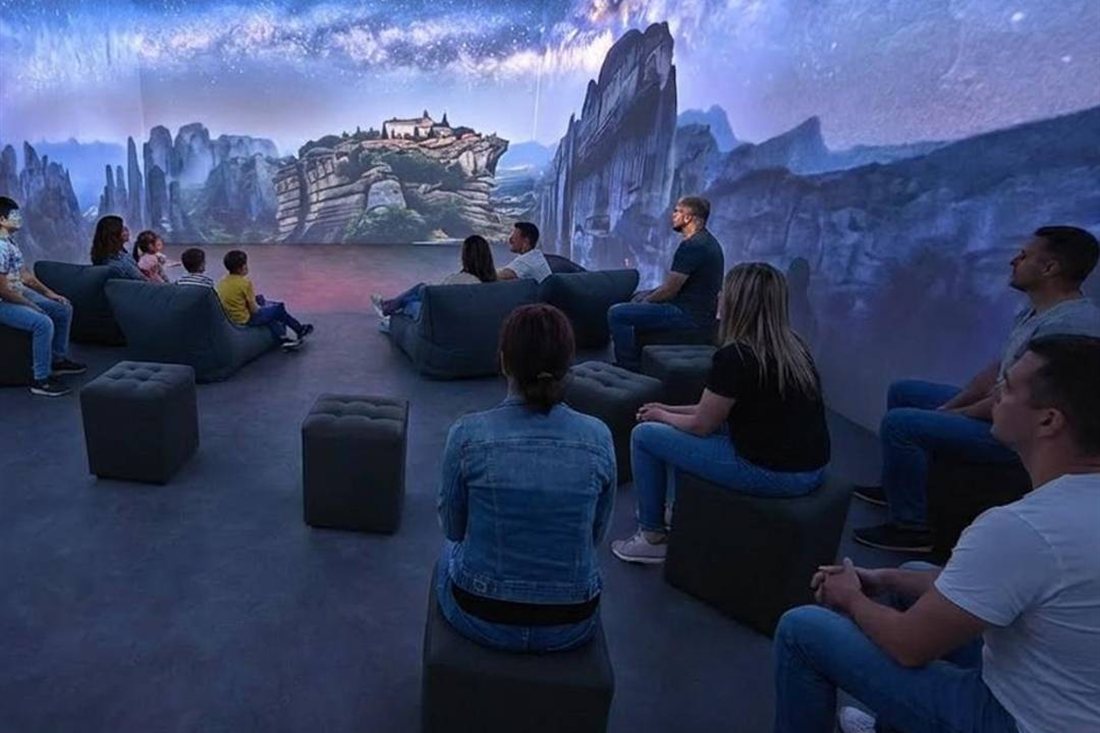
A local tour seller calls it a modern cultural attraction and says it is not a traditional museum. The listing places it in Kalambaka, just minutes from the monasteries. It is the one entry among Meteora cultural experiences built on a modern show rather than a building.
The seller’s page names three parts of the visit.
- The main hall, where 360 degree projection, sound and lighting surround you.
- An interactive floor that reacts to your movement.
- An exhibition area with visual material and information on the history, geology and cultural importance of Meteora.
The seller’s tour page lists three exclusions: food and drinks, transport and a guided tour. The GetYourGuide listing gives no language list. So this is a visit without a guide.
How long does it take? The listing says one hour. The seller’s own pages differ: one says about forty-five minutes, the other thirty to sixty. Leave the full hour free.
If you plan Meteora cultural experiences with a wheelchair, note that the listing marks this visit as wheelchair accessible. It also shows free cancellation and asks you to book at least 15 minutes ahead. It lists three age groups: adults 18 and over, children 6 to 17, and infants 5 and younger.
The seller says the show suits hot or rainy days, and suits families because it needs no hiking or steps. A bad weather day still leaves you an indoor stop among your Meteora cultural experiences.
The seller suggests seeing the show before Great Meteoron or Saint Stephen’s, which both sit above Kalambaka. Its reason is that the show gives a more atmospheric introduction to the landscape, history and cultural identity of Meteora.
None of the pages names the scenes in the show or the team behind it. Check the listing before you book if that matters to you. Choose this one of the Meteora cultural experiences for the setting and the exhibition, not for a guided talk.
Why do monastery manuscripts and icons belong in Meteora cultural experiences?
The Great Meteoron holds the largest manuscript collection at Meteora. A catalogue of all six monasteries counts 1,124 codices, and 610 of them sit in the Great Meteoron. Books like these are the written side of Meteora cultural experiences.
A codex is a handwritten book with bound pages, the form that replaced the scroll. Wikipedia says the word applies to older manuscript books. It links the spread of the codex to the rise of Christianity. Early Christians used the format for the Bible and for liturgical texts.
Copying books was honoured work in Byzantine monasteries. Wikipedia names Mount Athos and Patmos among the houses that excelled at it. It says the monks there produced miniatures, manuscripts, paintings and goldsmith work. That passage does not name Meteora. It describes the wider tradition behind Meteora cultural experiences, not a Meteora scribe.
Books are not the only written record. The reading list in the Meteora article includes an early twentieth-century piece titled “Serbian and Byzantine letters of Meteora”. The title shows that scholars study letters from Meteora as well as books.
The sources for this page do not say whether visitors can enter a monastery library. So the books stay part of the story here, not a stop on Meteora cultural experiences.
Icons are the painted side of Meteora cultural experiences. Wikipedia says the common icon is painted on a wood panel with egg tempera. In Greek, the word for painting an icon is the word for writing, so Orthodox sources say “icon writing”.
The same article says icons taught the faithful who did not read. It calls them “words in painting”. In the Orthodox view, to kiss an icon shows love for Christ himself, not for wood and paint. Saint Basil wrote that the honour paid to the image passes to the original.
One icon painter has a link to Meteora. Theophanes the Cretan, a painter of the Cretan school, died in the sixteenth century. Wikipedia says historians believe he worked at Saint Nicholas Anapausas. His name belongs in any account of Meteora cultural experiences that involves icons.
Crete was an important centre of painted icons. For ease of transport, Cretan painters specialised in panel paintings. At one time Heraklion boasted at least 120 painters. The members of the Theophanes family left over one hundred extant works across Greece.
How does the day run for a monk or a nun at Meteora?
A cenobitic monastery runs its day in common. The daily office, the work and the meals are all done together under an abbot. The Great Meteoron took that rule in the fourteenth century. No source for this page says Meteora cultural experiences include joining this day.
Wikipedia says monks and nuns follow a similar ascetic discipline. Their habit is the same, except that a nun wears an extra veil, the apostolnik. It adds that monastics live away from the world in order to pray for the world.
That rule follows a book. Athanasius the Meteorite gave the Great Meteoron a cenobitic rule based on the Typikon of the Mount Athos monasteries. A typikon is a liturgical book. It sets out the order of the office and the hymns of the liturgy. Wikipedia says such books arose to regulate monastic life.
In the Orthodox world, the horologion holds the fixed parts of the daily office. Wikipedia lists Vespers, Compline, the Midnight Office, Matins, the Little Hours and the prayers before meals. That list gives the shape of the daily office. It is not a schedule for Meteora cultural experiences.
The Jesus Prayer is personal practice, not a service. It is not one of the Meteora cultural experiences you can attend. The prayer is a single line: “Lord Jesus Christ, Son of God, have mercy on me, a sinner”.
Monks and nuns count the prayer on a prayer rope. A common rope has 33 knots, one for each year of Christ’s life. Wikipedia adds that others use the rope too.
Work is part of the common life too. Wikipedia’s Meteora article describes workrooms at Saint Stephen for painting, embroidery, incense-making and needlework. Those crafts belong to Meteora cultural experiences, yet the article does not say visitors can watch them. Saint Stephen became a convent in the nineteen-sixties.
The same article lists a kitchen and a hospital at the Great Meteoron. The kitchen stands near the refectory, the dining hall of the monks.
The table is part of worship. In an Orthodox monastery the trapeza counts as a sacred place. An icon with a burning oil lamp always stands in it. The service of the Lifting of the Panagia ends the meal.
The size of that company has changed. In the sixteenth century the Great Meteoron held over three hundred monks, says Wikipedia. As of twenty fifteen, the article counts three monks there, seven at Varlaam and 28 nuns at Saint Stephen. Those small communities stand behind Meteora cultural experiences today.
A monastery can follow the opposite way, called idiorrhythmic. Both terms come from Greek. Cenobitic joins koinos, common, and bios, life. Idiorrhythmic joins idios, particular, and rhythmos, rule. Wikipedia glosses it as “following one’s own devices”. The sources for this page call the Great Meteoron’s rule cenobitic.
Visitors do not watch this day. A traveller review on book-in-greece.com calls the nuns at Rousanou warm and welcoming. For why monks first climbed these rocks, read the history of the Meteora monasteries. No source here gives a timetable for the day, so this page gives none.
Which guided Meteora cultural experiences can you book?
Six GetYourGuide listings sell guided Meteora cultural experiences. They run from 3 hours on foot to 13 hours from Athens. Five carry a private group tag, and each one lists its own languages.
A listing counts among Meteora cultural experiences when its own text names a place with a story. These six name monasteries, the Monks’ Prison and a prehistoric cave. Every detail below comes from the listing data.
- The Holy Spirit Rock and Monks’ Prison hike. At 3 hours, it is the shortest of the Meteora cultural experiences here, and it is listed under Kalambaka. English and Greek are offered. The listing says you hike with a local guide past sacred paths and ancient caves. It bars ages under 7 and over 76.
- Trikala, Theopetra and Meteora private tour. It lasts 5.5 hours in a guided minibus for up to 8 people. The listing offers English, French, Romanian and Greek. It says you learn the history of the UNESCO landscape and explore 1 monastery. Pickup is available.
- Private highlights tour. The Kastraki listing lasts 4 hours and covers 3 to 4 monasteries, with photo stops at viewpoints. Seven languages are offered, the widest choice among these Meteora cultural experiences: English, Italian, Spanish, Greek, Japanese, Korean and Chinese. The booking form caps the group at 4.
- Private day tour with a local guide. The Kalabaka listing lasts 5 hours and runs in English. It says you visit monasteries and learn their history from your guide. Pickup is available.
- Morning tour of the monasteries. The Kalabaka listing lasts 4 hours in English. Its text opens on the first light of dawn on the rock towers. It is tagged small group, with a private option and pickup.
- Monasteries and Theopetra Cave from Athens. At 13 hours, it is the longest of these Meteora cultural experiences, and it runs in English. It is listed under Athens. The text says the cave dates from 137,000 BC. Pickup is available.
Match the format to what you want from Meteora cultural experiences. The hike is the one listing built on a walk, and its text names no monastery. The 4-hour and 5-hour tours name monasteries, and the 5-hour one adds the guide’s history.
Two listings add Theopetra Cave to Meteora cultural experiences. Wikipedia puts the cave 3 km south of Kalambaka. The village of Theopetra holds the Theopetra Cave Museum.
Wikipedia cites radiocarbon evidence for human presence at least 50,000 years ago. The Athens listing gives 137,000 BC and calls the cave’s structure the oldest known artificial one. Wikipedia lists a low wall from about 21,000 BC among unverified claims.
Want the private formats side by side? Our Meteora private tour page compares them.
What do the Greek Orthodox words on a monastery visit mean?
Ten Greek Orthodox words name the rooms, rites and roles of a monastery. Four of them appear in Wikipedia’s Meteora article. Learn them before Meteora cultural experiences that enter a church.
Sources spell one word two ways. Wikipedia gives katholikon or catholicon, and hegumen, hegumenos or igumen. Every spelling names the same thing.
- Narthex: the entrance area of a church, at the west end of the nave. One or three doors lead from it into the nave.
- Katholikon: the main church of a monastery. A new katholikon went up at St Stephen’s in the late eighteenth century, which makes it the newest of the Meteora structures, Wikipedia says.
- Iconostasis: a wall of icons and religious paintings between the nave and the sanctuary. It grew out of the Byzantine templon, a change complete by the fifteenth century.
- Theotokos: a title of Mary used in Eastern Christianity. Common English forms are Mother of God and God-bearer. In AD 431 the Council of Ephesus decreed that Mary is the Theotokos.
- Liturgy: the Divine Liturgy, Theia Leitourgia, is the Eucharistic service of Eastern Christian rites. Three forms are in common use in the Byzantine rite: John Chrysostom, Basil the Great and the Presanctified Gifts.
- Kellia: cells, the small rooms where a monk or a nun lives and prays. In the sixteenth century the Great Meteoron had over three hundred monks living and worshipping in its cells.
- Trapeza: Greek for table. In Eastern Orthodox monasteries it names the refectory, the dining room where the monks meet for communal meals.
- Hestia: the monastery kitchen. Wikipedia names one at the Great Meteoron, a dome-shaped building near the refectory, and one at St Stephen’s.
- Skete: a monastic community that allows relative isolation but also shared services and resources. Wikipedia calls an early community at Meteora the Skete of Stagoi.
- Hegumen: the head of a monastery, a title close to abbot. The head of a convent of nuns is a hegumenia.
Read the first three as a route through a church on Meteora cultural experiences. The narthex is the entrance, and doors from it open into the nave. The iconostasis then stands between the nave and the sanctuary.
A katholikon can have two narthexes, Wikipedia says. The inner one is the esonarthex and the outer one is the exonarthex. Both are used for special services.
How do the cultural stops of Kalambaka fit around a monastery visit?
Plan Meteora cultural experiences in two halves, with the monasteries in the morning and the town in the afternoon. The Dormition church, the Meteora Natural History Museum and the Terra Immersia show sit in Kalambaka. The show’s listing puts it just minutes from the monasteries.
The two halves follow the map. Wikipedia places Kalambaka at the foot of the Meteora massif, with the monasteries near the town. The Greek Edition guide calls the distances short. It tells readers to allow far more time than the kilometres suggest.
The monastery half sets the clock, so fix it first. The same guide gives a visit length for each one. Great Meteoron takes 60 to 90 minutes and Varlaam 45 to 60. Rousanou takes 30 to 45 minutes inside, and Saint Nicholas Anapafsas and Saint Stephen take 30 to 45 each. Holy Trinity takes about an hour with the approach.
- Morning on the rocks: Great Meteoron and Varlaam add up to 105 to 150 minutes by those figures. Saint Nicholas Anapafsas adds 30 to 45 more.
- Afternoon in town: the Dormition church needs about 30 minutes, the same guide says. The Terra Immersia show lasts 1 hour per its listing. The museum gets a short slot, because none of the guides names a visit length for it.
Why add a church to a monastery day? The Greek Edition guide calls it a reminder. The religious history of the area was not confined to monasteries on rock pillars. Meteora cultural experiences reach down into the town as well as up onto the rocks.
The meteora-tours.com highlights page calls the museum small, which fits a short slot. The same page says not every monastery opens every day. Check each monastery’s own days before you fix the plan. Our Meteora monasteries opening hours page carries the gate times, and this page names none.
The evening belongs to the town. The Greek Edition guide gives Kalambaka the evening after the monasteries close, with a walk and dinner. It adds the church for anyone with an hour before sunset. It also says Meteora is not a nightlife destination.
Kastraki is the other evening choice after a day of Meteora cultural experiences. Wikipedia lists it as a community of Kalabaka on the west side of the massif. The Greek Edition guide calls the village pleasant in the evening. The meteora-tours.com highlights page says the village square is lively in the evenings, with locals chatting at taverns.
Meteora cultural experiences still work without a car. The Greek Edition guide calls a local tour or a taxi the easiest way to reach the monasteries and viewpoints. It lists the Byzantine church and the restaurants of Kalambaka as walkable, and the old paths as walkable from Kastraki.
The meteora-tours.com highlights page adds that buses run from Kalambaka and Kastraki. The Greek Edition guide warns that a full day of road walking is harder than it looks. Heat, elevation, distances and staircases are the reasons. For the monastery order across a single day, read our one day in Meteora plan.
What do travellers ask about Meteora cultural experiences?
Travellers planning Meteora cultural experiences ask about guide languages, monastery days, craft workshops, the Theopetra cave and where to sleep. Each answer below names the listing or guide page it comes from.
Which languages do Meteora guides speak?
Guided Meteora cultural experiences list their languages. The private monks’ prison hike to Holy Spirit Rock offers English and Greek. The private highlights tour for up to four guests offers Greek, English, Spanish, Korean, Chinese, Japanese and Italian. Both lists come from the GetYourGuide listing data.
Do the monasteries keep one timetable?
No. The meteora-tours.com highlights page says each monastery closes on specific weekdays. A visit to a working monastery follows that timetable, and our Meteora monasteries opening hours page carries the current times.
Can you visit craft workshops in Kalambaka?
Meteora cultural experiences in town include craft workshops. The meteora-tours.com highlights page says you can browse workshops where artisans carve wood and paint icons. It also mentions the local folklore museum. Its visiting page adds shops that sell handmade icons, woven textiles and herbs from the nearby mountains.
Is Theopetra Cave a cultural stop?
Yes, it adds archaeology to Meteora cultural experiences. The Greek Edition guide puts the cave about 5 km from Kalambaka and lists finds from the Middle Palaeolithic onward. The meteora-tours.com highlights page says it lies 10 minutes from town, with finds dating back 130,000 years.
Do three or four monasteries fit into one day?
The meteora-tours.com FAQ answers three to four, depending on travel time, crowds and hiking. The Greek Edition guide names two or three monasteries as the better first visit, with viewpoints and a walk added.
Where do you stay for a cultural trip?
The Greek Edition guide gives Kalambaka the largest concentration of restaurants, cafés, shops and rooms. It puts Kastraki directly under the rocks. Building a trip around Meteora cultural experiences? Our where to stay in Meteora page sets the two bases side by side.