
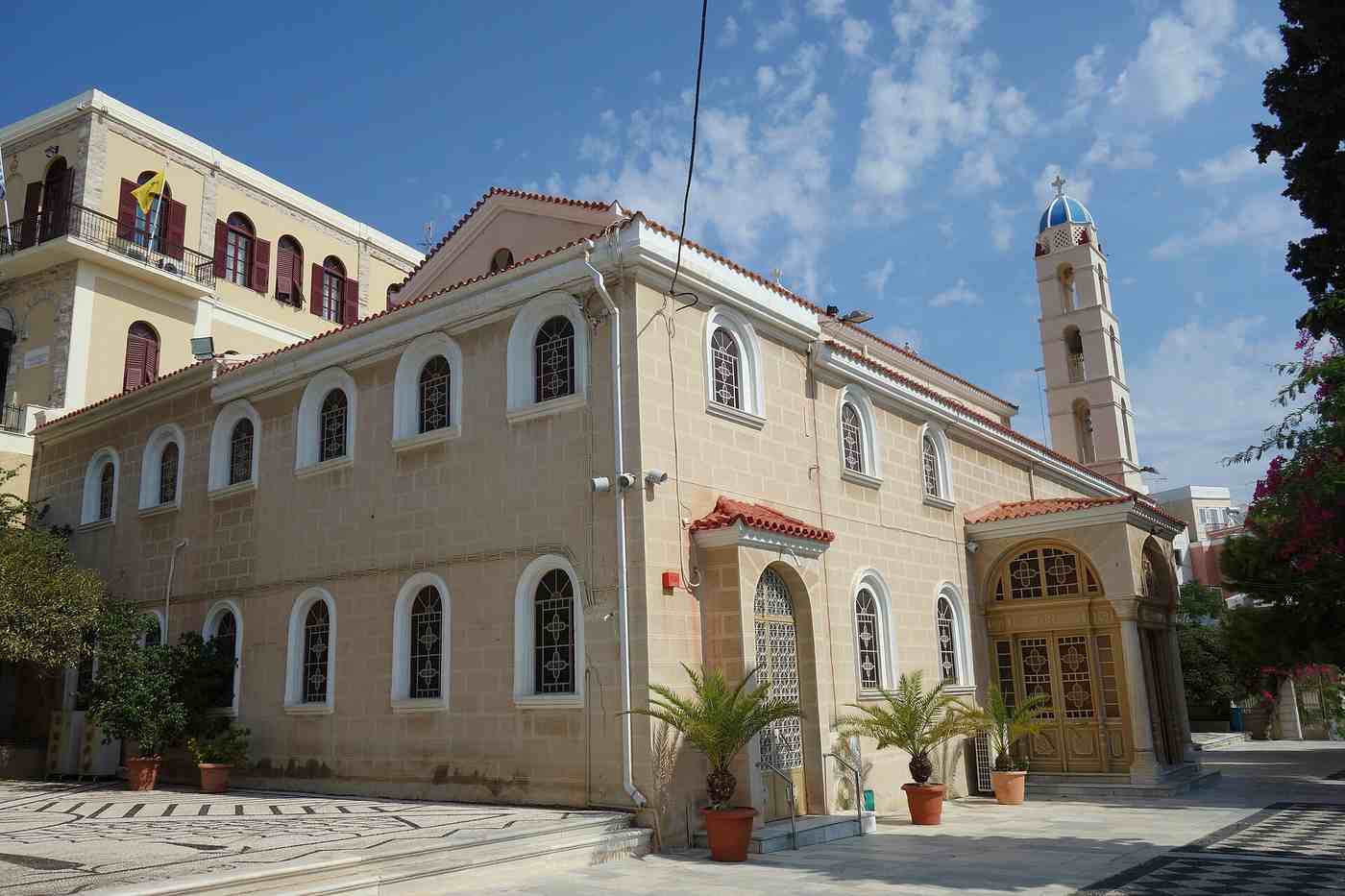
The Metamorphosis tou Sotiros, the Transfiguration of the Saviour, is the Orthodox metropolitan cathedral of Ermoupoli, the capital of Syros. The church stands in the upper town on the Orthodox-settled hill and serves as the seat of the Holy Metropolis of Syros. Plan the whole trip with Greece Tours.
The cathedral rises above the marble centre of Ermoupoli and faces the Catholic hill of Ano Syros across the capital. Builders raised the church in the nineteenth century in a neoclassical style, with marble features, a carved iconostasis, and painted icons. The wider island of Syros keeps the Metamorphosis as its principal Orthodox church.
What is the Metamorphosis Cathedral of Ermoupoli on Syros?
The Metamorphosis tou Sotiros, the Transfiguration of the Saviour, is the Orthodox metropolitan cathedral of Ermoupoli, the capital of Syros. The church serves as the seat of the Holy Metropolis of Syros and anchors Orthodox worship in the upper town.
The dedication honours the Transfiguration of Christ on Mount Tabor, a feast the Orthodox Church keeps on the sixth of August. Ermoupoli grew into the busiest Greek port of the nineteenth century, and its Orthodox residents wanted a cathedral to match that standing. The community funded marble, a carved iconostasis, and painted icons for the new church. The Metamorphosis took the rank of metropolitan cathedral, the principal seat of the local bishop. It rose in the upper town, on the Orthodox side of the divided capital. From the start the building carried both a religious and a civic weight, since the port measured its own importance partly through the scale of its churches.
Ermoupoli itself took shape after refugees from Chios and Psara settled the bay during the Greek War of Independence. The new city grew fast on trade, and marble public buildings rose along the harbour. The Metamorphosis belongs to that surge of confident nineteenth-century building. The cathedral shares the neoclassical language of the town hall, the Apollon Theatre, and the merchant mansions nearby. Residents who climb from the marble square to the church read one continuous architectural story. The building marks the Orthodox centre of a capital that also keeps a strong Catholic community on the ridge. That balance of two rites on one island gives Syros a church history matched by few places in Greece.
The cathedral works first as a living parish rather than a museum. Orthodox families of Ermoupoli baptise, marry, and bury their members within its walls. The feast of the Transfiguration each August draws the largest congregation of the year, when the church fills and the service spills toward the forecourt. Weekly liturgies keep the marble screen and the icons in daily use. The building therefore holds the rhythm of the Orthodox calendar for the whole capital. That constant use separates the Metamorphosis from a monument visited only for its stone, and it explains why the parish maintains the interior with such care.
The Metamorphosis also carries the memory of the men who paid for it. Shipowners and merchants of the new port financed the marble, the icons, and the fittings, and their names attach to the building’s history. The cathedral thus records the wealth that trade brought to Ermoupoli within a single generation. Its scale reflects a community that could afford to build large and finish quickly. The church stands today as a record of that confident era, kept in service rather than left as a relic. Visitors who read the interior read the story of a port that turned shipping money into stone and worship.
Why is the Metamorphosis the seat of the Holy Metropolis of Syros?
The Metamorphosis holds the seat of the Holy Metropolis of Syros because it is the metropolitan cathedral, the bishop’s own church. The metropolitan of Syros presides here, and the building serves as the administrative and liturgical centre of Orthodox worship on the island.
A metropolitan cathedral ranks as the chief church of a diocese, the seat from which the metropolitan governs. The Metamorphosis holds that rank for the Orthodox faithful of Syros and the neighbouring Cyclades under the same jurisdiction. Major services of the church year, ordinations, and diocesan ceremonies gather here rather than in the smaller parish churches. The bishop’s throne inside the nave marks the seat in a physical form. The cathedral therefore stands at the top of the local Orthodox hierarchy. Its role reaches beyond Ermoupoli to the surrounding islands that the metropolis serves from this single church in the capital.
The choice of Ermoupoli for the metropolitan seat followed the rise of the port. As the largest Orthodox city of the young Greek state, the town needed a cathedral equal to its population and its trade. The Metamorphosis answered that need at the scale of a metropolitan church. The seat concentrated the Orthodox administration of the region in the capital of Syros, close to the harbour and the town hall. That placement tied church authority to civic authority in one district. The cathedral thus grew into a centre of record for baptisms, marriages, and the wider religious life of the diocese.
The metropolitan of Syros carries pastoral duty for the Orthodox communities of the island and its dependent Cyclades. From the Metamorphosis the bishop oversees the parish clergy, the church schools, and the charitable work of the diocese. Great feasts bring the metropolitan to preside at the cathedral altar in full vestment. Ordinations of new priests take place under the same dome. These functions make the church far more than a large parish, since the whole regional structure of Orthodox worship runs through its sanctuary. The seat gives the building a weight of authority that its size and marble were designed to express.
The cathedral also represents the Orthodox community in the public life of a divided island. On national holidays and civic ceremonies the metropolitan of Syros speaks from the Metamorphosis, and the church stands beside the state in these events. The seat thereby links faith and civic identity in the capital. The parallel Catholic diocese keeps its own cathedral on the hill of Ano Syros, so the island supports two seats, one for each rite. That rare arrangement makes the Metamorphosis the Orthodox half of a shared religious map, and the metropolitan seat marks its rank within that balance.
Where does the Metamorphosis cathedral stand in the upper town of Ermoupoli?
The Metamorphosis stands in the upper town of Ermoupoli, on the Orthodox-settled hill that rises behind the harbour. The cathedral looks across the capital toward the Catholic hill of Ano Syros, and a short climb links it to the marble centre below.
Ermoupoli reads as an amphitheatre of houses around its bay, split between two low hills. The Orthodox residents settled the eastern rise, and the Metamorphosis crowns their side of the town. The Catholic community holds the western ridge, where the medieval settlement of Ano Syros climbs to its own cathedral. Between the two hills the marble heart of the city, Miaouli Square, holds the town hall and the harbour front. The Metamorphosis therefore marks one of the two crowns that frame the capital. Its position on the Orthodox hill gives the church command of the streets that rise from the port.
The cathedral sits above the dense lanes of the lower town, reached by stepped streets that climb from the centre. Neoclassical houses line the route, their painted facades stacked up the slope. The church occupies a raised terrace that opens a view back over the roofs to the water. That height lets the building serve as a landmark within the town, visible from the square and the quay below. The climb rewards walkers with both the cathedral and the townscape it commands. Its place in the upper town keeps the Metamorphosis at the centre of Orthodox Ermoupoli rather than at its edge.
The two-hill plan of Ermoupoli tells the religious history of Syros at a glance. The medieval Catholic town grew first on the western ridge under Venetian and later protection, gathered around its hilltop cathedral. The Orthodox port grew later around the harbour and up the eastern rise, crowned by the Metamorphosis. Each community built its principal church at the top of its own hill. The two summits face each other across the bowl of the capital, each marked by a cathedral. That mirrored layout makes the geography of the town a map of its dual faith, with the Metamorphosis anchoring the Orthodox side.
The setting also links the cathedral to the everyday movement of the capital. Streets from the port and from Miaouli Square converge on the climb to the Orthodox hill. Shops, homes, and small squares line the way up, so the walk passes through a lived-in quarter rather than an empty monument zone. The Metamorphosis stands at the head of that route, the goal of the climb through the upper town. Its forecourt gives a resting point and a viewpoint over Ermoupoli. The location thus ties the cathedral into the daily fabric of the city it serves.
How does the Metamorphosis express the dual Orthodox and Catholic faith of Syros?
The Metamorphosis expresses the island’s dual faith by crowning the Orthodox hill of Ermoupoli directly opposite the Catholic hill of Ano Syros. Two cathedrals face each other across the capital, and the two communities of Syros sometimes keep Easter on the same date.
Syros stands apart from most of Greece for its large Catholic population, a legacy of Venetian and Genoese rule and later French protection. The Catholic community centred on the medieval hill town of Ano Syros, gathered around its own cathedral. When the Orthodox port of Ermoupoli grew below, it built the Metamorphosis on the facing hill. The result set two cathedrals on two summits, one for each rite, within sight of each other. That arrangement is unusual in the country, where most towns keep a single dominant church. The Metamorphosis carries the Orthodox half of this shared skyline and marks the coexistence in stone.
The two hills of Ermoupoli read as a visible statement of the island’s balance. The Orthodox dome and towers of the Metamorphosis crown the eastern rise, while the Catholic bell tower of Ano Syros marks the western ridge. Residents of both faiths live in the streets that fill the bowl between the summits. The layout puts the two communities side by side rather than in separate towns. The Metamorphosis therefore does not stand alone but as one pole of a matched pair. Visitors who look across the capital from either hill see both cathedrals at once, the clearest image of Syros and its two rites.
The two communities of Syros sometimes celebrate Easter on the same date, a practice that draws attention across Greece. The Orthodox and Catholic calendars often place Easter on different Sundays, yet on Syros the two churches have in some years kept the feast together. The shared date lets the whole island mark its greatest festival at once, across both rites. The Metamorphosis holds the Orthodox observance while Ano Syros holds the Catholic one, and the town moves between the two. That coordination expresses a long habit of coexistence rather than mere tolerance, and it makes the island’s Easter a subject of its own.
The coexistence shows in daily life as much as in the great feasts. Mixed families, shared civic events, and neighbouring parishes tie the two communities together across the capital. The Metamorphosis and the Catholic cathedral each keep their own liturgy, calendar, and clergy, yet both serve one island. The rivalry of the two hills long ago settled into a working balance. The Orthodox cathedral stands as the marker of that balance on its side of the town. Syros thereby offers a model of two rites living within one small city, and the Metamorphosis gives the Orthodox community its visible centre.
What neoclassical features define the Metamorphosis cathedral in Ermoupoli?
The Metamorphosis follows a neoclassical design, with a symmetrical marble facade, a domed body, and a carved marble iconostasis inside. Builders raised it in the nineteenth century in the same idiom as the Ermoupoli town hall, tying church and civic centre into one style.
The facade presents a balanced neoclassical front of pale stone. A central entrance sits below classical detail, and the wall divides into clear horizontal and vertical lines. The design favours straight proportion over heavy baroque curves, in step with the taste of the merchant patrons who paid for it. That restraint matches the wider architecture of Ermoupoli. The cathedral reads as a temple front adapted to Orthodox use, a common move in nineteenth-century Greek church building. Marble carries the elevation and gives the front its cool, unified surface. The Metamorphosis thus wears the same civic dress as the public buildings on the square below.
The interior centres on a carved marble iconostasis, the screen that divides the sanctuary from the nave. Marble replaced the painted wood common in village churches, a choice that signalled the wealth of the parish. Craftsmen cut the screen into panels, columns, and a crowning tier, then set painted icons into the frames. The work belongs to the Cycladic marble tradition, above all the carving school of nearby Tinos that supplied churches across Greece. Gilded detail and the icons catch the light from the windows above. The screen gives the Metamorphosis an interior in step with the marble ambition of the town outside its doors.
Painted icons fill the frames of the iconostasis and hang along the walls of the nave. The images follow Orthodox convention, with Christ and the Virgin flanking the royal doors of the sanctuary. The Transfiguration, the scene of the cathedral’s dedication, takes its own place among the panels. The paintings date from the same nineteenth-century campaign that raised the building, so the interior reads as one programme rather than a patchwork. The marble bishop’s throne, the pulpit, and the floor repeat the pale stone and restrained lines of the exterior. That discipline keeps the focus on proportion and material across the whole church.
Materials tie the cathedral to its town and its region. The pale marble came from the quarries of the Cyclades, above all the celebrated stone of nearby Tinos, and Tinian carvers dressed much of the detail. Stone therefore links the Metamorphosis to a whole regional economy of extraction and craft. The consistent use of marble inside and out gives the building its unified surface from facade to floor. Ermoupoli spent its shipping wealth on this stone across its public and religious buildings alike. The cathedral shows the return on that spending at the scale of the island’s principal Orthodox church.
How does the Metamorphosis share the Ermoupoli skyline with Agios Nikolaos on Syros?
The Metamorphosis crowns the Orthodox hill of the upper town, while the blue-domed Agios Nikolaos rises above the Vaporia district by the sea. Two Orthodox churches mark the Ermoupoli skyline, and their domes give the capital its recognised profile from the harbour.
Ermoupoli carries more than one Orthodox landmark on its skyline. The Metamorphosis crowns the upper town on the eastern hill, the metropolitan seat of the island. Below and to the north the cathedral of Agios Nikolaos rises above the Vaporia quarter of sea-captain mansions, its blue dome facing the harbour. The two churches serve the same Orthodox community from different quarters of the capital. Together they give the town a skyline marked by domes and bell towers rather than a single profile. Arriving ferries pick out these forms above the roofs long before the port itself comes into clear view.
The two Orthodox cathedrals divide the town between them by district. Agios Nikolaos anchors the Vaporia quarter on the seaward edge, where mansions descend to the rocks and swimmers reach the water below the dome. The Metamorphosis holds the higher ground of the upper town as the metropolitan seat. Each church commands its own part of Ermoupoli, and residents attach to the parish nearest their homes. The pairing spreads Orthodox worship across the capital rather than concentrating it in one building. That distribution reflects the size of the nineteenth-century port, which grew large enough to need more than one great church.
Seen from a ferry entering the bay, the skyline organises the whole approach. The domes of the Metamorphosis and Agios Nikolaos mark the high points, the mansions cascade beneath them, and the harbour front closes the base. Across the water the Catholic bell tower of Ano Syros crowns the opposite ridge. The eye reads the religious map of the capital in a single view from the deck. Sailors once used these profiles as landmarks for the run into port. Arriving passengers still reach for cameras as the domes clear the breakwater, since the skyline of Ermoupoli begins with its churches.
The two Orthodox cathedrals and the Catholic hill together compose the emblem of the capital. Photographers frame the harbour with the domes above the roofs, a view repeated on postcards and posters of Syros. That visual shorthand markets the island as much as any brochure. The Metamorphosis contributes the crown of the upper town to this composition. Residents learn to read the skyline by its domes and towers from childhood. The church therefore works as both a place of worship and part of the civic image of Ermoupoli, sharing that duty with Agios Nikolaos below.
How do visitors reach and visit the Metamorphosis cathedral in Ermoupoli?
Visitors reach the Metamorphosis on foot from Miaouli Square, climbing the stepped lanes of the upper town in roughly ten minutes. The church works first as a parish, so hours follow the service times, and modest dress applies inside the sanctuary.
The walk starts at Miaouli Square, the marble heart of the lower town. The route leaves the square and enters the stepped lanes that climb the Orthodox hill. Neoclassical houses rise on both sides as the pavement turns to steps, and the church appears above the roofs within a few turns. The climb gains height quickly and takes about ten minutes at a steady pace. That short distance puts the cathedral within easy reach of the port, the ferries, and the cafes on the square. Signs and the church itself keep the direction clear, so no map is strictly required for the ascent.
Access to the interior follows the service times, since the Metamorphosis works first as a metropolitan parish church. Doors open for morning and evening liturgies and stay open around the feast of the Transfiguration in August. Outside services the forecourt and terrace remain open to walkers, with the townscape spread below. Modest dress applies inside, as at other Orthodox churches, with covered shoulders the usual expectation. No ticket is charged, though the parish keeps a candle stand and a donation box near the entrance. Visitors who plan around a morning liturgy see the marble screen and painted icons in use rather than empty.
Cars cannot climb the final stepped lanes, so drivers park in the lower town and continue on foot. The port and Miaouli Square hold the nearest parking and the main taxi rank. From the ferry quay the cathedral lies about fifteen minutes away on foot, taking in the square on the route. Cruise passengers on a short call can reach the church, tour the interior, and return within an hour. The stepped approach suits comfortable shoes rather than heels. That final car-free stretch keeps the upper town quiet and gives the cathedral its calm forecourt above the noise of the harbour.
A visit to the Metamorphosis fits easily into a wider walk through Ermoupoli. The route from Miaouli Square passes the town hall, the Apollon Theatre, and the neoclassical mansions of the merchant quarter. Walkers can pair the Orthodox cathedral with a crossing to the Catholic hill of Ano Syros for the full religious map of the town. Boat trips and guided tours of Syros often set out from the port a short distance below. The cathedral therefore slots into a day that reads the whole capital, from the marble square to the two hills that crown it.
Frequently Asked Questions
Is the Metamorphosis in Ermoupoli an Orthodox or Catholic church?
The Metamorphosis is Orthodox, and it serves as the metropolitan cathedral of Ermoupoli and the seat of the Holy Metropolis of Syros. The Catholic community of the island worships separately in the medieval town of Ano Syros on the facing hill. Syros is unusual in Greece for its large Catholic population, so the capital keeps two cathedral churches, one for each rite. The Metamorphosis on the Orthodox hill and the Catholic cathedral on the western ridge face each other across the town.
What does the name Metamorphosis mean?
Metamorphosis tou Sotiros means the Transfiguration of the Saviour, the moment in the Gospels when Christ appeared in radiant form on Mount Tabor before three of his disciples. The Orthodox Church keeps the feast of the Transfiguration on the sixth of August. The Ermoupoli cathedral takes its dedication from that event, and the scene appears among the painted icons inside. The feast day draws the largest congregation of the year to the metropolitan church.
Is the El Greco icon kept in the Metamorphosis cathedral?
No. The El Greco painting known as the Dormition of the Virgin is kept in a different Ermoupoli church, the Dormition of the Virgin, the Koimisis tis Theotokou, not in the Metamorphosis. Visitors sometimes confuse the two, since both are Orthodox churches in the same capital. The Metamorphosis holds its own carved marble iconostasis and painted icons from the nineteenth century, but the El Greco work belongs to the Dormition church elsewhere in the town.
How do the two communities of Syros celebrate Easter?
The Orthodox and Catholic communities of Syros sometimes celebrate Easter on the same date, which is unusual in Greece. The two Christian calendars often place Easter on different Sundays, yet on Syros the churches have in some years kept the feast together. The Metamorphosis holds the Orthodox observance while the Catholic cathedral on Ano Syros holds its own. The shared date lets the whole island mark its greatest festival at once, across both rites, and it has become a noted feature of the island.
How long does the walk to the Metamorphosis take from the port?
The walk from the ferry quay takes about fifteen minutes, and the climb from Miaouli Square alone takes roughly ten. The route runs uphill through the stepped lanes of the upper town, so comfortable shoes help. Cars cannot reach the cathedral terrace, and drivers park in the lower town near the square. Cruise passengers on a short call can reach the church, tour the interior, and return to the port within an hour.
What is inside the Metamorphosis cathedral?
The interior centres on a carved marble iconostasis, the screen that separates the sanctuary from the nave, set with painted icons. The furnishings include a marble bishop’s throne, a pulpit, and a marble floor, all in the pale neoclassical style of the exterior. The Transfiguration, the scene of the dedication, appears among the icons. The paintings and marble date from the nineteenth-century campaign that raised the building, so the interior reads as one coherent programme rather than a later patchwork.