
Kusadasi tours start in the port town of Kuşadası in Aydın Province on the Aegean coast of Turkey, across the Mycale Strait from the Greek island of Samos. The routes cover boat trips along the coast, Pigeon Island, the hill village of Şirince, the Dilek Peninsula National Park, the ancient cities of Priene, Miletus and Didyma, and the longer day trips to Ephesus and Pamukkale. Greece Tours lists the day trips that cross to Kusadasi from Samos.
This page covers what Kusadasi tours see on the coast and inland, which trips add Selçuk, jeep safaris, beaches and a Turkish bath, how visitors reach Kusadasi from Samos and İzmir, and which season suits each route. The tours below are checked on GetYourGuide and Viator and leave from Kusadasi, Selçuk and Samos.
What do Kusadasi tours cover?
Kusadasi tours cover the resort town of Kuşadası in Aydın Province, the castle on Güvercinada, boat trips to the bays of the Dilek Peninsula national park, the wine village of Şirince, the Cave of Zeus and Ephesus, the goal of cruise passengers.
Kuşadası, a district of Aydın Province with 130,835 residents in 2022, lies on the Aegean coast 95 km south of İzmir, and tourism is its primary industry. Kusadasi tours start from the port, where cruise passengers land on their way to Ephesus.
The Turkish Airlines travel guide names Ephesus, Güvercinada Castle, Mother Mary’s House, Kadıkalesi, the Davutlar region, Yılancı Foreland, Kirazlı Village and Şirince Village as the key places to visit in Kuşadası. Travellers from the Greek side join Kusadasi tours on a Kusadasi day trip from Samos.
The town centre keeps two buildings from 1618: the Kaleiçi Mosque, built by Grand Vizier Öküz Kara Mehmed Pasha, and the Öküz Mehmed Pasha Caravanserai near the docks, a strong-room for the goods of seamen. The city walls once had three gates, and one remains.
- Kirazlı: a traditional Turkish village 12 km from Kuşadası.
- Kadıkalesi: a Venetian and Byzantine castle 10 km along the Kuşadası–Davutlar road.
- Güzelçamlı: a resort 23 km south along the shoreline, beside the national park.
- Dilek Peninsula: a national park about 30 km south of the city centre.
Which boat trips do Kusadasi tours run along the coast?
Kusadasi tours by boat run mostly to the bays inside the Dilek Peninsula national park, where the water is clear and clean and the shores are full of rounded stones. Day trips by boat also leave from Güzelçamlı, the resort beside the park.
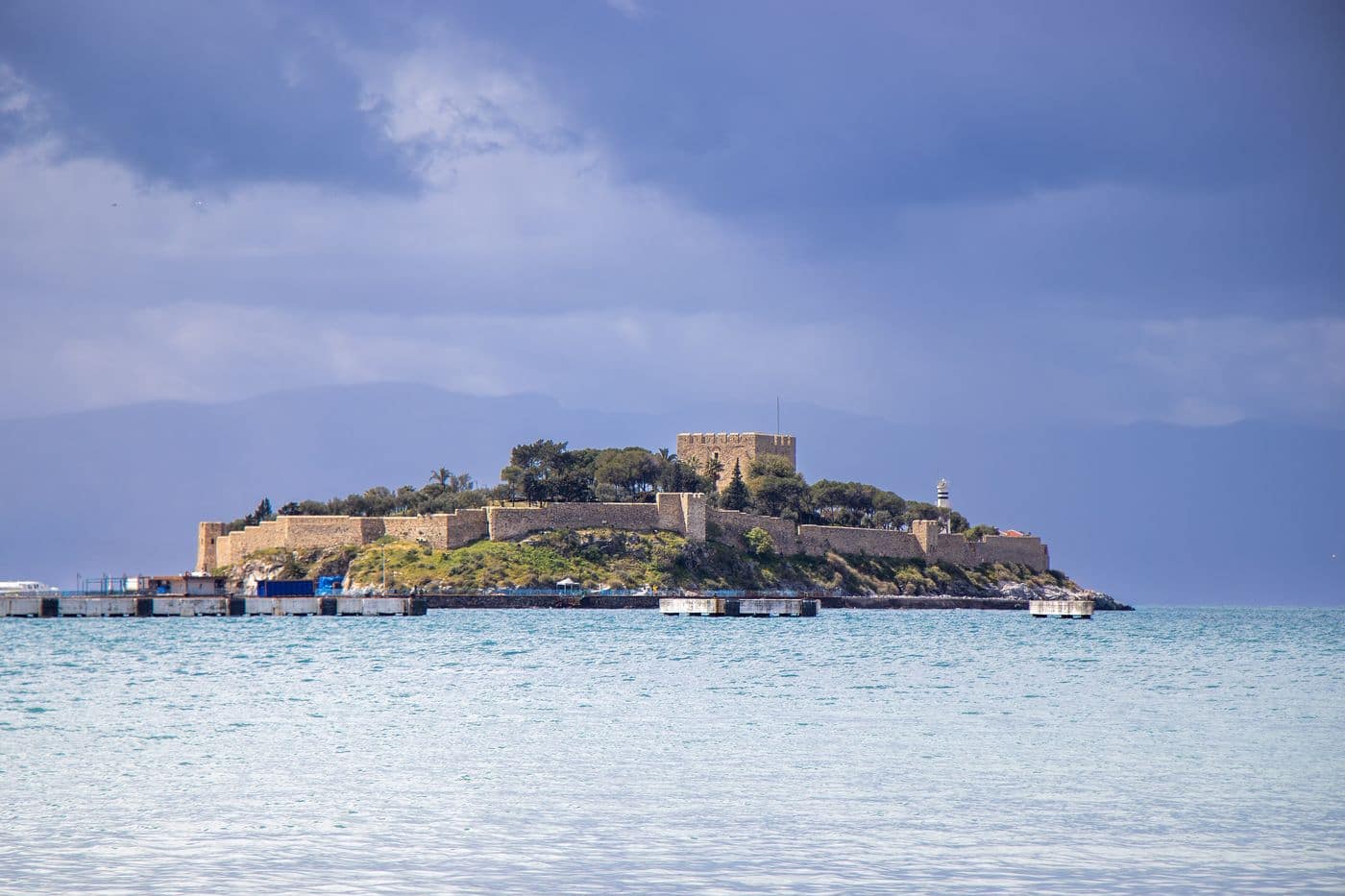
From the water, Kusadasi tours show the island that named the town: Kuşadası means “bird island”, from Turkish kuş and ada, because Güvercinada has the shape of a bird’s head when seen from the sea. A causeway joins Güvercinada, Pigeon Island in English, to the mainland beside the large hill of Kese Dağı, and its castle and garrison were rebuilt and expanded in 1834.
The island sits at the end of the bay, with swimming beaches, a private beach and a cafe looking back across the bay to the harbour. Public beaches lie at the back of the peninsula, facing the open sea. Beyond it, Yılancı Burnu, a second peninsula, has beaches, beach clubs and visible walls at the possible site of the original Neopolis.
Ferry boats link Kuşadası with Güzelçamlı, whose 30 km coastline adds sailing, windsurfing, canoeing, water skiing, fishing and diving. Turkish Airlines advises booking Kusadasi tours by boat in advance, as tourist numbers rise in the summer months.
Which Kusadasi tours visit the village of Şirince?
Kusadasi tours to Şirince climb a winding mountain road to a hill village 350 metres above sea level and 8 km east of Selçuk. The village, a UNWTO Best Tourism Village, is known for sweet fruit wines, restored stone houses and two Greek churches.
Şirince, a neighbourhood of Selçuk district in İzmir Province, had 456 residents in 2022. On the road up, Kusadasi tours pass the remains of Roman aqueducts, since the village was an important water source for ancient Ephesus. Its old name, Çirkince, means “ugly” in Turkish, and the governor of İzmir Province changed it to Şirince, “pleasant”, in 1926.
The village is a rare example of Ottoman Christian architecture, and its buildings date mainly from the 19th century. The 1908/1909 yearbook recorded more than 1,000 houses, all inhabited by Greek Orthodox Christians. Two Greek churches stand in the village, and no house blocks the view of another.
In the 1990s, linguist Sevan Nişanyan helped have the village declared a national heritage site and renovated ruined houses with the original materials. Stone mansions now work as boutique hotels, and street stalls sell homemade jams, sherbets and fruit wines to visitors on Kusadasi tours.
- Fruit wines: sweet wines made from nearly every fruit grown in the area.
- Bold grapes: the endemic Öküzgözü and Boğazkere varieties.
- Balanced grapes: the endemic Büyük Karası and Küçük Karası varieties.
- Elderberry sherbet: a drink made of local flowers.
Which Kusadasi tours explore the Dilek Peninsula National Park?
Kusadasi tours to the Dilek Peninsula–Büyük Menderes Delta National Park enter a protected area of 27,598 ha beside Güzelçamlı, with four public coves, forest trails, the Cave of Zeus, the Büyük Menderes Delta wetland and views across the Mycale Strait to Samos.
Turkey declared the Dilek Peninsula a national park in 1966 and added the Büyük Menderes river delta in 1994. Mount Mycale (Dilek Dağı), about 1,237 m high, looms over Samos across a strait only about 1.6 km wide at its narrowest point.
Entering from the east, Kusadasi tours reach İçmeler Cove first, with the shallowest water in the park, sandy beaches and parts of Kuşadası visible on the horizon. Aydınlık Cove, about 5 km further west, has pebbly shores and deeper water. Kavaklı Burun Cove and Karasu Cove, the westernmost public cove, give close views of Samos and are far less visited. A forest trail runs to the village of Doğanbey and the ancient port of Karine, and its final 9 km need a permit or a tour guide.
The Cave of Zeus lies about 200 m west of the park entrance, at the end of a 20 m slippery, stony trail. The cave is 10–15 m deep, 10–13 m wide and 20 m long, and its pool holds blue-green brackish water, a mix of mountain spring water and salty seawater. In Greek myth, Zeus hid here from his brother Poseidon, and visitors on Kusadasi tours tie a piece of cloth on the wishing tree beside the cave’s mouth.
- Plants: 804 species, six of them endemic, with maquis shrubs such as Phoenician juniper.
- Birds: 256 species, and the park is a key nesting place for Dalmatian pelicans.
- Mammals: 28 species, among them wild boar, golden jackals, Eurasian lynx and caracals.
- Reptiles and fish: 42 reptile species and 45 fish species.
The delta wetland falls under the Ramsar Convention and offers a visitor trail, canoeing and picnicking. About 700,000 tourists visit the park each year, and camping is forbidden, so Kusadasi tours visit the park by day.
Which Kusadasi tours visit Priene, Miletus and Didyma?
Kusadasi tours to Priene, Miletus and Didyma run as one combined day trip south of the port, known as the PMD tour. The route starts at Priene, 40 km from Kusadasi, continues 25 km to Miletus and ends 20 km further at Didyma.
Priene sits at the foot of the Mycale escarpment, just west of Güllübahçe village in the Söke district of Aydın Province, and its terraces climb from sea level to 380 metres. The satrap Mausolus planned the city around 350 BC, and Alexander the Great dedicated its Temple of Athena, designed by Pytheos, in 323 BC. Kusadasi tours walk past the agora, the bouleuterion and the well-preserved Hellenistic theatre.
Miletus lies 3 km north of Balat and now sits 10 km inland, after the Maeander River silted up its harbour. The city founded over 90 colonies and was home to the philosophers Thales, Anaximander and Anaximenes. Kusadasi tours stop at the theatre, the Ionic stoa, the Roman bathhouse and the Ilyas Bey Complex of 1403, a Europa Nostra award winner. The Market Gate of Miletus stands in the Pergamon Museum in Berlin.
Didyma held the oracle of Apollo, joined to Miletus by a 20 km Sacred Way built in the 6th century BC. Its Hellenistic temple was the largest in the Greek world after the Temple of Hera on Samos and the Temple of Artemis at Ephesus. The stepped base measures almost 60 by 120 metres, and each Ionic column stands 19.70 metres high. Kusadasi tours finish at the Medusa heads from the temple frieze, just northwest of modern Didim.
- Priene streets: six main streets about 6 metres wide cross fifteen streets about 3 metres wide, forming about 80 blocks.
- Miletus finds: the Miletus Museum in Didim has held the main collection since 1973.
- Didyma columns: a double file of Ionic columns ran 10 along each short side and 21 along each long side.
- Time on site: Kusadasi tours spend an hour or two at each ruin.


Which Kusadasi tours stop in Selçuk?
Kusadasi tours stop in Selçuk, 20 km northeast of the port, for four sites on and around Ayasuluk Hill: the Basilica of St John, the İsa Bey Mosque, the Temple of Artemis site and the Ephesus Archaeological Museum, which holds the Ephesus finds.
Selçuk belongs to İzmir Province and Kusadasi to Aydın Province, so Kusadasi tours cross a provincial line on the drive north. Selçuk was a township in the Kusadasi district until 1957. Under the Ottomans the town was Ayasoluk, from the Greek name Agios Theologos, and it took the name Selçuk in 1914. In the 14th century it was the capital of the Beylik of Aydin.
The Basilica of St John stands on the slopes of Ayasuluk Hill, just below the fortress, over the site where John the Apostle was said to be buried. Justinian the Great began the church in 535/6 and modelled it on the Church of the Holy Apostles in Constantinople. Five domes crowned the cross-shaped plan, which measured 428 by 213 feet, and Justinian placed his monogram and Theodora’s on the capitals.
The İsa Bey Mosque sits right next to the basilica. A Syrian architect built it in 1374–75 in honour of the Aydinid ruler Isa Bey and based the plan on the Great Mosque of Damascus. The asymmetric mosque covers a 48 by 56 metre base, the rims of its 9.4 and 8.1 metre domes carry İznik tiles, and twelve round columns stand in the courtyard. Kusadasi tours see a building that served as a caravanserai in the 19th century.
The Temple of Artemis, one of the Seven Wonders of the Ancient World, lies on the edge of Selçuk, marked by a single column built from fragments found at the site. The third temple measured 137 by 69 metres, stood 18 metres high and carried more than 127 columns. John Turtle Wood found the site in 1869, after six years of searching for the British Museum.
Kusadasi tours visit the Ephesus Archaeological Museum for the statue of Artemis, its best-known exhibit, shown in the Artemis of Ephesus Hall. The museum opened in 1964, grew in 1976 and displays about 64,000 pieces from the Hellenistic, Roman and Early Christian periods, including finds from the basilica and the temple.
- UNESCO status: Ayasuluk Hill forms part of the Ephesus World Heritage Site, listed in 2015.
- Fortress: the Byzantine fortress went up after the Arab invasions of the 7th century to guard the basilica.
- Timur: an invasion under Timur destroyed the basilica in 1402.
Which Kusadasi tours run jeep safaris, quad rides and horse riding?
Kusadasi tours run jeep safaris, quad and buggy rides and horseback rides into the forests, rivers, villages and coastal paths behind the resort. A jeep day lasts 6 to 7 hours, a quad or buggy ride 3 hours and a horse ride 2 hours.
One jeep safari route crosses the Dilek Peninsula National Park, with a swim at Zeus Cave, a stop at Kursunlu Monastery, a BBQ lunch in the forest and a last swim at Love Beach. Kusadasi tours by jeep add water fights along the route. A second off-road jeep route heads to the villages and the coast.
The quad area lies 20 km from the Kusadasi centre and the buggy area 15 km out. Kusadasi tours on quads follow dirt paths, forested trails and coastal paths, with guides giving instructions to beginners and experienced riders. Buggy drivers take the wheel themselves across forested areas, dirt paths and shallow streams.
Kusadasi tours on horseback cross pine forests, orange groves, open countryside and gentle riverbeds, and one route reaches Pamucak Beach for a gallop along the water’s edge. Safari stops at local villages serve traditional food, and spring and autumn are the best safari seasons. Kirazlı, a traditional Turkish village 12 km from Kusadasi, has 1,124 residents.
- Jeep safari: round-trip transfer, lunch, insurance and a beach swim.
- Quad ride: transfers, instructor, insurance and safety equipment.
- Buggy ride: round-trip transfer, instructor, insurance and safety equipment.
- Horse ride: transfer, instructor, protective gear and insurance.
Which beaches and water parks do Kusadasi tours reach?
Kusadasi tours reach Ladies Beach next to the town centre, the 10 km Long Beach running south to Güzelçamlı, and the 12 km Pamucak sands to the north. Water park trips go to Adaland Aquapark at Çamlimanı, 9 km from the centre.
Ladies Beach, Kadınlar Denizi Plajı in Turkish, lies very close to the town centre and ranks among the primary tourist attractions of Kuşadası. The beach was for women only in Ottoman times and has long been mixed, and its closeness to town makes it very crowded. Beach days on Kusadasi tours start on sand that is free to access, while hotels guard their own stretches. The resort beaches are long and sandy, with a shallow drop-off that blunts the waves and keeps bathing safe for children.
Long Beach stretches 10 km down to Güzelçamlı with multiple access points, and its southern parts carry their own names: Davutlar, Sevgi and Venus. For Kusadasi tours based in town, Sevgi Plajı, or Love Beach, on the Davutlar coast lies roughly 17 km by road to the south, with regular dolmuş minibuses from the city.
North of town, the beach strip that Kusadasi tours cover ends at Pamucak beach, the end of the long northern beach. Pamucak, also called Ephesus Beach, is one of the longest beaches in Turkey at 12 km and hosts five large hotels. Four more spots line the bay:
- Town beach: the sand between the port and the marina, a sunset spot rather than a swimming beach.
- Pigale Beach: the first strip north of town, quieter than the centre.
- Güvercinada: public beaches at the back of Pigeon Island, facing the open sea.
- Yılancı Burnu: a second peninsula beyond Güvercinada, with beaches and beach clubs.
Kusadasi tours to the water parks run 6 hours with a return transfer by air-conditioned bus and an entrance ticket, and the water park tour goes to Adaland Aquapark. The park covers 60,000 square metres and lists the Amazoon family slide at 406 m, billed as the longest family slide in the world, and a 90 m Water Coaster. A wave pool, a lazy river, rafting and surfing complete the park, and a separate Dolphinpark shares the site.
Three more parks widen the choice for Kusadasi tours. Aqua Fantasy, part of the Aqua Fantasy hotel and open to the public, lies 10 km from the centre, opened in 2000 as the first themed water park in Turkey, and holds 15 slides, 3 pools and a beach. Magic Aqua World fills 6,000 square metres in the Kadınlar Denizi neighbourhood with 13 slides and 3 pools, and Tortuga Pirate Island stands on the northern section of Long Beach with 14 slides.
Which Kusadasi tours include a Turkish bath or a cooking class?
Kusadasi tours include a 2-hour hamam package with hotel pickup, sauna, a warm marble stone, a peeling massage and a foam massage, and a 3-hour private cooking class for up to 15 guests in a local home, built on herbs and olive oil.
The hammam, called a Turkish bath by Westerners, grew out of the Roman thermae, and the first recorded use of the English term dates from 1644. Bathers keep a modesty garment and move from a cold room through a warm room into a hot room, where staff of the same sex wash them with soap and vigorous rubbing. The hamam session on Kusadasi tours adds a towel, special slippers, and tea or coffee.
In Ottoman baths the changing room, the camekân, is a domed hall with a central fountain, the şadırvan, where bathers relax over tea, coffee or sherbet before and after bathing. A traditional hammam massage mixes vigorous muscle kneading with joint cracking, and hammams with a tourist clientele add spa-style massages. For Kusadasi tours that pair the bath with the ruins, a Turkish Bath Ephesus Tour adds lunch and a workshop.
- Peştemal: a silk or cotton cloth that covers the body like a pareo.
- Kese: a rough mitten for the scrub.
- Göbektaşı: the large heated marble table at the centre of the hot room.
- Tellak: the traditional bathhouse masseur, a role passed to adult attendants in the 20th century.
The cooking class on Kusadasi tours starts with a pickup at the hotel lobby or the cruise ship port exit, and depending on the day the group visits the local market before cooking. The class runs in a local home and teaches the Mediterranean kitchen of the Aegean coast, with herbs, olive oil and ingredients unique to the local climate.
The Aegean kitchen behind Kusadasi tours with a cooking class uses olive oil as its primary cooking oil, as across western Turkey, where olive trees grow abundantly, and leans on vegetables, herbs and fish. Artichoke dolma, enginar dolması, is an Aegean region specialty, and in summer a cold dish of vegetables cooked in olive oil, zeytinyağlı yemekler, replaces soup. Two more olive oil staples are zeytinyağlı yaprak sarması, vine leaves stuffed with rice and spices, and cacık, cucumber with yogurt, dried mint and olive oil. The Oleatrium museum off the Davutlar road traces 2,500 years of olive oil making.
How do Kusadasi tours handle Ephesus and Pamukkale?
Kusadasi tours treat Ephesus and Pamukkale as the two big day trips: Ephesus lies 15 km northeast of the town, and Pamukkale sits 198 km inland, about 2 hours 30 minutes by road, so the Pamukkale day runs 10 hours.
Cruise ships at the Kuşadası harbour bus their passengers to the ruins, taxis drop visitors at the south gate and collect them at the north gate, and dolmuş minibuses towards Kuşadası pass the lower gate. The guided Ephesus day trip on Kusadasi tours lasts 9 hours with a round-trip transfer. Our Ephesus from Kusadasi page covers the full plan.
Pamukkale lies in Denizli Province, and its day tour pairs the travertine terraces with the ancient city of Hierapolis, listed together as a UNESCO World Heritage Site in 1988. The tour includes a round-trip transfer by air-conditioned bus, guide services and lunch. Kusadasi tours also sell a 13-hour Pamukkale day with a hot air balloon flight and breakfast. Our Pamukkale from Kusadasi page covers the full day.
How do visitors reach Kusadasi on Kusadasi tours?
Kusadasi tours start from three main gateways: cruise ships dock at Ege Port Kusadasi in the town centre, daily ferries sail in from Samos, and flights land at İzmir Adnan Menderes Airport (ADB), linked to the Kusadasi port by a six-lane highway.
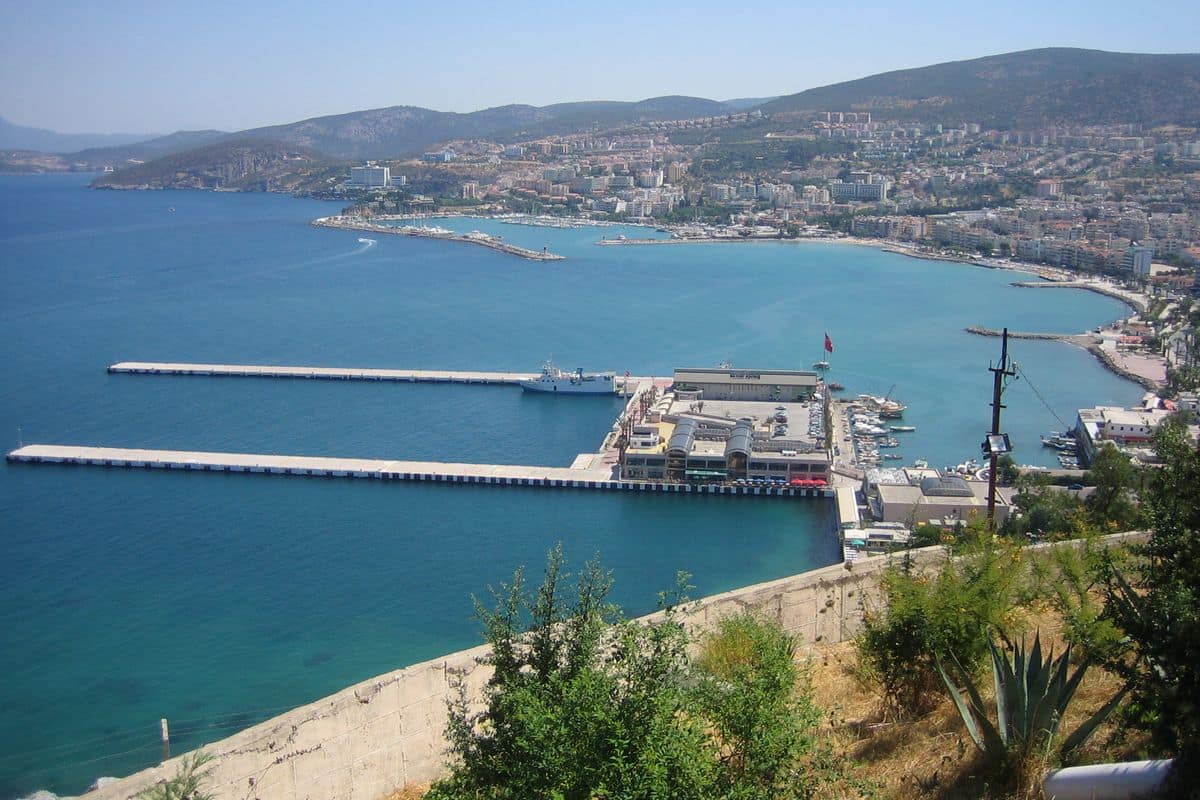
Cruise passengers begin Kusadasi tours at Ege Port Kusadasi, run by Global Ports Holding. A 2003 deal leased the formerly public port to a private company, and the port was renovated to attract luxury cruise liners. It ranks as the busiest cruise port in Türkiye and the fourth busiest in the Eastern Mediterranean, with a record season of 617 cruise calls and 995,303 cruise passengers.
The Greek island of Samos lies about 16 km offshore, and at the Mycale Strait only 1.6 km of sea separates it from Turkey. Ferries for Kusadasi tours leave Vathi and Pythagorio seven days a week all year, on routes of 29.65 km and 35.20 km, and the Meander Express crosses from Vathi in 30 minutes. Passengers clear customs and immigration on both sides.
Flights for Kusadasi tours arrive at İzmir Adnan Menderes Airport, 14 km southwest of central İzmir in the Gaziemir district and 65 km from Kusadasi. The D.550/E87 highway runs south from the airport through Selçuk and Aydın, and intercity trains from the airport station serve Söke and Aydın.
- İzmir: 95 km to the north.
- Aydın: 60 to 70 km by road, the provincial seat.
- Söke: the neighbouring district to the east and south.
When do Kusadasi tours run best?
Kusadasi tours run best from June to September, when the hot-summer Mediterranean climate (Köppen Csa) brings dry weather, the sea averages 22.6°C to 25.8°C, and July and August see only 1.3 and 1 rainy days.
Midsummer Kusadasi tours meet the peak heat: the 1991–2020 climate normals put the July high at 31.8°C and the August high at 31.6°C, and July logs 379.9 hours of sunshine out of 2,960.5 a year. Rain falls to 0.85 mm in July and 0.08 mm in August, against 117.99 mm in January.
The sea cools to a February low averaging 14.8°C, per NOAA satellite readings. Cruise lines call at Ege Port Kusadasi throughout the year. Summer Kusadasi tours share the town with crowds, as the district’s 130,835 residents swell to well over half a million in the summer months.
- April: highs of 20.6°C and 4.7 rainy days.
- October: highs of 24.1°C and 3.9 rainy days.
- January: highs of 13.7°C and 8.8 rainy days.
- December: highs of 15.1°C and 9.6 rainy days.
What history do Kusadasi tours tell?
Kusadasi tours trace a past that starts with the Leleges, who founded the first settlement in 3000 BC, and runs through Ionian Neopolis, the Genoese port of Scala Nova and the Ottoman caravanserai that Grand Vizier Öküz Mehmed Pasha built near the docks.
Aeolians followed in the 11th century BC and Ionians in the 9th. Neopolis is thought to have stood first on the Yılancı Burnu point, where walls are still visible, and later on the Pilavtepe hillside, today’s Andızkulesi. In antiquity Kusadasi was a minor port, overshadowed by Ephesus until the Ephesian harbour silted up.
- Lydians: ruled the coast from Sardis from the 7th century BC.
- Persians: held the coast from 546 BC.
- Alexander the Great: conquered the coast in 334 BC.
- Romans: took the coast in the 2nd century BC.
Traders from the Republic of Genoa settled in the late 13th or early 14th century and built the castle on Güvercinada. As Byzantine, Venetian and Genoese shippers traded along the coast, the port was re-founded as Scala Nova, meaning “New Port”, and the town centre moved from the hillside to the shore. Mehmed I brought the town into the Ottoman Empire in 1413.
Öküz Mehmed Pasha, a former governor of Ottoman Egypt who served twice as Grand Vizier, built the caravanserai between 1615 and 1618 to draw international trade through the port. Shaped like a small citadel, with merlons designed for pouring hot oil, it served as a customs house; its 28 ground-floor rooms frame a 28.50 m by 21.50 m courtyard.
The name Kuşadası joins the Turkish words kuş, “bird”, and ada, “island”, because Güvercinada looks like a bird’s head from the sea. Kusadasi tours that cross to Güvercinada reach the island castle, rebuilt and expanded with its garrison in 1834; people then began to call the whole town Kuşadası, and locals today shorten the name to Ada.
Frequently Asked Questions
Which lesser-known ruins can Kusadasi tours add?
Kadıkalesi, a Venetian and Byzantine castle, stands 10 km along the Kusadasi–Davutlar road. Panionium, 25 km south on the Davutlar–Güzelçamlı road, was the central meeting place of the Ionian League, though its ruins are in poor condition. Ancient Pygela, an Ephesian outpost with a temple of Artemis Munychia, lies partly drowned at Pygela Beach.
Can Kusadasi tours include a night in the caravanserai?
Yes. After a renovation that ran from 1954 to 1966, the caravanserai opened in 1968 as a Club Med hotel, and Club Caravanserail has run it since 1978. It offers 55 beds in 25 rooms and a suite, plus an open-air restaurant for 350 guests. US President Jimmy Carter stayed there while visiting Ephesus.
How do visitors on Kusadasi tours get around the town?
Dolmuş shuttle minibuses run inside the town and out to nearby places. Boat day trips leave from both Kusadasi and Güzelçamlı. The town bus station works as a transport hub, where coach buses link Kusadasi with cities across Turkey, and buses and taxis run to the airports at İzmir and at Bodrum in Muğla Province.
Which summer events can Kusadasi tours catch?
The Kuşadası Gençlik Festivali, or Kusadasi Youth Festival, has run every July since 2016 at Sevgi Plajı (Love Beach) in Davutlar, a 17 km drive south. It lasts five days with over 30 artists, and its promoters estimated about 90,000 visitors in 2017. An annual song contest here was once won by Cem Karaca.