
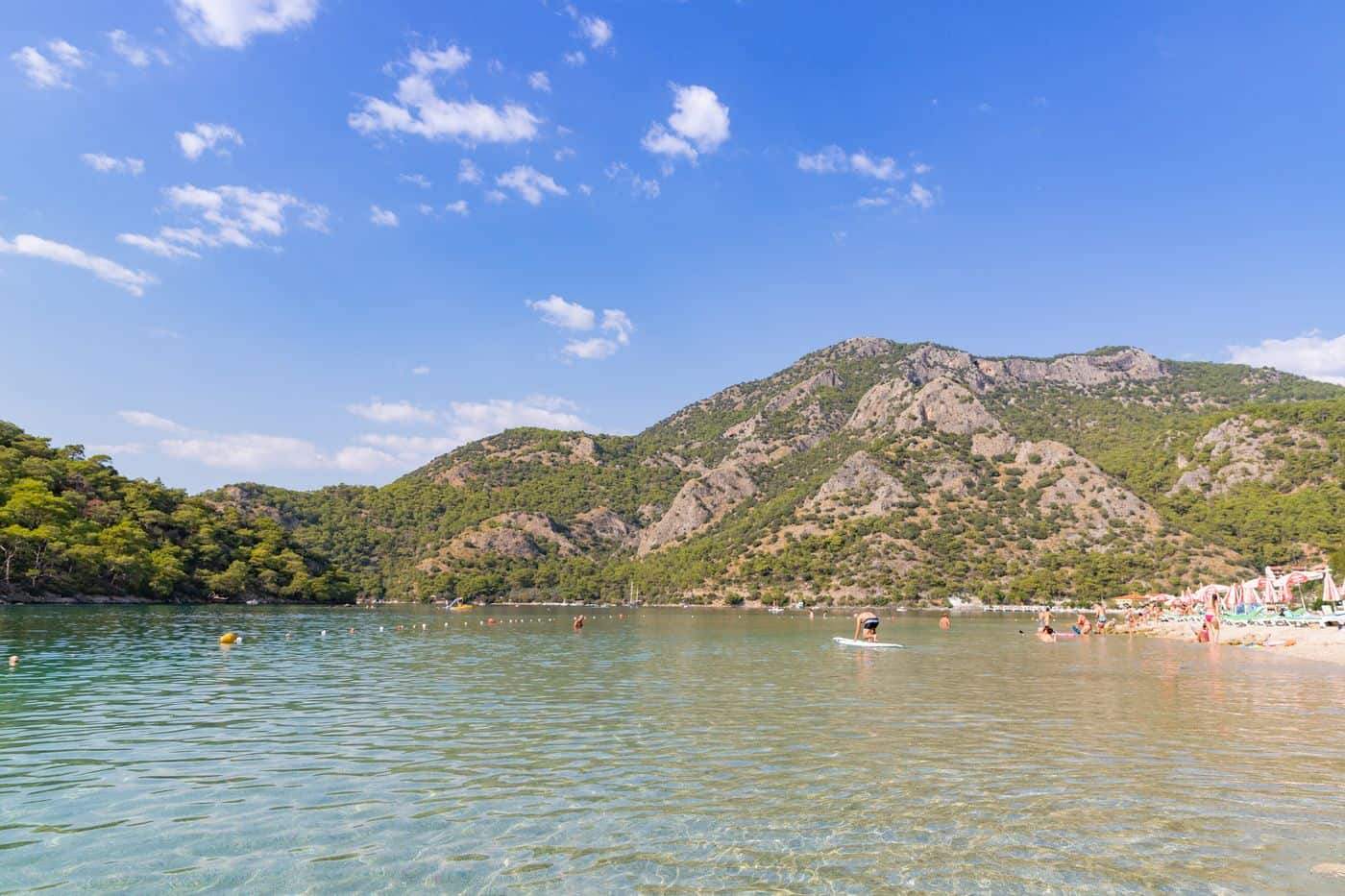
Fethiye tours start in the harbour town of Fethiye in Muğla Province on the Turkish Mediterranean coast, the site of ancient Telmessos, set on a gulf scattered with islands. The routes cover boat trips to the Twelve Islands, the Blue Lagoon of Ölüdeniz, paragliding from Babadağ, Butterfly Valley, Saklıkent Gorge, the Lycian rock tombs and the abandoned village of Kayaköy. Greece Tours lists the day trips that reach Fethiye from Rhodes and Marmaris.
This page covers what Fethiye tours see at sea and inland, which trips add Tlos and the Lycian Way, how visitors reach Fethiye from Rhodes and Dalaman, and which season suits each route. The tours below are checked on GetYourGuide and Viator and leave from Fethiye, Ölüdeniz and Marmaris.
What do Fethiye tours cover?
Fethiye tours cover boat trips around the Gulf of Fethiye islands, the Blue Lagoon at Ölüdeniz, tandem paragliding from Mount Babadağ, scuba diving at Afkule and day trips inland. The town lies in Muğla Province on the Turkish Riviera, on the site of ancient Telmessos.
Fethiye district covers 875 square kilometres and holds 177,702 residents at the westernmost corner of Türkiye’s Mediterranean coast. Boats lead the list of Fethiye tours, because the town is a well-known yacht charter stop with marinas in Fethiye and Göcek, and the gulf is a popular area for tourism and yachting.
- Gulf of Fethiye: a branch of the Mediterranean, bounded by Cape Kurdoğlu in the west and Cape İblis in the east.
- Old names: the Gulf of Makri until 1923, and the Gulf of Telmessos or Glaucus Sinus in antiquity.
- Ancient cities: Lydae and Telmessos stood on its shore.
- Resort towns: Ölüdeniz, the Çalış Beach area, Hisarönü and Ovacık.
Fethiye tours board at a rebuilt waterfront. The 1957 earthquakes damaged or destroyed 3,200 buildings, 90% of the city, and the new town has a modern harbour and a marina, with the Hellenistic theatre of Telmessos beside the main quay. The name Fethiye dates from 1934 and honours Captain Fethi Bey, one of the first pilots of the Ottoman Air Force.
Marmaris lies to the west, beyond Dalaman Airport, and Marmaris tours start Blue Cruise gulet voyages from that port, as Fethiye tours do from this one.
Which Fethiye tours sail to the Twelve Islands?
Fethiye tours to the Twelve Islands are eight-hour boat cruises from the town marina, with one-hour stops at four islets for swimming and snorkelling and lunch provided. Boats leave daily, and over a dozen operators sell the trip along the waterfront.
The same operators hire out boats for day trips and longer charters. Göcek, a neighbourhood of Fethiye district on the same gulf, lives on its coves and 12 islands. Private charter boats, simple fishing boats and larger yachts reach the Twelve Islands from Göcek, which has about 20 yacht charter companies and six marinas.
Göcek became a Registered Area of Special Protection in 1988, so multi-story buildings are not allowed, and it is a departure and arrival point for the Blue Cruise. These islands lie in the gulf:
- Kızılada: 6.4 km off Fethiye, with a 19th-century lighthouse that now holds a seafood restaurant and a nine-room hostel.
- Tersane Island: “Shipyard island”, a triangle of about 2.5 square kilometres with Lycian-era ruins and a restaurant quay for yachts.
- Şövalye Island: Knight Island, which shelters the bay and has a shingle beach and water taxis from town.
Kızılada takes its name from its reddish-brown look and is a popular stopover for Fethiye tours. Air France Flight 152 ditched 2 km off the island on 3 August 1953, and 38 of the 42 people on board survived.
What do Fethiye tours see at Ölüdeniz and the Blue Lagoon?
Fethiye tours at Ölüdeniz see the Blue Lagoon, a national nature reserve 14 km south of Fethiye where construction is strictly prohibited. Ölüdeniz means “Dead Sea”, a name that comes from water that stays calm even during storms, and its beach flies the Blue Flag.
The resort sits where the Aegean and Mediterranean seas meet, and its water shows shades of turquoise and aquamarine. A 1 km peninsula separates the lagoon from the open sea; its beach and seabed are gravel, pebbles and rocks, so swimmers need beach shoes.
Fethiye tours that start on Ölüdeniz beach run west along the coast to Gemiler Island or south to Faralya. Gemiler holds the Byzantine ruins of five Greek churches from the fourth to sixth centuries AD and a 350 m processional walkway. Archaeologists believe Saint Nicholas was buried in its rock-hewn church after his death in 326. Large gulets from Ölüdeniz anchor in its crescent-shaped bay, and the ruins can be seen from the sea.
- Belceğiz beach: sandy, and the best area for children to bathe.
- Dive centres: Bubbles and Lykia World.
- Courses: local diving agencies teach courses and issue scuba licences.
- Underwater: clear water over caves and rich fauna.
Which Fethiye tours go paragliding from Babadağ?
Fethiye tours go paragliding from Babadağ, a 1,969 m limestone mountain in Ölüdeniz whose summit stands less than 5 km from the sea. Pilots launch from the cable-car top station, and beginners fly one-hour tandem rides strapped in front of an instructor.
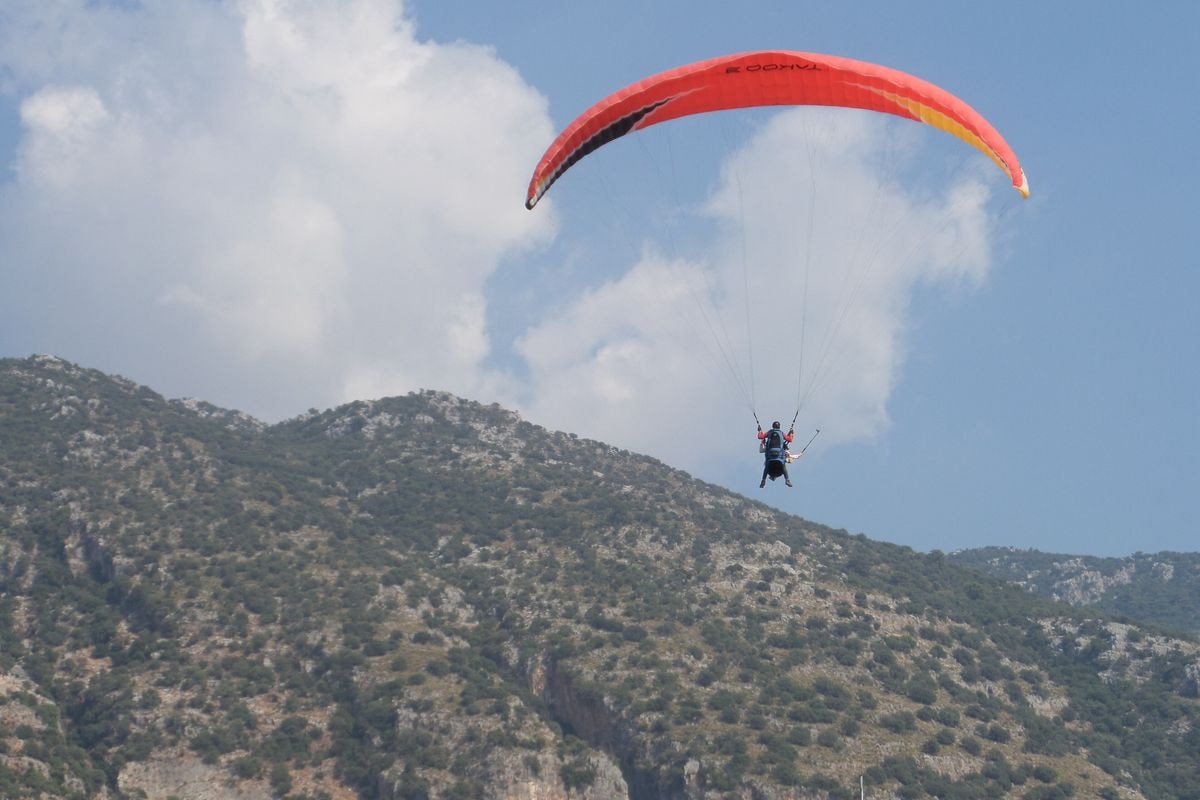
Ölüdeniz draws pilots with its views, stable weather and Babadağ’s exceptional height, and the chance to fly above water makes it a prime location for SIV safety training and paragliding acrobatics. Extreme sports companies based in the area run these Fethiye tours.
A cable car climbs from 500 m south of Ölüdeniz village, and the wing is already open at take-off. Experienced pilots soar along the mountain updraughts for hours before landing on the beach. Tandem passengers need proper trainers, not flip-flops or bare feet.
- Launch runways: 1965 North, 1900 Patara, 1800, 1700 South and 1200.
- Landing: Belceğiz beach, where paragliders prefer to come down.
- Second summit: Karatepe, 1,400 m, across a flood valley from the main peak.
- Flora: the endemic Acer undulatum and forests of Lebanon cedar.
Which Fethiye tours reach Butterfly Valley?
Fethiye tours reach Butterfly Valley by sea: a shuttle boat service runs from Belceğiz Beach in Ölüdeniz, 5 to 7 km away, and tour sailboats stop at the valley’s sand beach, where a canyon with 350 to 400 m walls opens onto the bay.
Butterfly Valley, Kelebekler Vadisi in Turkish, lies in Fethiye district at the foot of Babadağ. Fethiye tours that land on the beach follow a trail up the 3 to 4 km canyon to two small waterfalls that drop from 60 m all year. A creek carries water from a spring in Faralya village to the sea.
Scientists recorded 147 flora species from 54 families and 105 butterfly species from 15 families in the valley, among them the Jersey tiger, Euplagia quadripunctaria rhodosensis. Fethiye tours between June and September arrive when butterflies in a wide range of colours can be seen.
Fethiye tours find only temporary structures here, because the valley became a first-category nature reserve on 8 February 1995 and the law bans any construction. Up to 250 people can stay in tents beside simple wooden bungalows, and around 200 visitors camp in the valley daily in July and August.
- Activities: camping, hiking, canyoning, canoeing and scuba diving.
- Power: free electricity from a generator at set times of day.
- Food: a small country restaurant and a bar in summer.


Which Fethiye tours go to Saklıkent Gorge and Tlos?
Fethiye tours to Saklıkent Gorge, 50 km from Fethiye, run as Jeep Safari trips offered by local travel agents in Fethiye and Ölüdeniz, with water fights en route, and the ruins of ancient Lycian Tlos stand 4 km northwest of the gorge.
Saklıkent National Park, set up on 6 June 1996 at Seydikemer, protects a canyon 300 m deep and 18 km long, one of the deepest in the world. Flowing water formed it through abrasion over thousands of years, and Saklıkent means “hidden city” in Turkish.
Fethiye tours can enter the canyon all year, but the deeper parts open only in summer, as the water level rises in winter. Visitors can walk 4 km of the canyon after April, once the snow of the Taurus Mountains has melted. The full length needs professional equipment and advanced canyoning knowledge, and adventure centres offer guided tours with an overnight bivouac camp and about 30 waterfalls to rappel.
Tlos sits on a rocky outcrop on the east side of the Xanthos valley and was one of the oldest and largest cities of Lycia, called Tlawa in Lycian and Dalawa in Hittite documents. Remains at the Girmeler and Tavabaşı caves suggest its foundation started more than 4,000 years ago. In myth, the hero Bellerophon lived here with his winged horse Pegasus.
Fethiye tours at Tlos climb past Lycian sarcophagi and rock tombs to the Tomb of Bellerophon, which has an unfinished four-column facade and a relief of the hero riding Pegasus. Charles Fellows rediscovered the site in 1838, and regular excavations have run since 2005.
- Acropolis: an Ottoman fort for the governor Kanlı Ali Ağa on the old fortress foundations.
- Stadium: seats for 2,500 people beside a pool 72 m long.
- Theatre: a three-storey stage and a 20.5 m orchestra on the eastern slope.
- Great Bath: an apse with seven windows over the Tlos valley.
What do Fethiye tours see at the Lycian rock tombs and Kayaköy?
Fethiye tours see the Tomb of Amyntas, a Lycian rock-hewn tomb cut into the mountainside of ancient Telmessos in 350 BC, and Kayaköy, the abandoned Greek village of Livissi 8 km south of Fethiye, where around 500 ruined houses stand.
Fethiye tours find the Tomb of Amyntas, also called the Fethiye Tomb, on the south side of the city at the base of the mountain. Its Greek inscription, “Amyntou tou Ermagiou”, means “Amyntas, son of Hermagios” and gives the tomb its name. Its interior is very spacious compared with other tombs carved into the mountainsides of the area.
Modern Fethiye stands on the site of Telmessos, the largest city in Lycia, called Telebehi in Lycian. The Lydian king Croesus consulted its school of diviners, and Alexander the Great took the city in 334 BC. Fethiye tours along the main quay pass the Hellenistic theatre, and the Fethiye Museum displays finds starting with the ancient Lycians.
Kayaköy, also known as Livissi and anciently as Karmylessos, had over 6,000 people, and much of what remains was built in the 18th century. Its Greek Orthodox residents were exiled, and the 1923 Treaty of Lausanne barred them from returning; a group of Greeks from Livissi and Makri founded Nea Makri outside Athens.
Fethiye tours walk through a ghost town preserved as a museum village, where Greek-style houses and churches cover a small mountainside. More than 20 churches and chapels were built in the village and the plain, among them Taxiarhes, the upper church, and Panayia Pyrgiotissa, the lower church.
- Fountain: a 17th-century fountain stands in the middle of the village.
- Tombs: Lycian-style tombs lie in the village and at Gokceburun to the north.
- Film: Kayaköy appears in the closing scenes of Russell Crowe’s The Water Diviner.
- Novel: Kayaköy is presumed to be the inspiration behind Eskibahçe in Louis de Bernières’ Birds Without Wings.
How do visitors reach Fethiye on Fethiye tours?
Fethiye tours start from three gateways: Dalaman Airport, one hour west of town on the D400 road; the catamaran from Rhodes, which docks at the Fethiye ferry terminal on the east side of the marina; and intercity coaches from Istanbul, Ankara and Izmir.
Fethiye tours from Greece begin on Rhodes. Sky Marine Ferries make the crossing in 1 hour 45 minutes on a fast catamaran that takes foot passengers only. Ferries no longer sail from Fethiye to other Aegean ports such as Marmaris.
Crossing the border needs the right papers. Turkey asks for ordinary passports valid at least 150 days on entry. Citizens of Greece, Germany, Italy and Spain, among others, can enter with an ID card for up to 90 days within any 180-day period. Other visitors need a visa from a Turkish mission or an e-Visa unless their country is visa-exempt.
- Airport: Dalaman Airport (DLM) has flights to over 120 destinations in Turkey, Europe, North Africa and the Middle East.
- Airport bus: Havaş coaches run via Göcek to Fethiye in one hour, timed to meet domestic flights.
- Coach: Buses take 14 hours from Istanbul, 9 from Ankara, 5 from Izmir and 3 hours 30 minutes from Antalya.
- Own boat: Fethiye is a Port of Entry into Turkey for yachts that have not cleared in elsewhere.
Fethiye tours also head inland by road, and our Pamukkale from Fethiye page covers that trip.
When do Fethiye tours run best?
Fethiye tours run best in September and October, when the summer heat drops but the sea stays at 24 °C. The Rhodes catamaran sails daily from April to October, while winter brings heavy rainfall, strong winds and seasonal closures until spring returns in March.
Fethiye tours in high summer meet a Mediterranean climate, classed Csa under Köppen, with hot, long and dry summers that average 34 °C in the daytime. The hottest days top 40 °C, and climate change is making summers hotter and drier. Dalaman stays sunny all year, above all in June and July.
Winter Fethiye tours meet mild, rainy days with a daytime average of 16 °C. In the hills, snow covers ground above 1,500 m from January to early April, rain and storms arrive in December and January, and downpours hit between November and February.
- Spring: The best hiking season on the Lycian Way, with snow on the hills and flowers across the land.
- Autumn: October and November give enjoyable hiking as heat and humidity ease.
- Peaks: High ground can show the weather of all four seasons in one day.
Which Fethiye tours walk the Lycian Way?
Fethiye tours on foot follow the Lycian Way, a marked trail of over 760 km from Hisarönü (Ovacık) in the Fethiye district to Geyikbayırı in Antalya Province. The first stage runs from Hisarönü to Faralya, and the second continues to Kabak Bay.
British expatriate Kate Clow conceived the trail, which opened in 1999, and Garanti Bank sponsored the waymarking done by volunteers. Walkers follow red and white stripes in the GR style, painted on rocks and tree trunks every 50 m. Yellow signs mark junctions, and red crosses flag routes not to enter.
Fethiye tours that keep walking east continue through Alınca, Yediburunlar and Gavurağılı to Patara, with coastal and inland options between Kabak and Yediburunlar. Faralya, a Fethiye neighbourhood of 640 people 25 km from the town, offers hotels, motels and B&Bs, and Kabak Bay adds a campsite.
- Guidebook: Kate Clow’s guidebook gives the distance and hiking time of each stage, with detailed trail maps.
- Kit: Breathable ankle-high boots, a raincoat, sunscreen, a compass and a whistle, plus a swimsuit and towel.
- Race: The Lycian Way Ultramarathon has run since 2010, covering 220–240 km from Ölüdeniz to Antalya in around six days.
Frequently Asked Questions
Can Fethiye tours include a day trip to Rhodes?
Yes, from the Turkish side. The Sky Marine catamaran leaves Fethiye in the morning and sets off back from Rhodes in the afternoon, which gives day-trippers six hours on the island. No reverse day trip is possible, so travellers who start on Rhodes spend at least one night in Fethiye before sailing back.
How do Fethiye tours move between the resorts?
Dolmuş minibuses, run by Muttaş and listed on the Moovit app, link Fethiye with Ölüdeniz, Hisarönü, Ovacık, Kargı, Yanıklar, Seydikemer and Karaçulha. In town, the routes run west to Karagözler and north to Çalış. For self-drive days, Avis, Abalı, Europcar, Fetcar, Atlantic and Eskol rent out cars and motor scooters.
Can Fethiye tours start from Antalya Airport?
Yes. Antalya Airport (AYT) lies a 3-hour drive east and is one of three airports serving southwest Turkey, with Dalaman and Milas–Bodrum. The D400 twists and turns along the rugged coast between the two cities, while a scenic inland alternative cuts across on the D350 via Korkuteli and Söğüt.
Do Fethiye tours offer mountain biking on the Lycian Way?
Yes. Parts of the Lycian Way suit trail riding on mountain bikes, and experienced downhill and single-track riders cover the entire track by carrying the bike on their backs in places. A separate bicycle route runs partly on the Lycian Way and partly on parallel side roads, using alternative forest and village roads.