
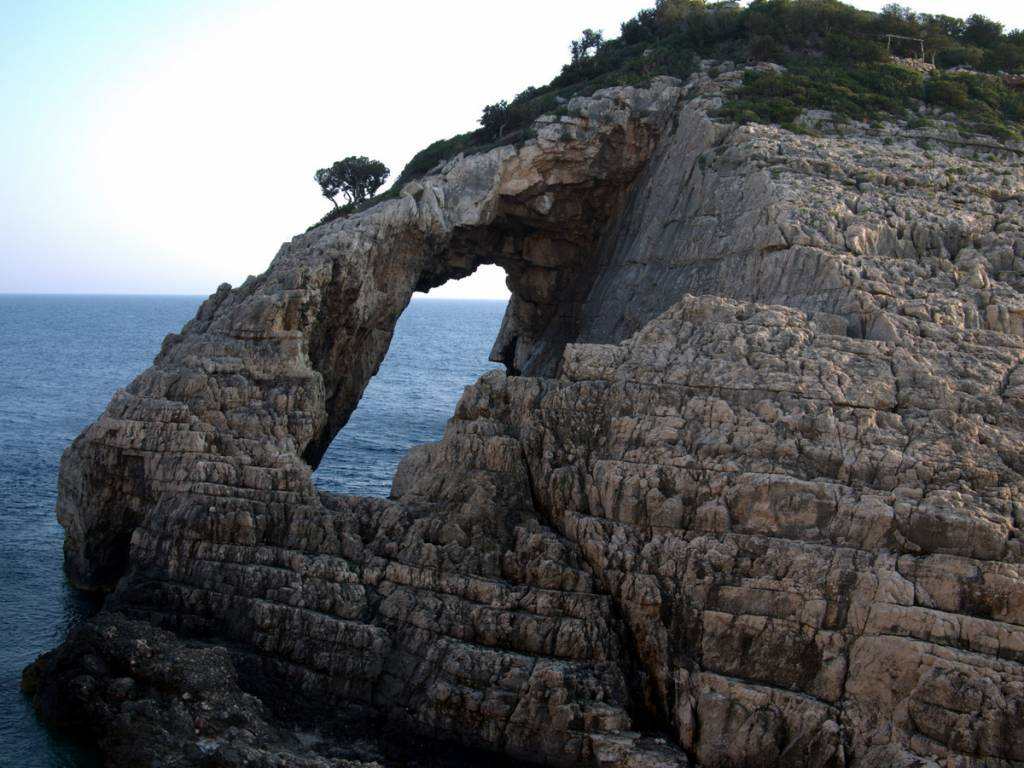
Korakonisi is a small, wild rocky cove on the west coast of Zakynthos, named for the little rock islet that rises just off the shore. It lies below the village of Agios Leon, reached by a track and a flight of steps down the cliffs. There is no sand here, only smooth rock ledges and deep, clear blue water. This makes it a favourite for snorkelling, cliff-jumping and swimming out to the islet and its natural arch. A small taverna sits above the cove. Discover the wild western shore of the island with My Greece Tours.
Korakonisi joins rugged rock to some of the clearest water on the island. Smooth ledges, deep blue sea and a natural stone arch draw swimmers, snorkellers and photographers away from the sandy resorts. The sunsets over the western sea are superb. The sections below cover the cove itself, its snorkelling and swimming, how to reach it, the sunsets, and what lies nearby. Set the cove in its wider surroundings with our Zakynthos travel guide.
What is Korakonisi beach on Zakynthos like?
Korakonisi is a small, wild rocky cove on the west coast of Zakynthos, with smooth rock ledges instead of sand, deep clear blue water, and a rock islet just offshore linked by a natural stone arch. The setting is rugged and unspoilt.
The cove is a cleft in the rocky western cliffs, with no sand at all. Smooth grey rock ledges run down to the water, giving space to lay a towel and slip into the sea. Just off the shore rises the little islet that gives the place its name, pierced by a natural stone arch. The water is deep, clear and a vivid blue, and it drops away quickly from the rocks. The whole setting is wild and rugged, backed by the steep cliffs and hills of the west coast.
It is a beach for swimming, snorkelling and jumping into deep water rather than for sunbathing on sand, and it keeps a raw, natural feel far from the resorts.
Korakonisi sits on the dramatic western shore, below the hill village of Agios Leon. This coast is the wildest side of the island, a line of cliffs, coves and rock formations facing the open Ionian Sea. There are few buildings, just a small taverna above the cove and the rough track down. The lack of sand and the steep approach keep the crowds away, so the cove stays quiet and unspoilt even in summer. It draws those who like clear deep water, snorkelling and cliff-jumping, and who value a wild setting over easy comfort. The rocky Zakynthos beaches of the west offer a very different day from the sandy south.
The name Korakonisi comes from the rock islet offshore, and the cove takes its whole character from stone. Layered ledges step down toward the sea, worn smooth by wind and water over long years. The islet stands close enough to swim to, its natural arch framing the blue water beyond. Grey and ochre rock meets the deep sea in a clean line, with no shallow shelf of sand to soften it. Cliffs rise behind the cove and hold the afternoon sun, so the rock warms underfoot by midday. The place feels remote and honest, shaped by the sea rather than by builders.
It rewards visitors who read the rock, tread with care on the ledges, and treat the deep water with respect.
Why is Korakonisi good for snorkelling and swimming?
Korakonisi has deep, clear blue water, smooth rocks and a stone arch that shelter fish and shape the seabed. Swimmers dive from the ledges into deep water, snorkel around the islet, and pass under the natural arch, making it a favourite spot.
The clear, deep water is the great draw of the cove. Rising over rock rather than sand, the sea stays clean and bright, so snorkellers can see far below the surface. The rocks, ledges and the islet give shelter to fish and shape to the seabed, making the underwater scenery varied and full of life. Swimmers can strike out to the islet and pass beneath its natural arch, a memorable experience in the clear blue water. The cove is a favourite for cliff-jumping too, as the ledges drop straight into deep water, though care is needed to check the depth and enter safely. It is a place for confident swimmers who enjoy the water itself.
The cove rewards those who come to explore the sea. Snorkelling around the rocks and the islet reveals fish, stone and the play of light through the deep water. The natural arch is a highlight, both to swim through and to photograph. Because the water is deep and can pick up swell from the open sea on windy days, the cove suits strong swimmers more than small children. On calm days it is a clear blue playground. Bringing a mask, water shoes for the rocks, and care on the ledges makes the most of a visit.
For those who want a wild swim over a sandy sunbathe, a Zakynthos boat tour or a swim here shows the finest of the west coast water.
Snorkellers find the seabed here shaped by fallen rock and sunlit stone rather than flat sand. Fish gather in the shadows of the ledges and around the base of the islet, where the arch channels the current. The clarity lets you trace the rock as it drops into blue depth, then fades to darker water further out. Cliff-jumpers use the higher ledges, yet the safe entry points shift with the sea, so checking depth before each jump matters. Water shoes guard the feet against sharp rock and sea urchins on the ledges. Calm mornings give the flattest water and the best light for snorkelling, before the afternoon breeze lifts the surface.
The cove rewards patience, a mask, and a swimmer who is at ease away from a shallow shore.
How do you reach Korakonisi on Zakynthos?
Korakonisi lies below the village of Agios Leon on the west coast of Zakynthos. A rough track leads from the village toward the coast, ending at a parking spot, from where steps and a path drop down the cliffs to the cove.
The cove is reached from the hill village of Agios Leon, in the west of the island. From the village a rough, unpaved track runs out toward the coast, passing through the quiet countryside of the western hills. The track ends at a rough parking area near the top of the cliffs, close to the small taverna that overlooks the cove. From there a flight of steps and a path lead down the rock to the water. The descent is steep in places, so firm shoes help, but it is short. The wild, out-of-the-way approach is part of the character of the place, and it keeps the cove quiet compared with the easy sandy beaches of the south.
Reaching Korakonisi is easiest with a hire car or quad bike, given the rough track and the distance from the resorts. The drive across the island to the west coast is scenic, winding through olive groves, vineyards and mountain villages. The cove pairs well with the other sights of the wild west coast, so many visitors fold it into a day of exploring this rugged shore. The cliffs and coves of the west, the sunset viewpoints and the mountain villages all lie within reach. From the nearby heights the famous overlooks of the coast, such as those near Kampi, add wide views to a day spent on this dramatic side of the island.
The final steps down to the water use a path cut into the rock, with a rope fixed to steady the descent. The rope helps on the steeper section, where the ledges are uneven and can grow slick near the sea. Firm shoes with grip serve far better than flip-flops on this ground. The taverna above the cove marks the top of the path and gives a shaded pause before or after the climb. Visitors carry down only what they need, since there are no facilities on the ledges below. The walk down takes a short while, yet the return climb feels longer in the heat of midday.
Starting early or late in the day eases both the descent and the walk back up to the parking spot.
Are the sunsets good at Korakonisi?
Yes, Korakonisi faces the open western sea, so it is one of the finest spots on Zakynthos to watch the sunset. The rock islet and its arch stand dark against the glowing sky as the sun sinks into the Ionian Sea.
The west coast setting makes the cove a superb place for sunsets. Facing out over the open Ionian Sea, with no land to break the horizon, Korakonisi catches the full glory of the sinking sun. As the light fades, the sky and sea turn gold, orange and rose, and the rock islet with its natural arch stands out in dark silhouette against the glow. The wild rocks and the deep water take on the warm colours of the evening. It is a quiet, dramatic spot to end the day, far from the crowds, with the small taverna above offering a place to sit and watch.
For photographers, the arch and the islet against the sunset make a striking image.
The sunset draws visitors to linger into the evening. Many time their visit to the cove for the late afternoon and dusk, swimming in the warm light before the sun goes down. The taverna above serves food and drink with a view over the water, a fine place to watch the show. The western coast of the island, including the cliffs near Kampi and the great overlook above Navagio Beach, is famous for its sunsets, and Korakonisi is one of the more intimate and wild among these spots. A swim, a meal and a sunset make a memorable end to a day on the west of the island.
The islet and its arch turn to dark shapes against the burning sky as the sun drops toward the sea. Warm light pours across the smooth ledges and paints the deep water in gold and copper. The open horizon means the sun sinks straight into the Ionian, with no headland to hide the final moment. Photographers frame the arch against the glow, using the rock ledges as a foreground of texture and shadow. The evening breeze often eases at dusk, leaving the cove calm and quiet for the last swim of the day. Staying for the sunset means climbing the path back in fading light, so a torch is worth carrying.
The reward is a wild, uncrowded viewpoint that many travellers rate among the finest evening spots on the coast.
What is near Korakonisi on the west coast?
Near Korakonisi lie the village of Agios Leon, the coves and cliffs of the west coast, the sunset viewpoint of Kampi, and the sea caves and beaches reached by boat. The cove sits among the wild sights of western Zakynthos.
Korakonisi lies among the coves and cliffs of the wild western shore, close to several other sights. Just above stands the hill village of Agios Leon, a quiet traditional settlement with tavernas and a fine church. The rugged coast holds other rocky coves and inlets, some reached only by boat or on foot. The cross-topped cliffs and sunset viewpoint near Porto Limnionas lie within reach, offering more clear water and dramatic scenery. This stretch of coast is the wildest and least developed on the island, a landscape of rock, sea and small villages, rewarding to explore by car over a day.
Boat trips open up more of the west and north coast. From the harbours of the island, boats run along the great cliffs to the sea caves and the famous shipwreck cove, passing the base of the western walls. The mountain village of Volimes, known for its weaving, lies in the hills to the north, on the roads toward the shipwreck viewpoint. So a visit to Korakonisi can be woven into a wider tour of the west and northwest, taking in the coves, the villages, the crafts and the great coastal overlooks. For those who seek the wild, unspoilt side of the island, this coast is the reward.
The wider west coast strings together coves, cliffs and hill villages within a short drive of Korakonisi. Agios Leon holds the nearest tavernas and a village church, a good stop for food away from the resorts. Rock inlets and clear-water swimming spots line the shore to the north and south, each reached by its own track or path. The mountain roads climb through olive groves and open onto viewpoints over the sea and the cliffs below. Craft villages in the hills sell local weaving, honey and oil to travellers passing through. A single day can join the cove, a village lunch and a cliff-top sunset into one loop across the west.
The rough roads reward slow, careful driving and a full tank before setting out from the resorts.
Frequently Asked Questions
Is Korakonisi worth visiting on Zakynthos?
Korakonisi is well worth visiting for travellers who love clear, deep water, wild scenery and a setting away from the crowds. Unlike the sandy resort beaches of the south, it is a rugged rocky cove on the wild west coast, with smooth rock ledges instead of sand, deep blue water, and a striking rock islet pierced by a natural stone arch just offshore. It is a favourite for snorkelling, swimming out to the islet, passing under the arch, and cliff-jumping from the ledges into the deep water. The setting is dramatic and unspoilt, backed by cliffs, with only a small taverna above the cove.
The west-facing position also makes it one of the best sunset spots on the island. The rough track and steep steps down keep it quieter than the easy beaches, so it rewards those willing to make the effort. It suits confident swimmers rather than families with small children, given the deep water and rocky entry. For a wild swim, good snorkelling and a memorable sunset, Korakonisi is one of the finest spots on the west coast of the island.
Is Korakonisi suitable for families with children?
Korakonisi is better suited to confident swimmers and older children than to families with very young ones, because of its rocky nature and deep water. There is no sand at the cove, only smooth rock ledges that drop straight into deep, clear blue water, so it lacks the shallow, gentle entry that small children need. The descent to the cove is also by a flight of steps and a path down the cliffs, which can be steep in places. On calm days, strong swimmers and older children who are comfortable in deep water will love snorkelling around the rocks and the islet, swimming under the natural arch, and jumping from the ledges.
On windy days the open western sea can bring swell, so care is needed. Families with young children who want soft sand and shallow water will find better options among the sandy beaches of the south and east coasts, or at the resort beaches. For families with older, water-confident children, though, Korakonisi offers a memorable and adventurous swim, as long as everyone takes care on the rocks and in the deep water.
What should you bring to Korakonisi?
To make the most of a visit to Korakonisi, it helps to come prepared, since the cove is wild and has few facilities beyond a small taverna above. Water shoes are especially useful, as the beach is made of rock ledges rather than sand, and they make walking over the rocks and entering the water more comfortable. A mask and snorkel are well worth bringing to enjoy the clear, deep water and the fish around the rocks and the islet. Bring a towel to lay on the smooth ledges, plenty of water, sun protection and a hat, as shade is limited on the open rock. Firm shoes help on the steep steps and path down to the cove.
The water is deep and can pick up swell on windy days, so it is wise to check conditions and swim within your ability. Bringing a camera is rewarding too, for the natural arch, the islet and the sunset. With a little preparation, the cove offers a fine wild swim, good snorkelling and a fine sunset on the west coast of the island.
When is the best time to visit Korakonisi?
The best time to visit Korakonisi is on a calm, sunny day in late spring, summer or early autumn, ideally in the morning or the late afternoon. Calm conditions matter most, because the open western sea can pick up swell and wind that make the deep water rough and the rocky entry harder. Morning brings the flattest water, the clearest light for snorkelling around the islet and the arch, and cooler rock underfoot for the walk down. Midday sun heats the exposed ledges and offers little shade, so a hat, water and sun protection are wise.
Late afternoon and dusk draw those who come for the sunset, swimming in the warm evening light before the sun sinks into the Ionian Sea. High summer sees the warmest water and the most settled weather, though the cove stays quieter than the sandy resorts thanks to its rough track and steep steps. Checking the forecast for wind and sea before setting out helps you pick a day when the cove is at its calm, clear best.