
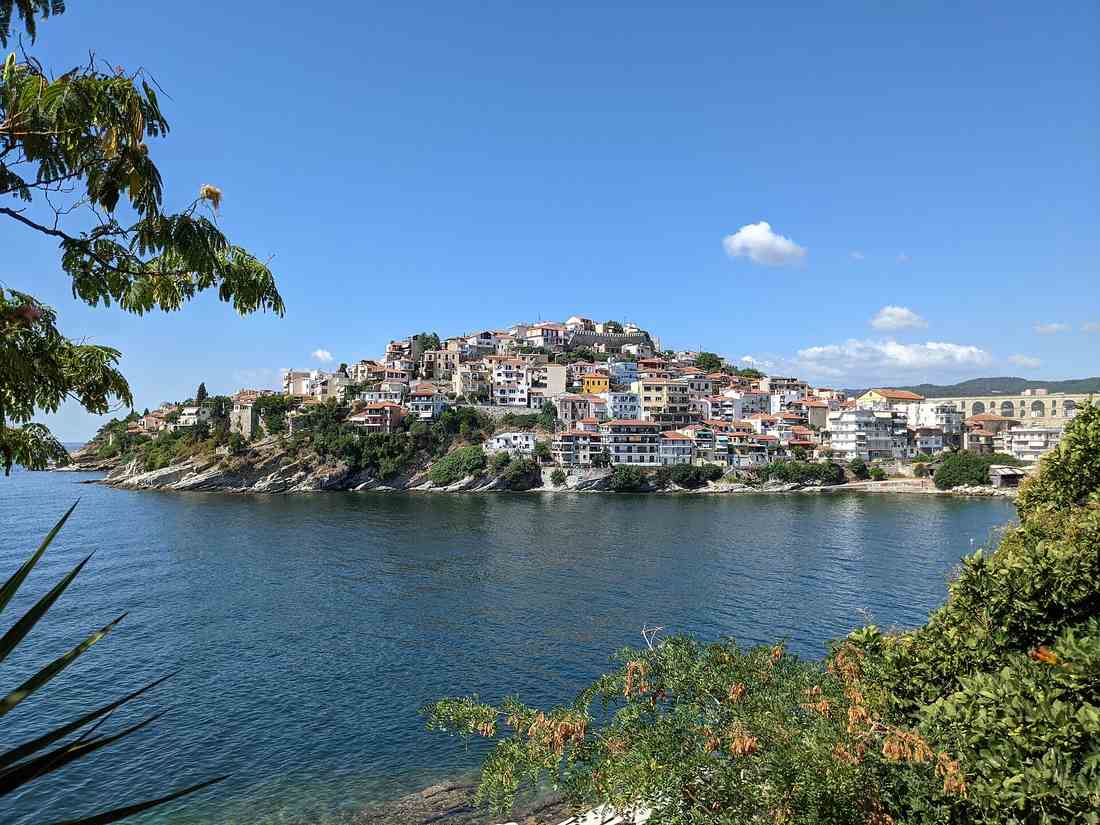
Kavala rises in tiers above its harbour on the north Aegean coast, a two-hour drive east of Thessaloniki along the Egnatia motorway. Stone houses of the Panagia quarter climb toward a Byzantine castle, an Ottoman aqueduct strides across the ridge, and the grand Imaret anchors the waterfront. The ruins of Ancient Philippi, a UNESCO World Heritage Site, lie a short drive inland from the port. A day here pairs a walkable old town with one of the richest archaeological sites in northern Greece. Plan the drive, the old town, and the ruins into one full day with My Greece Tours.
The city rewards a full day rather than a rushed stop, its layers of Greek, Roman, Byzantine, and Ottoman history stacked within a compact centre. The sections below cover what the day trip involves, how to reach Kavala from Thessaloniki, and what to see in the Panagia old town. The later parts turn to Ancient Philippi, the beaches and the Keramoti ferry to Thasos, and how to shape the day around the guided Thessaloniki tours.
What is a Kavala day trip from Thessaloniki?
A Kavala day trip from Thessaloniki is a full-day drive east to a port city of tiered stone houses, an Ottoman old town, and the UNESCO ruins of Ancient Philippi, set about 160 kilometres along the Egnatia motorway.
Kavala serves as the main port and second city of northern Greece east of Thessaloniki, the gateway to the region of eastern Macedonia and Thrace. Its natural harbour drew Greek settlers who founded the colony of Neapolis on the headland in ancient times. The city grew wealthy on tobacco in the modern era, and the tall warehouses of that trade still line the streets behind the port. A day trip treats Kavala as a compact destination, where the harbour, the old town, and the museums sit within a walkable core beside the water.
The city ranks among the leading targets for the eastern run of Thessaloniki day trips, set apart from the western routes toward Halkidiki and the Meteora rocks. Its draw rests on two anchors within a short drive of each other. The Panagia old town offers a headland of Ottoman and neoclassical houses under a castle, while Ancient Philippi holds the ruins of a Macedonian and Roman city on the plain inland. The pairing gives a day both an atmospheric town to walk and a major archaeological site to explore, a balance that few single destinations in the north can match.
A full day suits the distance and the range of sights better than a half-day dash. The drive east runs close to two hours in each direction, which leaves the middle of the day for the town and the ruins. A traveller can walk the Panagia quarter in the morning, break for lunch at the harbour, and reach Philippi in the afternoon when the light falls low across the theatre and the basilicas. The rhythm turns the long road east into a rounded day rather than a hurried errand, with the two headline sights given the hours they deserve.
How do you get from Thessaloniki to Kavala?
Kavala lies about 160 kilometres east of Thessaloniki, a drive of one hour and forty-five minutes to two hours along the Egnatia Odos motorway. A hired car, a private transfer, or the intercity bus each cover the route.
The Egnatia Odos motorway carries the fastest route east, a modern toll road that runs from Thessaloniki across the plains and hills of Macedonia toward the Turkish border. The drive holds a steady pace on dual carriageway for most of the way, with a short descent to the coast at the end. A Thessaloniki car rental gives the freedom to stop at Philippi on the way in and to reach the beaches or the Keramoti ferry without a timetable. Fuel and toll costs apply on the motorway, charged at staffed booths along the route.
The intercity KTEL bus runs east from Thessaloniki to Kavala through the day, a service that takes close to two and a half hours with its stops. Buses leave from the Macedonia coach station on the western edge of the city, reached by local bus or taxi from the centre. The route into the wider network of getting around Thessaloniki makes the coach a budget option for a traveller without a car. The bus drops passengers at the Kavala terminal near the harbour, within walking distance of the old town, though the ruins of Philippi then need a local bus or taxi to reach.
A private transfer or a guided day tour removes the driving and the planning from the trip. A driver handles the motorway and the tolls, and a guide draws out the history of Philippi that the bare stones keep quiet. The format suits travellers who want to read the theatre, the forum, and the early Christian basilicas without a guidebook in hand. The drive east also passes close to the wetlands of the Strymon and Nestos rivers, ground rich in birdlife, which a guided route can point out along the way. The choice of transport shapes the day, yet each option reaches Kavala within the same broad window of two hours.
What can you see in Kavala’s old town of Panagia?
The Panagia old town crowns a rocky headland above Kavala’s harbour, a maze of stepped lanes and stone houses under a Byzantine castle. Its landmarks include the grand Imaret, the Halil Bey Mosque, and the house of Mehmet Ali.
The Panagia quarter fills the headland that closes the eastern side of the harbour, the oldest ground of the city. Stepped lanes climb between houses of stone and timber, some Ottoman and some neoclassical, their balconies leaning over the narrow streets. The Byzantine and Ottoman castle crowns the summit, its walls and round tower open to a view across the gulf toward the island of Thasos. The climb through the quarter rewards a slow pace, each turn framing the sea below or a courtyard heavy with jasmine and bougainvillea. The headland reads as a living neighbourhood rather than a museum, its houses still lived in behind the old façades.
The Imaret dominates the lower slope of the headland, a long Ottoman complex of domes and arcades raised as a charitable religious school and hostel. Mehmet Ali Pasha, the founder of a dynasty that ruled Egypt, endowed it in the early nineteenth century for the poor and the students of the town. The building now works as a luxury hotel, though its courtyards and its silhouette still shape the waterfront. The Halil Bey Mosque stands nearby with its minaret, one of the Ottoman marks the quarter keeps. Together the two buildings anchor the Islamic chapter of a headland that also holds Greek churches and merchant mansions from later periods.
The house where Mehmet Ali Pasha was born stands preserved in the upper quarter, a fine example of a wealthy Ottoman residence with its stables, its harem wing, and its reception rooms. A bronze statue of the ruler on horseback marks a terrace nearby, above the roofs of the town. The Kamares aqueduct strides across the neck of the headland at the foot of the quarter, a tall arcade of arches built in the Ottoman era to carry water to the old town. Its double tier of arches frames the road into Panagia and ranks among the emblems of the city. The quarter packs these landmarks within a short, walkable circuit above the port.
What is Ancient Philippi near Kavala?
Ancient Philippi is a UNESCO World Heritage Site on the plain northwest of Kavala, founded by Philip the Second of Macedon and later a major Roman colony. Its ruins hold a theatre, a forum, and early Christian basilicas.
Philippi lies about fifteen kilometres northwest of Kavala, a short drive inland from the coast onto the plain below Mount Orbelos. Philip the Second of Macedon, the father of Alexander the Great, seized and refounded the town in the fourth century BC to control the gold mines and the road east. The site later grew into a Roman colony astride the Via Egnatia, the great highway that linked the Adriatic to Byzantium. A focused Philippi day trip from Thessaloniki treats the ruins as the headline, while a Kavala day trip folds them in beside the port and the old town.
The ruins spread across a wide field of stone, crossed by the paved line of the Via Egnatia itself. A Greek theatre cut into the acropolis slope survives from the Macedonian city and still hosts performances under the open sky. The Roman forum, the shops, and the public latrines lay out the civic heart of the colony, while the foundations of grand basilicas mark the later Christian town. The plain below the acropolis was the ground of the battle in which the heirs of Julius Caesar defeated his assassins, a clash that turned the course of Roman history. The scale of the site asks for a couple of hours on foot to read in full.
Philippi holds a founding place in the story of Christianity in Europe, which lifts it beyond its Greek and Roman ruins. The Apostle Paul preached here after landing at the port of Neapolis, the harbour that became Kavala, and he baptised Lydia in a stream outside the walls. Tradition marks that act as the first Christian baptism on European soil, and a modern baptistery stands at the site by the river. The great basilicas whose columns and arches rise across the ruins grew from that early church, among the oldest in the Greek lands. The UNESCO listing cites this layered record, Macedonian, Roman, and early Christian, held on one plain.
What are the best beaches and the Thasos ferry near Kavala?
Kavala fronts sandy beaches along its bay, and the port of Keramoti to the east runs frequent ferries to the green island of Thasos. Ammolofoi beach west of the city ranks among the finest sands in the north.
The coast around Kavala holds long stretches of sand within a short drive of the centre. Ammolofoi beach to the west spreads pale dunes and shallow water below low bluffs, a strand often ranked among the best in northern Greece. Batis and Kalamitsa beaches sit closer to the city, backed by cafés and easy to reach on foot or by local bus. The water of the north Aegean warms through the summer and stays clear along this coast, sheltered in part by the bulk of Thasos offshore. A day trip can trade an hour of the afternoon for a swim before the drive back west toward Thessaloniki.
The port of Keramoti lies about forty-five minutes east of Kavala, at the tip of a low spit reaching toward Thasos. Ferries cross from here to the island in around forty minutes, the shortest and busiest link to Thasos, and they run frequently through the warm months. A second ferry route sails direct from Kavala’s own harbour on a longer crossing. The island draws travellers for its pine forests, its marble villages, and its own ring of beaches, a full destination in its own right. A day trip rarely has time for the crossing, yet the ferries mark Kavala as the mainland gateway to Thasos.
The eastern coast around Kavala offers a different landscape from the peninsulas west of Thessaloniki. The beaches of a Halkidiki day trip from Thessaloniki lie on the western side of the city, while a Mount Athos cruise from Thessaloniki follows the monastic peninsula further out. Kavala turns the traveller east instead, toward the tobacco port, the ruins of Philippi, and the ferries to Thasos. The choice of direction shapes the character of the day, and the eastern run rewards those drawn to history as much as to the sea. A guided plan can weigh these routes against the time and the season.
How do you plan a Kavala day trip from Thessaloniki?
A Kavala day trip works best as a full day, with an early start east on the Egnatia motorway, the Panagia old town and harbour at midday, and Ancient Philippi in the afternoon before the drive back to Thessaloniki.
An early departure east makes the most of the long day and beats the heat at Philippi, where the ruins offer little shade. A route that reaches Kavala first suits a morning walk through the cool lanes of Panagia, followed by lunch at a harbour taverna over the fishing boats. The afternoon then turns inland to Philippi, a fifteen-minute drive back toward the motorway, where the low sun rakes across the theatre and the basilicas. The order can flip to take Philippi on the way in, which frees the middle of the day for the town and a swim. Either sequence keeps the driving in two clean legs.
The day asks for sturdy shoes for the stepped lanes of Panagia and the uneven stone of the ruins, along with sun cover for the open ground at Philippi. Water and a hat matter through the summer, when the plain inland grows hot by midday. The archaeological site charges an entry fee at the gate, and a combined ticket often covers the on-site museum. A guided visit adds the context that turns the scattered foundations into a readable city, from the forum to the octagonal church. The harbour of Kavala offers a wide choice of tavernas for a long lunch, with the day’s catch and the mussels of the north Aegean the local strength.
The trip suits travellers with a full day to spare and an interest in history layered over a working port. Families gain the beaches and the castle, walkers gain the headland and the ruins, and those short on time can trim the beaches to hold the two headline sights. A guided day removes the driving on the long motorway and draws out the deep past of Philippi, so the stones speak. The distance rewards commitment to a full day rather than a half-day rush, and a considered plan turns the two-hour road east into a rounded circuit of town, ruins, and coast that ends back in Thessaloniki by evening.
Frequently Asked Questions
How far is Kavala from Thessaloniki?
Kavala lies about 160 kilometres east of Thessaloniki along the Egnatia Odos motorway, a drive of one hour and forty-five minutes to two hours in normal conditions. The intercity KTEL bus covers the route in around two and a half hours with its stops, leaving from the Macedonia coach station on the western edge of Thessaloniki. A hired car or a private transfer gives the most flexible timing for a day trip, since it allows a stop at Ancient Philippi on the way and a detour to the beaches or the Keramoti ferry without a fixed schedule. The distance makes a full day the sensible frame for the trip.
Is Kavala worth visiting as a day trip?
Yes. Kavala rewards a day trip with a rare mix of an atmospheric old town and a major archaeological site within a short drive of each other. The Panagia headland offers stepped lanes, an Ottoman aqueduct, the grand Imaret, and a Byzantine castle above the harbour. Ancient Philippi, a UNESCO World Heritage Site on the plain inland, holds a Greek theatre, a Roman forum, and early Christian basilicas tied to the Apostle Paul. The harbour serves fresh seafood, and the beaches west of the city and the ferry to Thasos add coast to the day. The blend of history, food, and sea makes Kavala one of the fuller day trips from Thessaloniki.
What is the old town of Kavala called?
The old town of Kavala is called Panagia, after the church of the Virgin on the headland. It crowns a rocky peninsula that closes the eastern side of the harbour, the oldest ground of the ancient colony of Neapolis. Stepped lanes climb between stone and timber houses, Ottoman and neoclassical in turn, toward a Byzantine and Ottoman castle at the summit. The quarter holds the birthplace of Mehmet Ali Pasha, the founder of a dynasty that ruled Egypt, along with the Halil Bey Mosque and the arcaded Imaret below. A walk through Panagia takes in these landmarks within a compact, steep circuit above the sea.
How do you get from Kavala to Ancient Philippi?
Ancient Philippi lies about fifteen kilometres northwest of Kavala, a drive of about twenty minutes inland toward the motorway. A hired car reaches the site directly, with parking at the gate. Local KTEL buses run from Kavala toward Drama and Philippi through the day, dropping visitors near the entrance, though the timetable rewards a check before setting out. A taxi covers the short trip for travellers without a car. A guided day tour handles the transfer and adds the history of the theatre, the forum, and the basilicas on site. The short distance lets a Kavala day trip fold the ruins in beside the old town with ease.
Can you visit Philippi and Kavala in one day from Thessaloniki?
Yes. A full day from Thessaloniki comfortably covers both Kavala and Ancient Philippi, since the two sit within twenty minutes of each other. An early start east on the Egnatia motorway reaches Kavala in under two hours, which leaves the morning for the Panagia old town and the harbour. The afternoon then turns inland to Philippi, where a couple of hours read the theatre, the forum, and the early Christian basilicas. The order can reverse to take Philippi on the way in, freeing midday for the town and a swim. The pairing is the classic shape of a Kavala day trip, with the drive kept to two clean legs.
When is the best time to visit Kavala?
Late spring and early autumn offer the finest conditions for a Kavala day trip, with warm days, open sea for swimming, and cooler air for the ruins at Philippi. The height of summer brings strong heat on the shadeless plain inland, so an early start and sun cover matter for the archaeological site. The town stays lively through the warm months, when the ferries to Thasos run at their fullest and the harbour tavernas fill in the evening. Winter turns quieter and cooler, though the old town and the museums still reward a visit. A weekday trip avoids the busiest crowds at the ruins and on the coast road.