
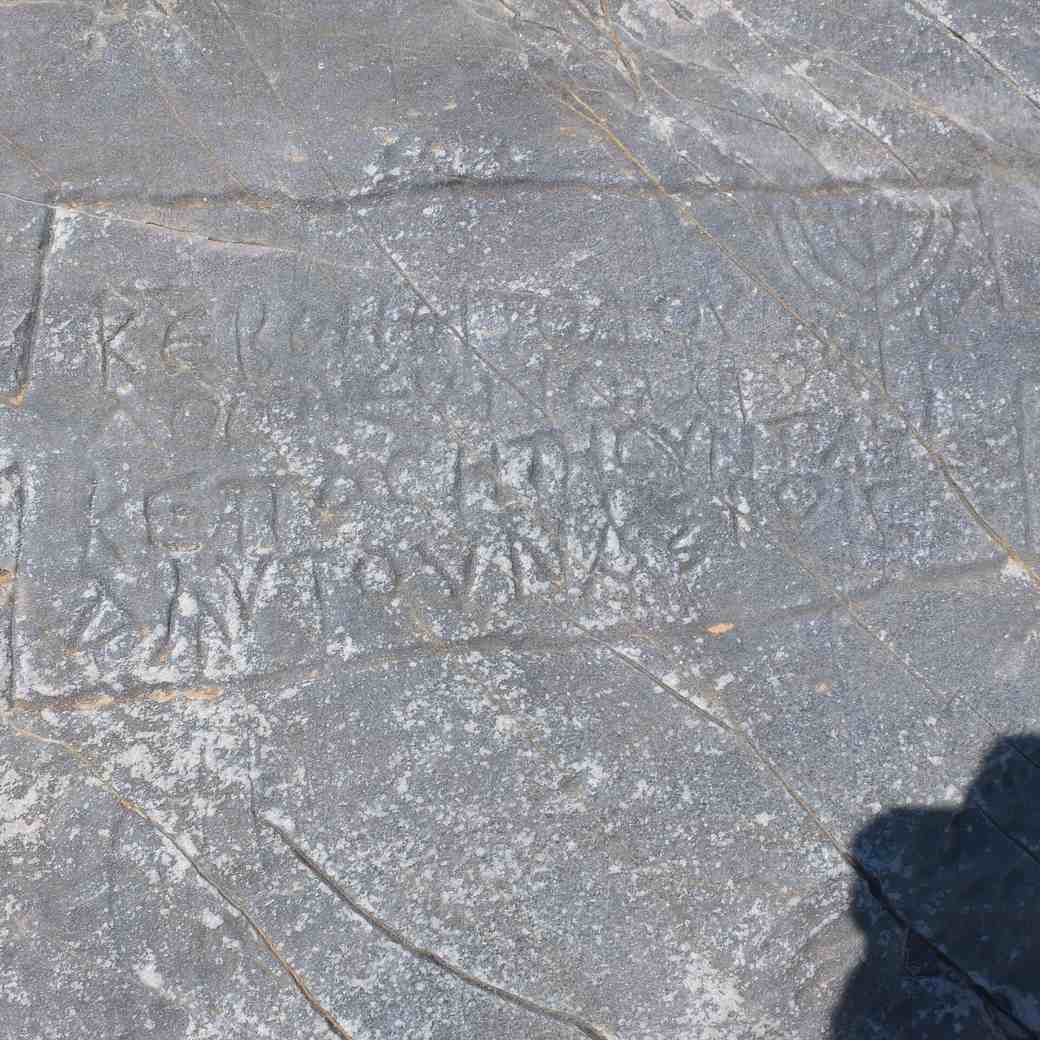
Grammata beach is a deep, sheltered cove on the remote northwest coast of Syros, hidden inside the wild Apano Meria. Its name means letters, taken from the many inscriptions that ancient and medieval sailors carved into the smooth marble rocks around the bay as prayers for safe passage. Plan the whole trip with Greece Tours.
The bay opens away from the open sea behind high headlands, so its water stays calm and clear through the summer. No road, taverna or sunbed reaches the sand, and most visitors arrive by boat from Kini or by a long walk down a rough track across Apano Meria. Grammata sits between the coves of Lia and Aetos and has served sailors as a natural harbour of refuge since antiquity.
Where is Grammata beach on Syros and how do you reach it?
Grammata beach lies on the remote northwest coast of Syros, deep inside the wild Apano Meria peninsula. Visitors reach it by boat from Kini in about 30 minutes, or by a rough 4×4 track and a steep walk through Apano Meria.
Grammata beach sits on the northwest shore of Syros, inside the mountainous Apano Meria that covers the island’s wild northern half. The cove lies far from Ermoupoli, the island capital and main port, with no paved road running to the sand. Most visitors board a small boat or a taxi-boat from Kini beach on the west coast, a run of about 30 minutes each way. The route hugs the coast past Delfini and Varvarousa before rounding into the sheltered bay. A second option follows a rough dirt track by 4×4 across Apano Meria, then a steep 20-minute walk down to the shore. Both approaches reward the effort with one of the quietest coves on Syros.
The boat trip from Kini is the standard way in, and small craft leave the west-coast harbour through the summer season. A one-way passage covers roughly 8 kilometres of coast and takes 25 to 35 minutes, depending on the swell. Skippers time the run for the calm morning hours before the north wind rises. Day boats often pair Grammata with the neighbouring coves of Lia and Aetos on a single loop. The return leg leaves in the late afternoon, so passengers plan the crossing ahead. No jetty or mooring stands at the beach, so boats anchor off the sand and land visitors in the shallows. The clear water makes the wade to shore easy on a still day.
The overland route to Grammata suits drivers with a high-clearance 4×4 and time to spare. A dirt track leaves the paved road above San Michalis and crosses the bare ridges of Apano Meria for several kilometres. The surface turns rough and stony, so ordinary cars stop well short of the shore. Walkers park at the track’s end and descend a steep footpath for about 20 minutes to the sand. The path drops through low scrub and terraced stone with the bay in view for the last stretch. Sturdy shoes and a full water bottle count as essential on the exposed slope. This long approach keeps the cove empty even at the height of August on Syros.
Grammata forms a narrow, deep inlet that cuts back into the coast between rocky headlands. Smooth marble and grey stone frame the small strip of sand and shingle at its head. The bay measures about 150 metres from its mouth to the beach, with steep slopes rising on either side. A scatter of caves and low cliffs lines the water, where the carved inscriptions cover the paler rock. The inlet faces roughly north but bends enough to shelter the sand from the open swell. Depth builds slowly over a floor of sand and weed near the shore. This tucked-away shape, sealed off by the ridges of Apano Meria, gives Grammata its hidden feel on the north coast of Syros.
Why is Grammata beach on Syros called the cove of letters?
Grammata beach takes its name from the Greek word for letters, since sailors carved hundreds of inscriptions into the smooth marble rocks around the bay. The prayers and vows, cut from antiquity through the Byzantine era, name the cove after its written stone.
The word Grammata means letters or writing in Greek, and the cove earns it from the marble rocks that ring the bay. Passing sailors and travellers cut their words into the soft, pale stone over many centuries. The inscriptions cluster on the smooth slabs near the waterline, where the marble takes a chisel cleanly. Some run only a few words, while others fill a whole face of rock with names and prayers. Salt and weather have worn many to faint lines, yet dozens stay legible today. Scholars have recorded the texts across repeated surveys of the north coast of Syros. The sheer number of carvings, gathered in one small inlet, gives Grammata a name found on no other beach on the island.
Sailors carved at Grammata because the cove served as a shelter from the open sea and its dangers. A crew that reached the calm bay in a storm left a mark of thanks for the safe landing. Others cut a vow before setting out again across the exposed channel toward Tinos and Andros. The act tied the written word to the hope of a safe passage over rough water. The habit ran for centuries, so later hands added lines beside far older ones. The marble face became a public record of the crews that sheltered here. This link between refuge and writing explains why the inscriptions gather at Grammata rather than at the open beaches of Syros.
The carvings span a long stretch of the island’s history, from antiquity through the Roman and Byzantine eras. The earliest use the Greek and Latin scripts of classical and Roman sailors who crossed the Aegean. Later hands added Christian symbols and Byzantine Greek, marking the shift in the seafarers who passed. A cross or a saint’s name sits beside older pagan appeals for calm seas. This layering turns the rock into a timeline of the crews that used the cove. Each era left its own script and its own form of prayer on the stone. The unbroken record, cut over so many centuries, marks Grammata as a rare open-air archive on the coast of Syros.
Reading the inscriptions today calls for a close look at the weathered marble near the shore. Many carvings sit low on the rock, close to the reach of the waves that slowly wear them. Faint letters show best in the raking light of morning or late afternoon. Visitors trace names, dates of office and short prayers cut in careful lines. The stone stays protected in principle, so touching or adding to it breaks the rule and the law. Photographs in low sun record the texts better than a rubbing, which harms the surface. This fragile gallery, open to the sky above the sand, gives Grammata a draw that its swimming alone would never earn on Syros.
What do the ancient inscriptions at Grammata beach on Syros record?
The inscriptions at Grammata record prayers, vows and names left by sailors seeking safe passage. Cut in Greek and Latin from antiquity through the Byzantine era, they mark thanks for shelter, appeals for calm seas and the crews who sailed the north coast.
Most of the Grammata texts are prayers and vows tied to the sea and its risks. A common form reads as a plea for a safe voyage across the open channel beyond the cove. Others give thanks for a landing made in a gale, when the sheltered bay saved a ship. Sailors named themselves, their vessels and at times the port they left. Some lines mark an official on a state crossing, cut with his title and term. The words stay short and practical, fixed to the moment of shelter. This focus on safe passage runs through the whole gallery of stone that lines the bay at Grammata on Syros.
The oldest carvings use the Greek and Latin of the classical and Roman worlds. Greek lines appeal to the gods of the sea for calm water and a fair wind. Latin texts, cut by Roman travellers and officials, name the writer and the date of a crossing. Both scripts share the same smooth marble faces near the waterline. The mix marks Grammata as a stop on the busy sea lanes that linked the Aegean islands. Ships bound for Delos, Tinos or the Asian coast could shelter here on the way. This spread of Greek and Latin hands sets the cove among the notable ancient sites on the north of Syros.
Later inscriptions shift to Byzantine Greek and the symbols of the Christian era. A carved cross often marks the start of a prayer to a saint or to Christ for protection. The names change too, drawn from the Christian world that replaced the pagan one. These carvings sit beside the older pagan appeals, sharing the same rock. The continuity shows that crews kept using the cove as a refuge across the change in faith. The sea stayed the same danger, and the written prayer stayed the same response. Byzantine crews bound for the same island ports left their mark where classical hands once cut theirs. This Byzantine layer, cut over the classical one, deepens the record held on the marble at Grammata beach on Syros.
Surveys of the north coast have catalogued the carvings and set out their range and dates. Researchers record each text, its script and its place on the rock before the sea wears it further. The inscriptions face slow damage from salt, spray and the salt crust that builds on the stone. Protection rules bar any new carving, touching or removal at the site. The cove holds no guard or fence, so the record depends on the care of each visitor. Scholars treat Grammata as a rare concentration of sailors’ graffiti in one Aegean bay. This body of stone writing gives the cove a place in the wider history of navigation across Syros and the Cyclades.
Why is the water at Grammata beach on Syros so calm and clear?
The water at Grammata stays calm and clear because the deep inlet sits behind high headlands that block the swell. No road, harbour or river clouds the bay, so the sheltered water holds a bright, transparent tone over a clean sand-and-marble floor.
The shape of the inlet is the main reason the water at Grammata stays so still. The cove cuts deep into the coast, and steep headlands rise on both sides to break the swell. Waves lose their force before they reach the sand at the head of the bay. Even when the sea runs high offshore, the inner water holds a light ripple rather than surf. The bend in the inlet turns the sand away from the strongest push of the open water. This natural shelter is the same feature that drew sailors to the cove for refuge. It leaves the bathing water calm on days when much of the Syros coast turns rough.
Water clarity at Grammata runs high because nothing muddies the bay. No river or stream mouth carries silt into the cove, and no harbour or road sheds runoff onto the shore. The floor of clean sand, weed and marble reflects light and gives the water a clear, bright cast. Swimmers read the seabed several metres down on a still morning. The lack of any development means no fuel, waste or crowd clouds the water through the day. Sea grass beds off the sand trap fine sediment and keep the bay transparent. The marble floor in places adds a pale base that brightens the water still further. This clean, sheltered water rewards the long trip to the remote north coast of Syros.
The calm holds best in the early hours before the summer north wind builds. The meltemi drives hard across the open Aegean and stirs the exposed beaches of the island. Grammata’s deep, north-bending inlet blunts that wind far more than a straight, open shore. Boats time their visit for the morning, when the water lies at its stillest. By the afternoon a light chop can reach the mouth of the bay, though the head stays sheltered. Swimmers and snorkellers make the most of the clear early water over the sand and rock. A boat that leaves Kini around 9 in the morning lands its passengers in the calmest hours. This daily rhythm shapes the best hours for a visit to the cove on Syros.
Snorkelling at Grammata rewards the clear water and the rocky margins of the inlet. Fish gather over the marble slabs and the sea grass that carpets the floor near the sides. The clean water lets a mask pick out bream, wrasse and the odd octopus among the stones. Depth builds slowly from the sand, so the shallows stay easy for a first look below. The rocks that carry the inscriptions also shelter marine life along the waterline. No boat traffic crosses the head of the bay, so the water stays undisturbed. This blend of clarity, shelter and rock makes Grammata a quiet spot for snorkelling on the north coast of Syros.
What facilities does Grammata beach on Syros have for visitors?
Grammata beach has no facilities at all, since no road, taverna, sunbed or shop reaches the remote cove. Visitors bring their own water, food and shade, and carry every piece of rubbish back out with them to protect the unspoiled bay.
Grammata offers nothing in the way of built services, and that absence defines a visit. No taverna, bar or kiosk stands at the cove, and no sunbed or parasol lines the sand. There is no fresh-water tap, shower or toilet anywhere near the beach. The nearest supplies sit back at Kini or in the villages of Apano Meria, well away by boat or track. Visitors carry in every litre of water, all their food and their own shade for the day. A beach umbrella or a light tarp matters most, since the marble and sand throw back the sun. This bare setup is the price of the cove’s calm and its empty sand on Syros.
Shade is the single greatest need at Grammata, as the inlet holds few natural shelters. The rocks give a little cover at the edges in the early morning, but the sun soon fills the bay. A portable umbrella or a shade cloth strung between poles handles the midday heat. Water counts next, since the exposed sand and the walk in both drain a visitor fast. A rule of thumb sets two litres per person for a full day at the cove. Sunscreen, a hat and sturdy shoes round out the pack for the rough approach. This short list of staples, carried in from Kini or the track, turns a hard trip into a comfortable day.
Food and drink follow the same rule at Grammata, since no kitchen serves the bay. Visitors pack a picnic that survives the boat ride or the walk without a cool store. Bread, cheese, fruit and cured meat travel well and need no fire or fridge. Any bottle or wrapper carried in must leave with the visitor at the end of the day. No bin stands at the cove, so all waste rides back out by boat or on the path. This carry-in, carry-out habit keeps the sand clean and the water clear. Respect for the rule protects both the beach and the carved marble that gives Grammata its name on Syros.
Safety at Grammata rests on the visitor alone, since no lifeguard or service covers the cove. The remote setting means help sits far off by boat or a long track drive. Swimmers judge the water and the wind for themselves and keep near the sheltered head of the bay. A phone signal can drop behind the high headlands of Apano Meria. Visitors tell a boatman or a friend of their plan and return time before setting out. A basic first-aid kit belongs in the day pack alongside the water and shade. This self-reliant approach fits the wild character of the north coast and keeps a day at Grammata safe on Syros.
How does Grammata beach serve as a natural harbour of refuge on Syros?
Grammata serves as a natural harbour of refuge because its deep, sheltered inlet gives ships calm anchorage away from the open swell. Sailors have run here for shelter in storms since antiquity, and the carved prayers around the bay record that long use.
The deep inlet at Grammata makes a ready shelter for small craft caught by rough seas. The cove cuts far enough into the coast to hold calm water when the open channel runs high. High headlands on both sides break the wind and the swell before they reach the anchorage. A ship rounding the point finds still water and a sand floor that holds an anchor well. This shelter matters on the exposed north coast, where few safe bays break the cliffs. Sailors reaching Grammata in a gale gained a haven within the wild shore of Apano Meria. The same feature that calms the bathing water has drawn boats to the cove for shelter across the centuries.
The role as a refuge reaches back to antiquity, when open boats crossed the Aegean by sight. A crew caught by the meltemi off Syros could run for the shelter of Grammata to wait out the wind. The bay lay on the sea road between the ports of the Cyclades and the coast beyond. Ships bound for Delos, Tinos or Asia Minor used the cove as a stop in bad weather. The safe landing meant survival, and the carved thanks on the rock record that relief. This deep history of refuge sets Grammata apart from the plain swimming bays of the island. The stone itself preserves the memory of the crews that sheltered here on Syros.
The carved inscriptions tie the harbour of refuge directly to the written stone of the cove. A sailor saved by the shelter cut a prayer of thanks into the marble by the water. Another marked a vow before facing the open channel once more beyond the headlands. The bay thus joined a working anchorage to a wall of sea prayers in one place. Each carving stands as proof that a ship found calm water here in its hour of need. The link between shelter and script gives Grammata a depth that its sand alone lacks. This union of harbour and inscription marks the cove among the notable maritime sites on Syros.
Small boats still use Grammata as a calm anchorage on a summer visit today. Day skippers from Kini drop anchor off the sand to swim and read the carved rock. The bay holds a sheltered spot to rest before the run back down the coast. No mooring or quay stands at the cove, so crews set an anchor on the sandy floor. The old role of refuge lives on in this quiet modern use of the bay. Yachts crossing the Cyclades still note Grammata as a bolt-hole in a north wind. This living link between past and present keeps the cove a working harbour of refuge on the north coast of Syros.
How does Grammata beach compare with Kini, Delfini and Varvarousa on Syros?
Grammata is the most remote of the northwest coves, reached only by boat or a rough track, while Kini, Delfini and Varvarousa lie closer to the road. Grammata trades all facilities for calm, clear water and its unique carved marble rocks.
Grammata sits well beyond Kini beach, the organised west-coast bay that serves as the gateway to the north. Kini carries a village, tavernas, sunbeds and a paved road, and boats to Grammata leave from its harbour. The two share the same sheltered, west-facing calm, but Kini offers full services while Grammata offers none. A visitor swims and eats at Kini, then rides 30 minutes north to the empty carved cove. Kini works as a base for the trip, holding the water, food and boat that Grammata lacks. This pairing of a serviced harbour and a wild refuge shapes many north-coast days. The contrast marks the two ends of the beach range on the northwest of Syros.
Delfini beach lies between Kini and Grammata and splits the difference in access and calm. Delfini offers a sheltered, sandy cove reached by a short drive and a walk, with a seasonal canteen. It draws more visitors than Grammata but far fewer than busy Kini or Galissas. The water runs calm and clear, shielded like Grammata by the north-coast headlands. Delfini holds no marble inscriptions, so it lacks the historical draw of the carved cove. A boat trip north often passes Delfini and Varvarousa on the way to Grammata. Delfini lies about 4 kilometres up the coast from Kini, roughly halfway to the carved cove. This chain of coves lets a visitor grade the coast from serviced Kini to wild, remote Grammata.
Varvarousa is the closest neighbour in spirit to Grammata, a quiet cove with clear water and no road. Reached by boat or a rough footpath, it shares the remote, undeveloped feel of the carved bay. Both trade all services for calm, transparent water on the sheltered north coast. Varvarousa carries fine sand and a green backdrop, but it holds no inscribed marble. Grammata stands apart for the carved rocks that give it a name and a history no other cove shares. A day boat from Kini can link Varvarousa and Grammata in a single loop. This run of wild coves marks the northwest as the least-built stretch of the Syros shore.
Choosing among the four coves comes down to the trade between service and solitude. Kini suits families and first-time visitors who want a village, food and easy road access. Delfini fits those after a calm swim with a short walk and a light canteen. Varvarousa and Grammata reward the traveller who trades all comfort for empty sand and clear water. Grammata alone adds the carved marble, the harbour of refuge and the deepest history of the group. A boat from Kini reaches every one of them in under 40 minutes each way. Many visitors ride out to the wild coves in the morning and return to Kini for a late lunch. This graded chain, from serviced bay to remote carved cove, defines the northwest coast of Syros.
Frequently Asked Questions
Is Grammata beach on Syros sandy or pebbly?
Grammata has a small strip of sand mixed with fine shingle at the head of the deep inlet. Smooth marble slabs and grey rock frame the beach on both sides, and these carry the ancient carved inscriptions. The floor near the shore is sand and weed, which gives the water its clear tone. The cove is compact, with steep slopes rising close behind, rather than a wide open shore. This mix of sand, shingle and inscribed marble sets Grammata apart from the plain sandy bays elsewhere on Syros.
How do you reach Grammata beach on Syros?
Grammata sits on the remote northwest coast of Syros, with no paved road to the sand. Most visitors take a boat or taxi-boat from Kini on the west coast, a run of about 30 minutes each way. Day boats often pair the trip with the coves of Lia, Aetos and Varvarousa. The overland option follows a rough 4×4 track across Apano Meria, then a steep 20-minute walk down to the shore. Ordinary cars cannot manage the track, so the boat from Kini stays the easier route for most.
Are there any facilities at Grammata beach on Syros?
Grammata has no facilities of any kind. There is no taverna, bar, kiosk, sunbed, shower or toilet at the remote cove, and no road reaches the sand. Visitors bring all their own water, food and shade, since the exposed bay offers little natural cover. A portable umbrella and at least two litres of water per person matter most for a full day. Every piece of rubbish must leave with the visitor, as no bin stands at the beach to keep it clean.
What are the Grammata inscriptions on Syros?
The Grammata inscriptions are hundreds of carvings cut into the smooth marble rocks around the cove. Sailors and travellers made them over many centuries as prayers and vows for a safe passage across the open sea. The texts run in Greek and Latin from antiquity through the Roman and Byzantine eras, with later Christian crosses beside older pagan appeals. They give the beach its name, since Grammata means letters in Greek. Protection rules bar any touching, rubbing or new carving at this fragile open-air site.
Is Grammata beach on Syros good for swimming and snorkelling?
Grammata offers calm, clear water that suits both swimming and snorkelling on a still day. The deep inlet sits behind high headlands, so the water stays sheltered when much of the coast turns rough. Depth builds slowly over a floor of sand, weed and marble, so the shallows stay easy for a first swim. Snorkellers find bream, wrasse and octopus over the rocks and sea grass at the sides. The calm holds best in the morning before the summer north wind builds across the Aegean.
What is near Grammata beach on Syros?
Grammata sits between the coves of Lia and Aetos on the remote north coast of Syros, all reached by boat or rough track. Varvarousa and Delfini lie further south toward Kini, the organised west-coast bay that serves as the gateway to the area. Boats to Grammata leave from Kini, about 30 minutes down the coast. The wild Apano Meria peninsula surrounds the cove, with the village of San Michalis on the ridge above. No shop or taverna stands nearby, so visitors carry supplies from Kini or the villages inland.