
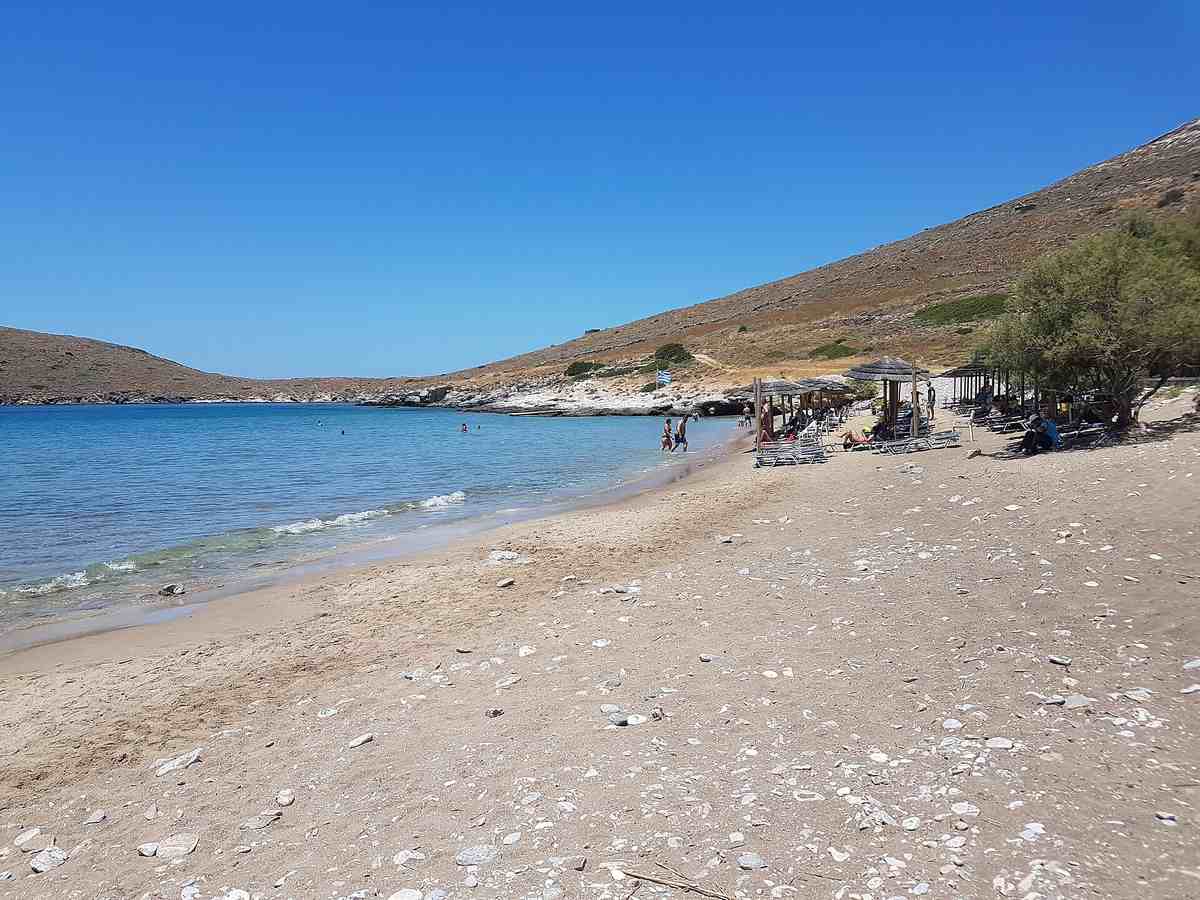
Delfini beach is a small sheltered cove on the west coast of Syros, set just over the headland north of the fishing village of Kini beach. The strip mixes soft sand and fine pebble, backed by low hills and a scatter of tamarisk trees, with a single taverna and six sunbeds in season. Clear, calm water and a west-facing horizon draw swimmers and snorkellers who prefer quiet to service. Plan the whole trip with Greece Tours.
The cove lies about 11 kilometres from the port capital of Ermoupoli, reached by a drive of roughly 20 minutes and a short walk down a narrow road. Most visitors arrive by car or cross the headland on foot from Kini in about ten minutes, since public transport to Delfini itself is limited. This guide covers access, the sand-and-pebble shore, why the cove stays quieter than Kini, the snorkelling, the sunset, the remote northern beaches beyond, and how Delfini measures against Kini, Galissas and Varvarousa.
Where is Delfini beach on Syros and how do you reach it?
Delfini beach lies on the west coast of Syros, just over the headland north of Kini, roughly 11 kilometres from Ermoupoli. A narrow road drops to the cove, or a ten-minute walk crosses the hill from Kini.
Delfini occupies a small west-facing cove on the western shore of Syros, the administrative centre of the Cyclades. The cove sits just north of the fishing village of Kini beach, over a low headland. A narrow surfaced road drops to the sand from the inland route above the coast. Drivers leave the car on the gravel verge above the beach and walk down a short slope. The cove opens west toward the open Aegean, so it faces the afternoon light. Low hills back the sand, with three tamarisk trees for shade near the shore. Signposts from the main island road mark the turning toward Kini and Delfini. The setting stays quieter than the serviced Kini bay a short distance to the south.
The drive from the port town of Ermoupoli covers about 11 kilometres and takes roughly 20 minutes. The road climbs the island’s central ridge before dropping toward the western coast near Kini. A hire car, taxi or rented scooter is the practical way to reach the cove directly. Public buses serve Kini rather than Delfini, so the final stretch is a drive or a walk. Drivers turn off the Kini road onto the narrow lane that ends above the beach. The last section is single-track in places, so meeting an oncoming car means using a passing spot. Parking sits on the gravel above the sand and fills early on July and August mornings.
Reaching Delfini on foot from Kini takes about ten minutes over a marked track across the headland. Walkers start from the northern end of Kini beach, near the harbour and the bronze mermaid statue. The path climbs the low rise and then drops to the Delfini cove on the far side. The route is short but uneven, so firm shoes suit the loose ground better than sandals. Most visitors pair the two beaches, swimming at Kini and crossing the hill for a quieter dip. The walk gives wide views west over the bay toward the open Aegean. Carrying water and shade matters, since Delfini has fewer facilities than the village beach behind.
Small boats also link Kini harbour with Delfini and the coves further north along the coast. Taxi-boats and day cruises leave Kini through the summer, mainly heading for the roadless northern beaches. A short hop by sea reaches Delfini when the driver drops swimmers on the way north. The crossing depends on a calm sea, since the north coast turns rough when the meltemi blows hard. Most visitors, though, reach Delfini by the narrow road or the headland walk rather than by boat. The cove works as a quieter alternative for anyone based in Kini or driving out from Ermoupoli. Access by car, on foot or by boat keeps the beach within easy reach of the west coast.
What kind of beach is Delfini on Syros, sand or pebble?
Delfini is a small cove of mixed soft sand and fine pebble on the west coast of Syros. The shore runs roughly 100 metres, backed by low hills and three tamarisk trees, with clear, calm water off a gently shelving seabed.
Delfini is a compact cove where soft sand meets stretches of fine pebble along the waterline. The strip runs roughly 100 metres in a shallow curve between two low rocky arms. The sand lies mainly toward the centre, while pebble and shingle edge the sides near the rocks. The seabed shelves gently, so the water stays shallow for roughly four metres before it deepens. Swimmers find a clean, sandy entry underfoot across most of the central beach. Low hills rise directly behind the sand, giving the cove its sheltered, enclosed feel. Three tamarisk trees stand at the back of the beach, offering the only natural shade. The mix of sand and pebble is common along the quieter western coves of Syros.
Facilities at Delfini stay limited compared with the serviced beaches nearby on the island. A single taverna operates behind the sand through the main summer months. Six sunbeds and umbrellas line the central strip in high season, set out by the taverna. Beyond these, the cove holds no mini-market, no showers and no permanent lifeguard. Most visitors bring their own water, food and shade for a full day at the beach. The tamarisk trees at the back give patchy cover when the sunbeds fill or close. The plain setup is part of why Delfini stays quieter than the bustling Kini seafront. Travellers who want service and tavernas at hand tend to base themselves at Kini instead.
The water at Delfini reads clean and clear because the cove drains cleanly over its sandy bed. The surface stays calm on most summer days, sheltered by the headlands and rising ground around it. A firm strip of wet sand at the waterline gives a level place for children to paddle. The gentle shelf lets swimmers wade out slowly rather than dropping into deep water at once. Snorkellers find small fish near the rocky arms that close each side of the cove. The clarity suits masks, fins and easy floating on the flat water through the middle of the day. These conditions place Delfini among the calmer swimming coves on the west coast of Syros.
Part of Delfini is used by naturists, a pattern common on the more secluded beaches of Syros. The quieter northern and western coves draw visitors who prefer seclusion to sunbeds and crowds. The naturist stretch sits toward one end of the cove, away from the taverna and the parked cars. Swimmers who want the serviced section stay near the centre, close to the sunbeds and shade. The low crowds and the limited facilities give the cove its calm, undressed character. This mix of a quiet family strip and a naturist end matches the beach’s out-of-the-way position. Delfini works best for visitors after a plain, unhurried day rather than a busy seafront.
Why is Delfini beach quieter than neighbouring Kini on Syros?
Delfini stays quieter than Kini because it sits over a headland with no village, no seafront row of tavernas and only a narrow access road. The single taverna and limited sunbeds draw far smaller crowds than the busy Kini bay.
Delfini lies over a low headland from Kini, cut off from the village and its seafront. The cove holds no cluster of houses, no promenade and no line of waterfront tavernas. A single taverna behind the sand is the only place to eat or buy a drink. The narrow access road and limited parking cap the number of cars that reach the beach. These traits keep the crowds far thinner than the busy Kini bay a short walk south. Visitors who cross the hill find a plain strip of sand rather than a serviced seafront. The separation by the headland is the main reason Delfini reads calmer than its neighbour.
Kini, by contrast, is a working fishing village with a curved seafront of fish tavernas. Its harbour, bronze mermaid statue and rows of sunbeds draw families and evening diners through the season. Buses run from the port to Kini, so day visitors reach it without a hire car. Delfini has no such bus link, so most arrivals drive or walk over from the village. The extra effort to reach the cove filters out most of the casual beach traffic. Those who make the trip trade tavernas and service for quiet and space on the sand. The difference in access explains most of the gap in crowds between the two beaches.
The limited facilities at Delfini reinforce its quieter character through the summer months. With one taverna, six sunbeds and no shops, the cove suits a self-sufficient day. Visitors carry water, food and shade rather than relying on a seafront row of businesses. The plain setup discourages large groups that prefer the sunbeds and menus of Kini. Naturists use one end of the cove, drawn by the seclusion the headland provides. The low hills and tamarisks give the beach an enclosed, sheltered feel away from the road. This combination of quiet, seclusion and simple facilities defines the Delfini experience on Syros.
Timing shapes how quiet Delfini feels across a summer day on the island. Mornings stay calm and near-empty before the first cars fill the gravel above the sand. The cove sees more visitors in the early afternoon, though numbers stay well below Kini. Late afternoon brings a small crowd for the west-facing sunset over the Aegean. Even at its busiest, the beach holds far fewer people than the serviced village bay. Arriving early secures both a parking space and a stretch of sand near the water. Delfini rewards visitors who value a slow, uncrowded swim over the bustle of a seafront.
Is Delfini beach on Syros good for snorkelling?
Delfini suits snorkelling well because its clear, calm water shelves gently over a sandy bed and two rocky arms close the cove. Small fish gather near these rocks, and the sheltered surface stays flat on most summer days.
Delfini offers clear, calm water that suits snorkelling across most of the summer season. The cove drains cleanly over a mostly sandy bed, keeping the water transparent close to shore. Two low rocky arms close each side of the beach, giving fish cover and structure. Snorkellers find small fish gathered around these rocks, where the depth increases beyond the sand. The gentle shelf lets swimmers ease out from the shallows into deeper water without a sudden drop. Flat, sheltered conditions on calm days leave the surface easy to read through a mask. These traits make the cove a steady choice for a quiet snorkel on the west coast of Syros.
The rocky edges at Delfini hold the most life for anyone with a mask and fins. Fish shelter in the crevices and among the stones where the sand gives way to rock. The clear water lets snorkellers watch them from the surface without diving deep. Sea grass beds in patches of the cove add cover for smaller fish and marine life. The sandy centre stays plainer, better for easy floating than for spotting fish. Moving toward either rocky arm brings the richest views within a short swim from shore. The sheltered water keeps visibility high through the calmer middle hours of the day.
Calm conditions are the key to good snorkelling at Delfini through the season. The headlands and rising ground around the cove block most of the summer meltemi wind. On sheltered days the surface stays flat, and the water clears to give sharp views below. A strong westerly wind can push swell into the cove, stirring the sand and cutting visibility. Such winds are far less common than the dominant north wind of the Aegean summer. Checking a simple wind forecast the evening before helps snorkellers pick a calm day. Morning visits often bring the flattest water before any afternoon breeze builds over the bay.
Snorkellers at Delfini should bring their own gear, since the cove has no rental stand. The single taverna and limited sunbeds do not stock masks, fins or other equipment. Water shoes help on the pebble and around the rocks where the fish gather. Carrying water and shade matters, because the tamarisk trees give only patchy cover. The sheltered water suits beginners learning to float and breathe through a snorkel. More confident swimmers explore the rocky arms and the deeper water beyond the sandy shelf. The quiet cove and clear water make Delfini a practical spot for an unhurried snorkel on Syros.
Why does Delfini beach on Syros catch the sunset?
Delfini faces west across the open Aegean, with no land closing the horizon. The sun drops straight into the sea beyond the cove, so the beach and its single taverna catch the sunset through the long summer evenings.
Delfini opens due west toward the open Aegean, with no island or headland blocking the view. The sun sets straight over the water beyond the cove through the long summer evenings. This west-facing angle is the trait the cove shares with neighbouring Kini to the south. The light turns the sea gold and then red in the final half hour before dark. Low hills behind the sand frame the open horizon and the sinking sun over the water. The quiet setting gives an unhurried view free of the crowds that fill the Kini seafront. Delfini’s western aspect sets it apart from the east-facing capital and the sheltered southern coves of Syros.
The single taverna behind Delfini gives a simple base for watching the sun drop. Visitors who linger past the afternoon swim stay for the light over the water. The plain setting means the sunset comes without the bustle of a busy seafront row. Photographers value the clear line of the horizon, broken only by the odd passing boat. The rocky arms of the cove add foreground to a frame of the sinking sun. Calm evenings leave the water flat, mirroring the colour of the sky across the cove. The quiet and the open western view are the two draws that hold visitors into the evening.
The best sunset months at Delfini run from late spring to early autumn, when skies stay clear. The sun sets later in high summer, so the light lingers until around nine in the evening. Clear Cycladic air keeps the horizon sharp, giving a defined line where the sun meets the sea. Swimmers time a final dip for the last hour of daylight as the water cools. The west-facing cove gives an unbroken view that other quiet beaches on Syros rarely match. Fewer visitors stay for the Delfini sunset than crowd the Kini tavernas a short walk away. Those who remain find a calm, open stretch of sand for the closing light.
Ermoupoli, the island capital, faces east across its harbour, so it misses the sunset over the sea. Visitors staying in town drive the 11 kilometres west to catch the sun dropping into the Aegean. Most pair the trip with a swim at Delfini and a fish dinner over at Kini. The short distance between the two beaches lets a family split the evening between them. Couples time the narrow-road drive for the final half hour of daylight over the water. The quiet cove suits anyone who wants the sunset without the seafront crowds. Most travellers treat the western beaches as the place to watch the sun set on Syros.
What lies beyond Delfini on the northern coast of Syros?
Beyond Delfini the coast turns remote, with Varvarousa just north and the roadless beaches of Grammata, Lia and Aetos further along. These bays face the open sea and are reached mainly by boat from Kini harbour.
Varvarousa lies just north of Delfini, a quiet bay reached by a rough track or by boat. The beach mixes sand and pebble and holds no taverna, sunbeds or shops of any kind. Visitors carry all they need, since the bay sits away from the road network of the coast. The clear, calm water suits swimming and snorkelling off the rocks that edge the shore. A four-wheel-drive track or a walk reaches Varvarousa, keeping its crowds thin through the season. The bay marks the point where the western coast of Syros turns wilder and more remote. It pairs with Delfini for anyone chasing quieter, less serviced sand beyond Kini.
Grammata is the best known of the roadless northern bays, a sheltered inlet of clear, deep water. Ancient sailors carved prayers and names into the soft rock around the cove over the centuries. These inscriptions give the beach its name, which means letters in Greek, and draw visitors by boat. The bay has no road, no taverna and no sunbeds, so the boat brings all that a day needs. The sheltered position keeps Grammata usable on days the open north coast runs rough. Snorkellers find calm, clear water and rocky edges rich with fish along the inlet. Most visitors reach it only by the taxi-boats and cruises that leave from Kini harbour.
Lia and Aetos lie further along the exposed northern coast, remote bays of sand, pebble and clear water. Both sit away from any road, so a boat from Kini is the main way to reach them. The beaches stay quiet even in high season because the crossing filters out casual visitors. Snorkellers find clear water and rocky edges rich with fish along these sheltered inlets. Neither bay carries a taverna or sunbeds, so the day-boats supply the shade, water and food. The northern coast faces the open sea, so crossings run only when the meltemi allows. A day trip by boat often takes in two or three of these bays in one loop.
Reaching the northern beaches beyond Delfini depends on a calm sea and a boat from Kini. Small taxi-boats and organised day cruises leave the harbour through the peak summer months. Crossings run in the morning when the sea is calmest, returning in the afternoon before the wind builds. Operators post schedules along the Kini seafront and take bookings at the harbour or the tavernas. Passengers carry water, a hat and food, since the northern bays hold no shops. Weather can cancel a trip at short notice, so travellers keep a spare day in the plan. Delfini sits at the near end of this wild coast, the last easy beach before the roadless bays.
How does Delfini beach compare with Kini, Galissas and Varvarousa on Syros?
Delfini is the quiet sunset cove north of Kini, plainer and less serviced than the fishing-village bay. Galissas offers a wide family beach to the south, while Varvarousa is a wilder, roadless bay further north.
Kini sits just south of Delfini, over the headland, and carries the tavernas and service the cove lacks. Its curved seafront, harbour and bronze mermaid statue draw families and evening diners through summer. Kini beach holds a bus link, a mini-market, showers and rows of sunbeds close to the sand. Delfini trades all of this for quiet, seclusion and a single taverna behind the strip. The two beaches share the same west-facing sunset over the open Aegean. A ten-minute headland walk lets visitors swim at both in a single day. Most pair a serviced stop at Kini with a quieter dip at Delfini next door.
Galissas lies a short drive south of Kini and offers the widest family beach on this coast. Its broad, sheltered sand and shallow water make Galissas beach a magnet for families. The stretch is far larger than the Delfini cove and leans toward a long day on the sand. Tavernas, sunbeds and rooms back the beach, giving it the service Delfini does not carry. The drive between the two takes only about fifteen minutes on the quiet inland roads. Both face west, so each catches the afternoon light and the sunset over the sea. Galissas suits a busy family day, while Delfini rewards visitors after a plain, quiet swim.
Varvarousa lies just north of Delfini and pushes further into the wilder western coast. The bay holds no taverna, sunbeds or shops and is reached by a rough track or a boat. It trades even the single Delfini taverna for a fully self-sufficient day on the sand. The clear, calm water suits swimming and snorkelling off the rocks that edge the bay. Varvarousa draws visitors who want more seclusion than the naturist end of Delfini. The two coves pair for anyone chasing quiet, roadless sand beyond the reach of Kini. Delfini sits between the serviced village bay and the remote beaches further north.
Choosing between them comes down to the day you want rather than a single best beach on Syros. Delfini wins for a quiet swim, easy snorkelling and a sunset away from the crowds. Kini suits a fish dinner, a seafront stroll and a bus link from the port capital. Galissas fits a long family day on wide, shallow sand with shade and service at hand. Varvarousa and the northern bays reward anyone after roadless, secluded shores by boat or track. A week on the island can take in all of them, using Kini as the serviced anchor. The short distances across Syros make hopping between these western beaches an easy part of any stay.
Frequently Asked Questions
Is Delfini beach on Syros sandy or pebbly?
Delfini is a mix of soft sand and fine pebble, a small cove roughly 100 metres long on the west coast of Syros. The sand lies mainly toward the centre, while pebble and shingle edge the sides near the two rocky arms. The seabed shelves gently over sand, so the water stays shallow for roughly four metres from shore. This mix of sand and pebble is common along the quieter western coves of the island.
How far is Delfini beach from Ermoupoli?
Delfini lies about 11 kilometres from Ermoupoli, the port capital of Syros. The drive takes roughly 20 minutes, climbing the island’s central ridge before dropping to the western coast near Kini. Public buses serve Kini rather than Delfini, so the final stretch is a short drive or a headland walk. Most visitors staying in town drive out to the western beaches in the evening for a swim and the sunset over the Aegean.
Can you walk to Delfini beach from Kini?
Delfini is reachable on foot from Kini by a marked track over the low headland, a walk of about ten minutes. Walkers start from the northern end of Kini beach, near the harbour and the bronze mermaid statue, then climb the rise and drop to the cove. The path is short but uneven, so firm shoes suit the loose ground better than sandals. Carrying water and shade matters, since Delfini has fewer facilities than the village beach behind.
Are there facilities at Delfini beach on Syros?
Delfini has limited facilities compared with the serviced beaches nearby. A single taverna operates behind the sand through the summer, and six sunbeds and umbrellas line the central strip in high season. There is no mini-market, no showers and no permanent lifeguard, so visitors bring their own water, food and shade. Three tamarisk trees at the back of the beach give the only natural cover when the sunbeds fill or close.
Is Delfini beach on Syros good for snorkelling?
Delfini suits snorkelling because its clear, calm water shelves gently over a sandy bed, with two rocky arms closing the cove. Small fish gather around these rocks, where the depth increases beyond the sand, and the sheltered surface stays flat on calm days. There is no gear rental at the cove, so snorkellers bring their own mask and fins. Morning visits often bring the flattest water and the clearest views before any afternoon breeze builds.
Is part of Delfini beach used by naturists?
Part of Delfini is used by naturists, a pattern common on the quieter, more secluded beaches of Syros. The naturist stretch sits toward one end of the cove, away from the single taverna and the parked cars. Swimmers who want the serviced section stay near the centre, close to the sunbeds and the tamarisk shade. The low crowds, the headland setting and the limited facilities give the cove its calm, out-of-the-way character.