
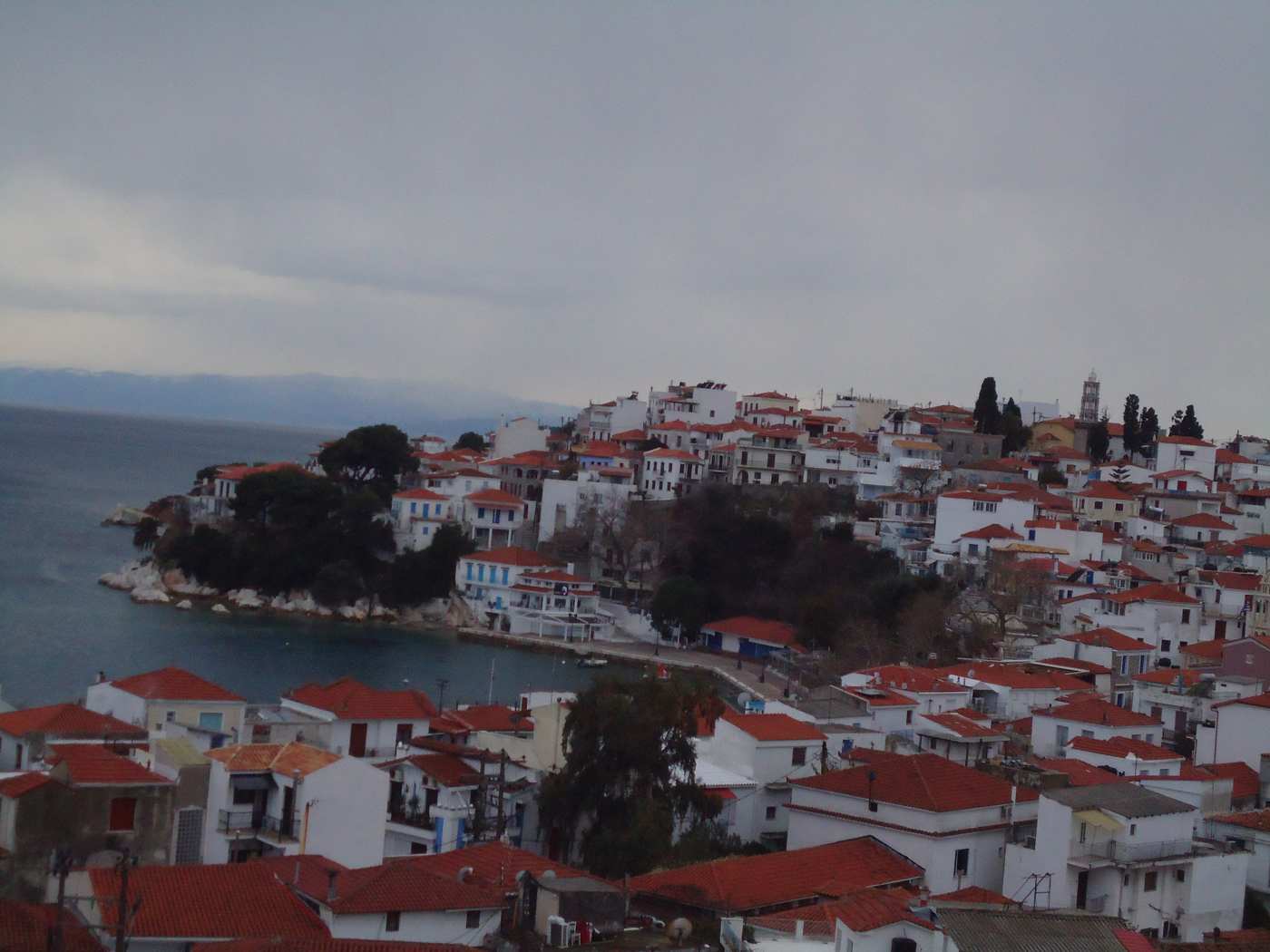
The Evangelistria monastery on Skiathos holds a rare double identity: an active Orthodox monastery founded by Athonite monks in the late eighteenth century. The place where an early version of the Greek flag was woven, blessed and raised. The complex stands about 4 km north of Skiathos Town on a pine-covered hillside, wrapped in fortress walls around a domed church, a museum and a working estate. Plan the whole trip with Greece Tours.
This guide covers the founding by the Kollyvades movement, the flag story and the oath of the fighters, the katholikon and its museum, the shop with wine from the monastery vineyards. Dress rules, access by road and footpath, the walks that start at the gate. How the visit compares with Kastro, the beaches and the boat trips.
What Is the Evangelistria Monastery on Skiathos?
The Evangelistria monastery is an active Orthodox monastery of the Annunciation, founded in the late eighteenth century by Kollyvades monks from Mount Athos on a pine-covered hillside about 4 km north of Skiathos Town.
The monastery’s full name is the Holy Monastery of the Annunciation of the Virgin Mary. Islanders shorten it to Evangelistria, the Greek word for the bringer of the good news. It ranks as the most important religious monument on Skiathos and the only monastery on the island that still houses a working monastic community. The complex crowns a terraced slope above a stream gorge, surrounded by pines, cypresses and olive trees, with the peak of Karaflytzanaka rising behind it. Fortress-like outer walls enclose a stone courtyard, the domed main church, two storeys of monks’ cells, a museum and a small shop.
Pilgrims, historians and beach visitors climb here in equal numbers, because the site combines national history with a quiet mountain setting far above the coastal crowds.
Evangelistria sits about 4 km from the harbour of Skiathos Town, a drive of roughly 10 minutes on a paved road that climbs steadily through pine forest. The elevation gives long views over the town, the Bourtzi peninsula and the channel toward the islet of Tsougria, with aircraft visible on their approach to the runway below. Spring covers the surrounding terraces in wildflowers, while summer fills the courtyard with the scent of resin and jasmine. Water from the hillside feeds the monastery gardens and the vineyard planted on terraces beneath the walls. Cicadas provide the only steady sound outside service hours. The temperature runs noticeably cooler than the beaches.
Which makes the climb comfortable even in the middle of a hot August day at sea level.
The monastery functions as a living religious house, not a museum piece, and a small brotherhood maintains the daily cycle of services, gardens and workshops. Islanders come up for baptisms, memorials and the feast of the Annunciation on the twenty-fifth of March. A date that doubles as the Greek national holiday and fills the courtyard with families from Skiathos Town. Bells ring across the valley on feast mornings, and the smell of incense carries through the gate. Monks also manage the estate’s olive groves, beehives and vines, continuing an agricultural tradition that once supported dozens of brothers. Visitors watch this working rhythm at close range.
Which separates Evangelistria from ruined religious sites elsewhere in the Sporades and explains its steady stream of returning guests across the whole season.
Athonite tradition shapes the entire complex, because the founders arrived directly from Mount Athos and reproduced the building pattern of their home monasteries. A defensive perimeter wall turns a blind stone face to the outside world. A single low gate leads into the courtyard, a layout designed in an era of pirate raids. The katholikon, the main church, stands free in the centre with a tall dome on a drum, three apses and masonry of local grey stone. Arched colonnades, wooden balconies and exterior staircases wrap the cell wings, and flagstone paths connect the church to the refectory, the museum rooms and the shop.
Restoration work over recent decades stabilised the roofs and reopened wings that had stood empty for generations after the community shrank.
Why Was the Greek Flag Raised at Evangelistria on Skiathos?
An early version of the modern Greek flag, a white cross on a sky-blue field, was woven on a loom at Evangelistria, blessed in its church and raised over the courtyard before the War of Independence.
Chieftains of the Greek independence struggle gathered at the monastery in the years before the revolution broke out, drawn by its isolation and its sympathetic monks. Tradition names famous captains of the armatoloi and klephts among them, men who had fought across Thessaly, Macedonia and the Aegean and needed a symbol to unite scattered bands. The monks wove a flag on the monastery loom, a plain white cross set on a sky-blue field, and the abbot blessed it during a service in the katholikon. Fighters then swore an oath on that cloth in the courtyard, binding themselves to the cause of liberation.
The scene turned a remote Sporades monastery into one of the recognised birthplaces of the national flag. Guides retell the episode beside the flagpole today.
The design carried clear meaning: the white cross stood for Orthodox faith. The sky-blue field for the Greek sky and sea. A combination later formalised in the national flag that flies today. Earlier revolutionary banners had varied wildly from region to region, so a single agreed emblem gave the scattered fighting bands a shared identity. The Evangelistria cloth is counted among the earliest physical versions of that emblem, which gives the monastery a place in national history books far beyond its size. A flagpole in the courtyard marks the raising, and reproductions of the banner hang inside the monastery buildings.
Greek schoolchildren visit on educational trips each spring, and the story anchors the island’s celebrations on the national holiday in March, when wreaths and flags appear at the gate.
Support for the revolution ran deeper than one ceremony, because the monastery sheltered fighters, refugees and supplies during the turbulent decades of Ottoman rule and open war. Its remote position, high above the north-facing gorges and away from the harbour, made surveillance difficult and escape routes plentiful. Families from the fortified settlement of Kastro knew the paths to its gate, and boats slipped in and out of quiet bays on the nearby coast. Monks paid a price for this involvement through reprisals and confiscations, yet the community survived and kept its records. The combination of spiritual authority and practical resistance explains why the flag story attached itself to this particular house rather than to a church in town.
Local historians treat the episode as settled island memory.
Visitors trace the flag story on site within about 20 minutes of unhurried walking. The courtyard flagpole flies the Greek colours daily, the katholikon where the blessing took place stands open outside service times. The museum displays weavings. Documents and weapons connected with the revolutionary period. Photography works best in mid-morning, when sunlight reaches the courtyard floor and the blue of the flag stands against the pale stone. Guides on island tours pause here longer than at any other inland stop, and independent travellers read the printed panels mounted near the gate.
The story lands hardest on the national holiday, when the raising is re-enacted and the courtyard fills with singing; ordinary weekdays offer the same monuments in near silence. Both experiences reward the short drive up from the port.
Who Founded the Evangelistria Monastery on Skiathos?
Monks from Mount Athos founded Evangelistria in the late eighteenth century, led by figures of the Kollyvades movement who left the Holy Mountain during a dispute over liturgical practice and settled on Skiathos.
The Kollyvades were a reform movement within Athonite monasticism that insisted on strict adherence to Orthodox tradition, frequent communion and the correct timing of memorial services. Their positions provoked fierce argument on Mount Athos, and groups of monks departed for islands across the Aegean, founding or reviving monasteries on Hydra, Paros and the Sporades. One such group reached Skiathos and chose the pine slope above a deep stream gorge for a new foundation dedicated to the Annunciation. The monk Niphon, a leading spiritual figure of the movement, is honoured as the guiding founder. His circle brought Athonite discipline, building knowledge and manuscript collections to the island, and the community grew quickly into the dominant religious institution of Skiathos.
Its influence shaped island worship for the next hundred years.
Construction proceeded in stages across the closing decades of the eighteenth century, beginning with the katholikon and its dome and continuing with the perimeter wall, cell wings and cisterns. Local grey stone came from the hillside itself, timber from the island’s pines, and craftsmen followed the fortified Athonite plan their leaders knew from the Holy Mountain. The monastery acquired land, olive groves and vineyards across northern Skiathos, and its workshops produced wine, oil, honey and woven cloth. At its height the brotherhood numbered dozens of monks and controlled dependencies elsewhere on the island. Manuscripts, printed books and liturgical treasures accumulated in the library, part of which survives in the museum collection displayed to visitors today.
The woven cloth mattered most, because the loom later produced the famous flag.
Literary history binds the monastery to the island’s most famous son, Alexandros Papadiamantis, whose father served as a priest and whose fiction returns repeatedly to its chapels, paths and monks. Papadiamantis grew up in Skiathos Town, walked these hillsides throughout his life and drew characters directly from the monastic world around Evangelistria. His cousin Alexandros Moraitidis, also a writer, shared the same devotion, and both men are honoured across the island. Readers who arrive with the short stories in hand recognise the gorge, the bells and the courtyard immediately. The connection gives the monastery a second national role, as a landmark of Greek literature alongside its place in the story of the flag.
The Papadiamantis House museum in town completes the pairing for literary travellers on a half-day circuit.
Decline followed the independence era, when monastic properties passed to the new Greek state and recruitment thinned across the country. The brotherhood shrank, wings fell into disrepair, and by the middle of the twentieth century the monastery stood close to abandonment. Revival came through determined abbots, church funding and island volunteers, who reroofed the cells, restored the katholikon and reopened the museum rooms. Vineyards on the lower terraces returned to production, and the shop began selling monastery wine, honey and preserves to visitors. The permanent community remains small, yet daily services continue and the buildings stand in their best condition for generations.
Conservation work proceeds in phases, so scaffolding appears on one wing or another without closing the site. Visitor numbers now support the upkeep directly through the shop.

What Do You See Inside the Evangelistria Monastery on Skiathos?
The visit covers a fortified courtyard, the domed katholikon with its carved wooden iconostasis and post-Byzantine icons, two storeys of monks’ cells, a museum of ecclesiastical and folk items, and a shop selling monastery products.
Entry passes through a low arched gate in the perimeter wall, and the courtyard opens immediately around the free-standing church. Flagstones, whitewashed arcades and pots of basil and geraniums set the tone, with the Greek flag flying from the central pole. Signboards near the gate outline the flag story and the monastery’s founding in Greek and English. Benches under the arcade give shade for a pause, and a stone fountain supplies drinking water piped from the hillside. The scale surprises first-time visitors, because the complex reads as a small fortified village rather than a single church.
Cats doze on the warm stones, swallows nest under the eaves in early summer, and the enclosing walls cut the wind on blustery days. A slow circuit of the courtyard takes about 10 minutes.
The katholikon holds the artistic heart of the complex. Its carved wooden iconostasis, gilded and dense with vine-scroll detail, screens the sanctuary and carries icons of the Annunciation, Christ and the Virgin. Post-Byzantine frescoes and portable icons line the walls, darkened by two centuries of candle smoke, and brass chandeliers hang from the dome on long chains. The Athonite plan places choir stalls in the side apses, where monks still chant the daily offices. Light enters through small drum windows, so the interior stays dim and cool even at noon, and eyes need a full minute to adjust.
Visitors move quietly, candles cost a small donation at the door, and photography rules are posted at the entrance; services close the church to sightseeing for their duration.
Two storeys of cells wrap the courtyard on the north and west sides, fronted by wooden balconies that sag with age in the older wing. Doors carry small name plaques, workshops occupy the ground floor, and a restored refectory displays a long marble table used for communal meals on feast days. Stairs at the corner climb to an upper walkway with views over the dome, the bell tower and the pine canopy running down toward the sea. Storage rooms hold wine barrels and olive-press equipment from the estate’s productive past, visible through open doorways.
The lived-in details matter: laundry lines, stacked firewood and vegetable crates remind visitors that the buildings serve a working community, not a heritage display frozen for tourism. Respect closed doors, because private areas stay off limits.
A full visit runs about 45-60 minutes: 10 for the courtyard, 15 inside the church, 20 in the museum rooms and the rest browsing the shop and terraces. Crowds stay light compared with the beaches, with tour groups arriving in late morning and independent visitors spread across the day. Early arrival, soon after opening, secures the courtyard in near silence and the coolest walking temperatures. The terraces outside the wall hold the vineyard rows and give the clearest photographs of the whole complex against the ridge. Sound carries strangely up here. Church bells. Goat bells on the far slope and the distant thump of aircraft reversing thrust at the runway mix into the island’s most distinctive soundtrack.
Budget extra time on feast days, when services extend the schedule.
What Does the Evangelistria Monastery Museum on Skiathos Display?
The monastery museum displays ecclesiastical treasures and folk items across restored cell rooms: icons, vestments, manuscripts, printed books, weavings from the historic loom, agricultural tools and documents linked to the Greek independence struggle.
The ecclesiastical rooms hold the strongest pieces: portable icons spanning the post-Byzantine centuries, gold-threaded vestments, carved wooden crosses, silver chalices and Gospel covers worked in relief. Manuscripts and early printed liturgical books fill glass cases, part of the library the Athonite founders carried to the island and expanded over decades. Labels identify workshops and donors where records survive, and a floor plan by the entrance orders the rooms into a simple one-way route. Conservation lighting stays low to protect pigments and textiles, so the cases reward slow viewing rather than a quick walk-through. Highlights cluster in the first two rooms, which lets short-stay visitors see the best material within about 15 minutes before rejoining companions in the courtyard.
Greek and English captions cover the principal exhibits.
Revolution-era material forms the emotional core of the collection. Cases display woven banners, weapons from the fighting decades, letters bearing signatures of captains and abbots, and coins that circulated under Ottoman rule. Pride of place goes to the loom tradition: weavings demonstrate the technique used for the famous sky-blue flag, and panels retell the oath ceremony step by step. School groups gather in this room longer than anywhere else on the route, and teachers use the displays to connect the island to the national story. Photographs of the raising re-enactment hang beside the cases, linking the artefacts to the ceremony still performed in the courtyard each March.
The room measures modestly at a glance, yet it carries more national weight than any other space on Skiathos.
Folk exhibits fill the remaining rooms with the working life of the estate and the island. Olive presses, wine barrels, copper cauldrons, bee smokers and carpentry tools document the monastery’s agricultural economy, while looms, spindles and embroidered textiles show the domestic crafts of Skiathos households. Ceramic storage jars taller than a person stand along one wall, once filled with oil and grain for the brotherhood’s winters. Photographs from the early decades of photography record monks, harvests and the buildings before restoration, a useful comparison with the complex outside the window. Children respond best to this section, because the objects explain themselves without labels.
The folk rooms round the visit into a portrait of a self-sufficient community rather than a purely religious monument. Allow about 10 minutes here.
Practicalities stay simple. The museum occupies restored cells reached from the courtyard. Entry follows the monastery’s own visiting arrangements. A modest contribution supports conservation. Check the current details at the gate rather than relying on second-hand reports. Rooms are compact, so groups of more than 15 split naturally into shifts. Bags stay outside the narrower rooms, flash photography is banned to protect textiles, and the attendants answer questions in Greek and basic English. Summer brings the fullest rooms between late morning and early afternoon, matching the tour-bus schedule from the port. Winter access depends on the community’s capacity, since the monastery remains open as a religious house even when tourism infrastructure across the island shuts down.
Spring and autumn offer the quietest viewing conditions of the year.
How Do You Get to the Evangelistria Monastery from Skiathos Town?
The monastery lies about 4 km north of Skiathos Town: around 10 minutes by car or taxi on a paved road, or about 60-90 minutes on foot along a signed uphill track through pine forest.
Drivers leave the ring road above the port, follow signs for Evangelistria and climb a narrow paved lane through pines and olive terraces. The route measures about 4 km and takes around 10 minutes, with passing places on the tighter bends and a gravel parking area below the monastery gate. Taxis wait at the harbour rank and quote the run as one of the standard island fares; arranging a pickup time for the return avoids a wait on the hill. Travellers planning the wider journey first read how to get to Skiathos, then treat the monastery as the easiest inland drive on the island. Scooters and quad bikes manage the gradient without difficulty in dry conditions.
Morning drives meet the least traffic on the single-lane stretches.
Walkers take the signed monopati, the old stone-paved footpath that leaves the edge of town and cuts across the loops of the road. The climb gains roughly 200 metres of altitude and takes about 60-90 minutes at a steady pace, shaded by pines for most of its length. Sturdy shoes handle the loose stones better than sandals, and a litre of water per person covers the ascent in summer heat. Spring turns the path into a wildflower corridor with orchids and cistus beside the stones. The descent back to town takes about 45 minutes and rewards tired legs with harbour views on the final stretch.
Walkers who time the return for late afternoon catch the low light falling across the red roofs of the town below.
Bus riders face a gap, because the island’s single bus line runs along the south coast and no scheduled service climbs to the monastery. Practical alternatives exist: shared minibus excursions include Evangelistria on island round-trips together with Kastro viewpoints and inland villages, and licensed guides add historical commentary that the signboards compress. Cyclists on mountain bikes use the road route, a stiff 4 km climb rewarded by a fast descent. Rental cars remain the most flexible option for combining the monastery with the north-coast beaches in one loop. Hitchhiking works informally on the monastery road in high season, since a stream of visitor cars passes in both directions, though schedules stay firmly in the traveller’s own hands.
Drivers cover the ground fastest, walkers remember it longest.
Timing shapes the experience more than transport choice. Morning visits, between opening and midday, meet open doors at the church, museum and shop, plus the coolest temperatures for the walk. Midday closures follow monastic practice at religious houses across Greece, so a siesta-hour arrival risks locked buildings even when the courtyard gate stands open. Late afternoon brings softer light for photography and the day’s emptiest rooms. The visit pairs naturally with a swim afterwards, since the road drops back to town in 10 minutes and the nearest sand at Megali Ammos lies a short drive beyond.
Travellers with one Skiathos day slot the monastery first, then spend the remaining hours on beaches or a boat departure from the old port. Check service times at the gate on arrival.
What Are the Dress Code and Visiting Rules at Evangelistria on Skiathos?
Modest dress is required: covered shoulders and knees for everyone, with wraps available at the entrance. Quiet voices, no flash photography inside the church, and respect for services and closed monastic areas complete the rules.
Dress rules follow the standard for active Greek monasteries. Men wear long trousers or knee-length shorts and a shirt with sleeves; women cover shoulders and knees, with skirts or wraps preferred over trousers in the strictest reading. A basket of wraps and long skirts waits at the gate for anyone arriving in beachwear, free to borrow and return. Swimwear, bare torsos and see-through fabrics stay outside the walls without exception. Hats come off inside the church, and sunglasses move to the pocket as a courtesy. The rules apply to every visitor regardless of faith, and the gatekeeper enforces them politely but firmly.
Dressing correctly from the start saves the awkward pause at the entrance and speeds the whole group inside. Light long layers also protect against the hill breeze.
Behaviour rules protect a living community. Voices drop to conversation level in the courtyard and to near silence inside the katholikon, phones switch to silent mode. Children stay within arm’s reach around the lit candle stands. Photography of the courtyard and exteriors is welcomed; inside the church, flash is banned and the attendants indicate which areas stay off camera. Monks in prayer or at work are not photographed without a clear invitation. Services take priority over sightseeing, so visitors either join quietly at the back or wait in the courtyard until the chanting ends. Eating, drinking and smoking stay outside the gate, with water the accepted exception on hot days.
The atmosphere rewards restraint, and the monks respond warmly to visitors who show it.
Opening follows monastic rhythm rather than shop hours: doors open in the morning. Close for a midday rest at religious houses’ customary hours. Reopen until early evening in the visitor season. Exact times shift with the liturgical calendar and the community’s duties. The reliable method is asking at the port tourist points or checking the sign at the gate the same day. Entry to the grounds is treated as a welcome, not a ticket transaction, and donation boxes stand by the church door. Feast days rearrange everything, above all the Annunciation in late March, when liturgy, processions and crowds replace normal visiting. Winter visits work for the church and courtyard, while the museum and shop follow reduced arrangements.
Patience at the gate solves nearly every timing question.
Access needs planning for visitors with limited mobility. The parking area sits below the gate, the approach path climbs on uneven stones, and thresholds inside step up and down between courtyard, church and museum rooms. Wheelchair users manage the courtyard with assistance, while the museum’s upper rooms stay out of reach. Families push strollers as far as the gate, then carry small children inside. Shade covers the arcades but not the open courtyard centre, so midsummer visits call for hats and water. Toilets for visitors stand near the entrance.
The monastery remains one of the calmest stops on the island for older travellers, because distances inside the walls stay short and benches appear at regular intervals along the arcade. Ten careful minutes cover the ground from car to courtyard.
What Products Does the Evangelistria Monastery on Skiathos Sell?
The monastery shop sells products from its own estate: red and white wine from the terraced vineyards, olive oil, honey, herbs, preserves and sweets, alongside icons, incense, candles and books about Skiathos.
Wine leads the shelf. The monastery cultivates vines on the terraces below its walls and bottles red, white and sweet styles under its own label, continuing a tradition documented since the founding era. Grapes grow within sight of the courtyard, the harvest involves the brotherhood and island helpers each autumn, and production stays small enough that vintages sell out on the hill. Tastings run informally at the counter when staffing allows, and the sweet dessert style draws the strongest following among returning visitors. Bottles travel well wrapped in beach towels for the flight home. Buying here funds the restoration directly, which turns a souvenir into a contribution, and the label itself records the monastery’s silhouette above the vines.
Ask at the counter which vintage is currently open.
Food products fill the second table: thyme honey from hives on the surrounding slopes. Olive oil pressed from the estate’s groves, mountain herbs dried in bunches, spoon sweets, jams and trays of loukoumi. Beeswax candles and soap made with monastery oil sit beside them. Everything carries simple labelling and short ingredient lists, since the point is farm output rather than industrial production. Prices post clearly on the shelves, and the counter takes cash and cards in the main season. Islanders buy here too, above all before feast days, which says more about quality than any marketing.
Gifts assembled from the shelves — a small bottle of oil, a jar of honey and a bar of soap — pack flat and survive checked luggage. Cash speeds the queue on busy mornings.
Icons painted or mounted in the traditional manner, censers, incense in resin blends, prayer ropes and silver votive plaques hang along the back wall. Books cover the monastery’s history, the flag story, the lives of local saints and the fiction of Papadiamantis, with editions in Greek and English. Postcards and printed views of the complex cost little and support the same fund. Pilgrims order commemorative baptism sets and icon reproductions through the community, a service arranged in person rather than online. The stock reflects a working religious house, so quality runs above the level of harbour-front souvenir stands. Purchases wrap carefully at the counter, and staff explain the imagery of an icon to anyone who asks.
Small icons in olive-wood frames make the most requested gift on the shelf.
The shop occupies a ground-floor room beside the museum entrance and keeps roughly the same hours as the rest of the complex. Revenue flows straight into conservation, wages for lay helpers and the upkeep of the estate, which makes the till the monastery’s main bridge between tourism and survival. Bags stay light on the walk down, since the heaviest bottles ride better in a car boot. Comparable products appear in Skiathos Town shops at higher prices and without the provenance, a point regular visitors confirm each season. Queues form behind tour groups for about 15 minutes around midday, then dissolve.
Shoppers with limited time head for wine, honey and one book on the flag story, the three items that define the place. Early afternoon offers the emptiest counter.
Which Walks Combine with the Evangelistria Monastery on Skiathos?
Marked trails link the monastery with Skiathos Town, the Kastro peninsula, the Agios Charalambos monastery area and the north-coast viewpoints, turning the visit into hikes of between one and five hours through pine forest.
The classic short walk pairs the town path with the road for a loop of about two hours. Hikers climb the stone monopati from the edge of town, spend an hour at the monastery and descend by the lane, watching the harbour grow larger at each bend. Waymarks and painted dots guide the route, and the gradient stays moderate apart from two steeper pitches near the top. Morning departures beat the heat and land walkers at the gate as the doors open. The loop suits families with children of school age, since the distance stays under 9 km round trip.
Water taps at the monastery refill bottles for the descent, and cafes at the town end pour the reward. Sturdy trainers handle the stone surface without trouble.
The full-day option continues north from the monastery toward Kastro on the island’s best-known long trail. The route crosses pine ridges and stream gullies for about 3-4 hours of walking, passing chapels, springs and clearings with views over the north coast. Signage improves each season, yet a mapping app and a paper backup remain sensible on the quieter interior sections. Walkers finish at the cliff-top ruins of the medieval settlement, swim below at Kastro beach and return by prearranged taxi. By retracing the trail or, in summer, by excursion boat from the beach. Boots, 2 litres of water per person and a hat cover the requirements.
The combination of monastery, forest and medieval ruins compresses the island’s whole story into one continuous line of walking.
Shorter strolls radiate from the gate for walkers with less ambition. The vineyard terraces below the walls take 20 minutes and give the classic photograph of dome, cypresses and sea. A dirt track contours east through the pines for about 30 minutes to a viewpoint over the wooded valley. Where the town, the airport runway and the Tsougria channel line up in one frame. Birdwatchers find warblers, jays and buzzards along the forest edges in spring and autumn. The stream gullies hold plane trees and ferns, a different Greece from the beach postcard, and shade covers most of the ground even at midday.
None of these paths demands equipment beyond trainers and water, which makes them the easiest inland walking on Skiathos. Autumn light suits photographers best.
Route planning turns the hillside into a half-day or full-day itinerary. A strong plan runs: taxi up at opening time, one hour inside the walls, the viewpoint track before midday. Then either the descent to town for lunch or the long trail onward to Kastro. Reversing the direction works poorly in summer, because the climb then lands in the hottest hours. Trail runners use the same network at dawn and cover the town-monastery-viewpoint circuit in under an hour. Rain rarely interrupts between late spring and mid-autumn, and the forest floor drains fast after storms.
Paper maps of the island’s path network sell in town bookshops, and the monastery marks the junction point of the busiest routes on every edition. Phone signal holds across the whole hillside for emergencies.
How Does Evangelistria Compare with Other Skiathos Sights?
Evangelistria stands as the island’s leading historical monument alongside Kastro: closer, easier and still inhabited, it delivers national history in under an hour, while beaches and boat trips fill the rest of a Skiathos day.
Kastro and Evangelistria divide the island’s history between them: the cliff-top ruins tell the story of survival under piracy, while the monastery tells the story of faith and revolution. Kastro demands a longer journey — a drive plus footpath, a boat landing or a 3-4 hour hike — and offers ruins without a living community. Evangelistria sits 10 minutes from town, keeps its roofs, monks and services, and adds a museum and shop. History-minded visitors with one free morning choose the monastery; those with a full day combine both by car or on the long trail. Photographers split the ticket, since Kastro wins on drama and the monastery on architectural detail.
Both stops together still cost less time than one beach afternoon. The pairing defines the island’s inland day.
Beaches dominate the average Skiathos itinerary, and the monastery competes by offering what sand cannot: shade, silence, history and a cool hilltop hour in the hottest weeks. Rankings of things to do in Skiathos place Evangelistria in the top handful of stops alongside Koukounaries, Lalaria and the town waterfront. Boat trips claim full days and depend on calm seas, while the monastery works in any weather and fits between breakfast and the first swim. Cloudy mornings, meltemi days that cancel north-coast sailings and arrival or departure half-days all favour the hill. Couples add it for the views, families for the story, and cruise passengers because it fits their window ashore.
The monastery also opens earlier than the excursion boats depart, which lets efficient planners do both in one day without conflict.
The Papadiamantis House in town forms the monastery’s natural cultural partner. The writer’s museum takes about 30 minutes. The monastery about an hour. The pair builds a half-day circuit that covers Greek letters and Greek independence in two stops linked by a 10-minute drive. Churches around the harbour, the Bourtzi peninsula and the clock-tower viewpoint extend the same walk for anyone staying in town without transport. The monastery outranks all of them for scale and setting, yet the combination beats any single stop for depth. Rainy-day planning leans on exactly this circuit, since every element offers a roof.
Cultural travellers who allocate one Skiathos day to heritage and one to the sea leave the island with its full range covered. Tickets and donations across the circuit stay modest.
The verdict lands clearly. Evangelistria delivers the highest historical value per hour on the island: 10 minutes of travel. An hour of visiting. A story. The weaving and raising of an early Greek flag. That no beach or boat can match. Skip it only on a trip devoted purely to sand and nightlife. First-time visitors slot it into day one or day two, which frames everything else the island shows afterwards. Repeat visitors return for feast days, quiet winter mornings or a new vintage in the shop. Measured against monasteries across the Aegean. The complex holds its own on architecture and beats most on historical weight. It does so within sight of the airport runway and the harbour.
One hill visit explains the whole island’s pride.
Frequently Asked Questions
Is the Evangelistria monastery on Skiathos free to enter?
Entry to the monastery grounds and church works on a welcome-and-donation basis rather than a fixed admission ticket. The museum follows the monastery’s own current arrangements, posted at the gate. Donation boxes stand by the church door, and contributions fund conservation, the museum rooms and the upkeep of the estate. The shop provides the other practical way to support the community, since revenue from wine, honey, oil and icons flows straight into the same budget. Candles cost a small amount at the church entrance, following standard Orthodox practice. Budgeting a modest sum per person covers donations, candles and a bottle or jar from the shop, and no visitor faces pressure beyond that.
Rules on fees change with the community’s needs, so the sign at the gate on the day carries the final word. The wrap baskets, the drinking-water fountain and the toilets cost nothing, and parking on the gravel area below the gate is unattended and free of charge.
How long does a visit to Evangelistria monastery take?
A standard visit takes about 45-60 minutes: roughly 10 minutes in the courtyard, 15 inside the katholikon. 20 in the museum rooms and the remainder at the shop and on the vineyard terraces outside the walls. Travel adds about 10 minutes each way by car or taxi from Skiathos Town, so the whole outing fits inside two hours door to door. Walkers extend the plan to a half day, with about 60-90 minutes uphill on the stone footpath and about 45 minutes back down. Feast days stretch everything, because services, processions and crowds fill the courtyard for hours, above all on the Annunciation in late March.
History-focused visitors linger longest in the revolution room of the museum, while families move faster and finish inside 40 minutes. Photographers add time at the terraces for the classic frame of dome, cypresses and sea. Pairing the monastery with the viewpoint track east of the gate builds the visit into a comfortable three-hour morning.
Can you walk to Evangelistria monastery from Skiathos Town?
The walk from Skiathos Town takes about 60-90 minutes uphill on a signed stone footpath. The old monopati, which leaves the edge of town and cuts across the loops of the paved road. The climb gains roughly 200 metres of altitude under pine shade for most of the distance, with two steeper pitches near the top. Trainers or light hiking shoes handle the surface, and a litre of water per person covers the summer ascent. Waymarks and painted dots keep navigation simple, and the route never strays far from the road, so a shortcut onto tarmac exists at every stage. The descent takes about 45 minutes and opens harbour views on the final stretch.
Early morning starts beat the heat and deliver walkers to the gate at opening time. Families with school-age children complete the round trip comfortably, and the water fountain at the monastery refills bottles for the way down. Taxis provide the bail-out option from the parking area.
What do you wear to visit Evangelistria monastery on Skiathos?
Covered shoulders and knees form the rule for every visitor. Men wear long trousers or knee-length shorts with a sleeved shirt; women wear skirts, dresses or trousers that reach the knee, with a shawl over bare shoulders. A basket of free loan wraps and long skirts waits at the gate for anyone arriving straight from the beach, returned on the way out. Swimwear and bare torsos stay outside the walls without exception, hats come off inside the church, and flip-flops work poorly on the flagstones and the parking path. Light natural fabrics keep the climb comfortable in summer, and a thin extra layer helps on the breezy hilltop even in July.
Sturdy trainers serve walkers on the stone footpath far better than sandals. Modest dress applies to photography sessions too, since the courtyard remains a religious space rather than a backdrop. Dressing correctly from the hotel saves the pause at the gate and sets the tone the monks appreciate.
Why is the Greek flag connected to Evangelistria on Skiathos?
An early version of the modern Greek flag. The white cross on a sky-blue field. Was woven on the monastery loom. Blessed in the katholikon and raised in the courtyard, where fighters of the independence struggle swore their oath. Chieftains of the klephts and armatoloi had gathered on Skiathos in the years before open revolution, seeking a safe meeting ground and a unifying emblem for scattered bands. The monastery supplied both: isolation behind pine ridges and a symbol that fused Orthodox faith with the colours of sky and sea. The design later fed into the national flag that flies over Greece today, which places this Sporades hillside in every account of the emblem’s origins.
The museum displays weavings, documents and weapons from the period, the courtyard flagpole flies the colours daily, and a re-enactment marks the national holiday each March. The story stands as the monastery’s defining claim and the main reason Greek visitors climb the hill.
Is Evangelistria monastery on Skiathos worth visiting with children?
Children manage the visit well, and the monastery repays them with concrete things to look at rather than abstract history. The flag story reads like an adventure. A secret loom, an oath. Hidden fighters. And the museum’s folk rooms show giant storage jars, tools and looms that explain themselves without labels. Cats doze in the courtyard, the drinking fountain splashes, and the wide flagstone space gives younger children room while adults view the church. Practical points help: the drive takes 10 minutes, distances inside the walls stay short, toilets stand near the entrance, and shade covers the arcades. Strollers stop at the gate, so baby carriers work better for infants.
Quiet behaviour applies inside the katholikon, which limits toddler time there to a short look. The stop pairs naturally with plane-spotting at the runway fence on the way back and a swim at Megali Ammos afterwards. Building a family morning that balances history, spectacle and sand.
When is the best time to visit Evangelistria monastery?
Morning visits between opening and midday work best across the whole season: doors stand open at the church. Museum and shop, temperatures stay coolest for the footpath. Tour groups arrive later. Late afternoon offers the second-best window, with softer light for photography and the emptiest rooms of the day. Midday carries the risk of the monastic rest period, when buildings lock even though the gate stays open. Seasonally, spring covers the terraces in wildflowers and greens the pine forest. June and September combine warm weather with light crowds. July and August bring the fullest courtyards between late morning and early afternoon.
The feast of the Annunciation in March transforms the monastery with liturgy, processions and a flag-raising re-enactment — the most powerful single day to attend, and the busiest. Winter keeps the religious house open in reduced form while the island sleeps. Photographers aim for mid-morning light on the courtyard or the golden hour on the vineyard terraces.