
Danakos is a tiny green mountain village on the eastern slopes of Naxos, tucked into a fold of the land below the peak of Mount Zas. Water defines the place: springs feed a stream that once turned a line of stone watermills, and terraced gardens still climb the hillsides in green steps. Hardly any travellers reach it, which is exactly the point, because Danakos keeps an unhurried, working-village character that the busier resorts have long since lost. This guide explains what makes Danakos worth the drive, what you can see and do around it, and how to fold the village into a wider island itinerary with My Greece Tours.
You will find Danakos deep in the mountainous heart of the island, well east of the coast and reached by a winding inland road that climbs through olive groves and stone terraces. It pairs naturally with a broader Naxos travel guide, since the village sits close to the island’s most rewarding highland sights and trails. The sections below cover how to get there, the watermills and running water, the nearby monastery, the walk up to the summit, and where to eat, so you can plan a half-day or full day around this quiet corner.
Where is Danakos and how do you reach it?
Danakos lies in the eastern mountains of Naxos, below Mount Zas, about a 45-minute drive inland from Naxos Town. You reach it by a narrow paved road that branches off near Filoti and winds down into a green valley to the village.
The approach is part of the experience. From Naxos Town you drive inland along the central island road toward the highland villages, gaining altitude steadily as the landscape shifts from coastal scrub to olive terraces and oak. Near Filoti, the largest of the mountain settlements, a signed side road peels off and drops eastward into the Danakos valley. The final stretch is single-lane and twisting, hemmed by dry-stone walls, so drive slowly and use the passing places. There is no bus service that runs into the village itself, which keeps day-trippers away and preserves the calm.
A rented car or a sturdy scooter is the practical way in, and the drive rewards you with wide views over the terraced slopes and, on a clear morning, the distant sea. Allow roughly 45 minutes each way from the coast, more if you stop for photographs, which you will. Because Danakos sits on the quieter eastern flank, it also works as a natural extension of a day spent exploring the highland villages of Naxos, letting you string Filoti, Danakos and the surrounding mountains into one unhurried loop rather than a single out-and-back trip.
What are the Danakos watermills and running water?
Danakos grew around abundant spring water that fed a chain of stone watermills once used to grind the valley’s grain. Running water still threads through the village in channels and streams, feeding the terraced gardens and giving it a lush, green character.
Water is the reason Danakos exists where it does. Springs high on the slopes gather into a perennial stream, and generations of villagers built stone watermills along its course to harness the flow for grinding wheat and barley. A line of these old mills still stands, part restored and part half-ruined among the greenery, and following the water downhill you can trace how the community organised itself around this single dependable resource. The sound of running water is constant here, an unusual thing on a Cycladic island where most settlements are dry and sun-bleached, and it explains the deep green of the surrounding gardens.
Those gardens are the second half of the story. Fed by channels drawn off the stream, the terraces around Danakos stay productive through the summer, growing vegetables, fruit and vines where neighbouring hillsides turn brown. Walking the lanes you pass fig trees, walnut and plane trees, and small irrigated plots that give the village a cool, shaded feel even at midday. This green micro-landscape is a highlight in its own right and a reason the village features in guides to hiking in Naxos, since short strolls along the watercourse reveal mills, springs and viewpoints within a few minutes of the village square.
What is the Christos Fotodotis monastery near Danakos?
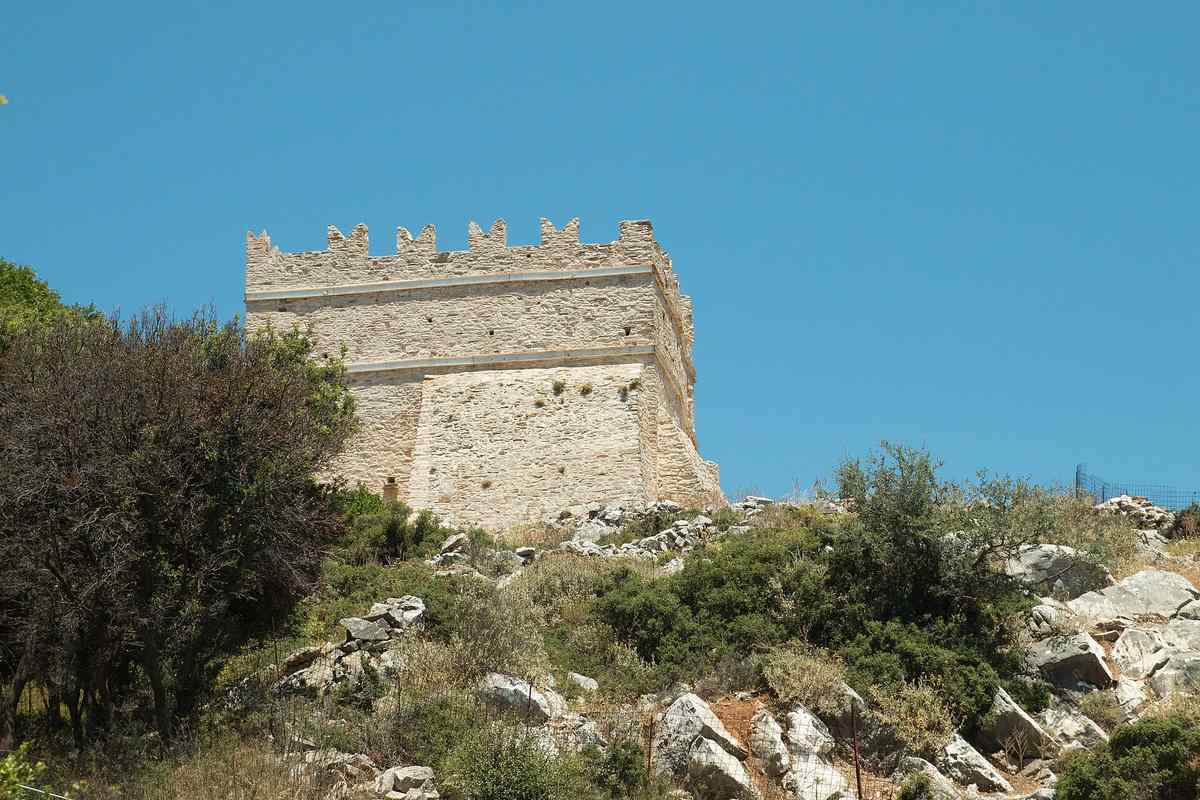
Christos Fotodotis is a fortified medieval monastery on the ridge above Danakos, dedicated to Christ the Light-Giver. Its tall, tower-like stone walls make it one of the oldest and most striking monuments in the Naxian highlands, within easy reach of the village.
The monastery of Christos Fotodotis crowns a rocky knoll on the slopes above the village and is impossible to miss as you approach the valley. Built in a fortified, tower-like form, it was designed as much for defence as for worship, its thick stone walls able to shelter the surrounding population in troubled times. The name means Christ the Light-Giver, and the site is counted among the earliest and most important religious monuments on the island, its severe outline rising over the terraces like a small castle. The setting, with the green valley below and the bare mountain above, is genuinely memorable.
You can visit as a short excursion from the village, and the walk or short drive up to the Christos Fotodotis monastery is one of the main reasons travellers seek out Danakos in the first place. From the walls the view opens across the eastern slopes toward the sea, and the quiet, unrestored feel of the place is a world away from the busy coastal churches. Pair the monastery with a wander through Danakos and a meal in the village and you have the makings of a satisfying half-day in the mountains, well removed from the crowds.
Can you climb Mount Zas from Danakos?
Yes. Danakos is the trailhead for the eastern route up Mount Zas, the highest peak in the Cyclades. This quieter path climbs the mountain’s Danakos flank and is a genuine alternative to the more popular ascent that starts from the Filoti side.
Mount Zas rises directly above the village, and Danakos gives you a less-trodden way onto the summit. The eastern trail leaves from near the village and climbs steadily through terraces and rock toward the ridgeline, joining the higher ground that leads to the peak. Because most visitors start from the western, Filoti side by the spring and the cave, the Danakos approach sees far fewer walkers, so you often have the slopes to yourself. The route is steep in places and unshaded higher up, so carry water, wear proper footwear and set off early in the cooler morning hours.
The reward at the top is the roof of the Cyclades, with panoramic views over Naxos and neighbouring islands laid out across the Aegean. Climbing Mount Zas from this side turns the village into a natural base for the day, and most walkers combine the ascent with a visit to the monastery below or a look at the watermills before or after the hike. Give yourself a full morning for the round trip, more if you want to linger at the summit, and check the weather, since cloud and wind on the exposed upper slopes can change quickly even in the warm season.
Where can you eat and what is Danakos like to visit?
Danakos has a traditional taverna serving home-style Naxian cooking, and the village itself is small, authentic and refreshingly non-touristy. Expect stone houses, shaded lanes, running water and a genuine working-village atmosphere rather than shops and crowds.
Eating in Danakos means one thing: a traditional taverna serving simple, home-style Naxian food, often using produce from the surrounding terraced gardens and local meat and cheese. Sitting under the plane trees with the sound of running water nearby, you get the kind of unhurried mountain meal that has largely disappeared from the coast. There are no rows of souvenir shops or beach bars here; the village keeps to its farming rhythm, and that authenticity is precisely what draws the travellers who make the effort to find it. It is a place to slow down rather than to tick off sights.
To make the most of a visit, treat Danakos as part of a highland loop rather than a standalone stop. Combine it with the fortified monastery, a stretch of the eastern Zas trail, and a drive on to a larger village such as Apeiranthos for its marble lanes and museums. That gives you a full, varied day in the mountains of Naxos, balancing the tiny green calm of Danakos with the grander sights around it. Plan your visit and tours through our Naxos travel guide.
Frequently Asked Questions
Is Danakos worth visiting on a short Naxos trip?
Danakos is worth the detour if you value quiet, authenticity and mountain scenery over convenience. On a very short trip focused on beaches and Naxos Town you might skip it, but if you have a car and at least a half-day to spare, it rewards the effort. The village offers a rare combination on a Cycladic island: constant running water, green terraced gardens, historic stone watermills, a striking fortified monastery on the ridge above, and a trailhead onto the highest peak in the Cyclades. It sees very few visitors, so you experience a working mountain community rather than a polished tourist stop.
The best approach is to fold Danakos into a highland day that also takes in Filoti and the eastern slopes of the mountain, so the drive up serves multiple sights at once. If your priority is authentic inland Naxos and a slower pace, it is one of the most rewarding small villages on the island.
How long should I spend in and around Danakos?
Plan on anywhere from a couple of hours to a full day, depending on whether you hike. A relaxed visit to the village itself, wandering the lanes to see the watermills and running water, exploring the terraced gardens and stopping for a meal at the traditional taverna, takes roughly two to three hours including the drive up and back. Adding the fortified Christos Fotodotis monastery on the ridge above extends that comfortably to a half-day, since the site and its views deserve unhurried time.
Climbers tackling the mountain from the eastern Danakos trailhead should set aside most of a day: the ascent and descent together take several hours, and an early start helps to beat the midday heat on the exposed upper slopes. Most visitors combine Danakos with a nearby larger village to round out the day. The key is not to rush; the whole appeal of this corner of Naxos is its slow, unhurried mountain rhythm.
What should I bring and know before driving to Danakos?
Come prepared for a remote mountain village with limited services. Bring water, sun protection and sturdy shoes, especially if you plan to walk to the monastery or start up the Zas trail, since shade is patchy and the upper slopes are exposed. There is no bus into the village, so a rented car or scooter is essential, and the final approach road is narrow and winding, so drive slowly and use passing places when you meet oncoming traffic. Fuel up before leaving the main highland villages, as there are no services in Danakos itself. Carry some cash, because the small taverna may not take cards.
Set off in the morning if you want to combine the village with a hike, both to enjoy cooler temperatures and to have time for the monastery and a leisurely lunch afterwards. Finally, check the forecast: mountain weather changes faster than on the coast, and wind or cloud can roll over the higher ground quickly, even during the warm months.