
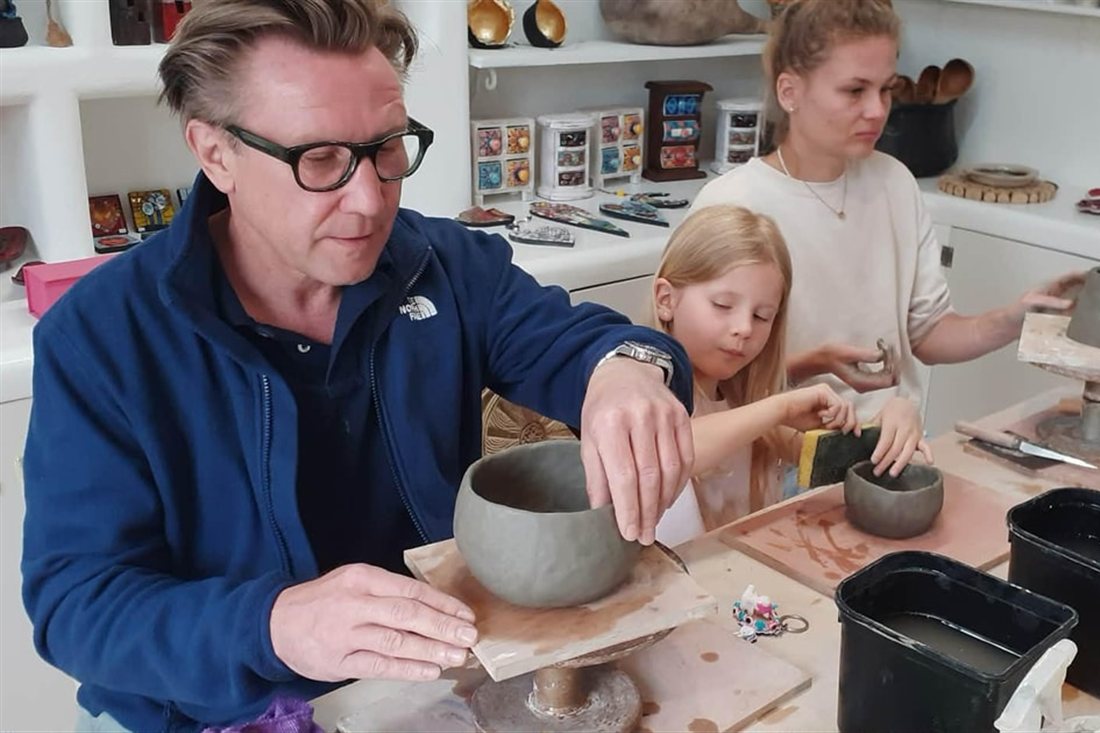
A Corfu pottery class is a hands-on clay workshop on the Ionian island of Corfu, where guests shape, sculpt and decorate a mug, plate or bowl. The class listed on GetYourGuide runs at the Witch House in the hill village of Pelekas. Tours across the rest of the country are listed on Greece Tours.
The sections below cover the studios, the Witch House, the steps, what you make, hand-building and the wheel, and firing. They also cover the island’s ceramic studios, who it suits, durations, getting there, the season and booking, with links into the Corfu pages. The class shown is checked on GetYourGuide.
What is a Corfu pottery class?
A Corfu pottery class is a short, hands-on lesson in a local studio. A potter shows you how to shape wet clay into a useful object. You leave with new skills. Your piece is then fired in a kiln, a very hot oven.
A Corfu pottery class needs no past experience. Groups stay small, from one private group up to four guests. The potter works beside you at the table and guides each step.
Classes take place in village workshops and in town studios. The Witch House sits in Pelekas, one of the hill Corfu villages on the west coast. Tsami Ceramics works in Gastouri, and Myrto Zirini teaches in Corfu Town.
Which Corfu pottery classes can you book?
You can book a Corfu pottery class at the Witch House in Pelekas through GetYourGuide. Three other studios also teach clay work. They sit in Gastouri, in Corfu Town and in Kavallouri in the north of the island.
The GetYourGuide listing is called Corfu: Pottery Workshop at the Witch House in Pelekas. This Corfu pottery class lasts 1.5 hours and runs as a private group.
- Witch House, Pelekas: slab-built mug, plate or bowl, booked through GetYourGuide.
- Tsami Ceramics, Gastouri: 2-hour class with pinch pots, coils and a short wheel session.
- Myrto Zirini Ceramics, Corfu Town: small-group class making a Medusa relief from clay moulds.
- Saitas Ceramics, Kavallouri: beginner and advanced lessons in hand-building and the potter’s wheel.
The three other studios take bookings directly by phone or email. Tsami Ceramics stands 500 metres from the Achilleion Palace, in Gastouri village. Myrto Zirini Ceramics also takes Medusa class bookings online.
Gregory Saitas also runs raku firing sessions. They take place at Villa Kefalomandouko, on a hill past the Corfu Town port. Each session takes two to four guests.
Where is the Witch House in Pelekas, the base of a Corfu pottery class?
The Witch House stands in Pelekas village, about 13 kilometres west of Corfu Town. This small craft shop is the base of the Corfu pottery class on GetYourGuide. The village sits on a hill 270 metres high above the west coast.
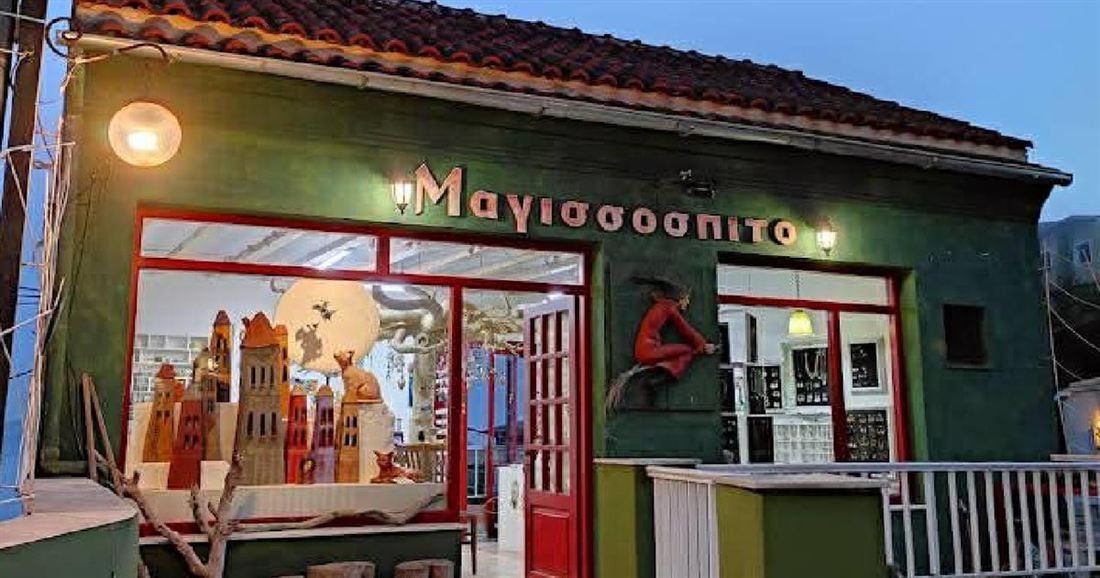
The Witch House is a small craft shop in the village lanes. Katerina, a local potter, runs it and makes its pieces by hand. Clay witches on broomsticks, little houses, animals and pots fill the shelves. Pelekas itself has about 500 residents.
The shop lies just down the road from Jimmy’s Restaurant. Kaiser’s Throne, a hilltop viewpoint, rises above the village. The Pelekas village guide covers the viewpoint and the lanes in full.
Pelekas Beach, also called Kontogialos, lies about 1.5 kilometres below the village. Glyfada Beach is close too, so a Corfu pottery class pairs easily with a swim.
What happens step by step in a Corfu pottery class?
A Corfu pottery class at the Witch House starts with the basics of working with clay. You then shape a piece with the slab method, sculpt it and decorate it. The listing names a mug, plate or bowl as the finished piece.
The slab method means rolling clay into a flat sheet, like pastry. You then cut, bend and join the sheet to build a shape.
- Learn the basics: how soft clay feels, bends and holds together.
- Roll a slab: press the clay into an even, flat sheet.
- Shape and sculpt: cut the slab and form your mug, plate or bowl.
- Decorate: press textures, stamps or patterns into the soft surface.
- Let it rest: the finished piece needs time to dry before the kiln.
Other studios follow other steps. A Corfu pottery class at Tsami Ceramics starts with pinch pots and coil building. It also includes a short turn on the potter’s wheel.
What do you make in a Corfu pottery class?
At the Witch House, a Corfu pottery class ends with one mug, plate or bowl. You decorate it with textures, stamps or patterns. Each piece is your own design, shaped by hand from soft clay during the lesson.
Textures are marks pressed into the clay, such as lines or dots. Stamps are small tools that print the same shape again and again. Patterns are designs you draw or cut into the surface.
The Corfu pottery class at Myrto Zirini Ceramics makes a different object. A relief is a raised picture on a flat clay piece. Guests press clay into studio-made moulds to form Medusa, a figure from Greek myth.
Raku sessions with Gregory Saitas start from a ready-made, unglazed pot or sculpture. Guests coat it in crackle or copper glazes, which are glassy colour coatings. A raku firing then gives the piece cracked lines and metallic tones.
Does a Corfu pottery class teach hand-building or the wheel?
A Corfu pottery class at the Witch House teaches hand-building. The listing names the slab technique, where you roll clay into flat sheets and join them. Other studios on the island also use the potter’s wheel.
Hand-building means shaping clay with your hands and simple tools. Pinching presses a ball of clay into a small pot. Coiling stacks long ropes of clay into walls. Slab work cuts shapes from flat, rolled sheets and joins them.
The wheel is a spinning disc that turns while you shape wet clay. It gives round, even forms, so potters use it for bowls, cups and plates.
A Corfu pottery class at Tsami Ceramics in Gastouri mixes both methods. Guests learn pinch pottery and coil building, then try the wheel for a short spell. Gregory Saitas teaches hand-building and wheel throwing at his studio in Kavalouri.
How are pieces glazed, fired and collected after a Corfu pottery class?
After a Corfu pottery class, your piece dries fully. Then it goes into the kiln, a very hot oven for clay. A first firing hardens it. Glaze, a glassy coating, goes on next, and a second firing seals it.
Corfu Ceramics in Gazatika explains each stage. The first firing lasts about 8 hours. The pots then cool slowly over 36 hours. Painting, glazing and a second firing follow, so the whole job takes ten to fifteen days.
Raku is a fast firing method used in the Corfu pottery class at Saitas Ceramics. Hot pieces leave the kiln and go into metal bins filled with sawdust. After 45 minutes of cooling, guests clean the piece and take it home.
- Corfu Ceramics, Gazatika: two firings, with Greek clay baked at 1,100°C.
- Witch House, Pelekas: stoneware clay fired at 1,260°C for its own creations.
- Saitas Ceramics, Kavalouri: raku firing in a gas kiln for 40 minutes, up to 1,000°C.
- Angsana hotel workshop: pieces fired at a nearby studio, then packed and shipped home.
What pottery tradition stands behind a Corfu pottery class?
A Corfu pottery class draws on a very old island craft. Tsami Ceramics speaks of seven thousand years of pottery on Corfu. Archaeologists have also excavated an ancient pottery workshop in the Figareto area of the island.
Finds from that dig are in the Archaeological Museum of Corfu. They include the base and part of the body of a kore, a statue of a young woman. It dates from the late Archaic period.
Clay pots still play a part in island life. On the morning of Holy Saturday, Old Town residents throw clay pots called botides from balconies. The custom has roots in Venetian rule. People keep the broken pieces for good luck.
Island workshops still make stamnaki, small water jugs, and plates painted with the eye against bad luck. A Corfu pottery class links you to that long local craft. A Rhodes pottery class shows how another island works its clay.
Which ceramic studios can you visit beside a Corfu pottery class?
Beside a Corfu pottery class in Pelekas, four island studios welcome visitors. They sit in Gastouri, Corfu Old Town, Gazatika and Kavalouri. Each one shows a different style, from hand-painted plates to raku pots and sculptural vessels.
- Tsami Ceramics, Gastouri: a studio 500 metres from Achilleion Palace, where Corfu-born artist Loula Tsami works.
- Myrto Zirini Ceramics, Corfu Old Town: a workshop and showroom at 5 Arseniou Street, in a 17th-century building.
- Corfu Ceramics, Gazatika: wheel-thrown, hand-painted ware by Sofoklis Oikonomidis and Sissy Moschidou on National Road 24.
- Saitas Ceramics, Kavalouri: Gregory Saitas works with a gas kiln in northern Corfu, on the road to Roda.
Myrto Zirini hand-builds uneven vessels shaped like pebbles and cocoons. Her tableware is lead-free and dishwasher-safe. She has added space for private or small-group workshops. Her studio takes Corfu pottery class bookings too.
Corfu’s crafts go beyond clay. The island has over four million olive trees, and carvers turn the old wood into bowls. Tasting the island’s olive oil fits well between studio visits.
Who suits a Corfu pottery class?
A Corfu pottery class suits beginners with no clay experience. The Witch House runs as a private group for your party only. Tsami Ceramics takes children from age 5, in groups of up to 4.
Your group works at its own speed, with no strangers at the table. Younger children can take breaks without holding anyone up. More family ideas are on the Corfu with kids page.
- Couples and friends: Tsami names both among the guests it hosts.
- Solo travellers: Tsami welcomes single guests in its small groups.
- Small groups: Saitas raku sessions take 2 to 4 people.
- English speakers: Tsami Ceramics teaches its sessions in English.
A Corfu pottery class also pairs well with other hands-on days. Travellers who enjoy working with their hands can book a Corfu cooking class on a different day.
How long does a Corfu pottery class last, and what is included?
The Corfu pottery class at the Witch House lasts one and a half hours. It runs as a private group, so your party works alone with the potter. You shape one piece of clay and decorate it before you leave.
The GetYourGuide page for Pelekas lists the session at 1.5 hours. Copies of the listing on other booking sites show the same length. The short time lets a Corfu pottery class fit into a beach day on the west coast.
- Length: one and a half hours at the studio
- Format: a private group for your own party
- Method: the slab technique with flat sheets of clay
- Piece: a mug, a plate or a bowl
- Decoration: textures, stamps or patterns pressed into the clay
How do you get to a Corfu pottery class in Pelekas?
To reach a Corfu pottery class in Pelekas, drive 13 kilometres west from Corfu Town or take blue bus line 11. The drive takes about 20 to 30 minutes. The bus leaves from San Rocco Square in the town centre.
Line 11 passes through Koulines, Alepou and Kouroumpatika on its way west. Its last stops are Pelekas Junction, Parking Pelekas and Pelekas Square. The ride takes about half an hour.
Parking inside the village is tight. The main car park lies on the edge of the village and fills up before sunset. More advice on island roads is in the guide to driving in Corfu.
Guests staying in Pelekas walk to a Corfu pottery class through the village lanes. Bases across the island are compared in the guide on where to stay in Corfu.
When does a Corfu pottery class run?
A Corfu pottery class at the Witch House is bookable in summer on GetYourGuide. Its Pelekas page showed sessions starting at 10:30 in the morning on dates across July. A class at that time ends at noon.
The July dates on the listing fell on weekdays, including Mondays and a Friday. A noon finish leaves the afternoon and evening free in the village.
Pelekas is known as the island’s sunset village. A morning Corfu pottery class leaves time to stay on for the evening light. Weather and crowds through the year are set out in the guide on when to visit Corfu.
How do you book and cancel a Corfu pottery class?
You book this Corfu pottery class online through GetYourGuide. Copies of the listing on other booking sites mark it with free cancellation. Places are booked per adult in your party.
The listing sits on the GetYourGuide page for Pelekas as tour 1303824. It also appears under Corfu workshops and classes, and under ceramic and pottery workshops in Greece.
- Open the Pelekas listing for the Witch House workshop
- Pick a date from the calendar
- Enter the number of adults in your party
- Choose the start time shown for that date
- Pay and save the booking confirmation
Cancelling runs through the same booking account. Under free cancellation, a Corfu pottery class cancelled in time is refunded in full. The exact deadline appears on the listing before you pay.
Frequently Asked Questions
What clay does the Witch House use?
The Witch House makes its own pieces from stoneware clay. Stoneware is a dense clay that turns hard and strong in the kiln. The studio fires it at 1,260 °C, far hotter than a home oven. The shop also sells glass, jewellery and objects made by Katerina Tsagaratou.
Can you visit Kaiser’s Throne after a Corfu pottery class?
Yes. Kaiser’s Throne is the lookout on the hilltop above Pelekas village. Kaiser Wilhelm II, the last German emperor, came here to enjoy the view across the island. Visitors walk up from the village on a steep climb. Three free parking areas also sit near the lookout for those who drive.
Can you get there by bus from Corfu airport?
Yes, a Corfu pottery class is reachable by bus with one change. Blue bus line 15 runs from the airport to San Rocco Square. There, you switch to line 11 for Pelekas. Line 15 also serves the port, so ferry arrivals use the same route.
Where do you buy a ticket for the Pelekas bus?
Buy the ticket before you board the blue bus. San Rocco Square has a kiosk, ticket machines and the Station Master’s office. Pelekas falls in Zone B of the network, alongside Achilleion and Benitses. The information kiosk at the square also hands out a free map and timetable.
Is there a beach near the Witch House?
Yes. After a Corfu pottery class, Kondogialos beach is a 10-minute walk from Pelekas. It has soft white sand and shallow water, like Glyfada further along the coast. The roads down are narrow, and parking near the beach is limited.