
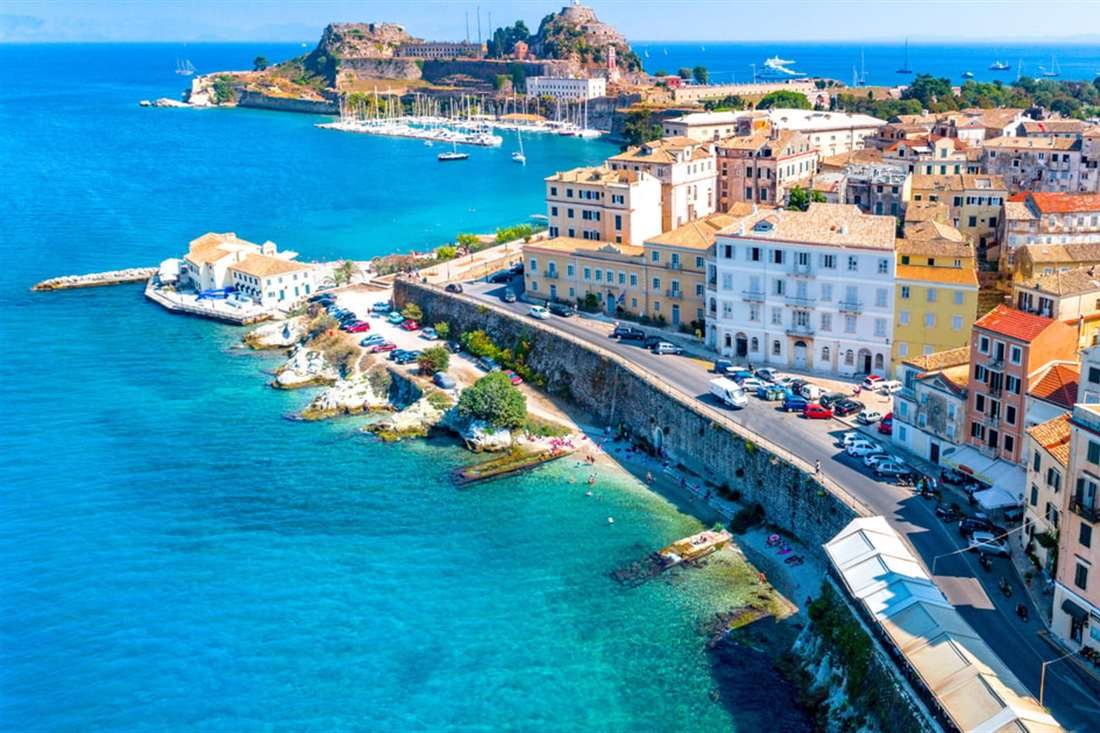
A Corfu mythology tour is a guided walk through Corfu Town that tells the island’s myths, from the nymph Korkyra to Odysseus and the Phaeacians. Guides link the stories to the streets, the sea views and the stars. Tours across the rest of the country are listed on Greece Tours.
The sections below cover the tours, the route, the myth behind the name, Odysseus, Pontikonisi, the other gods and heroes, the astrology stop, the dark legends, the coffee stop, who it suits, inclusions, timing, getting there and booking, with links into the Corfu pages. The tours shown are checked on GetYourGuide and Viator.
What is a Corfu mythology tour?
A Corfu mythology tour is a guided walk through the old streets of Corfu Town. A local guide tells the Greek myths tied to the island. Stories cover Poseidon, the nymph Korkyra, Odysseus and the Phaeacians, plus darker local legends.
The walks run on foot and last 1.5 to 2 hours. Groups stay small, with caps of 8 to 16 guests. The setting is the UNESCO-listed old quarter of Corfu Town.
A Corfu mythology tour differs from a standard history walk. A Corfu Town walking tour explains the Venetian, French and British buildings. The myth walk uses the same lanes as a stage for gods and heroes.
Each Corfu mythology tour mixes ancient myth with local folk legend. The guide links gods and heroes to the places you pass. For myth sites across the country, see the top Greek mythology sites.
Which Corfu mythology tours can you book?
Two listings cover a Corfu mythology tour in Corfu Town. GetYourGuide sells the Mythology and Astrology Tour with Coffee. Viator and GetYourGuide both sell the Dark Myths and Legends Tour, run by the local firm Corfu Perspectives Guided Tours.
- Mythology and Astrology Tour with Coffee: a 1.5-hour small-group walk in Corfu Town, with a coffee break.
- Dark Myths and Legends Tour: a storytelling walk of 1.5 to 2 hours from the Old Fortress Gate.
- Ghost Stories, Dark Legends and Facts: a 2-hour evening walk by the same firm, for adults only.
- Private walks: the same firm runs private old town tours of 2 to 2.5 hours.
The astrology walk ties Greek myths to the signs of the zodiac. Its listing aims at fans of both subjects. It names Corfu Town as the meeting area.
A licensed local guide leads each Dark Myths and Legends walk. At the meeting point, the guide holds a lollipop sign, a small board on a stick. It shows the firm’s logo, so guests spot the group fast.

Where does a Corfu mythology tour start, and which streets does it walk?
The Dark Myths and Legends Corfu mythology tour starts at the Old Fortress Gate, beside Schulenburg’s statue. It crosses Spianada Square and then winds on foot into the narrow streets of the oldest quarter of Corfu Town.
- Schulenburg’s statue: the statue of Count von der Schulenburg, where guests gather.
- Old Fortress Gate: the entrance to the Venetian Old Fortress, the first landmark of the walk.
- Spianada Square: the large open square the listing names on the route.
- Old town lanes: the maze of narrow streets in the oldest part of town.
Along these streets, the guide shares tales passed down through generations. The listing copies advise comfortable shoes and a bottle of water for the cobbled streets.
A Corfu mythology tour stays inside the old town. Sites further out need their own trip, such as the Byzantine castle of Angelokastro near Paleokastritsa.
Which myth gives Corfu its name on a Corfu mythology tour?
On a Corfu mythology tour, the name story starts with the nymph Korkyra. Poseidon, god of the sea, fell in love with her. He carried her off to an unnamed island and gave it her name.
Korkyra was a naiad, a nymph of springs and fountains. Her father was the river god Asopos. Her mother was the river nymph Metope, a daughter of the river god Ladon.
The island’s name, Korkyra, slowly changed into Kerkyra, the Greek name today. In Latin it became Corcyra. The English name Corfu has a different root. It comes from Koryfo, meaning peaks, after the summits of Pantocrator and Stravoskiadi.
Guides on a Corfu mythology tour also name the couple’s son, Phaiax. The islanders took his name and became the Phaiakes, or Phaeacians. In the Argonautica, Apollonius of Rhodes says dark forests covered the island. Passing sailors called it Black Korkyra.
How does Odysseus feature in a Corfu mythology tour?
Odysseus sits at the heart of a Corfu mythology tour. Ancient writers linked Corfu to Scheria, the land of the Phaeacians in Homer’s Odyssey. It was his last stop before he reached his home island of Ithaca.
- Calypso lets Odysseus go, but Poseidon’s storm wrecks his raft.
- He washes ashore on Scheria, naked and worn out, and sleeps under leaves.
- Athena sends Princess Nausicaa a dream, telling her to wash clothes by the river.
- Her maids run from the stranger, but Nausicaa stays and talks to him.
- She guides him to her parents, King Alcinous and Queen Arete.
- The Phaeacians then sail him home to Ithaca on one of their ships.
The Greek geographer Strabo named Kerkyra as Homer’s Scheria. Nausicaa appears mainly in Book 6 of the Odyssey. Books 7 and 8 tell of the welcome at the palace.
At the feast, the court singer Demodocus sings of the Trojan Horse. Odysseus weeps at the song. That is how King Alcinous learns who his guest is.
Not every scholar accepts the Corfu link. The Phaeacians did not know Odysseus, though he ruled nearby Ionian islands. A Corfu mythology tour still treats Scheria as home ground.
What is the Pontikonisi legend told on a Corfu mythology tour?
Pontikonisi, in the stories of a Corfu mythology tour, is the Phaeacian ship that took Odysseus home. Poseidon turned it to stone as it sailed back into harbour. Corfiots point to this small islet off Kanoni as that petrified ship.
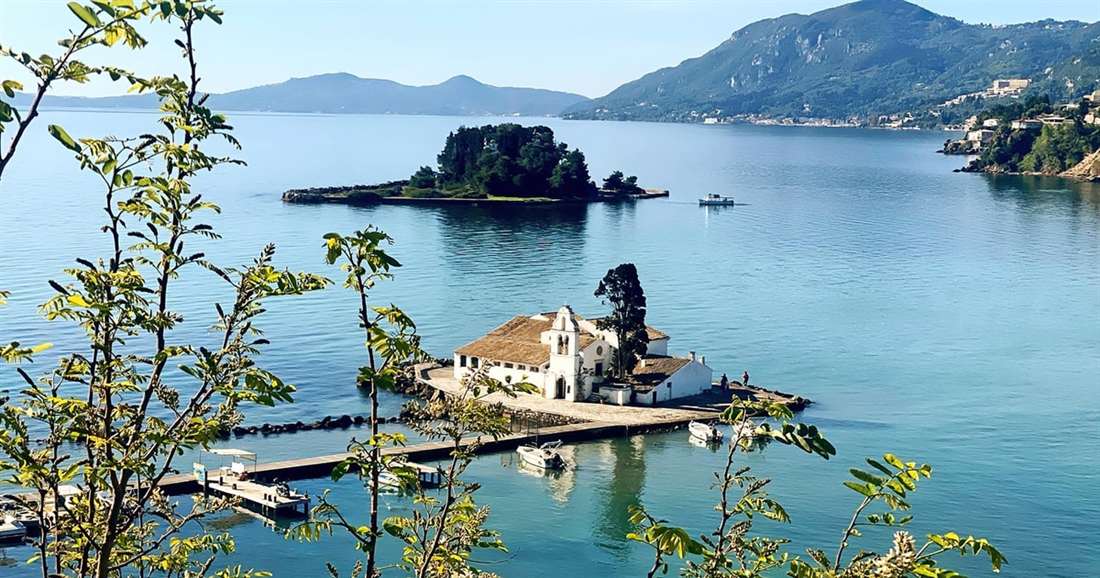
The story comes from Book 13 of Homer’s Odyssey. Poseidon was angry that the Phaeacians helped Odysseus, who had blinded his son, the Cyclops Polyphemus.
With one blow of his flat hand, Poseidon froze the ship and rooted it to the sea floor. The frightened Phaeacians then prayed and made sacrifices to calm him. This gives a Corfu mythology tour a myth you can see from the shore.
Pontikonisi means “Mouse Island”, since from above it looks like a mouse. A chapel stands on it, at the mouth of the Halkiopoulos lagoon. In Classical times, writers already named it as the stone ship.
Which other gods and heroes appear on a Corfu mythology tour?
A Corfu mythology tour also brings in Kronos and his sickle, Jason and Medea, and Achilles. Each story ties to a name, a cave or a palace on the island. Two of these stories lead back to the Phaeacians.
- Kronos and Drepane: Apollonius of Rhodes called the island Drepane, meaning “sickle”. It hid the sickle Kronos used on his father Uranus, whose blood gave rise to the Phaeacians.
- Macris: an older name honoured the nurse of the god Dionysus, who fled here.
- Jason and Medea: in the Argonautica, the pair married in a cave here, later called Medea’s Cave.
- Achilles: the Achilleion palace honours the Greek hero of the Trojan War.
On a Corfu mythology tour, the Jason story plays as a race against time. Medea’s people, the Colchians, sailed in to take her back. King Alcinous agreed, but only if she was unmarried, so the pair wed at once.
Another version swaps Kronos’s sickle for the scythe of Demeter, goddess of farming. The name Drepane also suits the island’s long, curved shape.
The Achilles link sits in Gastouri, 10 kilometres south of Corfu Town. Empress Elisabeth of Austria, known as Sisi, built the Achilleion Palace and named it after her favourite hero. Its garden centrepiece is the Dying Achilles statue by Ernst Herter.
What does astrology add to a Corfu mythology tour?
Astrology turns a Corfu mythology tour into a personal story. The GetYourGuide walk links the island’s myths to the zodiac and to your own star sign. Guests meet in Corfu Town and share a coffee along the way.
This Corfu mythology tour names its audience plainly: mythology and astrology lovers. It promises the myths of the island alongside the astrology of your own life.
The bond between stars and myths is ancient. The Greek word for constellations was katasterismoi. The twelve signs on the sun’s path formed the zodiakos, the “circle of small animals”.
In Greek myth, the constellations were heroes and beasts set among the stars to honour their deeds. Mainland cities run their own myth walks, such as the Athens mythology tour and the Thessaloniki mythology tour.
- Orion: named after the hunter Orion from Greek myth.
- Capricorn: a creature that is half goat and half fish.
- Pisces: the fish linked to Aphrodite and her son Eros.
- Ophiuchus: left out of astrology because the sun barely crosses it.
What dark myths and legends does a Corfu mythology tour tell?
The dark side of a Corfu mythology tour comes from Corfu Perspectives Guided Tours. Its Dark Myths and Legends walk mixes ancient Greek myths with local Corfiot tales. Saint Spyridon, the island’s patron saint, stars in the town’s own legends.
Tales of mythical creatures and immortal heroes fill the route. The guides aim to inspire, not to frighten, and set the minimum age at 12.
A Corfu mythology tour of this kind meets at Schulenburg’s statue, by the Old Fortress gate. Schulenburg led the defence of Corfu in the great Ottoman siege. Corfiots also credit Saint Spyridon with that victory.
- The plague: the saint, dressed as a monk, chased a winged beast out of Corfu.
- The scratch: as it fled, the plague clawed a stone of the Old Fortress.
- The siege: Ottoman troops panicked at the sight of him holding a torch and a cross.
- The slippers: his relics’ shoes are replaced because, people say, he wears them out walking at night.
His relics leave the church in procession four times a year. They mark Palm Sunday, Holy Saturday, 11 August and the first Sunday of November. More after-dark stories feature on the Corfu night tour page.
Where does the coffee stop fit in a Corfu mythology tour?
Coffee is part of the astrology Corfu mythology tour. Its full title is Mythology and Astrology Tour with Coffee. The drink is included in the booking, and guests take it during the walk through the Old Town.
On a walking Corfu mythology tour, a coffee break also rests tired legs.
Corfu Town has a long café culture. The Liston arcade runs for about 200 metres along the western edge of Spianada Square. Its row of traditional cafés faces the green.
Greek coffee is boiled in a small pot and served with the grounds settled at the bottom. For a full tasting walk with kumquat liqueur, local cheese and mandolato nougat, see the Corfu food tour.
Who suits a Corfu mythology tour?
A Corfu mythology tour suits adults, teens aged 12 and over, and cruise visitors with a free evening. The walks stay under two hours on flat but uneven Old Town lanes. Guides speak English, and one walk also runs in German.
The dark legends walk sets a minimum age of 12. Its operator, Corfu Perspectives Guided Tours, says the stories aim to inspire, not frighten. Parents decide whether a child is ready for the darker tales.
- Languages: English and German on the dark legends walk
- Group size: up to 8 guests on the operator’s own page
- Pushchairs: accepted on the route
- Wheelchairs: the route is not wheelchair accessible
- What to bring: comfortable shoes and water
A Corfu mythology tour is not recommended for people with limited mobility. Families with younger children find other outings in the guide to Corfu with kids.
How long does a Corfu mythology tour last, and what is included?
A Corfu mythology tour lasts between 1.5 and 2 hours on foot. The astrology walk runs for 1.5 hours and includes a coffee. The dark legends walk includes a licensed local guide, and food and drinks are extra.
Listings for the dark legends walk differ on length. Viator gives 1 hour 30 minutes. The operator’s own site and GetYourGuide give 2 hours for the same route.
Hotel pickup and drop-off are not part of the dark legends walk, and tips are left out. Tickets come as a mobile voucher, so there is nothing to print. Both walks run as small groups.
When does a Corfu mythology tour run?
A Corfu mythology tour runs in the early evening, after the heat of the day. The astrology walk lists 18:00 starts on summer dates. The dark legends walk runs on Fridays, with separate English and German groups.
- Astrology and coffee walk: 18:00 on the listed summer dates
- Dark legends walk in German: Fridays at 19:30, as Viator lists it
- Dark legends walk in English: Fridays at 19:45, as Viator lists it
- Dark legends walk on the operator’s site: Fridays at 18:30
Each booking calendar shows the live start times for a Corfu mythology tour on the chosen date. Corfu’s weather and crowds change across the year, as the page on when to visit Corfu explains.
How do you reach a Corfu mythology tour from the port and the resorts?
Each Corfu mythology tour starts inside the Old Town. The dark legends walk meets at the Old Fortress gate by Schulenburg’s statue. Cruise visitors walk in along the seafront, and buses and taxis link the resorts.
- On foot from the cruise port: 1.5 to 3 km on a flat seafront path, about 20 to 30 minutes
- Blue bus 15: from the port to San Rocco Square, then about 10 minutes on foot to the Spianada
- Blue buses from resorts: line 7 from Ipsos, Dassia and Gouvia; line 6 from Benitses; line 11 from Pelekas
- Green KTEL buses: about 45 minutes from Paleokastritsa and 1 hour 15 minutes from Sidari
- Taxi: 5 to 10 minutes from the cruise terminal, where cars wait outside
- Car: park at the Old Port in Spilia, by the New Fortress or at the Spianada car park
Only residents and deliveries with a permit drive into the Old Town. Green buses use their own station near the New Port, away from San Rocco.
Cruise passengers pairing a Corfu mythology tour with a day ashore find ideas in the shore excursion guide. Hotel areas across the island are compared in the guide to where to stay in Corfu.
How do you book and cancel a Corfu mythology tour?
You book a Corfu mythology tour online through GetYourGuide or Viator, or on the guide’s own website. On GetYourGuide, free cancellation runs up to 24 hours before the start. Viator sends confirmation at the time of booking.
A Corfu mythology tour cancelled inside those 24 hours loses the full refund. GetYourGuide also offers a reserve now, pay later option. It holds the seat without payment on the day of booking.
The operator’s own page sets a minimum of two guests per departure.
Frequently Asked Questions
Is there an adults-only Corfu mythology tour?
Yes. The same operator runs a Ghost Stories and Legends Tour with a minimum age of 18. It lasts about two hours and fifteen minutes and is offered in English. Groups hold up to 8 guests, and the evening start is 20:30 on listed dates.
Can you film or record the guide on a Corfu mythology tour?
No. The dark legends walk does not allow audio or video recording. The ghost stories walk sets the same rule. The guide tells each tale live at the stops, so guests follow by listening. Old Town lanes stay open after the tour for a return walk at your own pace.
Is the walk suitable for people with health conditions?
The dark legends listing says the walk is not suitable for people with heart problems or breathing problems. It also lists pregnant women among those advised against joining. Old Town paving is uneven and can be slippery, so non-slip shoes help.
Is the Old Town on a Corfu mythology tour a protected site?
Yes. Corfu’s Old Town is a UNESCO World Heritage Site. Its streets were shaped by Venetian, French and British rule. The UNESCO listing covers the lanes where both walks take place. The local name for these narrow alleys is cantounia, and the walks thread through them.
Does the dark legends guide team run other walks in Corfu Town?
Yes. Corfu Perspectives Guided Tours also runs a two-hour Small Group Walking Tour of Corfu Town. Its Historic Buildings and Great Personalities tour lasts about 2 hours 30 minutes and starts at 10:00. A dark history walk, Shadows of the Past, rounds out the list.