
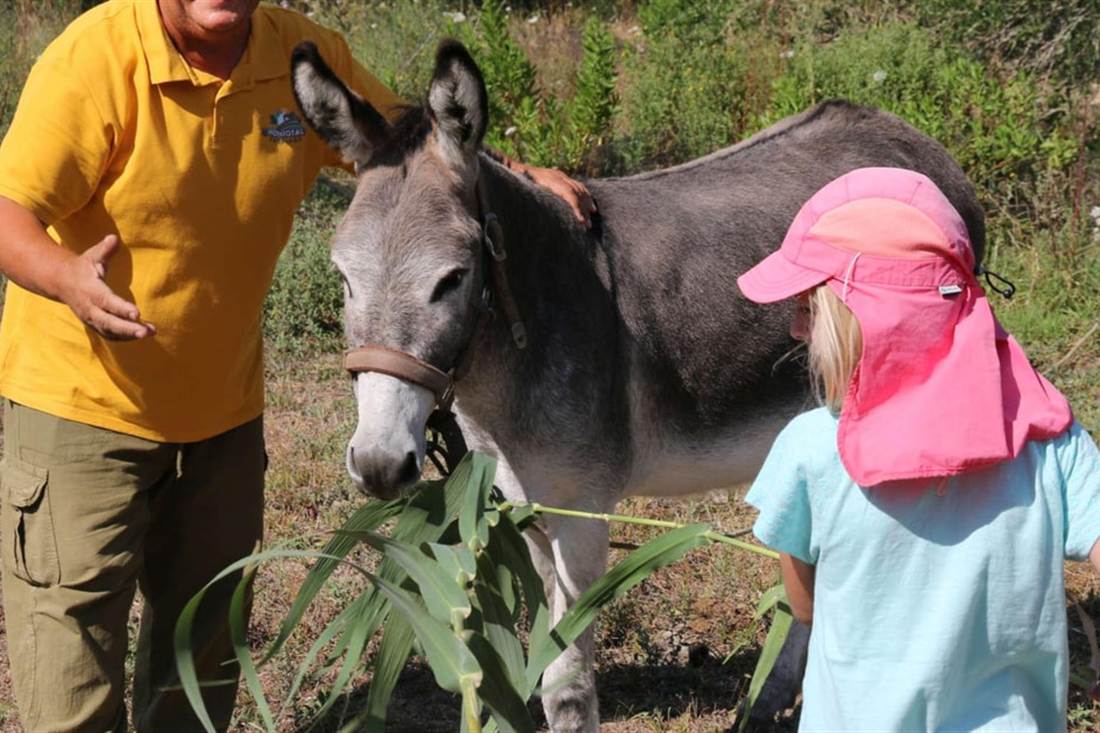
The Corfu donkey sanctuary is a rescue home for old and unwanted donkeys in the hills near Paleokastritsa, on the west coast of Corfu. Visitors meet, brush and learn about the donkeys, and farm tours add horses and lunch. Tours across the rest of the country are listed on Greece Tours.
The sections below cover the visits, the place, the people behind it, the donkeys and what happens on a visit. They also cover the farm tour, who it suits, what to bring, inclusions, getting there, opening times, how to help and booking, with links into the Corfu pages. The tour shown is checked on GetYourGuide.
What is the Corfu donkey sanctuary?
The Corfu donkey sanctuary is Corfu Donkey Rescue, a small charity shelter near Doukades in the island’s northwest. It cares for donkeys that are old, sick, injured, mistreated or abandoned. It is the only donkey rescue centre on Corfu.
The shelter aims to give old donkeys a safe and happy retirement. Sick donkeys get a chance of cure, and injured ones a chance to recover. Abused and abandoned donkeys learn to trust people and feel secure again.
Donkeys are the main focus, but cats and dogs live at the Corfu donkey sanctuary too. Staff and volunteers handle feeding, grooming, medicine, cleaning and vet care. The shelter runs on gifts and donations.
It is one of the quieter things to do in Corfu, away from the beach resorts. Visitors come to meet the animals, not to watch a show. The shelter’s motto is simple: love the abandoned.
Which Corfu donkey sanctuary visits can you book?
There are two kinds of Corfu donkey sanctuary visit. GetYourGuide sells a six-hour Donkey Sanctuary and Farm Tour with Lunch. Corfu Donkey Rescue itself takes walk-in visitors every day. Entry is free, and individuals and families need no booking.
The GetYourGuide tour is run by Corfu Outdoor & Leisure Activities. Its listing says it visits a donkey sanctuary and a family-run farm. At the sanctuary, guests learn how donkeys once served as the pickup trucks of the islands.
- Duration: 6 hours
- Group size: up to 8 people
- Guide: live, in English and Greek
- Pickup: available, with options shown at booking
- Farm extras: animals, a horse ride and a barbecue lunch
- Drinks: organic wine or local beer with lunch
The listing does not name the sanctuary it visits. Corfu Donkey Rescue states that it no longer accepts guided group tours. It also turns away visitors who arrive on organised tour buses. It gives health, safety and legal reasons, for the animals and the visitors.
A direct visit to the Corfu donkey sanctuary suits travellers with their own transport. Donations in the box go towards the daily needs and medicines of the animals.
Where is the Corfu donkey sanctuary?
The Corfu donkey sanctuary sits in the countryside near Doukades, a small hill village in the northwest of Corfu. It lies about 20 kilometres from Corfu Town. Paleokastritsa, on the west coast, is about 6 kilometres away.
Doukades, home of the Corfu donkey sanctuary, belongs to the Paleokastritsa area. Hills dominate the landscape around the village. The shelter’s land is surrounded by olive trees, with the mountains of Corfu behind.
The shelter is reached from the main Paleokastritsa road, which links Corfu Town to the west coast. Doukades itself is listed as a traditional settlement, with a restored stone mansion of the Theotokis family. The village had 407 residents at the last census.
Angelokastro, a Byzantine castle above the west coast, is in the same corner of the island. Pair the donkeys with a visit to Angelokastro or a walk through Corfu’s inland villages.
Who runs the Corfu donkey sanctuary, and how did it start?
Judy Quinn, an Englishwoman who moved to Corfu to retire, founded the Corfu donkey sanctuary. Its first rescue was a donkey called Hope, and Dusty came second. Today a board of trustees, staff and volunteers run the shelter.
Judy saw how hard life was for abandoned and unwanted donkeys on the island, and she decided to help. She found Hope abandoned on Corfu. The work began in the village of Poulades and later moved to land at Doukades.
Judy Quinn died after two decades of animal welfare work on Corfu. The board then held elections, and Fabiola Jubeau became the new president. She had first joined the team for a job working with the animals.
- Fabiola Jubeau, president
- Julie Doran, vice president
- Dagmar Lohrenz, treasurer
- Angeliki Anthi, secretary
- Cheryl Eve, advisor
A partner charity, Friends of Corfu Donkey Rescue, is registered with the UK Charity Commission. It works closely with the Corfu donkey sanctuary. Its registration number is 1136204.
How large is the herd at the Corfu donkey sanctuary?
The Corfu donkey sanctuary has taken in over 500 donkeys since Hope arrived. The herd at the shelter is far smaller at any one time. A farrier, or hoof trimmer, once trimmed the hooves of 40 donkeys there, plus two in foster homes.
New arrivals are old, sick, injured or simply unwanted. Each one gets a home for the rest of its life. They reach the shelter from these sources:
- Owners who bring in their own animals
- Dealers who hand donkeys over
- People who find a donkey and call for help
- A private zoo, the origin of a one-year-old named Synefoula
Unwanted donkeys on the island were once neglected, or exported and sold for their meat. The rescue says its work stops Corfu donkeys being transported to Italy for slaughter.
Donkey care differs across Greece. Compare the Corfu donkey sanctuary with the Athens donkey sanctuary. On Hydra, which has no cars, the island’s donkeys still work as transport.
What happens on a visit to the Corfu donkey sanctuary?
A visit to the Corfu donkey sanctuary starts at the entrance near Doukades. A volunteer greets you and shows you round. Then you walk among the donkeys, brush them and meet the cats and dogs that live there too.
- Arrive at the entrance, where the donation box stands.
- Meet a volunteer, who explains the rescue and its work.
- Walk among the donkeys in their stables and enclosures.
- Pick up a brush and groom the donkeys nearby.
- Say hello to the rescued cats and dogs.
- Drop a donation in the box as you leave.
Feeding is the one firm rule. The donkeys follow strict diets set by their health and teeth problems. Too much fruit and vegetables harms them, so visitors do not feed them.
The donkeys at the Corfu donkey sanctuary are not there to perform. They live there because they need a home. The rescue asks only for a cuddle, a brush and a donation if you wish.
What does the farm tour and lunch add to a Corfu donkey sanctuary visit?
The GetYourGuide tour pairs a Corfu donkey sanctuary visit with a family-run farm. It lasts 6 hours. After the donkeys, you meet farm animals, take a horse ride and sit down to a lunch grown on the farm.
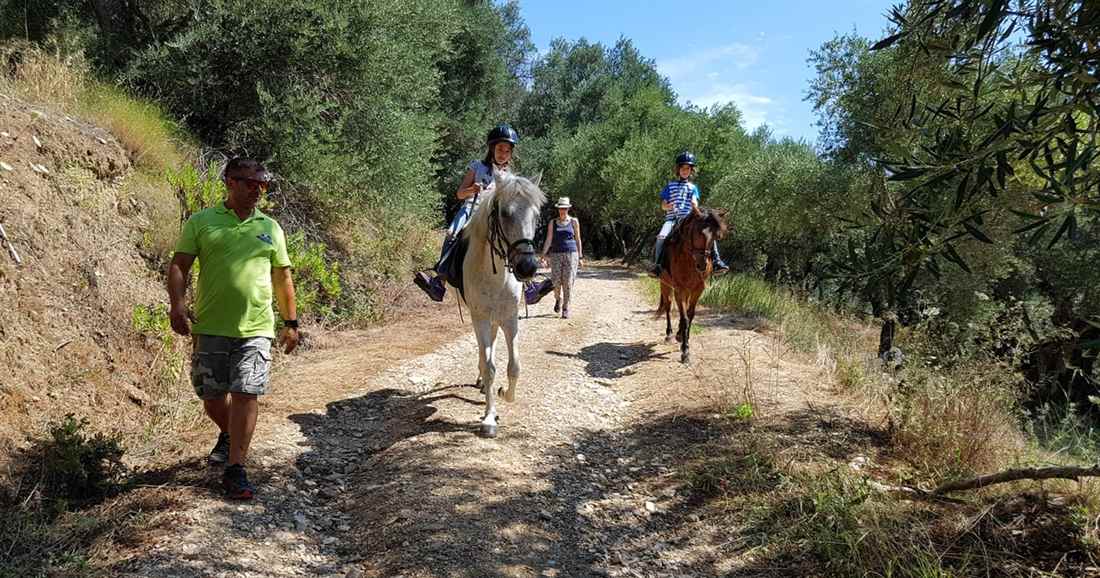
The day begins at a donkey sanctuary, which the listing does not name. A guide explains how donkeys once worked like pickup trucks on the islands. Then the group drives to the northwest coast.
At the family-run farm, guests touch and feed the animals. The horse ride crosses the farm, and the guide to horse riding on Corfu lists other rides. Guests who prefer not to ride relax in the garden with a drink.
- Horses and donkeys
- Rabbits and pigs
- Sheep and goats
- Ducks and chickens
- Turtles
Lunch is a barbecue of meat, poultry and vegetables, all produced on the farm. Organic house wine or local beer and a homemade dessert complete the meal. Vegetarian lunches are arranged on request, and the guide to Corfu olive oil covers other farm tastings.
Why do donkeys need rescue on Corfu?
Donkeys once carried people and olive harvests across Corfu. Machines and pickup trucks replaced them. Old, sick and unwanted donkeys then faced neglect or export for meat. The Corfu donkey sanctuary takes them in for the rest of their lives.
The first donkey reached Corfu from Malta in the nineteenth century. Later donkeys came from mainland Greece, Albania, Cyprus and Eastern Europe. Corfu donkeys are small, and heavy work wore their bodies down.
The island lacked expert vets, hoof trimmers and dentists for donkeys. Even the samara, the old Corfiot saddle, damages young donkeys for life. As work dried up, the only buyers left were Italian meat markets.
The Corfu donkey sanctuary set out to halt that export. Donkeys still work on other islands, as the pages on Santorini’s donkeys and donkey rides on Paros show. On Corfu, the rescue’s aims cover each kind of donkey:
- The old get a safe and happy retirement.
- The sick get a chance of cure.
- The injured get time to recover.
- The abused learn to trust again.
- The abandoned feel secure once more.
Who suits the Corfu donkey sanctuary?
The Corfu donkey sanctuary suits animal lovers and families with children. Children are welcome and can help brush the donkeys. The ground is rural and uneven, so the site is harder for visitors with limited mobility.
Brushing gives children a calm task with their hands. Volunteers explain how each animal is cared for. Families planning more animal days can read the guide to Corfu with kids.
The final stretch of road is an unpaved track. The rescue advises against coming by bus with children or elderly people. The walk from the stop runs along a busy road without a pavement.
Teens from 16 can volunteer at the Corfu donkey sanctuary with at least one parent. Younger children come as visitors only. The farm tour is not suitable for people with animal allergies.
What do you bring to the Corfu donkey sanctuary?
For the Corfu donkey sanctuary, bring closed shoes, a hat, sunscreen and water. Bring cash for the donation box and tinned pet food as a gift. Leave fresh carrots at home, because they rot before the donkeys get through them.
- Trainers, not sandals or flip-flops
- A cap or hat in the hot months
- Long clothes against mosquitoes and thorns
- Wet wipes for dusty hands after brushing
- Rain gear and warm layers from November to March or April
The Corfu donkey sanctuary is almost all outdoors, with no café or drinks stand. Carry your own water. Morning visits are cooler for both people and donkeys.
The rescue only takes food that keeps, such as tinned cat and dog food or treats. Donors can also fund a watermelon, the donkeys’ favourite treat, through the rescue’s website.
Other vital supplies are hard to buy on Corfu. The Corfu donkey sanctuary keeps wish lists on Amazon UK and Amazon Germany. It no longer accepts parcels by post, so visitors pack items in their luggage.
How long does a Corfu donkey sanctuary visit last, and what is included?
A visit to the Corfu donkey sanctuary near Doukades lasts one to two hours. Entry is free, and visitors can leave a donation in the box. The GetYourGuide farm tour lasts six hours and includes a farm lunch.
At the rescue, a volunteer guides each visitor around the site. Nothing is on sale there, so the visit costs only what you choose to give. A basic toilet is on site.
The GetYourGuide tour runs in a small group of up to eight people. A live guide speaks English and Greek, and pickup is available. Its listing includes:
- A visit to a donkey sanctuary
- A visit to a family-run farm and its animals
- A horse ride on the farm
- A farm lunch, or a vegetarian lunch on request
- A drink with lunch: house wine or beer
- A homemade dessert and a digestive liqueur
How do you get to the Corfu donkey sanctuary?
The Corfu donkey sanctuary is reached from the National Paleokastritsa Road only, close to Doukades. Drivers turn off onto a tarmac road, then a track. Bus riders take the green bus and walk the last 1.1 km.
From Corfu Town, head north towards Paleokastritsa. About 2 km before Doukades, Villa Alexandra, a pink building, stands on the right. Then follow these steps:
- Turn right straight after Villa Alexandra.
- Follow the tarmac road ahead.
- Take the second track on the left.
- Turn right at the tiny orange house.
- Drive on to the end of the track.
Passing a kiosk or a sign for Liapades means you have gone too far. A good-sized car park waits at the Corfu donkey sanctuary. Book a hire car in Corfu and read these driving tips for Corfu.
The green bus links Corfu Town and Paleokastritsa. Ask the driver for Zomeno, the kiosk by the Liapades turn. The rescue advises against this with children or older people, since the main road has no pavement.
When is the Corfu donkey sanctuary open?
The Corfu donkey sanctuary opens every day of the year from 10:00 to 16:00. The rescue’s own website calls these hours strict. Individuals and families are welcome in every season, winter included. Summer, though, is its busiest period.
Older guides list a 17:00 close, but the rescue’s own page gives 16:00. Arrive well before closing to spend unhurried time with the donkeys and volunteers.
The site is largely outdoors, and Corfu gets very hot in summer. A morning visit is cooler for you and the animals. See when to visit Corfu to plan around the heat.
How can you help the Corfu donkey sanctuary?
Corfu Donkey Rescue runs on gifts and donations. You can help the Corfu donkey sanctuary in four ways. Adopt a donkey, give money, volunteer, or bring useful supplies. Volunteers commit to at least two weeks.
Adopting does not mean taking a donkey home. You choose a donkey, pay through the Donate button and send the adoption form. Adopters get a personalised certificate, two or more shelter updates a year and a printable calendar.
Every gift to the Corfu donkey sanctuary goes only to the animals’ needs. Food is its largest running cost. Donations arrive in these five ways:
- Bank transfer to an English, German or Greek account
- An online PayPal payment
- An online gift through theBigGive
- A cheque by post, for UK donors only
- A standing order for regular gifts
How do you book and cancel a Corfu donkey sanctuary visit?
No booking is needed for the Corfu donkey sanctuary at Doukades. You simply arrive within opening hours. The GetYourGuide farm tour is booked online. It offers free cancellation up to 24 hours before the start, with a full refund.
Questions about volunteering or adoption go by email through the rescue’s contact form. The shelter asks people not to phone just to check opening times. Such calls block urgent lines to staff.
On GetYourGuide, you pick a date and check the start times. A reserve-now, pay-later option holds your place without payment that day. Pickup options appear for each date. Still choosing a base? See where to stay in Corfu.
Frequently Asked Questions
Is the GetYourGuide tour the same as a Corfu Donkey Rescue visit?
The listing names no sanctuary at all. Corfu Donkey Rescue no longer allows guided group tours. It turns away visitors on organised tour buses or any group transport, for health, safety and legal reasons. Treat the walk-in rescue visit and the six-hour farm tour as two separate trips.
Where do the donkeys live at the Corfu donkey sanctuary?
The Corfu donkey sanctuary has two areas. The stable area houses donkeys that need close watching and intensive care. Blind donkeys have their own safe space there too. Healthier donkeys, or those with minor problems, live in the tent area. A fundraiser is collecting money for a second, smaller dome tent for new arrivals.
What care do donkeys get at the Corfu donkey sanctuary?
Each donkey gets medical treatment and regular visits from dentists and farriers. Farriers are the experts who trim and care for hooves. Cuddles and attention come whenever a donkey asks for them. When a donkey’s time comes, the rescue offers comfort and a humane, gentle death.
What does a volunteer day at the Corfu donkey sanctuary involve?
Each volunteer takes part in daily duties based on experience. Jobs include preparing special diets, giving medicine and cleaning stalls. Volunteers also lay fresh hay, give water and groom donkeys. They feed the cats, dogs and chickens, and walk the dogs. Animal experience is not needed, but deep compassion is a must.
Where do volunteers stay?
Volunteers cover their own meals and housing. The rescue can arrange basic rooms near the farm. Each room has a TV, a private shower and a toilet, and bedding and towels are provided. A small shared kitchen serves for cooking. The nearest beaches lie in Liapades and Paleokastritsa.