
If you’ve ever sat down in Greece, opened a menu, and thought, “Okay… but what do we actually order?”, we get it. Plan the whole trip with Greece Tours. Greek food on tour can feel simple on the surface (salad, souvlaki, feta, done), but the real joy is in the rhythm: a few shareable plates, a carafe of house wine, something grilled “tis oras,” and a little sweet at the end that you didn’t even ask for.
We’re locals at heart and on the road a lot, between islands like Milos and Santorini, Athens every month, and plenty of detours to places like Meteora, Crete, and the Peloponnese. So this guide is our practical, confident cheat sheet for Greek food to try on tour: what to order, where to find it (taverna vs. ouzeri matters), and how to eat in a way that feels like Greece, not just a checklist.
How To Approach Greek Eating On Tour
Greek eating isn’t a sprint; it’s a slow, social habit. And once we lean into that, the whole trip gets better. Instead of chasing “the best restaurant” every night, we do this:
- Choose the right kind of place for the moment (grill house vs. seafood taverna vs. ouzeri).
- Order for the table, not for ourselves.
- Let the meal unfold: a couple of starters, then something grilled or cooked, then fruit or a small dessert.
In most of Greece, the most “authentic” meal isn’t some hidden tasting menu. It’s a casual taverna night where nobody’s in a hurry, and the food tastes as if it came from someone’s home kitchen.
Taverna Vs. Psistaria Vs. Ouzeri Vs. Mezedopoleio
These words are more useful than any review site because they tell us what the kitchen is built to do.
- Taverna (ταβέρνα): The all-purpose classic. We’ll find grilled meats, salads, fries, seafood in coastal areas, and “cooked” dishes (mayirefta) like stifado or briam. Often the best value, often the best vibe, especially when it’s full of locals on a weeknight.
- Psistaria / Psitopolio (ψησταριά / ψητοπωλείο): Grill house territory. Think souvlaki, gyros, pork chops, lamb chops, burgers, and the kind of smoky, straightforward cooking that’s perfect after a beach day.
- Ouzeri / Tsipouradiko / Rakadiko: Drink-first places where food comes as mezedes (small plates) to match ouzo, tsipouro, or raki. In some regions (like Volos-style tsipouradika), the food can escalate in rounds and feel almost “endless” if we keep ordering drinks.
- Mezedopoleio (μεζεδοπωλείο): A meze-focused spot where sharing is the whole point. Sometimes there’s a full menu, sometimes it’s a chalkboard, sometimes it’s more “curated.” In popular neighborhoods (for example, tourist-heavy meze areas in central Athens), prices can be higher, so we check the menu before committing.
Meze Culture And How Ordering Works
Meze culture is basically Greece’s most enjoyable “system.” Here’s how it typically plays out when we do it like locals:
- We order the drink first: ouzo, tsipouro, raki, beer, or wine.
- We order 2–4 small plates to start (spreads + one fried/one grilled is a solid formula).
- If it’s an ouzeri/tsipouradiko, more plates may arrive with each round, sometimes chosen by the house, sometimes suggested.
A useful word to know: poikilia (ποικιλία), a variety platter. If we’re indecisive (or hungry), asking for a variety/poikilia of meats or mezedes can be the easiest win.
What To Know About Bread, Olive Oil, And The Cover Charge
A small surprise for first-timers: bread often appears on the table whether we ask or not.
- Bread is standard, and so is olive oil (sometimes with oregano, sometimes plain).
- Many places charge a small cover (often called a “couvert” on menus; in Greek, you may hear pitogo used informally in some areas). It’s usually a few euros per person and may include bread and table settings.
Our rule: don’t stress it. If the bread is great, we’ll happily pay for it. If we truly don’t want it, we can politely say so when we sit down, but in most tavernas, bread is part of the flow.
Street Foods And Quick Bites You’ll See Everywhere
When we’re touring Greece, ferries, ruins, beach hops, and long drives, street food is what keeps the day fun. The trick is knowing what’s genuinely good (most of it) and what fits the moment (breakfast vs. late-night vs. “we need something in 3 minutes”).
Souvlaki Vs. Gyros: The Differences That Matter
People use these interchangeably, but in Greece, they’re not the same.
- Souvlaki is skewered grilled meat (usually pork, sometimes chicken). If we order “one souvlaki,” we might get a skewer on a plate.
- Gyros is rotisserie meat shaved into slices (pork is classic in many areas; chicken gyros is common too).
And then there’s the format:
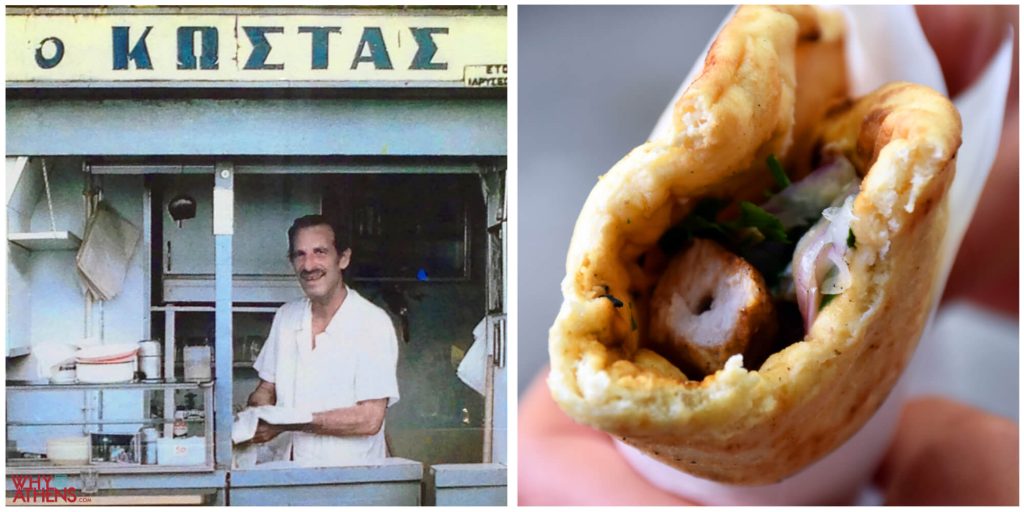
- Pita wrap: “pita gyros” or “pita souvlaki” with tomato, onion, fries, and tzatziki (or sometimes a lighter yogurt sauce).
- Merida: a portion on a plate (useful when we want a fork-and-knife meal).
Local note: if we see kontosouvli (slow-rotisserie pork) or kokoretsi (for the adventurous), that’s a different lane, more feast food than quick bite.
Koulouri, Tiropita, And Spanakopita For On-The-Go Breakfast
Greek mornings aren’t always a big breakfast. A lot of locals grab something from the fournos (bakery) and keep moving.
- Koulouri: a sesame bread ring that’s perfect with coffee, simple, cheap, everywhere in Athens and beyond.
- Tiropita: cheese pie (usually feta and other cheeses). Salty, flaky, very hard to stop at one.
- Spanakopita: spinach pie. If we want something a little lighter (or just greener), this is the classic pick.
On islands, bakery items can be more regional, with different cheeses, different shapes, and sometimes with herbs. If something looks “local,” we try it once. Worst case: we’ve eaten a fresh pastry in Greece. Not exactly a tragedy.
Loukoumades And Other Grab-And-Go Sweets
For a quick sugar hit (especially after dinner strolls), we look for:
- Loukoumades: little fried dough balls drenched in honey and cinnamon. Sometimes with crushed walnuts, sometimes with chocolate or pistachio.
- Spoon sweets (glyko tou koutaliou): fruit preserved in syrup, often offered as hospitality in smaller, family-run places.
If we’re walking through a market area, we also keep an eye out for seasonal fruit. Greek peaches, figs, grapes, and cherries can be unreal when they’re in.
Taverna Classics Worth Seeking Out At Least Once
Taverna food is where Greece stops being “Mediterranean diet in theory” and becomes “why does this taste like my aunt cooked it?” Even if we’re only in the country for a week, there are a few classics worth trying at least once.
Moussaka, Pastitsio, And Other Oven-Baked Staples
These are the dishes people picture, and when they’re made well, they earn the hype.
- Moussaka: layers of eggplant (sometimes potato too), spiced meat sauce, and béchamel on top. Rich, comforting, and usually a full meal on its own.
- Pastitsio: baked pasta with meat sauce and béchamel, think “Greek lasagna,” but with its own personality.
We usually find these at an estiatorio or a taverna that has a “cooked dishes” section. If we see them listed under mayirefta (cooked foods), that’s a good sign.
Stifado, Kleftiko, And Slow-Cooked Comfort Dishes
This is the part of Greek food we miss the most when we’re away: slow, patient cooking.
- Stifado: typically a stew (often rabbit or beef) with lots of tiny onions and warm spices. It’s savory, slightly sweet, and perfect with bread.
- Kleftiko: slow-cooked lamb, traditionally sealed and roasted until it’s falling apart. On Milos, it’s practically a love language. If we’re on an island or in a mountain village and see kleftiko, we don’t overthink it; we order it.
These dishes can take hours to make. If a place says, “It’s finished,” and points to a pot, that’s good news. If they say, “We can do it in 10 minutes,” that’s… less good news.
Fassolada, Briam, And Other Everyday Home-Style Plates
Not every memorable Greek meal is meat-heavy. Some of the most “real” plates are the everyday ones.
- Fassolada: bean soup (white beans, tomato, olive oil). It sounds humble because it is, and that’s the charm.
- Briam: baked mixed vegetables in olive oil (often zucchini, eggplant, potatoes, tomato). If we’re eating vegetarian for a day, briam is one of the best choices.
A small ordering tactic: if we’re at lunch and see a row of trays behind glass (the classic cooked-food setup), we can just ask what’s good today. The best dish is often the one that’s almost sold out.
Mezedes And Small Plates To Share With Drinks
If we had to pick one “Greek eating” experience to recommend to every traveler, it’s this: sit down somewhere lively, order a drink, and build the meal out of mezedes. It’s social, flexible, and it fits touring life because we can eat lightly or turn it into a feast.
Tzatziki, Taramosalata, Fava, And Spreads To Start Every Meal
Spreads are the easiest way to start strong, and most tables in Greece will have at least one.
- Tzatziki: thick yogurt, cucumber, garlic, olive oil. Cooling with grilled meat, perfect with fries (yes, locals do it).
- Taramosalata: fish roe spread, salty, pink or beige depending on the style, often whipped with bread or potato.
- Fava: not fava beans, usually yellow split peas, cooked down into a silky puree with olive oil and onion. On islands (especially the Cyclades), fava can be outstanding.
We add warm pita or village bread, and we’re already happy.
Dolmades, Keftedes, Saganaki, And Cheese-Based Bites
Now we move into the “small plates that disappear too fast” category.
- Dolmades: vine leaves stuffed with rice (sometimes with herbs, sometimes with minced meat). The best ones taste bright and lemony.
- Keftedes: Greek meatballs, usually with mint or oregano. Crispy outside, juicy inside.
- Saganaki: pan-fried cheese. It arrives sizzling, and it’s exactly as indulgent as it sounds.
If we want one fried thing and one fresh thing, we’ll pair saganaki with a Greek salad (horiatiki), tomato, cucumber, onion, olives, feta, oregano, olive oil. Simple, but in Greece, the tomatoes actually taste like tomatoes.
Regional Favorites Like Dakos, Tomatokeftedes, And Kolokithokeftedes
This is where touring gets delicious: each region sneaks its identity onto the table.
- Dakos (Crete): barley rusk topped with tomato, olive oil, and usually soft cheese (often mizithra or similar). It’s crunchy, juicy, and very Cretan.
- Tomatokeftedes (Santorini): tomato fritters made with the island’s sweet, concentrated tomatoes and herbs. They’re one of those dishes we order “for the table” and then guard like treasure.
- Kolokithokeftedes: zucchini fritters, often with herbs and feta, usually served with tzatziki.
When we’re on an island, we scan the menu for anything that sounds like it belongs there. The tourist trap version of Greek food is sameness. The best version is regional.
Seafood And Island Specialties
Greece has a long coastline and even longer opinions about seafood. The good news: if we’re near the water and we choose a solid psarotaverna (fish taverna), it’s hard to go wrong. The even better news: we don’t need to order the most expensive fish to eat well.
Grilled Octopus, Calamari, And What To Order At A Psarotaverna
A few reliable seafood orders show up all over Greece:
- Grilled octopus (htapodi sta karvouna): tender, smoky, usually finished with olive oil and vinegar or lemon.
- Calamari: grilled or fried. If it’s tender and not rubbery, we’re in the right place.
- Small fried fish (often gavros/anchovies or marides): crispy, salty, perfect with lemon and a cold drink.
We also look for simple classics like horiatiki and horta (boiled greens with olive oil and lemon). Those “boring” sides are exactly what make a seafood meal feel Greek.
How To Choose Fresh Fish And Understand Market Pricing
Fresh fish can be the best meal of the trip, or a pricey mystery if we don’t ask a couple of basic questions.
- In many fish tavernas, the fresh catch is priced by the kilo. That means the final price depends on weight.
- It’s normal to ask the price per kilo and to ask to see the fish.
When we’re choosing, we look for simple freshness clues:
- Clear, bright eyes (not cloudy)
- Red gills
- A clean sea smell, not “fishy.”
If we’re watching our budget, we skip the big-name trophy fish and ask what’s great today that’s not too expensive. Often, the answer is something local and seasonal.
Island Plates To Watch For On Menus
Islands don’t just do “seafood.” They do island food, ingredients shaped by wind, sun, and scarcity.
A few things we keep an eye out for:
- Fava and tomato fritters in the Cyclades (Santorini is famous, but nearby islands do them beautifully too).
- Local cheeses (each island has its own favorites, soft, salty, sometimes tangy).
- Sea urchin in some coastal areas (for seafood lovers).
- Slow-cooked lamb or goat in smaller villages where meat dishes are traditional weekend food.
And a small practical tip: if a menu has 120 items, it’s rarely an island specialty place. We trust the shorter menu more.
Desserts, Pastries, And Sweet Finishes
In Greece, dessert often arrives in a low-key way: fruit, a spoon sweet, a little cake “from the house.” But if we’re actively hunting sweets (and we should, at least a little), the pastry shops are a dream.
Bougatsa, Galaktoboureko, Kataifi, And Syrup Sweets
These are the syrup-and-custard legends.
- Bougatsa: custard-filled pastry (often dusted with powdered sugar and cinnamon). In some regions, it’s a morning staple.
- Galaktoboureko: semolina custard baked in phyllo and soaked in syrup. Rich, messy, worth it.
- Kataifi: shredded phyllo pastry, often wrapped around nuts and soaked in syrup.
If we see a Zacharoplasteio (pastry shop), we step inside and point at what looks good. That’s a valid strategy in Greece.
Baklava, Yogurt With Honey, And Seasonal Treats
A few easy, sweet finishes that work after a big meal:
- Baklava: layered phyllo with nuts and syrup. Classic for a reason.
- Greek yogurt with honey: simple, cooling, and perfect when we want something sweet but not heavy.
- Seasonal fruit: especially in summer, watermelon after dinner is very normal.
One thing we do: if we’ve had a heavy lunch, we switch to yogurt with honey at night. It keeps the trip feeling light (and we still get dessert, which matters).
Coffee, Wine, And Spirits To Try Along The Way
Greek drinking culture, coffee included, is tied to time. We don’t “grab and go” everything. We sit. We talk. Even if it’s just 20 minutes in the shade. On tour, those little pauses can save the day.
Greek Coffee, Frappé, And Freddo Drinks
Coffee orders in Greece come with their own language.
- Greek coffee: thick, unfiltered, served in a small cup. We choose the sweetness level: sketos (no sugar), metrios (medium), glykos (sweet). Let it settle, don’t drink the sludge.
- Frappé: the old-school iced instant coffee, foamy and iconic.
- Freddo espresso / freddo cappuccino: more modern and extremely common, strong espresso poured over ice: the cappuccino version adds cold foam.
If we’re doing long sightseeing days, freddo cappuccino becomes a pretty reliable friend.
Wine Styles And Easy-Order House Options
We don’t need a sommelier to drink well in Greece.
- House wine is often solid, especially in tavernas. We’ll order it by the carafe (karafaki).
- If we want a safe, refreshing choice, we go with dry white alongside seafood and meze.
Greece also has serious indigenous grapes, and if we see them listed, it can be fun to try a glass. But even without getting nerdy: a chilled carafe, a salad, grilled calamari, that’s a vacation.
Ouzo, Tsipouro/Raki, Mastiha, And How To Pair Them With Food
These spirits aren’t meant to be slammed. They’re meant to be paired.
- Ouzo: anise-flavored, usually diluted with water (it turns cloudy). Best with salty meze: octopus, fried fish, spreads.
- Tsipouro: grape spirit (sometimes with anise, sometimes without). In many regions, it’s the default with mezedes.
- Raki (often called tsikoudia in Crete): strong, clean, and often offered at the end of a meal.
- Mastiha: aromatic spirit from Chios, sweet-herbal and easy to sip.
Our pairing shortcut:
- Ouzo + seafood meze
- Tsipouro + mixed mezedes (meatballs, dolmades, spreads)
- Raki + after-dinner nibble or just conversation
And yes, water on the table is normal. We drink it. Greek summers don’t negotiate.
Practical Ordering Tips For Travelers
Knowing what to eat is half the battle. The other half is ordering smoothly, especially when we’re tired, sunburned, and standing in front of a menu with words we’ve never seen before.
Helpful Menu Words And Common Dish Clues
A few Greek menu categories show up again and again:
- Orektika: appetizers
- Salates: salads
- Mayirefta: cooked dishes (stews, baked foods)
- Tis oras: “of the hour” (grilled to order)
Clues we look for:
- If a place highlights mayirefta, it’s often more “home cooking.”
- If the menu is mostly tis oras, expect a grill-forward kitchen.
- If there’s a big section on fresh fish by the kilo, it’s a psarotaverna experience.
And one more very human tip: if we don’t understand something, we ask, “What do you recommend today?” In good places, the answer is specific.
Dietary Needs: Vegetarian, Seafood-Only, And Dairy-Heavy Dishes
Greece is easier than it looks for some diets, and trickier for others.
- Vegetarian-friendly dishes we actively look for: briam, fava, fassolada, horta, Greek salad, dolmades (often rice-only, but not always), and many vegetable mezedes.
- Seafood-only travelers can do very well near the coast: grilled octopus, calamari, small fried fish, shrimp dishes, plus all the spreads and salads.
- Dairy-heavy reality: feta, yogurt, and cheese pies are everywhere. If we’re dairy-free, we focus on grilled meats/seafood, legumes, and vegetable dishes cooked in olive oil, and we ask directly about cheese or butter.
One more note: during traditional fasting periods, many tavernas offer nistisima (fasting foods), which are often vegan by default. If we see that word, it’s useful.
Timing, Portions, And How To Avoid Tourist Traps Near Major Sights
A few habits make eating on tour smoother (and tastier):
- Lunch can be the main meal. Many cooked dishes are best earlier in the day when they’re freshest.
- Portions are meant for sharing. If we order one starter per person plus mains, we usually overdo it. A good rule for two people: 2–3 mezedes + one main to share, then adjust.
- Step one or two streets away from major sights (Acropolis area, main caldera viewpoints, the obvious harbor strip). The food doesn’t magically get better with a view.
How we spot a likely tourist trap:
- Someone is aggressively inviting us in
- Menus in ten languages with huge photo grids
- Massive lists of dishes that span every region and every cuisine
How we spot a good local place:
- A shorter menu
- Locals are eating at normal hours
- The smell of grilling and the sound of people actually having a good time
And if we’re unsure, we do the simplest test: order one classic (Greek salad, grilled meat, or a cooked dish) and see if it tastes like care. Greece rewards places that cook with pride.
Conclusion
The best part about searching for Greek food to try on tour is that we don’t need to turn it into a mission. Greece feeds us if we let it: a koulouri in the morning, a freddo in the afternoon, a table full of meze at night, and maybe kleftiko once, because some meals really do stick with us.
If we take only one approach, it’s this: choose the right kind of place, order a few things for the table, and follow what the region does well. That’s how we end up eating like locals, whether we’re in Athens for a quick stop, on Milos by the sea, or island-hopping until the calendar stops making sense.
Key Takeaways
- To find the best Greek food to try on tour, pick the right venue type—taverna for home-style mayirefta, psistaria for grilled tis oras, and ouzeri/mezedopoleio for meze with drinks.
- Eat like a local by ordering for the table: start with 2–4 mezedes (spreads plus one fried and one grilled), then share a main and let the meal unfold slowly.
- Know your quick bites: souvlaki is skewered grilled meat, while gyros is rotisserie slices, and bakery staples like koulouri, tiropita, and spanakopita make easy tour-day breakfasts.
- Seek out taverna classics at least once—moussaka or pastitsio for oven-baked comfort, plus slow-cooked stifado or kleftiko when you spot them made properly.
- On islands, prioritize regional specialties (like Cretan dakos or Santorini tomatokeftedes) and keep menus short to avoid “same-everywhere” tourist food.
- At a psarotaverna, order simple winners (grilled octopus, calamari, small fried fish) and ask the price per kilo and to see the fish before committing to fresh catch.
Frequently Asked Questions About Greek Food to Try on Tour
What Greek food to try on tour if I want to eat like locals (not a checklist)?
The best Greek food to try on tour comes from a slow, shareable rhythm: pick the right spot (taverna, ouzeri, or grill house), order 2–4 mezedes for the table, then add one grilled or cooked main to share. Finish with fruit or a small “from the house” sweet.
What’s the difference between a taverna, psistaria, ouzeri, and mezedopoleio in Greece?
These names tell you what the kitchen does best. A taverna is the all-purpose classic with grills and home-style mayirefta. A psistaria focuses on grilled meats like souvlaki and gyros. An ouzeri pairs drinks (ouzo/tsipouro/raki) with meze. A mezedopoleio is meze-first and built for sharing.
Souvlaki vs gyros: what should I order on a Greek tour?
In Greece, souvlaki is skewered, grilled meat (often pork or chicken), while gyros is rotisserie meat shaved into slices. For a fast bite, order a pita wrap (“pita gyros” or “pita souvlaki”). If you want a sit-down feel, ask for a merida (portion on a plate) with a fork and a knife.
Why do Greek restaurants bring bread and olive oil—and what is the cover charge?
Bread and olive oil often arrive automatically because they’re part of the taverna flow. Many places add a small cover charge (“couvert”) that helps cover bread and table settings. If you truly don’t want bread, you can politely say so when you sit down, but it’s normal to see it on the bill.
What are the best mezedes and spreads to order as Greek food to try on tour?
A reliable meze order is one spread plus one fried or grilled plate. Start with tzatziki, taramosalata, or island-style fava, then add dolmades, keftedes, or saganaki. If you’re indecisive, ask for a poikilia (variety platter). Pair with ouzo or tsipouro for the full experience.
How can I avoid tourist-trap meals when looking for Greek food to try on tour?
Step one or two streets away from major sights and prioritize shorter menus with locals eating at normal hours. Be cautious of aggressive greeters, huge photo menus in many languages, and “everything-from-everywhere” lists. A simple test: order one classic (Greek salad or a cooked mayirefta dish) and judge the care.
See more in My Greece Tours:
- The Old Acropolis Museum Reopens: Hidden Life Of The Sacred Rock
- Buy Acropolis Tickets in Advance: Acropolis Visiting Tips & Tickets Guide
- Acropolis Mistakes to Avoid: Big Mistakes to Avoid When Visiting the Acropolis
- Acropolis: Is It Safe to Buy Acropolis Tickets Online? Tips for Safe Ticket Purchase
- Acropolis Skip the Lines: Discover Ancient History Without the Wait at the Acropolis
- Avoiding Crowds at Acropolis: Tips to Avoid Big Crowds
- Are Acropolis Guided Tours Worth It? An Honest Look at the Acropolis Experience
- Acropolis Accessibility Guide: Information and Tips
- Best Time to Visit Acropolis Athens: Optimal Times & Sunset Visits
- Acropolis Multi-Site Pass & Combo Tickets: Acropolis Pass & Tickets Guide
- Acropolis Museum Tickets – Prices, Guide, & Tours | Skip The Line Tickets
- Explore the Acropolis: Acropolis Tickets & Tours Guide