
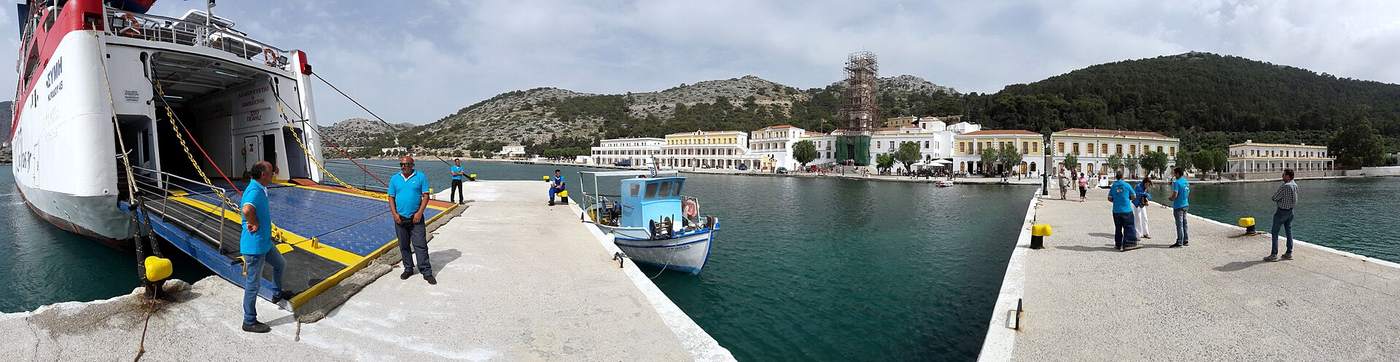
Symi keeps a full Orthodox religious calendar, and its feasts run from Easter in the spring through the summer panigyria to the great feast of the Archangel Michael at Panormitis Monastery in November. Easter stands as the most important date, with candlelit processions of the Epitaphios through Gialos and Chorio on Good Friday and the midnight Resurrection service that fills the churches. This guide covers the Easter observances, the November pilgrimage to Panormitis, the summer chapel feasts, and how visitors join the worship and the celebration across the island.
The feasts of Symi mix worship with community celebration. A liturgy opens each gathering, and food, wine, local music and dancing follow late into the night. Each chapel and monastery keeps its own saint’s day, so the calendar carries a steady round of celebrations from spring to late autumn. Pilgrims travel from across Greece for the eighth of November, arriving by boat and staying in the monastery cells at Panormitis. Visitors are welcome to join the services and the panigyria, and the religious life of the island gives a traveller a clear window into its traditions and its people.
What is the religious calendar of Symi like?
Symi keeps a full Orthodox religious calendar, and Easter is the most important date on it. The island runs from the Good Friday processions through the summer panigyria to the great feast of the Archangel Michael at Panormitis on the eighth of November.
The Orthodox faith shapes the yearly rhythm of Symi, and its calendar marks the island from spring to late autumn. Easter stands at the centre, drawing residents and visitors into the churches of Gialos and Chorio. Through the warm months the island turns to its panigyria, the chapel name-day feasts held across the villages and the hills. The feast of the Archangel Michael at Panormitis Monastery closes the main cycle in November. Every chapel and monastery keeps its own saint’s day, so the calendar carries a steady round of smaller celebrations. Worship and community life run together at each of these gatherings, and the pattern repeats year after year on the island of the Dodecanese.
Easter ranks as the high point of the Symi year, and the whole community turns to the churches for Holy Week. Good Friday brings candlelit processions of the Epitaphios through Gialos and Chorio, the harbour and the upper town. The midnight Resurrection service on Holy Saturday fills the churches and spills into the squares. Families keep the customs of the fast, the vigil and the feast that follows. The date moves with the Orthodox calendar, so it can fall weeks apart from the Western Easter. Visitors on the island during Holy Week find the streets quiet by day and alive by night. The services welcome outsiders, and travellers stand among the residents for the processions and the midnight liturgy.
The summer belongs to the panigyria, the name-day feasts tied to the chapels and monasteries of Symi. A liturgy opens each feast, and food, wine, music and dancing follow late into the night. Villagers and visitors gather at the chapel courtyard, and the celebration carries the saint’s day into a shared meal. Each chapel keeps its own date, so the season holds a rolling series of feasts across the island. The hillside chapels and the remote monasteries draw walkers and boat parties to reach them. These gatherings blend the liturgy with community life, and the mix defines the character of the island’s faith. The panigyria run from early summer through the warm months, matching the calendar of the local saints.
The feast of the Archangel Michael at Panormitis Monastery stands as the largest fixed date of the Symi calendar. Pilgrims travel from across Greece for the eighth of November, arriving by boat and staying in the monastery cells. The bay fills with craft, and the guest rooms take families who keep the vigil through the night. Priests lead a long liturgy, and the monastery hands out food to the gathered crowd. The date honours the patron of sailors on an island built by the sea. Every strand of the calendar, from Easter to the panigyria to this November feast, joins prayer with the life of the community. The round of worship shapes the year and gives visitors a window into island tradition.
How does Symi mark Good Friday and the Epitaphios?
Symi marks Good Friday with candlelit processions of the Epitaphios through Gialos and Chorio. The decorated bier leaves each church after the evening service, and residents follow with candles through the harbour lanes and the streets of the upper town.
Good Friday sits at the heart of Holy Week on Symi, and the day centres on the Epitaphios. The Epitaphios is a carved wooden bier that represents the tomb of Christ, dressed with flowers by the women of each parish. The churches of Gialos and Chorio prepare their own biers through the morning and afternoon. An evening service precedes the procession, and the mood across the island stays solemn. Shops close and the harbour falls quiet in respect for the day. The flowers, the candles and the chanting set the tone for the night to come. Residents of every age take part, and the preparation of the Epitaphios draws families to their parish church across the two settlements of the island.
The processions form the core of the Symi Good Friday. Each church carries its Epitaphios out into the streets, and the faithful follow behind with lit candles. The route winds through Gialos along the harbour and climbs the Kali Strata steps toward Chorio on the ridge. Chanters and the priest lead the slow walk, and the bier passes beneath the neoclassical houses of the port. The separate parish processions cross paths in the town, and the lines of candles trace the streets in the dark. Bells toll through the walk. The procession returns each bier to its church, and the night closes the mourning of Good Friday before the Resurrection service of the following day on Symi.
Candlelight defines the Good Friday night on Symi, and the scene draws residents and visitors alike. Thousands of small flames move through the harbour and up the stone stairways between the two settlements. The amphitheatre of houses around Gialos frames the processions from above, and the reflections carry across the still water of the port. Families line the route, and older residents watch from balconies and doorways. The scent of the flowers on the Epitaphios drifts through the lanes. The evening holds a hush broken by the chanting and the bells. This blend of faith, place and light gives the Symi Good Friday its particular character among the observances of the island through Holy Week.
Visitors on Symi for Good Friday join the residents without difficulty, and the churches welcome outsiders to the service and the procession. Travellers gather in the harbour square before the biers emerge, then follow the route through Gialos and up toward Chorio. Modest dress marks respect at the church and in the procession, with covered shoulders a basic courtesy. The walk suits steady footwear, since the Kali Strata steps are worn and steep. The processions run in the evening, so guests plan their meal and their day around the timing. A place near the harbour gives the widest view of the candlelit lines. The night rewards those who stay for the full procession rather than a passing glance.
What happens at the midnight Resurrection service on Symi?
The midnight Resurrection service on Symi fills the churches on Holy Saturday, and the priest brings out the holy light at midnight. Residents pass the flame candle to candle, greet each other with the Easter words, and celebrate the risen Christ.
Holy Saturday builds toward the midnight Resurrection service, the peak of the Orthodox Easter on Symi. The churches of Gialos and Chorio fill through the late evening, and the crowd spills into the courtyards and the squares outside. Worshippers carry white candles ready for the holy light. The service moves through the readings toward the moment of the Resurrection at midnight. Lamps dim inside the church before the priest emerges with the flame. The community gathers across both settlements, and the harbour draws the largest congregation around its parish church. The anticipation grows through the final hour, and residents who fasted through Holy Week wait for the announcement that Christ is risen from the tomb on Symi.
Midnight brings the central moment of the Symi Easter, and the priest carries the holy light from the sanctuary. He passes the flame to the nearest candles, and the light spreads hand to hand across the whole crowd. The words Christos Anesti, meaning Christ is Risen, ring out, and the people answer that he is truly risen. Bells peal from the churches, and fireworks crack over the harbour of Gialos. The dark squares fill with moving candle flames in a single shared instant. The mood turns from mourning to celebration in a heartbeat. Residents exchange the Easter greeting and the kiss of peace, then start home carrying the lit candle to bless the house.
Easter customs carry the celebration on from the midnight service into Sunday on Symi. Families break the long fast with magiritsa, a soup eaten after the Resurrection liturgy. The lit holy candle marks a cross of soot above the door of the house for a blessing. Red-dyed eggs pass around the table, and each person cracks an egg against another in a small contest. Easter Sunday brings the roasting of lamb on the spit and a long midday meal with wine. Relatives gather across the two settlements, and the tables run through the afternoon. The feast answers the fast, and the food, the family and the faith join in the fullest celebration of the Symi year.
Visitors join the midnight Resurrection on Symi as readily as the residents, and a candle is easy to obtain before the service. Travellers take a place in the harbour square or inside a parish church well before midnight. The holy light reaches every candle, so a guest shares the flame with the crowd around them. Warm layers suit the late hour, since the spring night by the water stays cool. The fireworks and the bells mark the moment for the whole harbour to see. A room near Gialos or Chorio puts the traveller within walking reach of the service. The night stands among the strongest experiences of the island calendar for a visitor who stays on Symi for Easter.
When is the Panormitis feast on Symi and who attends?
The feast of the Archangel Michael at Panormitis on Symi falls on the eighth of November. Pilgrims travel from across Greece, arriving by boat and staying in the monastery cells for the vigil and the long feast-day liturgy at the shrine.
The great November feast centres on Panormitis Monastery, the main pilgrimage site of Symi on the sheltered southwest coast. The monastery honours the Archangel Michael, the patron of sailors, whom the island’s captains and fishermen trusted for safe voyages. The eighth of November marks the joint feast of the archangels across the Orthodox calendar, and Panormitis keeps it as its greatest day. Preparation begins well before the date, and the bay makes ready for the arriving pilgrims. The complex reads as a walled village around a courtyard, with a tall bell tower above the water. Guest cells frame the court, and these plain rooms take the families who come to keep the feast on Symi.
Pilgrims reach the November feast at Panormitis from across Greece, not only from Symi and the neighbouring islands. Boats bring the faithful into the bay, where craft moor bow to stern along the quay. Families book the monastery cells ahead, and the plain rooms fill with visitors who stay for the vigil. Travellers cross from Rhodes and the mainland to keep the date. The remote bay, screened by hills from the harbour town, turns wholly to the feast for the day. The scale of the gathering ranks the celebration among the major religious events of the Dodecanese. The pilgrims come to venerate the silver-clad icon of the archangel and to give thanks at the shrine of the sea.
The feast day unfolds through a night vigil and a long liturgy at Panormitis. Priests lead an all-night service, and the church fills with pilgrims who wait to venerate the icon. The morning liturgy draws the full crowd into the katholikon and the courtyard beyond. The monastery keeps the tradition of hospitality, handing out food to the gathered faithful after the service. The bay stays busy through the day with worshippers, boats and the movement of the crowd. Weddings and baptisms cluster around the date, since families choose Panormitis for the archangel’s blessing. The whole complex works at its fullest on the eighth of November, and the feast shows the monastery in its central role on Symi.
Attending the Panormitis feast calls for early arrangements, and rooms across Symi and passage from Rhodes book out ahead of the date. The monastery cells take registered pilgrims, so a place for the vigil needs planning well in advance. November weather turns cooler and wetter, and the crossing can meet rougher seas than the summer. Warm and waterproof layers suit the day at the exposed bay. The dress code holds at the shrine, with covered shoulders and knees for entry to the church. Visitors who want the full spectacle of the vigil and the crowds aim for the eighth. The feast rewards the effort with the monastery at the height of its year and the bay alive with pilgrims.
What are the summer panigyria on Symi?
The summer panigyria on Symi are chapel name-day feasts held across the island. A liturgy honours the saint of the chapel, and food, wine, music and dancing follow, so villagers and visitors gather for a celebration that runs late into the night.
The summer fills the Symi calendar with panigyria, the name-day feasts of the island’s chapels and monasteries. Each site keeps its own saint’s day, from the harbour chapels to the remote hillside sanctuaries. The old monastery of Roukouniotis Monastery in the interior stands among the sites that draw the faithful for their feast. A liturgy opens each celebration, and the community gathers at the chapel courtyard afterward. Walkers and boat parties reach the far chapels to join the day. The season holds a rolling series of feasts, so the panigyria fall across the warm months rather than on a single date. Every one blends the worship of the saint with a shared meal and celebration on Symi.
A panigyri begins with the liturgy for the saint whose day the chapel keeps. Residents and visitors gather at the chapel, and the service honours the name of the sanctuary. Food follows the worship, and the courtyard turns to a shared table for the crowd. Local dishes, wine and bread pass among the gathering, often prepared by the villagers who tend the chapel. Music strikes up on traditional instruments, and dancing carries the feast late into the night. The celebration draws families from the settlements and travellers staying on the island. Each panigyri ties the saint’s day to the life of the community, and the pattern repeats at chapel after chapel through the summer season on Symi.
Chapels and monasteries scatter across the whole of Symi, and each holds its own name-day feast. The interior monasteries, the coastal chapels and the small sanctuaries above the beaches keep their saints through the calendar. Boat trips reach the shoreline chapels, and footpaths climb to the ones set in the hills. The feast brings the site to life for a day, and the courtyard fills where it stands empty the rest of the year. Villagers restore and tend these chapels, and the panigyri repays their care with the gathering of the community. The spread of the feasts across the island turns the summer into a season of celebration. Each date marks a different corner of Symi and its patron saint.
The panigyria carry a strong sense of community, and the feasts welcome visitors alongside the residents of Symi. Travellers who join a panigyri share the food, the wine and the dancing with the villagers. The gatherings run into the small hours, and the music holds the crowd well past midnight. Reaching the far chapels adds to the day, whether by boat to the coast or on foot into the hills. The feast asks nothing of a guest beyond respect for the liturgy that opens it. These name-day celebrations give a traveller the clearest sight of island life through the summer. The panigyria endure as living tradition rather than a show staged for outsiders on Symi.
What food, music and dancing feature at Symi festivals?
Symi festivals pair the liturgy with a shared meal of local food and wine, then music and dancing that run late. Villagers prepare the dishes, traditional instruments strike up in the courtyard, and residents and visitors dance together through the night.
Food anchors the celebration once the liturgy of a Symi panigyri ends. The villagers who tend the chapel prepare the dishes, and the courtyard turns to a communal table. Local cooking carries the feast, with meat, bread and seasonal produce from the island. The small Symi shrimp appear on tables through the season, eaten whole and fried. Pots of stew and rice feed the crowd at the larger gatherings. The food passes freely among residents and visitors, in the tradition of the open table. The meal answers the worship, and the two halves of the feast join in the courtyard. This shared cooking gives the panigyri its warmth and draws the community together for the saint’s day on the island.
Wine flows alongside the food at a Symi feast, and the shared table sets the tone for the night. Local wine passes around the courtyard, poured for residents and visitors alike. The drinking stays tied to the meal and the celebration rather than standing apart from it. Bread, cheese and small dishes fill the table between the larger plates. The gathering sits together at long tables, and conversation runs across the families and the travellers who join. The hospitality of the feast extends to every guest who reaches the chapel. The wine and the food carry the celebration from the end of the liturgy into the music and the dancing. This open table defines the spirit of the panigyri across the island of Symi.
Music lifts the Symi feast once the meal is under way, and traditional players lead the night. Instruments such as the lyra, the violin and the laouto carry the island tunes of the Dodecanese. The players set up in the courtyard, and the music runs live through the celebration. Songs of the island and the wider Aegean fill the night air. The rhythm draws the crowd from the tables toward the open ground for the dancing. Older residents know the tunes and the words, and the music passes down through the generations at these feasts. The live playing holds the panigyri together and carries it past midnight. This music marks the celebration as a living tradition of Symi rather than a staged event.
Dancing closes the circle of the Symi panigyri, and the crowd takes to the floor once the music starts. Islanders lead the traditional round dances of the Dodecanese, and the line links hand to hand across the courtyard. Residents of every age join, and the steps pass to the visitors who follow the lead. The dance runs late, and the music holds the gathering well past midnight. The courtyard of the chapel becomes the floor, ringed by the tables and the lights. Travellers who join the dance share the fullest part of the feast. The worship, the meal, the wine, the music and the dance complete the panigyri. This late celebration gives the Symi summer its rhythm from chapel to chapel across the island.
How do worship and celebration mix at Symi feasts?
Symi feasts open with worship and close with celebration, and the two run together as one event. A liturgy honours the saint or the season, then the shared meal, the wine, the music and the dancing carry the day into the community.
The Symi feasts hold worship and celebration as two sides of one day rather than separate events. A liturgy or a service opens the gathering, and the sacred act sets the reason for the crowd to assemble. The meal, the wine and the music follow directly, so the celebration grows out of the worship. This pattern runs through Easter, the panigyria and the November feast at Panormitis alike. The community treats the saint’s day as both a religious duty and a social occasion. The two strands support each other, and neither stands complete without the other. This union of faith and festivity shapes the character of the island calendar and marks the way Symi keeps its traditions across the year.
Easter shows the mix most clearly on Symi, with the solemn processions giving way to the Easter feast. The mourning of Good Friday and the vigil of Holy Saturday carry the religious weight of the week. The midnight Resurrection turns the mood from grief to joy in a single moment. The Sunday table, the roast lamb and the family gathering complete the celebration. The fast of Holy Week and the feast of Easter Sunday form two halves of one observance. The faith frames the food, and the food answers the faith. This rhythm of restraint and release runs through the greatest festival of the Symi year and binds the worship to the celebration of the risen Christ.
The panigyria join worship and community life in the same way through the summer on Symi. The liturgy for the chapel’s saint opens each feast, and the courtyard fills for the service. The meal, the wine, the music and the dancing follow once the worship ends. Villagers who tend the chapel through the year host the gathering on the saint’s day. The feast repays their care, and the community renews its bond with the sanctuary. The travellers who join share both halves of the day. The sacred and the social run together at chapel after chapel across the island. This mix keeps the panigyria alive as faith and celebration rather than as one or the other alone on Symi.
The November feast at Panormitis carries the same union of prayer and gathering to its largest scale on Symi. The night vigil and the long liturgy hold the religious core of the day. The monastery’s gift of food to the crowd extends the worship into hospitality and shared celebration. Pilgrims who keep the vigil also share the meal and the company of the bay. The weddings and baptisms around the date add family celebration to the feast. The sacred draw of the shrine and the social gathering of the pilgrims run as one. This blend defines every strand of the Symi calendar, from the smallest chapel panigyri to the great feast of the archangel by the sea.
Can visitors join the church services and panigyria on Symi?
Visitors are welcome to join the church services and the panigyria on Symi. Travellers stand among the residents for the Easter processions and the midnight liturgy, and they share the food, the wine, the music and the dancing at the summer feasts.
Visitors find a genuine welcome at the religious life of Symi, and the churches open their services to outsiders. Travellers join the Easter processions, the midnight liturgy and the panigyria alongside the residents. Modest dress marks respect at every service, with covered shoulders a basic courtesy in the church. Quiet conduct holds inside the church during the liturgy and the chanting. The community expects respect for the worship rather than any formal role from a guest. A traveller stands with the crowd, follows the procession and lights a candle like any resident. This openness runs through the whole calendar, from the harbour churches at Easter to the remote chapels at their summer feasts across the island of Symi.
Easter offers the deepest experience for a visitor on Symi, and the week welcomes travellers into its observances. Guests join the Good Friday procession, following the Epitaphios through Gialos and up the Kali Strata toward Chorio. The midnight Resurrection service takes a candle and a place in the harbour square or the church. The holy light reaches every hand, so a guest shares the flame with the crowd. Warm layers suit the cool spring night by the water. A room near the two settlements puts the traveller within walking reach of the services. Holy Week rewards those who follow its full rhythm, from the solemn processions to the joy of the midnight Resurrection and the Easter feast on Symi.
The summer panigyria draw visitors as readily as the residents of Symi, and the feasts share their table with every guest. Travellers reach the chapels by boat along the coast or on foot into the hills for the celebration. The liturgy opens the day, and the food, the wine, the music and the dancing follow for all. A guest joins the round dances, shares the meal and stays for the music that runs late. Respect for the opening service is the one expectation of a visitor. The panigyria fall across the warm months, so a traveller can time a stay to catch a feast. These gatherings give the clearest window into the living tradition of the island of Symi.
The November feast at Panormitis takes pilgrims and visitors together, and the shrine welcomes travellers to the vigil and the liturgy. Guests reach the bay by boat for the eighth of November and join the crowd at the monastery. The dress code holds at the shrine, with covered shoulders and knees for entry to the church. The monastery shares its food with the gathered faithful, guests among them. A place in the monastery cells needs early booking for the feast. Respect for the worship guides a visitor through the day at the bay. This great feast, like the Easter services and the summer panigyria, opens the religious life of Symi to those who come to share it.
When is the best time to see the festivals on Symi?
The best time to see the festivals on Symi is Orthodox Easter for the processions and the midnight Resurrection, the summer for the chapel panigyria, and the eighth of November for the great feast at Panormitis Monastery on the coast.
Timing a trip around the feasts calls for a look at the Orthodox calendar, since the best time to visit Symi depends on the season and the events. Easter moves with the Orthodox date and can fall from early April into May, weeks apart from the Western Easter. The summer panigyria run from the start of the warm season through the following months. The great feast at Panormitis holds a fixed date on the eighth of November. Each of these windows shows a different face of the island’s faith. A traveller who wants the processions plans for Holy Week, while one who wants the panigyria aims for the summer feasts across the chapels of Symi.
Easter stands as the strongest window for a visitor drawn to the Symi processions and the midnight service. Holy Week fills the calendar with the Good Friday Epitaphios and the Holy Saturday Resurrection. The date shifts each year with the Orthodox reckoning, so the trip needs planning against that calendar. Spring brings mild weather and a quieter island than the peak of summer. The two settlements of Gialos and Chorio host the main services and processions. A stay near the harbour puts the traveller at the centre of Holy Week. Easter rewards the visitor with the fullest expression of the island’s faith, from the candlelit walks to the celebration of the Resurrection at midnight on Symi.
The summer opens the season of the panigyria, and the warm months hold feast after feast across Symi. Each chapel keeps its own saint’s day, so the calendar scatters the celebrations through the season. A traveller staying in summer stands a strong chance of catching a panigyri within a short trip. The long evenings suit the late music and dancing that carry the feasts past midnight. Boats reach the coastal chapels, and footpaths climb to the ones in the hills. The weather favours the walks and the sails to the remote sites. The summer pairs the beaches and the sea of the island with the living tradition of the name-day feasts, giving a broad window on the culture of Symi.
The eighth of November marks the single fixed date for the traveller set on the great feast at Panormitis. The feast of the Archangel Michael draws pilgrims from across Greece to the bay, and the monastery works at its fullest. The date falls outside the tourist season, so the island turns quiet around the pilgrimage. Cooler and wetter weather meets the visitor who crosses for the feast. Rooms and passage book out ahead, and the monastery cells take registered pilgrims for the vigil. This November feast, the Easter processions and the summer panigyria together map the calendar of the island. A traveller can plan a trip to Symi around whichever of these windows suits the season and the interest.
Frequently Asked Questions
When is Orthodox Easter celebrated on Symi?
Orthodox Easter on Symi follows the Orthodox calendar, which sets the date each year and can place it weeks apart from the Western Easter. The celebration falls in spring, most often from early April into May. Holy Week builds through the Good Friday processions of the Epitaphios and the Holy Saturday midnight Resurrection service. Easter Sunday brings the family feast of roast lamb. A traveller who wants the Easter observances checks the Orthodox date for the year and plans the trip against it, since the timing shifts and rarely matches the Western festival.
What is the Epitaphios procession?
The Epitaphios procession takes place on Good Friday evening and forms the heart of the Symi Holy Week. The Epitaphios is a carved wooden bier that represents the tomb of Christ, dressed with flowers by the women of each parish. The churches of Gialos and Chorio carry their biers out into the streets, and the faithful follow with lit candles. The route winds through the harbour and climbs the Kali Strata steps toward the upper town. Chanting and tolling bells accompany the slow walk, and the candlelit lines trace the streets in the dark.
What happens at the Panormitis feast on the eighth of November?
The Panormitis feast honours the Archangel Michael, the patron of sailors, at the main monastery of Symi on the southwest coast. Pilgrims travel from across Greece, arriving by boat and staying in the monastery cells. Priests lead an all-night vigil and a long liturgy, and the faithful queue to venerate the silver-clad icon. The monastery hands out food to the gathered crowd in the tradition of hospitality. Weddings and baptisms cluster around the date. The bay fills with craft, and the feast ranks among the major religious events of the Dodecanese.
What is a panigyri on Symi?
A panigyri is a chapel name-day feast that honours the saint of a sanctuary on Symi. The celebration opens with a liturgy, and food, wine, music and dancing follow late into the night. Villagers who tend the chapel host the gathering, and residents and visitors share the table. Each chapel and monastery keeps its own saint’s day, so the feasts scatter across the summer calendar. Traditional players lead the island tunes, and round dances carry the crowd past midnight. The panigyria join the worship of the saint with the community life of the island.
Can tourists attend the religious festivals on Symi?
Tourists are welcome to attend the religious festivals on Symi, and the churches and chapels open their services to visitors. Travellers join the Easter processions, the midnight Resurrection and the summer panigyria alongside the residents. Modest dress marks respect at the services, with covered shoulders a basic courtesy and covered knees at the monastery. A guest follows the procession, lights a candle and shares the food and dancing at the panigyria. Respect for the worship is the one expectation. The openness of the feasts gives a traveller a clear window into the living faith of the island.
What food is served at Symi festivals?
Food at the Symi festivals comes from the island and the season, prepared by the villagers who host each feast. The small Symi shrimp appear on the tables, eaten whole and fried. Roast lamb marks the Easter Sunday meal, and stews, rice and bread feed the crowds at the panigyria. Local wine passes around the courtyard through the celebration. The shared table follows the liturgy, and the food passes freely to residents and visitors alike. This open hospitality carries the feast from the end of the worship into the music and the dancing of the night.
How do you reach Symi for the festivals?
Symi sits in the Dodecanese between Kos and Rhodes, and the sea gives the only approach, since the island has no airport. Ferries and day-cruise boats run from Rhodes, and the crossing takes about one hour on the fast boats. Boats reach the bay of Panormitis directly for the November feast. Ferries also connect Symi with Kos, the other Dodecanese islands and the mainland ports. A traveller for Easter or the summer panigyria bases in Gialos or Chorio, within walking reach of the churches and the processions. Passage books out ahead of the great feast at Panormitis.