
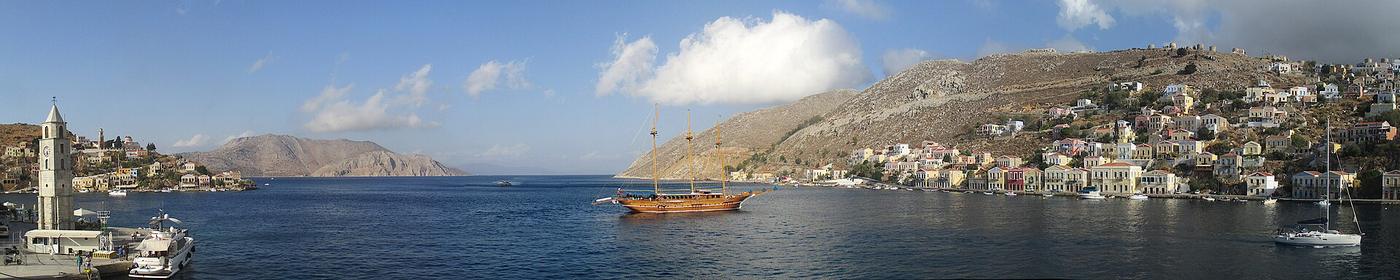
Symi Town is the main settlement of Symi, a Dodecanese island set between Rhodes and the Turkish coast. The town divides into two linked parts. Gialos rings the harbour at sea level, and Chorio crowns the hill directly above it. Neoclassical mansions in ochre, pink and pastel rise in tiers around the bay, a legacy of the island’s sponge-diving and shipbuilding wealth. This guide walks through Gialos and Chorio, the Kali Strata steps that join them, the waterfront landmarks and the museums of the upper town.
Symi Town works as one settlement stacked on two levels, and the short climb between them shapes every visit. Boats land at the quay in Gialos, and a stone stairway of roughly 500 steps leads up to the older lanes of Chorio. The harbour front carries the tavernas, sponge stalls and boat departures, while the upper town holds the churches, the castle area and the town museum. This page anchors the Symi Town cluster and links out to the neighbouring guides on the steps, the beaches and the monastery.
What is Symi Town, and how do Gialos and Chorio divide it?
Symi Town is the island’s principal settlement, built in two linked tiers. Gialos wraps the harbour at sea level, while Chorio, the older quarter, crowns the ridge above it. The whole town is a protected traditional settlement of the Dodecanese.
Symi Town stands at the head of a deep natural inlet on the island’s northeast coast. Gialos, the lower town, rings the harbour where boats tie up along the quay. Chorio, the upper town, spreads across the hillside directly above the port. The two districts read as one settlement built on two floors. Level ground stays scarce around the bay, so the houses stack up the slopes instead. Rooflines rise in tiers, one above the next, from the water to the ridge. This vertical plan follows the shape of the terrain rather than a grid. The result gives Symi Town the profile of an amphitheatre facing the harbour, with Gialos at the stage and Chorio in the upper seats.
Symi Town grew wealthy in the nineteenth century on sponge diving and shipbuilding. Captains, merchants and boat-builders funded the tall stone mansions that still line the port and the ridge. The town reached its peak population before the sponge trade declined and steamships replaced wooden hulls. Families left for Rhodes, Athens and abroad, and parts of Chorio emptied out. The stone shells of abandoned houses stand beside restored homes across the upper town. This layered record of boom and decline gives Symi Town its distinct texture. The protected-settlement status now guards the facades, so new building follows the old scale, colours and rooflines rather than modern concrete forms. Timber balconies, carved doorways and tiled roofs recur across the surviving mansions of the port and the ridge.
Gialos and Chorio each carry a clear role within Symi Town. Gialos handles arrivals, dining and shopping at the water’s edge, where ferries and excursion boats dock through the day. Chorio guards the history, the churches and the quiet residential lanes on the ridge. The harbour stays busy from the first morning boat until late in the evening. The upper town turns calm once the day visitors head back down to the quay. Residents live year-round in both districts, so laundry lines and potted herbs share the alleys with visitors. The contrast between the working port below and the still lanes above gives the town its everyday rhythm and its long-standing character. A local bus links the two districts for anyone who skips the steps.
Symi Town ranks among the best-preserved harbours in the Dodecanese. The government lists the whole settlement as protected, which fixes the height, colour and roof form of every building. No large resort hotels operate in the town, so restored mansions, guesthouses and studios hold the visitor rooms instead. The absence of an airport keeps arrivals tied to the sea and holds the crowds below the level of the busier Cyclades. Evening light turns the mansion facades gold and draws diners to the harbour tables. Photographers favour the view down over the tiered rooftops from the steps. This blend of preserved architecture, working port and lived-in old town defines the character of Symi Town.
Why is Gialos harbour the heart of Symi Town?
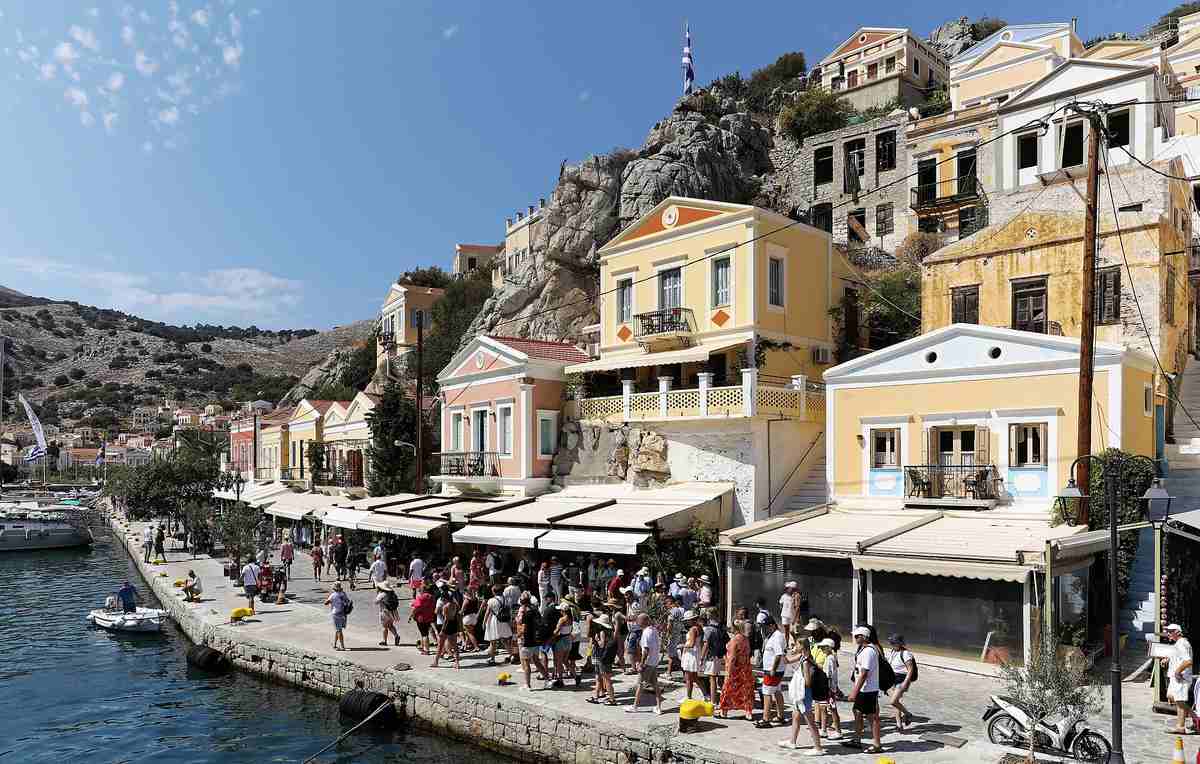
Gialos is the harbour district of Symi Town, wrapped around a deep inlet at sea level. Neoclassical mansions in ochre, pink and pastel rise in tiers around the bay, and tavernas, sponge shops and boutiques line the quay where boats dock.
Symi centres its whole life on Gialos, the harbour at the foot of the town. The waterfront curves around a deep natural inlet that shelters fishing boats and excursion craft. Neoclassical mansions painted in ochre, pink, cream and pastel rise in tiers behind the quay. Their pediments, tall windows and tiled roofs date from the nineteenth-century sponge-diving boom. Bougainvillea spills over the balconies above the shopfronts. The first row of buildings holds tavernas, cafes, bakeries and sponge stalls at street level. Behind them, narrow lanes climb between the taller houses toward the steps. The harbour stays lively from the morning ferry arrivals until late evening, yet it never reaches the scale of the large Cycladic ports.
The mansions around Gialos give the harbour its signature tiered facade. Sponge merchants and sea captains built them in the nineteenth century, when the island’s fleet crossed the eastern Mediterranean. Stone walls carry painted plaster in warm ochre, faded pink, terracotta and soft blue. Triangular pediments, carved cornices and shuttered windows mark the neoclassical style of the period. The houses climb the slopes in stepped rows, so each roofline clears the one below and keeps a view of the water. Restoration work has brought back the facades along the quay and the lower steps. The protected-settlement rules hold new paintwork to the traditional palette, which keeps the amphitheatre of colour intact around the bay. Iron balconies and fanlight windows complete the neoclassical detail of the fronts.
The quay at Gialos packs the town’s trade into a single waterfront strip. Seafood tavernas plate the tiny local shrimp, grilled fish and Dodecanese mezes at tables beside the moored boats. Sponge stalls sell natural sponges harvested from the sea, a direct link to the industry that built the port. Boutiques, jewellers and craft shops fill the arcades between the cafes. Bakeries and mini-markets cluster near the boat departures for anyone stocking up before a beach trip. Ferry agencies and excursion desks sell tickets along the same front. This concentration lets a visitor eat, shop and board a boat within a short walk. The harbour front works as the town’s high street, its market and its port at once.
Gialos serves as the transport hub for the whole island. Scheduled ferries from Rhodes and the wider Dodecanese berth along the main quay. Day-cruise boats moor here after their morning crossing and their stop at Panormitis. Small taxi-boats leave the harbour each morning for the coves that no road reaches. The clock tower marks the northern end of the waterfront, and the deep basin gives yachts a sheltered anchorage. Buses and taxis wait near the quay for the short run up to Chorio and out to Pedi. Cars stay limited in the town, so the harbour edge doubles as the main meeting point. Every arrival and departure on Symi funnels through this single stretch of Gialos.
What stands on the Symi Town waterfront?
The Symi Town waterfront carries a stone clock tower at its northern end and a bronze fishing-boy war memorial along the quay. Tavernas, sponge shops and boutiques line the front, while taxi-boats leave the harbour for the island’s beaches.
The clock tower stands at the northern edge of the Gialos waterfront and marks the harbour mouth. The stone tower dates from the era of the Italian administration in the early twentieth century, which left its stamp on the island’s public buildings. The clock faces the water and serves as the first landmark that arrivals see from the sea. A small square and a war memorial sit near its base, at the point where the promenade meets the quay. Fishing boats tie up along the wall in front of it. The tower gives the harbour a fixed reference point, and boat crews still use it when they describe where a taxi-boat waits. Its outline closes the northern end of the tiered facade of mansions.
The bronze fishing-boy statue stands on the waterfront as the town’s war memorial. The figure of a young fisherman honours the islanders lost at sea and in wartime, a fitting symbol for a community built on the water. The statue looks out over the harbour toward the boats and the open bay. It sits within a short walk of the clock tower along the quayside promenade. The memorial marks a quiet pause in the busy line of tavernas and shops. Islanders gather here on days of remembrance. For visitors, the bronze figure ties the harbour scene to the seafaring history that shaped Symi Town. The statue keeps the sponge-diving and shipping past present on the modern waterfront.
Taxi-boats gather along the Gialos quay each morning and run swimmers out to the island’s beaches. The small local craft leave on a fixed schedule and drop passengers at coves that roads cannot reach. Their painted hulls line the waterfront beside the fishing boats and the excursion craft. Pedi bay, a short ride or drive east of Chorio, adds a second departure point with its own tavernas and beach. Riders pick a return time and pay the modest fare on board. The boats pass caves and rock formations on the way to the swimming bays. This shuttle system turns a beach day into a short sea journey along the cliffs and inlets of the coast.
The waterfront promenade ties the clock tower, the memorial and the quay into one continuous walk. Tables from the tavernas and cafes spill across the paving toward the moored boats. Sponge stalls and shopfronts fill the ground floors of the mansions behind them. The paved strip stays flat and easy, in contrast to the steep stairway that climbs to Chorio. Evening brings the strongest crowds, once the day boats have gone and diners take the harbour tables. The mansion facades glow in the low sun across the water. This level waterfront forms the social spine of Gialos, the place where arrivals, meals, shopping and boat trips all meet at the edge of the bay. Lamps and moored yachts light the water once the sun drops behind the ridge.
What are the Kali Strata steps that climb from Gialos to Chorio?
The Kali Strata is a broad stone stairway of roughly 500 steps that links Gialos harbour to Chorio, the upper town. It climbs past neoclassical mansions, chapels and cafes, and remains the main pedestrian route through Symi Town.
the Kali Strata steps form the historic spine that joins the two halves of Symi Town. The stairway of roughly 500 broad stone treads rises from the harbour at Gialos to the heart of Chorio. Sponge merchants and captains built grand mansions along its length in the nineteenth century. Their pedimented facades still line the climb, and restored homes stand beside open stone shells. Chapels, cafes and guesthouses break up the ascent at intervals. The wide, even treads make the route a stone street rather than a rough path. The gradient stays steady the whole way up the slope. Kali Strata means the good steps in Greek, a name earned by the careful stonework of the stairway.
The climb up the Kali Strata takes a steady walker between 15 and 25 minutes. Early morning and the hour before sunset bring the coolest air and the clearest light for the harbour view. Grippy shoes help on the worn, polished stone, which turns slick after rare rain. Shaded landings and benches give resting points along the way up. The reward at the top is a wide outlook over the tiered rooftops, the harbour and the bay beyond. Carrying water matters in summer, since the stairway climbs an open, sun-exposed slope with little shade. The steps carry everyday foot traffic as well as visitors, because the upper town keeps limited road access. Residents haul goods up and down these treads daily.
A second, older stairway called the Kataraktis climbs a parallel line close to the Kali Strata. Both routes connect Gialos and Chorio on foot, since vehicles reach the upper town only by a longer road around the ridge. Walking the steps threads visitors through the daily life of Symi Town, past shutters, courtyards and blooming vines. The stairway doubles as the town’s open gallery of neoclassical architecture, one mansion after another. Restored houses along the route now hold guesthouses, studios and cafes. Photographers favour the mid-climb landings for the view down over the harbour at dusk. The two stairways together carry the pedestrian traffic that keeps Gialos and Chorio joined as a single settlement. Handrails and low walls edge the treads where the drop steepens toward the harbour.
The Kali Strata records the boom and decline of Symi Town in its buildings. The tall houses along the steps went up when the sponge fleet brought wealth to the island in the nineteenth century. Their carved doorways, iron balconies and painted plaster show the confidence of that era. Depopulation later left rows of these mansions as roofless shells above the treads. Restoration has since returned windows, roofs and colour to a growing share of them. The contrast between polished facades and open ruins lines the entire climb. This mix gives the stairway a layered, lived-in feel rather than a museum finish. Climbing the Kali Strata at least once ranks among the defining acts of a stay in Symi Town.
What is Chorio, the upper old town of Symi?
Chorio is the older upper town of Symi, spread across the ridge above Gialos harbour. Narrow paved lanes wind past churches, small squares and stone houses toward the Kastro, the medieval castle area that crowns the ancient acropolis.
Chorio crowns the ridge above Gialos and holds the oldest core of Symi Town. Narrow paved alleys wind between stone houses, small squares and churches across the hillside. The lanes run too steep and tight for cars, so life here moves on foot. Restored houses stand beside roofless stone shells left from the depopulation years. Residents live in Chorio year-round, which keeps the quarter a working neighbourhood rather than a stage set. Potted herbs, laundry lines and cats fill the alleys between the doorways. The upper town predates the harbour district of Gialos, and its plan follows the medieval pattern of a defensive hilltop settlement. The climb up rewards walkers with quiet lanes and long views over the bay.
The Kastro, the medieval castle area, occupies the highest point of Chorio on the site of the ancient acropolis. The Knights of Saint John raised the castle walls in the medieval period, reusing older stone from the classical town. From the top, the view sweeps over the harbour, the tiered rooftops and the Turkish coast across the strait. A church stands within the castle enclosure, built among the surviving walls. The Kastro marks the defensive heart of old Symi, chosen for its command of the sea approaches. Wartime damage struck the upper town hard, and the castle area carries scars from that period. The climb to the Kastro caps the walk through Chorio with the widest panorama on this side of the island.
Churches stand throughout Chorio, a mark of the upper town’s long religious life. The Church of the Panagia sits within the old quarter, one of the parish churches that serve the resident community. Smaller chapels tuck into the lanes and squares across the hillside. Painted domes and bell towers rise among the stone rooftops of the district. Feast days bring the neighbourhood together at these churches through the year. The buildings blend Orthodox tradition with the island’s neoclassical detailing in their facades and interiors. Their positions on the ridge make the domes and towers visible from the harbour below. These churches give Chorio a spiritual core to match the trading role of Gialos on the waterfront.
Chorio suits travellers who prefer quiet lanes and long views over harbour bustle. Guesthouses in the upper town occupy restored stone houses, with terraces that look down over the tiered rooftops. The daily climb up the Kali Strata becomes part of the routine for anyone based here. Nights stay calm once the day visitors head back to the quay and the boats leave. Dawn light over the ridge and the bay rewards early risers. The upper town keeps a bakery, small shops and tavernas among its lanes, so a stay here does not depend on Gialos. This balance of quiet, altitude and history draws walkers, photographers and repeat visitors to base themselves in Chorio. Water tanks and solar panels sit discreetly behind the restored stone facades.
Which museums and monuments does Chorio hold?
Chorio holds the island’s archaeological and folklore museum, the Kastro castle area on the ancient acropolis, and old churches along its lanes. The museums display finds, costumes and household objects that record the sponge-diving and seafaring history of Symi.
The archaeological and folklore museum sits in the heart of Chorio, reached through the paved lanes of the upper town. The collection gathers finds from the island’s ancient and medieval past alongside everyday objects from the sponge-diving era. Displays cover local costume, household tools, ceramics and carved woodwork from the neoclassical mansions. The museum occupies a traditional house, so the building itself shows the architecture of old Symi Town. Panels trace the trade in sponges and the shipbuilding that funded the town. A restored mansion nearby, kept as a house museum, shows how a captain’s family once lived. Together these collections turn the walk through Chorio into a record of the island’s rise, decline and craft traditions.
The Kastro castle area stands as the chief monument of Chorio and the whole town. The medieval walls rise on the ancient acropolis, the earliest inhabited point on the island. Stone from the classical settlement sits reused in the later fortifications. A church within the enclosure keeps the site in use for worship. The castle commands the harbour, the strait and the coast of Turkey beyond. Its ruined walls and towers record the island’s medieval defence under the Knights and its later wartime damage. The climb to the Kastro gives the widest view over Symi Town, from the rooftops of Gialos to the open bay. The monument anchors the historic top of the upper town.
Old churches and mansions form the standing monuments along the lanes of Chorio. The Church of the Panagia and the neighbourhood chapels carry painted interiors and carved screens. The stone houses themselves, with their pediments and iron balconies, count among the protected structures of the settlement. Bell towers and domes mark the skyline of the upper town above the harbour. Roofless shells stand beside restored homes, a visible record of depopulation and return. Fountains, arches and paved squares punctuate the walk between them. These everyday monuments, rather than any single grand building, give Chorio its historic weight. The protected-settlement status guards the whole ensemble, from the churches to the humblest stone doorway. Carved lintels and pebble-mosaic courtyards survive behind the old doorways.
Visiting the museums and monuments of Chorio calls for a walk up from Gialos. The archaeological and folklore museum keeps set opening hours, so an early or mid-morning climb fits a day visit best. Grippy shoes handle the polished steps and the uneven paving of the lanes. The Kastro sits at the top of the quarter, a steady climb beyond the museum. Signposts guide walkers through the maze of alleys toward the main sights. A single loop through Chorio takes in the museums, the churches and the castle within a morning. Carrying water helps on the open upper slopes. Pairing the climb with lunch back down in Gialos rounds out a full day in Symi Town.
How do you reach Symi Town and travel on from it?
Symi Town has no airport, so boats from Rhodes land at Gialos harbour after a crossing of about one hour. Taxi-boats run from the quay to the beaches, and a road crosses the island to Panormitis Monastery.
Symi Town receives every arrival by sea at the quay in Gialos. Fast passenger boats from Rhodes cover the route in about one hour, and catamarans take closer to 1.5 hours. Day-cruise boats cross in the morning, call at Panormitis, then moor at Gialos for lunch and a walk. Scheduled ferries also link the town with Piraeus, Kos, Tilos and Nisyros across the Dodecanese network. The boats tie up along the main waterfront beside the clock tower. Buying tickets ahead pays off in July and August, when the crossings fill with visitors. The harbour front doubles as the arrivals hall, since the ferry agencies and excursion desks line the same quay where the boats dock.
Travel within Symi Town runs mostly on foot between Gialos and Chorio. The Kali Strata and the parallel Kataraktis stairway carry walkers up the ridge from the harbour. A road loops around the slope to the upper town for cars, buses and taxis. Local buses run a short circuit between Gialos, Chorio and Pedi on a set pattern through the day. Taxis wait near the quay for the climb to the upper town or the ride east to the bay. The stepped core of both districts stays car-free, so vehicles stop at the edges. Walking remains the quickest way across the town itself, given the tight lanes and the steep, stacked layout of the settlement.
Small taxi-boats leave Gialos each morning for the beaches that ring the island. The craft drop swimmers at coves such as Agios Georgios Dysalona, Nanou, Marathounta and Agios Nikolaos. Passengers pick a return time and pay the fare on board. Nos beach lies within a 10-minute walk of the harbour, past the clock tower along the shore. Pedi bay, east of Chorio, adds a beach with tavernas and its own boat departures. The taxi-boats reach the cliffs and inlets that the limited road network cannot serve. This shuttle turns a beach day into a short coastal cruise from the heart of Symi Town out to the quieter swimming bays. Fares stay modest and cover the ride out and the return trip along the coast.
A road crosses the island from Symi Town to Panormitis Monastery on the southwest coast. The monastery honours Archangel Michael, the patron saint of sailors, and stands about 18 kilometres from Gialos. Day-cruise boats from Rhodes stop at the sheltered bay before they reach the town. Visitors staying overnight drive or ride the road across the interior to the site. Buses and taxis link the harbour with the monastery on set patterns through the season. Pedi bay lies just east of Chorio for a shorter trip out of town. These routes carry visitors beyond the harbour to the beaches, the monastery and the neighbouring bays that complete a Symi Town base. The drive across the interior passes stone chapels and open hillside on the way south.
Frequently Asked Questions
What is the difference between Gialos and Chorio in Symi Town?
Gialos is the harbour district of Symi Town at sea level, while Chorio is the older quarter on the ridge above it. Gialos rings the port with tavernas, sponge shops, boutiques and the boat departures. Chorio holds the churches, the Kastro castle area and the town museum along quiet lanes. The Kali Strata stairway of roughly 500 steps joins the two levels. Gialos handles arrivals and dining at the water, and Chorio keeps the history and the residential streets above. Together the two districts form one settlement built on two floors.
How many steps are in the Kali Strata on Symi?
The Kali Strata is a broad stone stairway of roughly 500 steps that climbs from Gialos harbour to Chorio, the upper town. The stairway passes neoclassical mansions, chapels and cafes as it rises. A steady walker reaches the top in 15 to 25 minutes. Walking up in the cooler morning or evening avoids the midday heat. Grippy shoes help, because the worn stone turns uneven in places. The Kali Strata remains the main pedestrian link between the two halves of Symi Town, alongside the older parallel stairway called the Kataraktis.
Why are the houses in Symi Town painted ochre and pastel?
The neoclassical mansions of Symi Town date from the nineteenth century, when sponge diving and shipbuilding brought the island wealth. Captains and merchants built tall stone houses with pediments and tiled roofs, then painted the plaster in ochre, pink, terracotta and soft blue. The colours rise in tiers around Gialos harbour and up the ridge to Chorio. The protected-settlement rules now hold new paintwork to the same traditional palette. This keeps the amphitheatre of warm colour intact and preserves the record of the island’s trading past on the facades.
What is the bronze statue on the Symi Town waterfront?
The bronze statue on the Gialos waterfront is a fishing-boy figure that serves as the town’s war memorial. It honours the islanders lost at sea and in wartime, a fitting symbol for a community built on the water. The statue stands along the quay within a short walk of the clock tower, looking out over the harbour. Islanders gather at the memorial on days of remembrance. For visitors, the bronze figure ties the modern waterfront to the sponge-diving and seafaring history that shaped Symi Town.
Can you reach Symi Town’s beaches on foot?
Nos beach lies within a 10-minute walk of Gialos harbour, past the clock tower along the shore, so the nearest swim needs no boat. Reaching the other beaches usually means a taxi-boat from the Gialos quay, since the coves ring a coast that roads cannot serve. The taxi-boats run each morning to Agios Georgios Dysalona, Nanou, Marathounta and Agios Nikolaos. Pedi bay, east of Chorio, sits within a walk or a short drive and adds its own beach and boat departures. For the remote southern coves, the morning taxi-boats are the practical route.
Is Symi Town a protected settlement?
Symi Town is a protected traditional settlement of the Dodecanese, which guards its neoclassical harbour and upper town. The listing fixes the height, colour and roof form of the buildings across Gialos and Chorio. New work follows the old scale and the traditional palette rather than modern concrete forms. No large resort hotels operate in the town, so restored mansions, guesthouses and studios hold the visitor rooms. This status preserves the tiered facades around the harbour and the historic lanes of the upper town for the long term.