
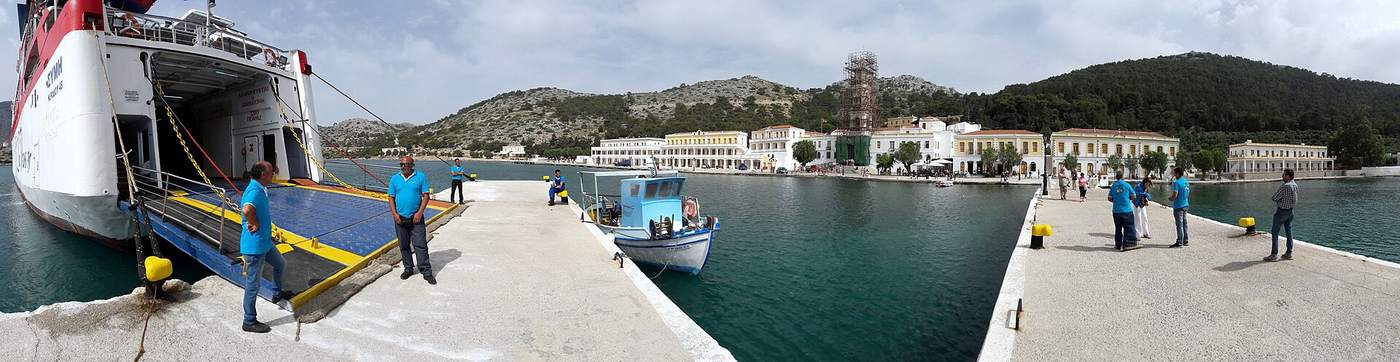
Panormitis Monastery is the largest and most revered pilgrimage site on Symi, an island in the Dodecanese. The monastery of the Archangel Michael Panormiti, known in Greek as Moni Taxiarchi Michail Panormiti, stands in a sheltered bay on the southwest coast, about 18 kilometres from Symi Town. Pilgrims sail here to venerate a silver-clad icon of Archangel Michael, the patron saint of sailors, and to leave offerings. This guide covers the monastery’s church, its two museums, the feast day on the eighth of November, and the boat and road routes that bring visitors to the bay.
Symi ranks among the Dodecanese islands set between Kos and Rhodes, and Panormitis gives the island its deepest layer of faith and seafaring memory. Day-cruise boats from Rhodes call at the bay before continuing to the harbour, and a road crosses the island from the main town. The walled complex holds a tall bell tower, a pebble-mosaic courtyard, guest cells and two small museums. Read the wider island overview on the Symi hub, which links to the town, the beaches and the ferry routes covered across the vertical.
What is Panormitis Monastery on Symi?
Panormitis Monastery is the main Orthodox pilgrimage complex on Symi, formally the Monastery of the Archangel Michael Panormiti. It sits in a sheltered bay on the island’s southwest coast, about 18 kilometres from Symi Town, and honours Archangel Michael, the protector of sailors.
The monastery carries the full name Moni Taxiarchi Michail Panormiti, which marks it as the house of the Taxiarch, or commander, Michael at Panormitis. Panormitis names the bay itself, a calm inlet that shelters boats on the exposed southwest coast of the island. The complex reads as a walled village rather than a single church, with a tall bell tower rising above white ranges of buildings around a central court. Monks live and work here through the year, so the site functions as a living monastery and not a museum piece. The bay draws yachts and excursion craft that moor along the quay, and the still water mirrors the bell tower on calm mornings.
Symi holds a dense record of Orthodox faith, and Panormitis stands at the centre of it as the island’s foremost shrine. Villagers, sailors and travellers from across Greece treat the monastery as a place of vow and thanksgiving. Fishermen and captains have long tied their fortunes to the archangel, whom Orthodox tradition names as the guardian of those at sea. The bay lies well away from the main harbour, so the site keeps a quiet, self-contained air outside the midday cruise arrivals. A shop and a simple cafe serve visitors by the water. The setting pairs a working religious community with a natural anchorage, and that combination has shaped the monastery’s role for generations of Symi seafarers.
Two elements define a first visit: the courtyard and the church. The courtyard spreads in a pebble mosaic of black and white stones laid in patterns, a craft found across the Dodecanese. The church, or katholikon, holds a carved wooden iconostasis, the screen that separates the nave from the sanctuary. Behind the screen and along the walls hang icons darkened by candle smoke and time. The silver-clad icon of Archangel Michael stands as the focus of veneration, and pilgrims file past to light candles and leave offerings. Guest cells frame the courtyard on the upper levels, plain rooms that once housed pilgrims who stayed for the feast. The scale of the enclosure surprises visitors who expect a small seaside chapel.
Panormitis works as a counterpoint to the busy harbour town on the north coast. The bay sits roughly 18 kilometres away by the island road, screened by hills from the traffic of Gialos and Chorio. This distance keeps the monastery calm and lets pilgrims focus on the shrine rather than cafes and shops. The whitewashed ranges, the bell tower and the mosaic court form a single composed picture against the water. Cypress trees and a scatter of outbuildings edge the site. The monastery also carries a sombre wartime memory from the years of occupation, recorded within its museums. A visit rounds out a Symi trip with the island’s spiritual heart, set apart from the neoclassical mansions of the main port.
Why is Panormitis Monastery the main pilgrimage site on Symi?
Panormitis draws pilgrims because it honours Archangel Michael, the patron saint of sailors. Symi’s captains and fishermen made vows to the archangel for safe voyages, and the monastery became the island’s spiritual centre and foremost shrine.
The archangel’s role as protector of seafarers explains the depth of devotion at Panormitis. Symi built its wealth on sponge diving and shipping, trades that sent men into danger on open water. Sailors prayed to Michael before a voyage and returned to give thanks at the monastery for a safe passage. Votive offerings fill the church as a result: ship models, gold and silver tokens, and objects left by grateful crews. Tradition holds that gifts sealed in bottles and cast into the sea drift back to the bay of Panormitis on their own. The ecclesiastical museum keeps a collection of these returned votives, a record of faith tied directly to the hazards of a seafaring life.
Pilgrims arrive from across Greece, not only from Symi and the neighbouring Dodecanese islands. Families travel to baptise children at Panormitis, and the monastery guest register records visitors from the mainland and beyond. The silver-clad icon of the Archangel is the object of veneration, and the faithful queue to kiss it, light a candle and leave a written prayer. Offerings of money, jewellery and small metal plaques cover the icon stand. This steady flow of devotion, rather than any single monument, marks Panormitis as the island’s principal shrine. The monastery holds relics and treasures gathered over centuries of pilgrimage, displayed in the museum beside the church for those who come to pray.
Panormitis also anchors the religious calendar of the island. The great feast of Archangel Michael falls on the eighth of November, and a second celebration marks the archangel in the warmer months. On these days the bay fills with boats and the guest cells fill with pilgrims who stay overnight. Priests lead long liturgies, and the monastery hands out food to the crowds gathered in the court. The scale of these gatherings confirms the monastery’s standing across the wider Orthodox world. Outside the feasts, a steady stream of day visitors and worshippers keeps the shrine active. The rhythm of daily prayer by the resident monks continues under all conditions, so the site never falls silent even in the quiet winter months.
Panormitis sits apart from the island’s other headline sights, and that separation sharpens its role. Visitors climb the Kali Strata steps in the town for the neoclassical mansions and the harbour view, then travel south to the bay for the monastery and the shrine. The two experiences balance the secular and the sacred sides of the island. The monastery’s remove from the port also protected its treasures and traditions through changing rulers and hard years. A visit to Panormitis gives context to the faith that shaped the sponge captains who built the town. The shrine and the stairway together frame a fuller picture of what Symi has valued across its history.
How do you get to Panormitis Monastery on Symi?
Panormitis Monastery is reached by day-cruise boat from Rhodes and Symi Town, or by the island road that crosses south from the main harbour. The bay lies about 18 kilometres from Symi Town on the southwest coast, and cruise boats often call here first.
Day-cruises from Rhodes give the most common route to Panormitis. Excursion boats leave Rhodes in the morning, cross the strait in about one hour, and moor first at the monastery bay before sailing on to Gialos. Passengers step ashore to visit the church and the museums, then reboard for the second leg to the town. Working out how to get to Symi starts with these Rhodes sailings, since the island has no airport and the sea is the only approach. The round trip returns to Rhodes in the late afternoon. This format packs the monastery and the harbour into a single day for travellers based on the larger island.
Boats also run to Panormitis from Symi Town at Gialos, the island’s main harbour. Local excursion craft and taxi-boats leave the quay and follow the coast south to the bay, a trip that traces the cliffs and inlets of the southwest shore. Guests staying on the island can join a morning departure and return by afternoon. Private charters from Gialos and Pedi also reach the bay for those who want to set their own timing. The sea route rewards passengers with views of the rugged coast that the road never touches. Sailings run more often through the warm season and thin out over winter, so checking the schedule ahead matters for a firm plan.
The island road offers the alternative for visitors who prefer to travel overland. A paved route crosses from Symi Town south over the interior hills to the bay of Panormitis, a drive of about 18 kilometres. Scheduled transport and taxis run between the town and the monastery on set patterns, and rental scooters and small cars cover the route for independent travellers. The road climbs through bare, rocky uplands before dropping to the sheltered inlet. This approach suits pilgrims who stay overnight and want to reach the shrine outside the midday cruise arrivals. Driving also allows a longer, quieter visit than the fixed timetable of the excursion boats, which limits time ashore at the monastery.
Timing shapes the experience at Panormitis more than the route chosen. Cruise boats converge on the bay around midday, so the courtyard fills with day-trippers before emptying again. Early mornings and late afternoons return the site to pilgrims and the resident monks. Overnight guests in the monastery guest cells wake to the bay before the first boats arrive. The dress code applies to every visitor: covered shoulders and knees mark respect at the working shrine. A shop and cafe by the quay serve refreshments, and a small landing stage handles the boat traffic. Planning around the cruise schedule lets a visitor choose between the lively midday scene and the calm of the early hours on the water.
What can you see inside the Panormitis Monastery complex on Symi?
The Panormitis complex holds a large church with a carved wooden iconostasis, a tall baroque bell tower, a pebble-mosaic courtyard, and guest cells. Two small museums complete the site, one covering ecclesiastical treasures and the other recording Symi folklore.
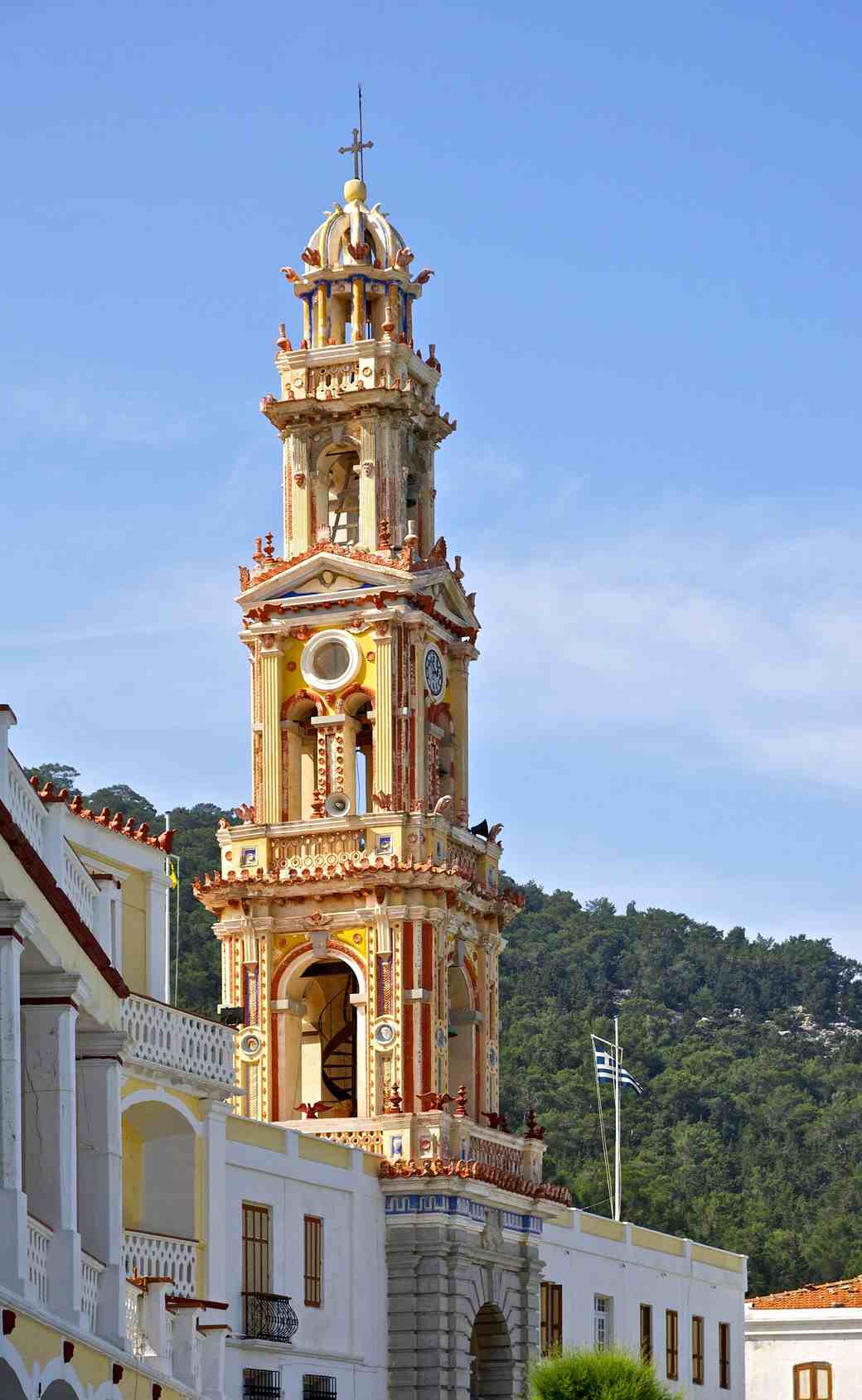
The bell tower forms the landmark of Panormitis, a tall multi-tiered structure that rises above the white ranges and signals the bay from the water. Its baroque outline recalls the churches of the Ionian and the wider Greek world under Western influence. Below it the katholikon, the main church, holds the heart of the shrine. A carved wooden iconostasis screens the sanctuary, its panels worked with vines, birds and saints in the Dodecanese tradition. The silver-clad icon of Archangel Michael stands near the screen, blackened by age and draped with offerings. Candles, hanging lamps and dark old icons fill the interior with the atmosphere of a long-used pilgrimage church rather than a display gallery.
The courtyard spreads before the church in a mosaic of sea-worn pebbles. Black and white stones, gathered from the shore, form geometric patterns and border designs across the paved floor. This chochlakia technique appears in churches and mansion yards throughout Symi and the Dodecanese. Ranges of white buildings enclose the court on several sides, their arcades and balconies giving the site the look of a fortified village. Guest cells occupy the upper floors, plain lodging rooms that once housed pilgrims arriving for the feast days. A gateway under the bell tower controls the entrance from the quay. The enclosed plan protected the community and its treasures through centuries of raids and shifting rule along this stretch of coast.
Two museums occupy rooms within the walls, and both reward a visit. The ecclesiastical museum gathers the votive offerings of generations: ship models, silver and gold tokens, vestments, old books and church silver left by grateful sailors. Among its exhibits stand the bottles said to have drifted back to the bay carrying prayers cast into the sea. The folklore museum records the daily life of Symi, with tools, costumes, furniture and household objects from the island’s past. Together the collections join the sacred and the everyday sides of the community. Entry supports the upkeep of the monastery. The displays give visitors the history behind the shrine, from the seafaring vows to the domestic world of the island’s villages.
Beyond the church and museums, the site holds working spaces and quiet corners. Monks tend the monastery through the year, and their cells, kitchen and stores lie behind the public ranges. A bakery and refectory once fed the crowds who gathered for the feast, and simple guest rooms still take overnight pilgrims. The quayside carries a shop, a cafe and a landing for boats. A war memorial and records within the museums recall the hardship of the occupation years, when the monastery suffered along with the island. Cypress and a scatter of shade trees soften the walled enclosure. The whole complex reads as a self-sufficient settlement built for pilgrimage, hospitality and prayer on a remote and sheltered bay.
Who is Archangel Michael and why does Panormitis on Symi honour him?
Archangel Michael is the commander of the heavenly host in Orthodox tradition and the patron saint of sailors. Panormitis honours him because Symi lived by the sea, and its captains and fishermen sought his protection for safe voyages and gave thanks at the shrine.
Orthodox tradition names Michael the Taxiarch, the archangel who leads the angelic armies against evil. The Greek title Taxiarchis, meaning commander, gives the monastery its formal name of Taxiarchis Michail. Believers call on Michael as a guardian and a healer, and as the escort of souls. Sailors adopted him as their special protector, a role that fits an island whose men crossed open water for a living. The silver-clad icon at Panormitis shows the archangel in armour, a figure of strength and defence. This image, rather than a gentle saint, matched the needs of a seafaring community that faced real danger on every voyage across the Aegean and the eastern Mediterranean.
Symi’s history explains why the archangel took such a central place. The island grew rich from sponge diving and shipbuilding, trades that carried constant risk. Divers worked at depth without safe equipment, and crews sailed long routes across the eastern Mediterranean. Families turned to Michael for the safe return of their men, and the monastery gathered the vows and thank-offerings that followed. The bay of Panormitis, a natural harbour on the route south, made a fitting home for the shrine. Sailors could anchor, pray and give thanks at the start or end of a voyage. This bond between trade, danger and devotion built the monastery’s standing over generations of island seafarers.
Veneration at Panormitis follows the customs of Orthodox pilgrimage. The faithful approach the icon of the archangel, make the sign of the cross, and kiss the glass that covers the silver. Candles burn before the screen, and written prayers pile at the icon stand. Pilgrims leave tama, small metal plaques stamped with an image of the need they bring, whether a ship, a limb or a child. These offerings cover the icon and the surrounding stand in silver. The practice ties each visitor’s private hope to the archangel’s protection. The museum preserves the older and richer offerings, while the living stream of tama shows that the devotion continues into the present day.
The archangel’s protection extends beyond Symi to the wider Orthodox world. Pilgrims from Rhodes, the Dodecanese and the Greek mainland travel to Panormitis to seek his help and give thanks. Emigrant families with roots on the island return to the monastery for baptisms and vows. The reputation of the bottles that drift home carrying prayers spread the shrine’s fame among sailors far from the island. This broad reach, built on the archangel’s role as guardian of the sea, lifts Panormitis above a purely local chapel. The monastery stands as a regional centre of the cult of Michael, drawing devotion from every community that once sent its sons to work the water.
When is the Panormitis feast day on Symi?
The main feast of Archangel Michael at Panormitis falls on the eighth of November, the date the Orthodox Church keeps for the Synaxis of the Archangels. Pilgrims from across Greece gather at the monastery, and the bay fills with boats and overnight visitors.
The eighth of November marks the joint feast of the archangels Michael and Gabriel across the Orthodox calendar. Panormitis keeps this day as its great celebration, and preparation begins well before the date. Pilgrims book passage from Rhodes and the mainland, and the guest cells fill with families who stay for the vigil. Priests lead an all-night service and a long liturgy on the feast morning. The bay crowds with boats moored bow to stern, and the courtyard packs with worshippers waiting to venerate the icon. The monastery distributes food to the gathered crowds in the tradition of monastic hospitality. This gathering ranks among the major religious events of the Dodecanese and draws attention from across the country.
A second celebration honours the archangel in the warmer part of the year. This summer feast draws pilgrims who cannot travel in November, and it fits the season when boats run often and the sea stays calm. The pattern of two observances keeps the shrine active across the calendar rather than at a single peak. Weddings and baptisms cluster around these dates, since families choose Panormitis for the archangel’s blessing on a new marriage or child. The monastery’s role as a place of vow shows most clearly at these times. Crowds gather, the liturgy lengthens, and the bay returns to the seafaring devotion that first built the shrine on this remote southwest coast.
Outside the great feasts, the monastery keeps a steady daily rhythm. Resident monks hold the cycle of services through the year, and worshippers arrive with the cruise boats or by road. Sunday and the fixed feasts of the church calendar bring larger congregations from the town and nearby settlements. The quiet winter months return the bay to the resident community, with services continuing under grey skies and empty guest cells. This constant round of prayer, rather than the feast days alone, defines the monastery as a living house of worship. Visitors who come outside November find the shrine calm and the icon accessible, without the press of the pilgrimage crowds that pack the courtyard on the feast.
Planning a visit around the feast calls for early arrangements. Rooms on Symi and passage from Rhodes book out ahead of the eighth of November, and the monastery guest cells fill with registered pilgrims. Visitors who want the full spectacle of the vigil, the liturgy and the crowds aim for that date. Those who prefer a calm, reflective visit choose an ordinary weekday outside the feasts. The dress code holds at all times: covered shoulders and knees for entry to the church and the shrine. Weather in November turns cooler and wetter, so pilgrims pack for changeable conditions on the crossing. The feast rewards the effort with the monastery at the fullest expression of its role on Symi.
What practical tips help a visit to Panormitis Monastery on Symi?
Visitors to Panormitis dress modestly, with covered shoulders and knees, and plan around the midday cruise arrivals. The monastery sits about 18 kilometres from Symi Town on the southwest coast, reached by boat or road, and offers a shop, a cafe and guest cells.
The monastery enforces a modest dress code for entry to the church. Covered shoulders and knees mark respect at the working shrine, and staff turn away visitors in beachwear. Wraps are available at the entrance for those who arrive uncovered. Quiet conduct holds inside the katholikon, where pilgrims pray and light candles. Photography rules vary inside, and posted signs mark where cameras stay down near the sanctuary and the icon. The site remains a place of worship first and a monument second. Respect for the liturgy, the monks and the praying pilgrims shapes the visit. These courtesies let day-trippers and worshippers share the courtyard and the church during the busy midday hours without friction.
Timing rewards the visitor who plans around the boats. Cruise craft from Rhodes reach the bay near midday, so the courtyard crowds around the middle of the day before clearing. Early and late arrivals find the shrine calm and the icon easy to approach. Cash covers the museum entry, the shop and the cafe by the quay, since card acceptance stays limited at the remote bay. The nearest full services lie back in Symi Town, so visitors carry water and any needs for the day. Toilets and refreshments exist on site but stay basic. The bay offers shade under the ranges and the trees. Modest planning turns a rushed cruise stop into a proper visit to the shrine.
A visit to Panormitis pairs naturally with the rest of a Symi trip. Day-cruises from Rhodes bundle the monastery with a stop at the harbour town, giving both the sacred and the secular sides of the island in one outing. Travellers staying on Symi reach the bay by road or local boat and set their own pace. The monastery suits a half-day, with time for the church, the two museums and a coffee by the water. Pilgrims seeking the full experience time their visit for the feast on the eighth of November. The remote setting, screened by hills from the port, makes the bay a quiet close to a day spent among the mansions and beaches of the north coast.
Overnight stays at Panormitis remain open to pilgrims through the monastery guest cells. These plain rooms around the courtyard let visitors wake to the bay before the first cruise boats arrive and share the daily rhythm of the monks. Booking runs through the monastery, and demand peaks around the feast days. Guests respect the quiet hours and the services of the community. The experience suits travellers drawn to the spiritual side of Symi rather than the comforts of a town hotel. Simple meals, early nights and morning prayer set the tone. A night at the bay gives the deepest sense of Panormitis as a living monastery, far removed from the day-tripper crowds that pack the court at noon.
Frequently Asked Questions
Where is Panormitis Monastery on Symi?
Panormitis Monastery stands on the southwest coast of Symi, about 18 kilometres from Symi Town, in a sheltered bay that shares its name. The calm inlet gives boats a safe anchorage on an exposed stretch of coast. Day-cruise boats from Rhodes and Symi Town reach the bay by sea, and the island road crosses south from the main harbour to the monastery. The remote setting, screened by hills from the port, keeps the shrine quiet outside the midday cruise arrivals.
Who is Panormitis Monastery dedicated to?
Panormitis Monastery is dedicated to the Archangel Michael, known in Greek as the Taxiarch, or commander, of the heavenly host. Orthodox tradition honours Michael as the patron saint of sailors, which explains his central place on a seafaring island. Symi’s captains, divers and fishermen sought his protection for safe voyages and returned to the monastery to give thanks. Pilgrims venerate a silver-clad icon of the archangel and leave offerings at the shrine. The formal name of the site is the Monastery of the Archangel Michael Panormiti.
When is the Panormitis feast day?
The main feast of the Archangel Michael at Panormitis falls on the eighth of November, the date the Orthodox Church keeps for the archangels. Pilgrims travel from Rhodes, the Dodecanese and the Greek mainland, filling the guest cells and the bay with boats. Priests lead a vigil and a long liturgy, and the monastery gives out food to the gathered crowds. A second celebration honours the archangel in the warmer season, when boats run often. Booking passage and rooms ahead matters for anyone attending the November feast.
How do you get to Panormitis Monastery?
Panormitis is reached by boat or by road. Day-cruise boats from Rhodes cross the strait in about one hour and moor at the bay before continuing to Symi Town, while local craft and taxi-boats run from the harbour at Gialos. The island road crosses south from Symi Town to the monastery, a drive of about 18 kilometres, served by scheduled transport, taxis and rental vehicles. Cruise passengers reach the shrine near midday, while drivers and overnight guests visit in the calmer early hours.
What is there to see at Panormitis Monastery?
The Panormitis complex holds a large church with a carved wooden iconostasis, a tall baroque bell tower, and a courtyard paved in black-and-white pebble mosaic. The silver-clad icon of Archangel Michael stands as the focus of veneration inside the church. Ranges of white buildings enclose the court, with guest cells on the upper floors that once housed pilgrims. Two small museums complete the site: one holds ecclesiastical treasures and votive offerings, and the other records the folklore and daily life of Symi. A shop and a cafe serve visitors by the quay.
Can you stay overnight at Panormitis Monastery?
Panormitis keeps guest cells around its courtyard for pilgrims who stay overnight, a tradition that once housed the crowds gathered for the feast days. These plain rooms let visitors wake to the quiet bay before the first cruise boats arrive and follow the daily rhythm of the resident monks. Booking runs through the monastery, and demand peaks around the eighth of November. The stay suits travellers drawn to the spiritual side of Symi rather than the comforts of a town hotel. Simple meals and early services set the tone at the bay.