
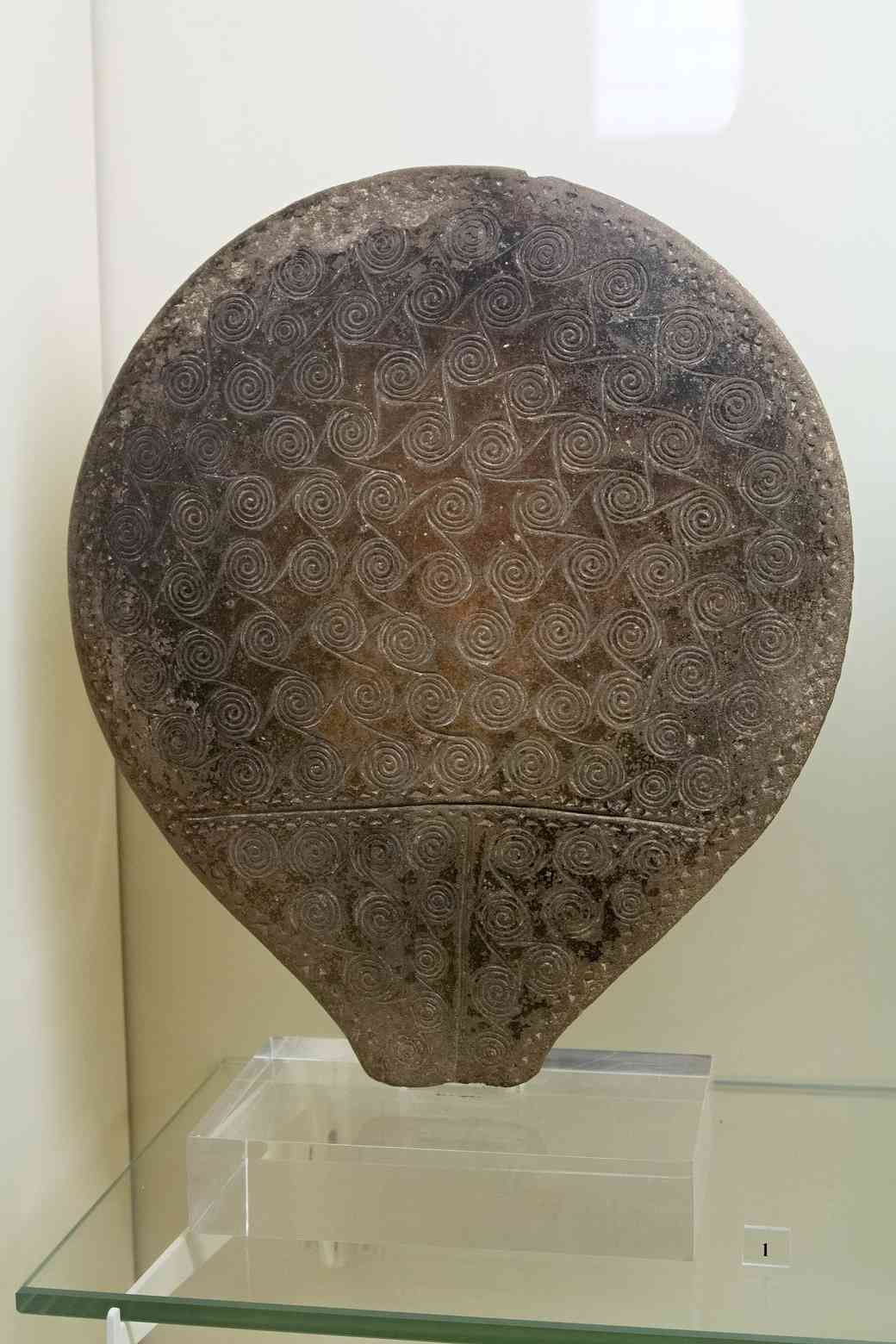
Kastri and Chalandriani are two linked prehistoric sites on the northern coast of Syros in the Cyclades. Kastri is a fortified hilltop settlement of the Early Bronze Age, ringed by one of the oldest defensive walls in the Aegean. Chalandriani, on the slopes below, holds a vast cemetery of small stone graves from the same period. The two sites belong to the third millennium BC, the era archaeologists call the Early Cycladic. Excavations here produced marble figurines, engraved clay pans, and early metal tools that fill museum cases in Ermoupoli and Athens. The pair gave its name to a whole cultural phase of the Aegean past. This guide maps the settlement, the graves, and the finds of northern Syros. Plan the whole trip with Greece Tours.
The sites lie in Apano Meria, the wild upland that forms the northern half of Syros, far from the marble port of Ermoupoli. A rough track climbs from the small village of Chalandriani across bare hills toward the coast. Kastri sits on a steep spur above a ravine, its stone wall still tracing the crown of the hill. The cemetery spreads over gentler ground a short distance away, where hundreds of graves once held the island’s dead. Christos Tsountas, the Greek archaeologist, dug both sites in the late nineteenth century and recorded the finds. Few travellers reach this corner today, so the ground stays quiet. The remains reward those who cross the empty north of the island on foot.
What are Kastri and Chalandriani on Syros?
Kastri and Chalandriani are twin Early Bronze Age sites on the rugged north coast of Syros. Kastri is a fortified hilltop settlement, and Chalandriani nearby holds a large Cycladic cemetery of hundreds of small stone graves.
Kastri and Chalandriani lie in Apano Meria, the rugged northern third of Syros. The land here turns dry and steep, cut by ravines that fall toward the sea. Few people farm this corner of the island today, so the ancient ground sits in near silence. Kastri crowns a low hill above a ravine, while Chalandriani spreads across gentler slopes close by. Both belong to the Early Bronze Age, in the third millennium BC. Together they form one of the largest prehistoric records in the Cyclades. Archaeologists read the pair as a settlement and its burial ground, linked in daily life. The remote setting has shielded the site from modern building. A visit today crosses empty hills to reach the stones.
Kastri stands on a naturally defended spur, walled off from the slope behind it. The builders chose a hilltop that dropped away on several sides, then closed the open approach with stone. Inside the wall, small rooms of rough masonry packed close together on the summit. Families lived, worked metal, and stored grain within this tight circuit. The position gave a clear view over the northern sea and any boats nearing the coast. Height and stone walls together answered the threat of raids in an unstable age. The settlement held perhaps a few hundred people at its peak. Kastri counts among the earliest walled towns known in the Aegean world. Its plan marks a turn toward defended, organised life on the island.
Chalandriani served as the cemetery for the community, set apart from the houses. Its graves cover the slopes in scattered clusters rather than neat rows. Each tomb held a single body, laid on its side with the knees drawn up. The dead went into the ground with pottery, tools, and small marble figures beside them. Christos Tsountas recorded more than five hundred graves here in the late nineteenth century. This makes Chalandriani one of the largest known cemeteries of the Early Cycladic period. The sheer number of tombs points to a stable population living nearby for generations. Grave goods reveal trade links reaching across the Aegean islands. The cemetery gives archaeologists a broad window onto death and belief in the Bronze Age.
The settlement and the cemetery worked as two halves of one community on northern Syros. People of Kastri buried their dead a short walk away at Chalandriani, over many generations. The same styles of pottery and figurine appear in both the houses and the graves. This close tie lets researchers date the two sites together and read them as a single story. The pairing of a walled town and its cemetery stays rare and valuable in Aegean study. Finds from the pair now anchor the prehistoric collections of the island of Syros. The sites also lend their names to the wider culture of the age. Together they stand at the heart of Early Cycladic archaeology.
Why does Kastri rank among the earliest fortifications in the Aegean?
Kastri carries a stone defensive wall studded with projecting horseshoe-shaped bastions, built in the third millennium BC. This ring of towers let defenders cover the approaches, and it ranks among the earliest true fortifications known anywhere in the Aegean.
The wall of Kastri sealed the single gentle approach to the hilltop settlement. Builders raised it from rough stone, thick enough to stand against attackers. Along its line they set projecting bastions, curved outward like horseshoes. Six of these towers survive in the plan traced by excavators. Each bastion let defenders shoot along the face of the wall at anyone below. This flanking design shows real military thinking at an early date. The gate passed through a narrow, guarded point in the circuit. Little else quite like it survives from such an early phase in the islands. The wall turned a natural hill into a planned stronghold. Kastri shows that raiding and defence shaped island life in the third millennium BC.
Fortifications on this scale answer a real fear of attack from the sea. The Early Bronze Age brought growing trade in metals, obsidian, and fine pottery across the Aegean. Wealth drew raiders, and coastal communities learned to guard their goods and people. Kastri met that danger with height, stone, and a wall of bastions. The northern coast of Syros faced open water and the sea lanes between the islands. A watch from the summit could spot sails long before they landed. The design let a small force hold the gate against a larger band. This defensive turn marks a shift across the Cyclades toward the end of the era. Kastri stands as the clearest surviving example of that shift today.
Archaeologists rank Kastri among the oldest defended settlements in the whole Aegean region. Its bastioned wall predates the great citadels of the later Bronze Age by many centuries. The design points ahead to the fortified towns that would spread across the islands and mainland. Similar walls appear at a few other sites of the same phase, but Kastri remains the type example. The horseshoe bastions in particular mark a clear step in early military building. Scholars study the circuit to understand how island societies organised defence. The wall also shows a community able to plan and pool heavy labour. Stone had to be quarried, carried, and set on a steep hill. Kastri proves the reach of Early Cycladic engineering.
Visitors today can trace the line of the wall across the crown of the hill. Low courses of stone still mark the circuit and the curve of several bastions. The gate, the towers, and the packed house foundations remain legible on the ground. No signs or fences guard the site, so care matters when walking the fragile stones. The view from the summit still sweeps the northern sea, as it did for the defenders. Wind and thin soil have kept the ruins bare and open to the sky. A slow walk along the wall reveals the logic of the ancient plan. The remains sit within the wider upland of Apano Meria on northern Syros. The setting makes the defensive purpose easy to read.
What is the Kastri group phase of the Early Cycladic period on Syros?
The Kastri group is a cultural phase of the late Early Cycladic period, named after the fortified settlement on Syros. It marks a horizon of new metal tools, pottery shapes, and defended sites across the Aegean near the close of the period.
Archaeologists name whole phases of prehistory after the sites where they first appear. The Kastri group takes its name from the Syros settlement and its distinctive finds. The phase falls late in the Early Cycladic sequence, near the shift into the Middle Bronze Age. It shows a fresh set of pottery shapes, including tankards and two-handled cups. New metal types appear alongside them, pointing to wider contact with the eastern Aegean. Some of these forms echo Anatolian models from across the sea. The Kastri group thus marks a period of change and outside influence. Scholars use these traits to date sites across the islands. The name of a small Syros hill now labels a whole chapter of the Aegean past.
The wider culture of the age carries the name Keros-Syros, after two key sites. Keros is a small island to the south, and Syros supplied the great cemetery of Chalandriani. Together they define the mature Early Cycladic phase, rich in marble figurines and fine pottery. This culture spread a shared style across the central Aegean islands over centuries. Its people traded obsidian, metal, and marble by sea in small boats. The folded-arm figurines and engraved pans belong to this same cultural world. Chalandriani gave up more of these objects than almost any other site. The Keros-Syros name ties Syros to the very definition of Cycladic civilisation. The island sits at the core of the culture that scholars still study.
The whole story here unfolds within the third millennium BC, deep in the Bronze Age. The mature Keros-Syros phase runs through the middle of that span across the islands. The later Kastri group marks its closing stage, as new influences arrived by sea. Radiocarbon dates and pottery styles let researchers order the phases in sequence. No written records survive from this age, so objects and layers tell the story. The people left no names, cities, or texts, only their tools, graves, and walls. Each style of pot or figurine acts as a clock for the archaeologist. Kastri and Chalandriani anchor several points on that long timeline. Their finds help fix the chronology of the entire Cycladic Bronze Age.
The naming of these phases puts Syros at the centre of Aegean prehistory. Students of archaeology meet the island first through the Kastri group and the Keros-Syros culture. The terms appear in textbooks far from Greece, tied forever to this northern coast. Few small islands lend their names to two separate archaeological labels. The finds behind the names fill cases in the island’s own museum in Ermoupoli. This deep past sits beneath the later Venetian layers, seen in the hilltop town of Ano Syros and its port. Syros thus carries a record stretching back more than four thousand years. The prehistoric sites give the island a claim in world archaeology. Kastri and Chalandriani hold that claim in stone and clay.
What did Christos Tsountas find in the Chalandriani cemetery on Syros?
Christos Tsountas excavated the Chalandriani cemetery in the late nineteenth century and recorded more than five hundred graves. He found small cist and corbelled tombs holding marble figurines, engraved clay pans, pottery, and early metal tools beside single burials.
Christos Tsountas ranks among the founders of Greek prehistoric archaeology. He dug at Mycenae and across the Cyclades before turning to northern Syros. At Chalandriani he opened grave after grave across the bare slopes. His careful records of the tombs and their contents set a standard for the field. Tsountas recognised the graves as belonging to a single early culture of the islands. His work first defined the Cycladic burial customs that scholars still describe today. The finds he lifted from the ground entered the national collections in Athens. His reports remain the base for all later study of the site. Tsountas turned a remote Syros hillside into a landmark of Aegean research.
The graves at Chalandriani take two main forms across the slopes. Most are small cist tombs, boxes built from thin stone slabs set on edge. Others use a corbelled method, with stones stepped inward to roof a low chamber. Each tomb held one body, folded on its side with the knees drawn up. The dead lay in shallow pits cut into the rocky ground. The small size of the graves suited this contracted burial pose. Family groups may lie clustered together across parts of the field. The builders sealed each tomb with a capstone or a slab. The sheer number of graves, above five hundred, marks a long-used cemetery. Their plan reveals a shared custom held for many generations.
Grave goods accompanied the dead into nearly every tomb at Chalandriani. Marble figurines, mostly of the folded-arm type, lay beside many bodies. Clay pans engraved with ships and spirals turned up in grave after grave. Pottery vessels for food and drink filled out the offerings. Metal objects appeared too, including daggers, tweezers, and pins of copper and bronze. These goods show belief in some form of life or journey beyond death. They also reveal the wealth and trade reach of the community. Marble came from other islands, and metal from distant ores. The range of finds sets Chalandriani among the richest Cycladic cemeteries. Each object adds a line to the record of Early Bronze Age life.
The Chalandriani finds transformed the study of the Early Cycladic world. Their sheer number let scholars define types, styles, and burial rules for the whole culture. The frying-pan vessels and folded-arm figurines became icons of Cycladic art. Museums and textbooks draw on the Chalandriani material to this day. The graves also mapped the spread of trade and craft across the islands. Tsountas dated the cemetery firmly within the third millennium BC. His finds now sit in Athens and in the island museum at Ermoupoli. Later scholars have restudied the objects with new methods and questions. The cemetery remains a cornerstone of Aegean prehistory. Chalandriani gave the field a vast, dated body of evidence.
Why are the frying-pan vessels from Chalandriani on Syros important?
The frying-pan vessels are flat, circular clay objects with a handle, engraved on one face with ships, spirals, and stars. Those from Chalandriani carry some of the earliest images of Aegean longboats, making them prized evidence of Bronze Age seafaring.
The frying-pan vessels puzzle archaeologists as much as they attract them. Each is a shallow clay disc with a short handle, shaped like a pan. One flat face carries fine engraved patterns, filled with white paste for contrast. Their true use stays unknown, despite a century of study. Some scholars read them as mirrors, filled with water or oil to reflect a face. Others see ritual objects, or symbols of status placed in the grave. Chalandriani produced a large series of these pans in its tombs. Their form and decoration mark them as a signature of the Keros-Syros culture. The vessels rank among the most studied objects of Cycladic art. Their mystery keeps them at the centre of scholarly debate.
The most famous frying-pans carry engravings of long, low ships. These boats show many oars along a curved hull, driven by a crew of rowers. A fish or standard often rises from the high prow of the vessel. The images count among the earliest clear pictures of ships in the Aegean. They prove that islanders crossed open water in sizeable rowed boats. Such craft carried the trade in marble, obsidian, and metal between the islands. The ships tie the land-bound graves to a wider world of sea travel. Scholars use the engravings to reconstruct Early Bronze Age seafaring. The vessels of Chalandriani thus record how the Cycladic world stayed connected. Each ship engraving adds detail to that maritime picture.
Spirals, stars, and sun-like rays also cover the pans beyond the ships. The spirals link and repeat across the surface in flowing bands. Some scholars read the patterns as symbols of the sea, the sun, or fertility. The star and ray motifs may carry meaning now lost to us. This decoration shows a developed sense of design in the third millennium BC. The same spiral runs through other Cycladic art of the age. The care in the engraving points to skilled, specialist hands. Each pan repays close looking with its dense, ordered pattern. The motifs tie Chalandriani into a shared symbolic language of the islands. The vessels speak of belief as well as of craft.
The frying-pans of Chalandriani now sit in museum cases in Athens and on Syros. Visitors study them behind glass, tracing the ships and spirals with the eye. Casts and drawings of the vessels fill books on Cycladic art worldwide. The pans shaped how scholars picture Early Bronze Age boats and beliefs. Their engraved ships appear on posters, logos, and museum guides across Greece. The objects give a human face to the distant people of Kastri and Chalandriani. Few finds from a single cemetery have shaped a field so strongly. The pans turned a Syros hillside into a source of world heritage. They remain the signature find of the prehistoric north of the island.
Where can you see the Kastri and Chalandriani finds from Syros today?
The Kastri and Chalandriani finds are split between two museums. The Archaeological Museum of Syros in Ermoupoli holds a strong local collection, while the richest figurines and frying-pans sit in the National Archaeological Museum in Athens.
The Archaeological Museum of Syros stands in Ermoupoli, the island’s marble capital. It occupies part of the town hall on the main square, close to the port. The collection gathers finds from Kastri, Chalandriani, and other sites across the island. Cases hold marble figurines, engraved frying-pans, pottery, and metal tools from the graves. Labels set the objects in their Early Bronze Age context for visitors. The museum ranks among the oldest in Greece, founded in the nineteenth century. Its rooms give the clearest local picture of the prehistoric north of Syros. Entry costs little, and the central location makes a visit easy. A stop here prepares travellers before they cross to the remote sites themselves.
Ermoupoli grew into the leading port of Greece during the nineteenth century. Its marble squares, mansions, and opera house crown the harbour below the old hill towns. The Archaeological Museum sits at the civic heart of this neoclassical city. A visit pairs the deep prehistoric past with the grand trading age of the island. The town also links by stepped lanes to the medieval quarter above it. Travellers can study the Chalandriani finds, then walk the streets of Ermoupoli itself. The museum thus anchors a wider day of history in the capital. The port also makes a natural base for reaching the northern sites by car. Ermoupoli holds the key to understanding Kastri and Chalandriani.
The National Archaeological Museum in Athens holds the finest Chalandriani finds. Tsountas sent his best discoveries there after the excavations. The Cycladic galleries display folded-arm figurines and the famous engraved pans. Visitors see the Chalandriani ship vessel among the highlights of Early Cycladic art. The Athens setting places the Syros finds beside material from Keros and other islands. This grouping shows the shared Keros-Syros culture in one set of rooms. The museum draws scholars and travellers from across the world. Its labels credit Chalandriani as the source of key objects. Anyone tracing Cycladic art meets the Syros material first in Athens. The capital holds the richest single display of the culture.
A full study of Kastri and Chalandriani spans two islands and the mainland. The finds sit in Athens and in Ermoupoli, while the sites themselves lie in the north of Syros. Travellers often start in the Athens galleries, then cross to the island by ferry or plane. The Syros museum fills in the local story with more finds and maps. From Ermoupoli a car reaches the ruins across the upland of Apano Meria. Seeing both the objects and the ground gives the fullest picture of the culture. The museums stay open through the year, with longer summer hours. This chain of visits ties the marble figures back to their hillside graves. The record of the island rewards the effort to follow it.
How do you reach Kastri and Chalandriani in Apano Meria on Syros?
Kastri and Chalandriani lie in Apano Meria, the roadless northern upland of Syros, reached by car from Ermoupoli and then on foot. A rough track and path run from Chalandriani village to the cemetery and the walled hill.
Syros lies in the central Cyclades, a short ferry from Athens and the nearby islands. Boats dock at Ermoupoli, the capital on the eastern coast. From the port a road runs north into the wild uplands of Apano Meria. The route climbs past small villages onto bare, windswept hills. Chalandriani village marks the last settled point before the ancient sites. Cars park near the village, and the final stretch goes on foot. The drive from Ermoupoli takes roughly half an hour across the island. Public buses reach the northern villages on a limited schedule. Most visitors hire a car or scooter to reach this remote corner. The journey itself crosses the emptiest ground on Syros.
A rough track leaves Chalandriani village toward the coast and the ancient sites. The path crosses dry terraces, low walls, and open grazing land. Signs are few, so a map or local advice helps on the way. The cemetery slopes and the walled hill of Kastri lie a short walk apart. Sturdy shoes suit the stony, uneven ground of the upland. The full visit on foot takes one to two hours across the sites. Little shade breaks the route, so water and a hat matter in summer. The ground stays exposed to the strong northern wind much of the year. A guide or archaeological map turns the bare stones into a readable story. The walk rewards the effort with silence and deep history.
The sites today show as low stone remains rather than standing buildings. At Kastri the wall, bastions, and house foundations trace across the hilltop. At Chalandriani the graves appear as slabs, hollows, and scattered stones on the slopes. No ticket office, fence, or cafe marks the open ground. Visitors walk freely but must tread with care among the fragile remains. Interpretation comes best from a museum visit or a guidebook beforehand. The setting gives a raw sense of the Early Bronze Age landscape. Sea views open north from the summit of the walled hill. The quiet and space set these ruins apart from crowded island sights. Imagination fills the stones with the life once lived here.
Spring and autumn suit a visit to the northern sites of Syros best. Mild weather and green hills replace the heat and dust of high summer. Morning light falls well across the ruins and eases the walk. The trip pairs with a wider stay based in Ermoupoli or across the island of Syros. A half-day covers the drive north, the walk, and the sites themselves. Add the island museum in the port for the finds and the full story. The northern coast also holds quiet beaches and old monasteries to explore. A car opens the whole upland of Apano Meria beyond the ancient sites. Kastri and Chalandriani reward travellers who seek the island’s deepest past.
Frequently Asked Questions
What are Kastri and Chalandriani?
Kastri and Chalandriani are two linked prehistoric sites on the northern coast of Syros. Kastri is a fortified hilltop settlement of the Early Bronze Age, ringed by a stone wall with projecting bastions. Chalandriani, on the slopes nearby, is a large Cycladic cemetery of more than five hundred small stone graves. Both date to the third millennium BC and belong to the Keros-Syros culture. Excavations produced marble figurines, engraved clay pans, and early metal tools, now shown in Athens and in the museum at Ermoupoli.
Who excavated the Chalandriani cemetery?
Christos Tsountas, a founder of Greek prehistoric archaeology, excavated the Chalandriani cemetery in the late nineteenth century. He opened more than five hundred graves across the slopes and recorded their contents in detail. His finds included marble figurines, engraved frying-pan vessels, pottery, and metal tools from single burials. Tsountas also studied the nearby fortified settlement of Kastri. His careful reports first defined Cycladic burial customs and remain the base for all later study. The finds he lifted now sit in the National Archaeological Museum in Athens and on Syros.
What are the Cycladic frying-pan vessels?
The frying-pan vessels are shallow clay discs with a short handle, shaped like a pan and engraved on one flat face. Those from Chalandriani carry images of long rowed ships, running spirals, and stars. The ship engravings count among the earliest clear pictures of boats in the Aegean. Their true purpose stays unknown; scholars suggest mirrors, ritual objects, or symbols of status. The vessels form a signature of the Keros-Syros culture and rank among the most studied objects of Cycladic art. Fine examples sit in the museums at Athens and Ermoupoli.
How old are Kastri and Chalandriani?
Kastri and Chalandriani date to the third millennium BC, in the Early Bronze Age. They belong to the mature Early Cycladic phase known as the Keros-Syros culture, and Kastri also names a later phase, the Kastri group. This places the sites more than four thousand years before the present day. No written records survive from the age, so pottery styles and radiocarbon dates fix the chronology. The settlement and its cemetery were in use across several generations during this long span of the Cycladic Bronze Age.
Can you visit Kastri and Chalandriani?
Kastri and Chalandriani are open ground in Apano Meria, the northern upland of Syros, free to visit at any time. A car from Ermoupoli reaches Chalandriani village in about half an hour, and a rough track then leads to the sites on foot. No fence, ticket, or cafe marks the ruins, so visitors walk freely but must tread with care. Sturdy shoes, water, and a map help on the exposed hills. A museum visit in Ermoupoli first makes the bare stones easier to read.
Why is Syros important in Cycladic archaeology?
Syros stands at the centre of Early Cycladic archaeology because of Kastri and Chalandriani. The cemetery gave up hundreds of graves and a vast body of figurines, pottery, and engraved pans. The settlement carries one of the earliest bastioned fortifications in the Aegean. The island’s name marks two archaeological terms, the Keros-Syros culture and the Kastri group. These finds define types and dates for the whole Cycladic Bronze Age. Scholars worldwide meet Syros first through this prehistoric record, studied in museums in Athens and Ermoupoli.