
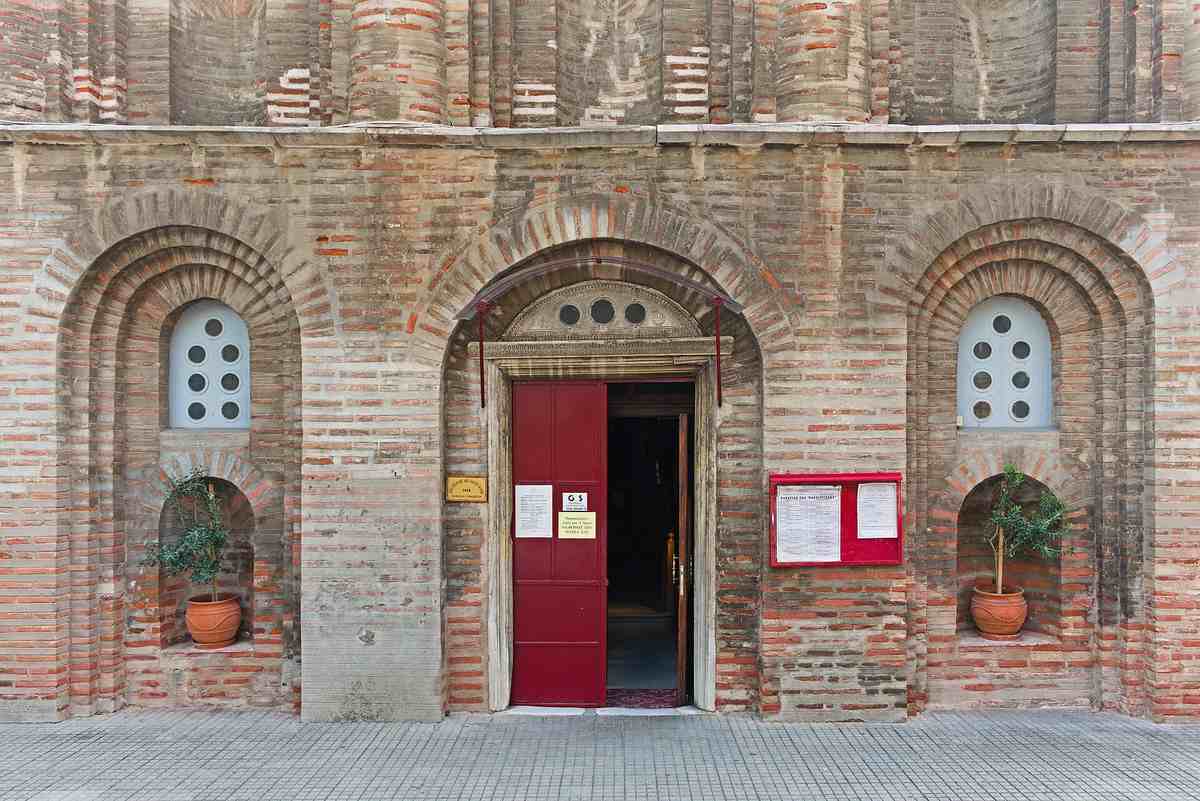
Panagia Chalkeon, also known as the Church of the Virgin of the Coppersmiths, stands as a testament to the Byzantine heritage in Thessaloniki. Founded in the eleventh century by the Byzantine official Christophoros, this brick-built church is famed for its decorative architecture and historical significance. The church’s name is derived from the coppersmiths’ bazaar that once encircled it. With its central dome, two smaller domes over the narthex, and intricate brickwork, Panagia Chalkeon is part of the UNESCO Palaeochristian and Byzantine Monuments of Thessaloniki. Visitors can still admire its original wall paintings, offering a glimpse into the artistic traditions of its era. Discover the allure of this ancient site with My Greece Tours.
Panagia Chalkeon is nestled near the Roman forum and Egnatia avenue, offering a unique window into Thessaloniki’s Byzantine past. This church’s transformation from a Christian place of worship to Kazancilar Camii during Ottoman rule speaks volumes about the city’s layered history. The sections below cover the architectural details, historical context, and cultural significance of Panagia Chalkeon, providing a comprehensive understanding of its role in Thessaloniki. Learn more about the broader context of Thessaloniki’s history by exploring the Thessaloniki tours and other nearby attractions. This guide will help you appreciate the intricate beauty and enduring legacy of Panagia Chalkeon, inviting you to explore its historical and cultural depth.
What is the architectural significance of Panagia Chalkeon?
Panagia Chalkeon is an exemplary Byzantine cross-in-square church, showcasing fine decorative brickwork and a central dome, reflecting architectural brilliance.
Panagia Chalkeon exhibits architectural brilliance through its cross-in-square design, a hallmark of Byzantine architecture. The structure is characterised by a central dome, supported by four robust columns, with two smaller domes adorning the narthex. Its decorative brickwork is particularly noteworthy, featuring intricate patterns that accentuate its aesthetic appeal. These elements collectively exemplify the architectural prowess of the Byzantine era, making Panagia Chalkeon a vital study for those interested in historical architecture and the development of religious structures during this period.
The facade of Panagia Chalkeon stands out as a testament to the craftsmanship of Byzantine builders. Alternating layers of brick and stone create a visually striking effect, a technique prevalent in Byzantine architecture. The meticulous attention to detail extends to the interior, where surviving wall paintings provide insight into the artistic traditions of the time. These construction techniques and materials highlight the architectural capabilities of the era and reflect the socio-economic conditions of eleventh-century Thessaloniki, offering a tangible connection to the past.
The location of Panagia Chalkeon near significant landmarks like the Roman forum and Egnatia avenue underscores its importance in Thessaloniki’s religious and cultural landscape. This proximity to these areas suggests a deliberate choice, integrating the church into the city’s bustling life. The church’s architecture not only stands as an individual masterpiece but also as part of a larger historical narrative, linking it to the commercial and cultural activities of its time, providing a focal point for both religious and community gatherings.
How does Panagia Chalkeon connect to Thessaloniki’s history?
Panagia Chalkeon encapsulates Thessaloniki’s Byzantine and Ottoman past, reflecting historical transitions through its architectural and religious transformations.
Thessaloniki’s history is deeply intertwined with Panagia Chalkeon. This church, established in the eleventh century, originally served the Byzantine Christian community, reflecting the city’s religious and cultural identity during this period. The dedicatory inscription by Christophoros is a tangible link to its founding, offering insights into the motivations and aspirations of its patrons. Being part of the UNESCO Palaeochristian and Byzantine Monuments of Thessaloniki, the church remains a crucial piece in understanding the city’s Byzantine heritage and its enduring influence, providing a window into the spiritual and social dynamics of the era.
The Ottoman rule brought significant transformation to Panagia Chalkeon, as it became the Kazancilar Camii. This change from a church to a mosque illustrates the religious and cultural shifts Thessaloniki experienced over the centuries. The structure maintained its architectural integrity, with many original features preserved despite these changes. This dual history of the church as a Christian and Muslim place of worship highlights the city’s diverse heritage and the coexistence of different cultures within its boundaries. The mosque’s history is a testament to Thessaloniki’s ability to evolve while retaining its historical essence, contributing to its multicultural identity.
The environment surrounding Panagia Chalkeon also speaks to its historical context. The church’s location amidst the former coppersmiths’ and cauldron-makers’ bazaar reflects the economic activities of the area. This bustling commercial setting not only provided a backdrop for the church but also influenced its identity and function within the community. The church’s connection to the everyday lives of Thessaloniki’s inhabitants underscores its significance as more than just a religious building, serving as a social and economic hub for the surrounding neighbourhood, illustrating the interplay between commerce and culture.
What are the artistic features inside Panagia Chalkeon?
Inside Panagia Chalkeon, visitors find eleventh-century wall paintings depicting religious scenes, offering insights into Byzantine artistic traditions.
The interior of Panagia Chalkeon is adorned with wall paintings that date back to the eleventh century. These paintings provide a vivid portrayal of religious narratives, illustrating the artistic style and religious fervour of the Byzantine period. The frescoes, though aged, retain their brilliance and detail, showcasing the skill and devotion of the artists who created them. Each painting serves as a visual story, capturing the essence of Byzantine spirituality and iconography, and offering a glimpse into the lives and beliefs of the people who once worshipped here, reflecting the artistic and theological priorities of the time.
The themes depicted in the wall paintings predominantly focus on religious figures and biblical scenes. These images were designed not only to inspire devotion but also to educate the faithful about the key tenets of Christianity. The use of vibrant colours and intricate details in these frescoes highlights the importance of visual storytelling in Byzantine religious practice. As visitors explore the church, they can appreciate the symbolic significance of each scene, understanding the narratives that shaped the spiritual lives of the community and the role of art in bridging the divine and the earthly, demonstrating the power of imagery in religious education.
The preservation efforts have been crucial in maintaining the integrity of these wall paintings. Conservationists have worked diligently to protect and restore these priceless artworks despite the passage of time. The ongoing preservation of these frescoes allows modern visitors to connect with the artistic and spiritual heritage of the Byzantine era. Panagia Chalkeon not only serves as a place of worship but also as a gallery of Byzantine art, offering a window into the past for historians and art enthusiasts alike, ensuring that the cultural legacy of the era is accessible for future generations, allowing continued study and appreciation.
What role did Panagia Chalkeon play during the Ottoman era?
During the Ottoman era, Panagia Chalkeon was converted into the Kazancilar Camii, reflecting the religious and cultural transformations of Thessaloniki.
The conversion of Panagia Chalkeon into the Kazancilar Camii marks a significant chapter in its history. This transformation occurred during the Ottoman era when numerous churches in Thessaloniki were repurposed as mosques. The change in function from a Christian church to a mosque illustrates the broader religious and cultural shifts within the city. Despite this conversion, the structure maintained its architectural integrity, preserving its Byzantine elements while adapting to Islamic practices. This adaptability highlights the resilience of the structure amid changing religious landscapes, demonstrating its enduring significance.
The renaming of the church to Kazancilar Camii highlights the influence of the cauldron-makers’ guild, reflecting the socio-economic landscape of Ottoman Thessaloniki. This guild was central to the local economy, and the mosque served as a spiritual home for its members. The presence of this guild underscores the interplay between commerce and religion, demonstrating how economic activities shaped the cultural and religious practices of the time. The mosque’s role as a community centre for the cauldron-makers further illustrates its significance within the local social fabric, bridging economic and spiritual needs, and contributing to community cohesion.
Panagia Chalkeon’s history during the Ottoman era is a testament to Thessaloniki’s multicultural identity. The city’s ability to accommodate diverse religious practices is evident in the church’s survival and adaptation over centuries. Visitors today can explore Ottoman Thessaloniki and witness the remnants of this period, gaining a deeper understanding of the city’s layered past. Panagia Chalkeon’s dual identity as both a church and a mosque encapsulates the complex history of religious coexistence in Thessaloniki, offering insights into the city’s ability to preserve its heritage while adapting to new cultural influences, reflecting its dynamic historical narrative.
Why is Panagia Chalkeon important for Byzantine studies?
Panagia Chalkeon is crucial for Byzantine studies due to its well-preserved architecture and artwork, offering insights into eleventh-century religious and cultural life.
The study of Panagia Chalkeon is essential for understanding Byzantine architecture and art. This well-preserved example of a cross-in-square church provides scholars with valuable insights into the construction techniques and aesthetic preferences of the Byzantine era. The church’s intricate brickwork and architectural features serve as a primary source for researchers studying the evolution of Byzantine religious structures. Its inclusion in the UNESCO Palaeochristian and Byzantine Monuments of Thessaloniki further highlights its significance in the study of Byzantine heritage, making it a cornerstone for academic research and historical inquiry, contributing to architectural studies.
The surviving wall paintings inside Panagia Chalkeon are of particular interest to art historians. These frescoes offer a glimpse into the artistic conventions and theological themes prevalent in the Byzantine period. The detailed depiction of religious scenes provides a window into the spiritual and cultural values of the time. These artworks are a testament to the skill of Byzantine artists, revealing the techniques and materials used in their creation. Preservation of these paintings is vital for continued research and understanding of Byzantine art, providing a tangible connection to the artistic and spiritual world of the past, enriching historical knowledge.
The historical context of Panagia Chalkeon enhances its importance for Byzantine studies. The church’s founding by Christophoros and its subsequent transformation during the Ottoman era exemplify the dynamic religious and cultural landscape of Thessaloniki. Scholars can explore these transitions to gain a broader understanding of the interactions between different cultures and religions in the region. Panagia Chalkeon, therefore, serves as a microcosm of Byzantine history, providing a rich source of information for academic inquiry and exploration, contributing to a deeper appreciation of the complexities and continuities in Byzantine and post-Byzantine history, illuminating the evolution of cultural practices.
What can visitors experience at Panagia Chalkeon today?
Visitors to Panagia Chalkeon today can explore its Byzantine architecture, admire historical frescoes, and learn about its cultural significance in Thessaloniki.
Visitors to Panagia Chalkeon can immerse themselves in the rich history and architecture of the Byzantine era. The church’s exterior, with its intricate brickwork and domes, offers a striking visual introduction to Byzantine architectural style. The interior wall paintings provide a captivating glimpse into the artistic traditions of the time. These frescoes, depicting religious scenes and figures, allow visitors to appreciate the skill and creativity of Byzantine artists. The church’s peaceful atmosphere invites reflection and exploration, making it a rewarding destination for those interested in history and art, and offering a serene space for contemplation, enhancing the visitor’s experience.
Panagia Chalkeon’s location in central Thessaloniki makes it easily accessible to visitors exploring the city’s historic sites. Its proximity to other attractions, such as the Roman forum and the Rotunda, allows for a comprehensive exploration of Thessaloniki’s cultural heritage. Being part of a UNESCO World Heritage site, the church is well-maintained, ensuring that visitors can experience its historical significance in a preserved state. Guided tours often include Panagia Chalkeon, providing contextual information and insights into its history and architecture, enriching the visitor experience, and offering educational opportunities.
The church’s role as part of the Byzantine churches of Thessaloniki highlights its importance within the broader context of the city’s religious heritage. Visitors can appreciate the interconnectedness of these historic sites, gaining a deeper understanding of the Byzantine influence on Thessaloniki’s cultural landscape. Whether exploring independently or as part of a guided tour, Panagia Chalkeon offers an enriching experience, connecting past and present through its enduring beauty and historical significance, inviting visitors to engage with the city’s vibrant history, and contributing to its cultural appreciation.
How does Panagia Chalkeon compare to other Byzantine churches in Thessaloniki?
Panagia Chalkeon stands out for its brickwork and frescoes, while sharing the cross-in-square plan common among Thessaloniki’s Byzantine churches.
Panagia Chalkeon is one of several Byzantine churches in Thessaloniki, each with its unique features and historical significance. It shares the cross-in-square architectural plan with other churches, but its decorative brickwork sets it apart. The intricate patterns and blind arches on its exterior are distinctive features that highlight the craftsmanship of Byzantine builders. This attention to detail is a common thread among Thessaloniki’s Byzantine churches, yet Panagia Chalkeon’s execution is particularly noteworthy, making it a standout example of this architectural style, contributing significantly to the city’s architectural heritage and historical narrative.
The wall paintings inside Panagia Chalkeon offer another point of comparison with other Byzantine churches in the city. These frescoes, depicting religious scenes, are among the finest examples of Byzantine art in Thessaloniki. They provide a vivid contrast to the more austere interiors of other churches, where less emphasis might be placed on visual storytelling. The preservation of these paintings is a testament to the church’s historical and artistic value, attracting scholars and visitors interested in Byzantine art and iconography, enhancing the church’s reputation as a centre of cultural and artistic importance, offering insights into the artistic priorities of the era.
The status of Panagia Chalkeon as part of Thessaloniki’s UNESCO-designated monuments aligns it with other significant sites like the Rotunda. This collective recognition underscores the cultural and historical importance of these religious structures. Each church contributes to the understanding of Thessaloniki’s Byzantine heritage, offering unique insights into the religious practices and architectural innovations of the time. Panagia Chalkeon, with its distinct features and rich history, remains a vital part of this broader narrative, enriching the city’s cultural tapestry and fostering a deeper appreciation of its historical landscape, contributing to the study of Byzantine history.
Frequently Asked Questions
What is the history behind the name Panagia Chalkeon?
The name ‘Panagia Chalkeon’ translates to ‘The Virgin of the Coppersmiths’. It references the coppersmiths’ and cauldron-makers’ bazaar that surrounded the church in its early days. This name reflects the church’s historical connection to the local trade and community, highlighting its role in the area’s economic and social life, linking it to the commercial activities of its time.
Are there guided tours available for Panagia Chalkeon?
Guided tours are available for Panagia Chalkeon, often as part of broader Thessaloniki historical and cultural tours. These tours provide insights into the church’s architectural features, historical significance, and its role within the context of Byzantine Thessaloniki. Visitors can enhance their experience through guided exploration, gaining a deeper understanding of the site’s cultural and historical importance, and learning about its architectural and artistic features.
What makes Panagia Chalkeon’s architecture unique?
Panagia Chalkeon’s architecture is unique due to its cross-in-square design and decorative brickwork. The church features a central dome with two smaller domes over the narthex. Its intricate patterns and blind arches exemplify the craftsmanship of Byzantine builders, offering a distinct visual appeal and showcasing the architectural innovation of the era, contributing to its historical significance.
How has Panagia Chalkeon been preserved over the years?
Preservation efforts have focused on maintaining Panagia Chalkeon’s structural integrity and restoring its eleventh-century frescoes. Conservation work ensures that the church’s architectural and artistic features remain intact, allowing visitors to appreciate its Byzantine heritage. Continued preservation is crucial for its historical and cultural longevity, ensuring that future generations can experience its historical significance and artistic beauty.
What are the highlights of the wall paintings in Panagia Chalkeon?
The wall paintings in Panagia Chalkeon are highlights of Byzantine art, depicting religious scenes with vibrant colours and intricate details. These frescoes provide insight into the spiritual and artistic traditions of the time, reflecting the theological themes and artistic conventions of the Byzantine period, making them invaluable for both art historians and visitors, offering a glimpse into the artistic priorities of the era.
Can Panagia Chalkeon be visited year-round?
Panagia Chalkeon is generally open to visitors throughout the year, allowing for exploration of its historical and architectural features. However, it is advisable to check local resources for specific visiting hours and any seasonal closures or special events that may affect access to the site. Visiting during different times of the year can also offer varied experiences of the church’s ambiance, contributing to a deeper appreciation of its historical significance.