
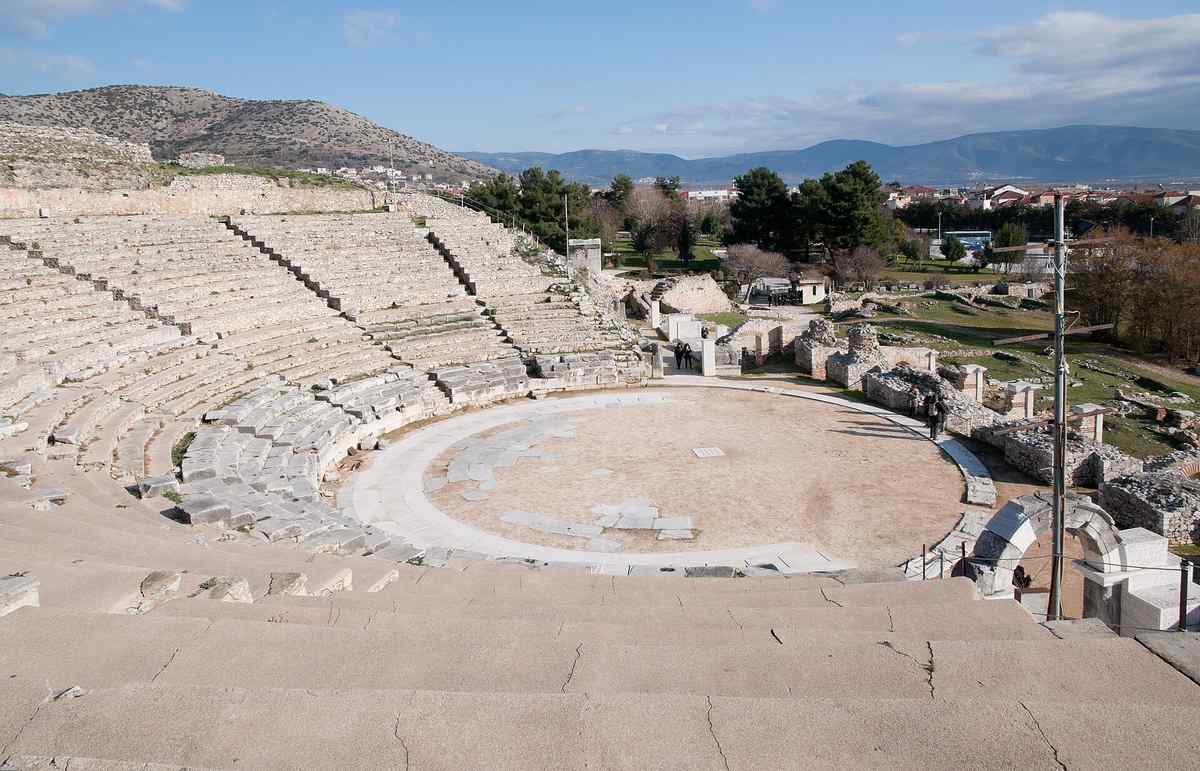
Philippi is a UNESCO World Heritage archaeological site on the plain of eastern Macedonia, set about a hundred and sixty-five kilometres east of Thessaloniki and a short drive inland from Kavala. Philip II of Macedon founded the city in the fourth century BC on the earlier settlement of Krenides, and Rome later raised it to a colony astride the Via Egnatia. Its ruins hold a Greek theatre, a Roman forum, early Christian basilicas, and the traditional site of the Apostle Paul’s first baptism on European soil. Read the layers of the city and plan the drive from the coast with My Greece Tours.
The site rewards a slow walk across the plain rather than a quick look from the road. Its stones carry the Macedonian foundation, the Roman colony that grew rich on the highway, and the earliest Christian community that Paul addressed in his letter to the Philippians. The sections below cover what Philippi is, how to reach it from the city, what survives on the ground, and why UNESCO added it to the World Heritage List. The later parts turn to the baptism of Lydia and to pairing the ruins with the harbour of Kavala on the guided Thessaloniki tours.
What is Philippi and why visit it on a day trip from Thessaloniki?
Philippi is an ancient city on the plain of eastern Macedonia, founded by Philip II and rebuilt as a Roman colony. It draws day visitors from Thessaloniki for its theatre, its forum, and its early Christian sites.
Philip II of Macedon seized the small settlement of Krenides in the fourth century BC and renamed the place for himself. He wanted the gold of the nearby hills and a strong point on the road between the coast and the interior. The city grew behind a wall that climbed the acropolis hill, and its Greek theatre was cut into the same slope. That Macedonian core set the shape that the later Roman and Christian builders reworked over the following centuries.
Rome drew the Via Egnatia through Philippi and turned the town into a colony settled with army veterans. The great highway carried the trade and the troops of the empire from the Adriatic to the Aegean and on toward the east, and Philippi grew rich beside it. A forum, temples, and public buildings rose on the flat ground below the theatre. The city later became a centre of the early Church, which raised the basilicas whose columns still stand across the plain.
The plain that holds Philippi shaped the city as much as its rulers did. Marshland once spread below the acropolis, drained over the centuries into the farmland that now surrounds the ruins. The gold-bearing hills to the north filled the treasury of Philip and later of Rome, and the pass through the mountains funnelled the highway past the town. The mountains of Pangaion rise to the south and west, a wall of rock that framed the plain and held the mines that first drew the Macedonian king. The setting gave Philippi its wealth, its walls, and its long life as a stop on the road east.
Philippi ranks among the leading destinations for a day out from the city, a fixture on most guides to Thessaloniki day trips. Its ruins gather Greek, Roman, and Christian Philippi into one open field that a visitor reads in a single walk. The drive runs east along the motorway toward Kavala, so the site pairs cleanly with the harbour town for a full day that mixes ancient stones with a working port and a sea view.
How do you get to Philippi from Thessaloniki?
Philippi lies about a hundred and sixty-five kilometres east of Thessaloniki, roughly a two-hour drive along the Egnatia motorway toward Kavala. A car, a guided tour, or a bus-and-taxi link from Kavala each reach the site.
The drive follows the modern Egnatia Odos, the motorway that traces the line of the ancient Via Egnatia across northern Greece. A traveller leaves the city on the eastbound carriageway, passes the plain of the Strymon and the town of Serres to the north, and reaches the Philippi exit near Kavala in about two hours. The route runs almost the whole way on the toll road, so the timing stays steady outside the summer rush. Hiring a vehicle gives the freest hand with the plan, a step covered on the guide to Thessaloniki car rental.
A guided day tour removes the drive and the parking from the visitor’s list of tasks. A coach or a minivan collects travellers in the centre, runs east on the motorway, and delivers a guide who reads the theatre, the forum, and the basilicas in order. The format suits a first visit, where the layers of Greek, Roman, and Christian Philippi can blur without someone to set them straight. The same trip usually folds in Kavala, so the day balances the ruins with the port.
Public transport reaches Philippi through Kavala rather than direct from the city. An intercity coach runs from Thessaloniki to the Kavala terminal, and a local bus or a taxi covers the last fifteen kilometres out to the site. The approach works for a traveller without a car, though it ties the day to the coach timetable and the local links. The wider picture of moving around the region sits in the overview of getting around Thessaloniki.
The timing of the departure shapes the quality of the visit as much as the mode of travel. An early start beats the midday heat on the open plain and leaves the afternoon free for the coast. The motorway runs its heaviest at the start and the close of the summer weekends, when traffic bound for the beaches of the north Aegean fills the eastbound lanes. A weekday drive, or an early hour on a weekend, keeps the two-hour estimate honest and the site quiet on arrival.
What can you see at the archaeological site of Philippi?
Philippi holds a Greek theatre on the acropolis slope, a Roman forum on the plain, two large early Christian basilicas, and a stretch of the Via Egnatia. A prison crypt and a museum round out the visit.
The theatre forms the oldest visible monument, cut into the foot of the acropolis hill in the Macedonian period. Its stone tiers curve around a stage that Roman builders later widened for the shows of the colony. The seats look out over the plain where the rest of the city spread, and the acropolis wall climbs the hill above. Summer festivals still fill the tiers, which keeps the theatre a working stage rather than a dead ruin.
The Roman forum spreads across the level ground at the heart of the site, a paved square once ringed by temples, offices, and colonnades. Its layout mirrors the civic centres that Rome laid out across its colonies, the same plan a visitor meets at the Roman Forum of Thessaloniki. Foundations and column bases mark the shops and the public halls, and the paved main street of the Via Egnatia runs along one edge. The forum reads as the beating heart of the Roman town.
The early Christian basilicas rank among the largest structures on the plain, their columns and arches raised in the centuries after the forum. Basilica B stands with its brick piers and a surviving vault that hints at the ambition of its builders, who reached beyond the engineering of their day. An octagonal church and a baptistery lie near the forum, tied to the memory of Paul. A crypt on the site marks the traditional prison of the apostle, and a museum gathers the finds from the excavations.
The acropolis and its walls crown the visit for the traveller who climbs above the plain. A circuit of fortification runs up the hill behind the theatre, its towers and gates set by the Macedonian and later builders to guard the road below. Shrines cut into the rock, among them reliefs of hunting gods and heroes, line the path to the summit. The view from the top gathers the theatre, the forum, and the basilicas into one frame, which fixes the plan of the ancient city in the eye.
The site museum sets the loose stones of the plain in order for the visitor who wants the full story. Its rooms hold inscriptions, coins, capitals, and mosaic floors lifted from the churches and the forum, arranged to track the city from Krenides to the Christian town. Panels explain the Macedonian gold, the Roman colony, and the letters of Paul in plain terms. A pass through the galleries before the walk across the ruins turns the bare foundations into a city a traveller can picture.
Why is Philippi a UNESCO World Heritage Site?
Philippi is inscribed on the UNESCO World Heritage List as an outstanding record of a Hellenistic and Roman city on the Via Egnatia. The listing cites its role in the spread of early Christianity through Europe.
UNESCO recognised Philippi for the way its ruins trace the passage from the Greek world to the Roman and then to the Christian. The Macedonian foundation, the Roman colony, and the early Church all left standing remains on one plain, a span that few ancient sites match. The theatre, the forum, and the basilicas together map that long story on the ground. The listing marks the city as a landmark of the shared heritage of the eastern Mediterranean.
The place the city held on the Via Egnatia sits at the core of its value. The highway carried people and ideas across the empire, and Philippi commanded a key stretch of that road between the coast and the interior. Its forum, its paved main street, and its milestones show how a Roman colony grew and worked beside a great imperial route. The setting explains why the city prospered and why its remains stand so full.
The tie to the apostle Paul lifts Philippi onto the map of Christian heritage travel. The city held the first Christian community that Paul founded on European soil, and the baptistery and the basilicas grew from that memory. Pilgrims and students of the early Church follow the site for that reason, alongside the travellers drawn by the classical ruins. The UNESCO status guards the remains and steers the care of the fragile mosaics and walls.
The inscription binds the whole plain rather than a single monument, which keeps the ruins open and legible. Conservators hold the mosaic floors against damp, prop the vault of Basilica B, and clear the paved streets so the plan of the colony reads whole. The protection also shapes the festivals in the theatre, which run under rules that guard the ancient stone. The listed status ties the future of the site to the standards of world heritage care.
Where did Saint Paul baptise Lydia at Philippi?
The Apostle Paul baptised Lydia, a dealer in purple cloth, at a river beside Philippi, in the event held to be the first Christian baptism in Europe. A modern baptistery marks the traditional spot outside the ancient walls.
Paul reached Philippi on his second journey and preached to a group of women gathered by the water outside the city gate. Lydia, a trader in purple dye from the town of Thyatira, heard him and accepted his message. Her baptism in the stream stands in the record of the Acts of the Apostles as the first on the European mainland. That moment gave Philippi its lasting place in the history of the Church.
The traditional site of the baptism lies at the Zygaktis stream, a short way from the ruins on the road toward Krinides. A modern open-air baptistery and a small church now mark the spot, set among the trees beside the running water. The Orthodox Church holds services and baptisms there, which keeps the link between the ancient event and the living faith. Pilgrim groups fold the stop into a visit to the archaeological site.
Paul’s stay at Philippi ran beyond the baptism into conflict and arrest, which the crypt on the site recalls. He was seized, beaten, and held in the city after he freed a slave girl of a spirit that made money for her masters, in the account of the Acts. The letter he later wrote to the Philippians, one of the warmest in the New Testament, grew from that founding visit. The prison crypt and the baptistery bracket the apostle’s time in the city for the visitor who follows his path.
Lydia stands as the first named convert on the European mainland, which gives her a firm place in the memory of the site. She opened her home to Paul and his companion Silas, and the young church of Philippi met under her roof. The modern baptistery carries her name, and the river scene draws groups who trace the earliest chapter of the faith in Europe. Her story roots the grand basilicas of the plain in a single household by the water.
How do you combine Philippi with Kavala on a day trip?
Philippi sits about fifteen kilometres inland from Kavala, so the two pair naturally in one day. A common plan visits the ruins in the cooler morning, then drops to the harbour town for lunch and a walk along the waterfront.
Kavala rises around a working port on the north Aegean coast, its old town climbing a headland below a Byzantine citadel. An Ottoman aqueduct strides across the modern streets, and the lanes of the Panagia quarter hold the house where Muhammad Ali of Egypt was born. The harbour front lines up cafés and fish tavernas along the water. The town gives the day a coastal counterweight to the ancient stones on the plain above.
A morning at Philippi followed by an afternoon in Kavala matches the rhythm of the light and the heat. The open field of the ruins offers little shade, so the earlier hours suit the walk across the theatre, the forum, and the basilicas. The drop to the coast for lunch then rewards the climb through the site. The full plan of the outing sits on the guide to a Kavala day trip from Thessaloniki, which threads the two stops into one route.
The pairing also balances the kinds of sight the day holds. Philippi delivers the depth of the ancient and early Christian world, while Kavala adds a lived-in port with a citadel, a market, and a sea view. A traveller drives the fifteen kilometres between them in about twenty minutes, so neither stop feels rushed. The return west to the city runs the same motorway, which brings the day back in about two hours from the coast.
The day stretches further for a traveller with the time and the will to add a stop. The beaches east of Kavala and the ferry across to the island of Thasos both lie within reach for a longer outing. A quieter plan lingers over lunch on the Kavala waterfront and a slow climb through the old town instead. The route holds enough slack for either choice, since the drive itself eats only about four hours of the day between the city and the coast.
Frequently Asked Questions
How far is Philippi from Thessaloniki?
Philippi lies about a hundred and sixty-five kilometres east of Thessaloniki, a drive of roughly two hours on the Egnatia motorway toward Kavala. The site sits some fifteen kilometres inland from the coast, so most day trips reach it through Kavala.
Is Philippi worth visiting on a day trip?
Philippi rewards a day trip for its rare span of Greek, Roman, and early Christian remains on one plain. The theatre, the forum, the basilicas, and the traditional baptism site of Saint Paul draw travellers of classical and religious interest alike, and Kavala rounds out the day on the coast.
What is Philippi known for?
Philippi is known as a UNESCO World Heritage city on the Via Egnatia, founded by Philip II and rebuilt as a Roman colony. It holds the site of the first Christian baptism in Europe, where Paul baptised Lydia, which ties the ruins to the earliest history of the Church.
Who founded Philippi?
Philip II of Macedon founded Philippi in the fourth century BC on the earlier settlement of Krenides, and named the city for himself. He sought the gold of the nearby hills and a strong point on the road, and the town later passed to Rome, which raised it to a colony.
Can you visit the site of Saint Paul’s baptism?
Yes. The traditional site of Lydia’s baptism lies at the Zygaktis stream near the ruins, marked by a modern open-air baptistery and a small church. The Orthodox Church holds services and baptisms there, and pilgrim groups fold the stop into a visit to the archaeological site.
Should you combine Philippi with Kavala?
Combining Philippi with Kavala makes the most of the day, since the two sit about fifteen kilometres apart. A common plan walks the ruins in the cooler morning, then drops to the harbour town for lunch and a stroll past the aqueduct, the citadel, and the waterfront.