
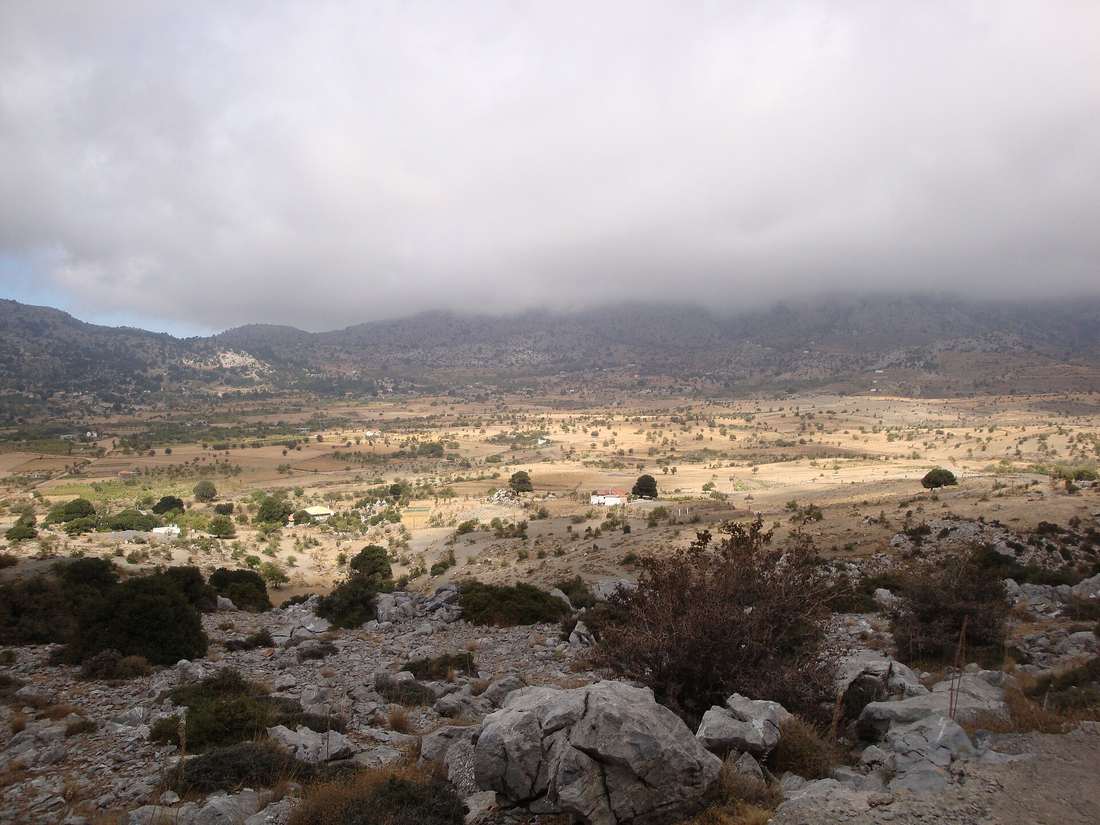
The Katharo Plateau sits high in the Dikti mountains of eastern Crete, a remote plain of stone huts, vineyards and orchards far above the everyday coast. It lies in the Lasithi district, around eleven hundred metres above sea level, reached by a steep, winding road up from the village of Kritsa near Agios Nikolaos. Farmers move here for the summer and return to the village for winter, keeping a rhythm of old pastoral Crete alive. Cherries, apples, potatoes, wine and raki come off this red soil each year. Plan a quiet mountain day into your wider island route with My Greece Tours.
Katharo rewards travellers who want silence, clear air and a taste of the island’s mountain interior rather than another crowded beach. The plateau ranks among the highest cultivated plains on the island, ringed by bare Dikti peaks and dotted with vineyards, potato fields and fruit orchards. A small chapel and two seasonal tavernas serve the few people who make the climb. The sections below cover how to reach it, when to visit, what farmers grow here, the fossil bones in its red earth, and the walking trails that leave from the plain. For the wider region, the Crete travel guide sets Katharo within the whole island.
Where is the Katharo Plateau in Crete?
The Katharo Plateau lies in the Dikti mountains of eastern Crete, in the Lasithi district, around eleven hundred metres above sea level. It rises high above the village of Kritsa, near Agios Nikolaos, at the island’s northeast.
The plateau occupies a bowl of high ground deep in the Dikti range, one of the great mountain massifs of eastern Crete. It belongs to the Lasithi district and sits at roughly eleven hundred metres, well above the treeline haze of the coast. Bare grey peaks ring the plain on every side. That wall of rock gives Katharo a closed, sheltered feel that the lower farmland never has. The nearest large settlement is Agios Nikolaos, the harbour town on the Gulf of Mirabello, and it makes an easy base for the drive inland. Travellers who use Agios Nikolaos as their coastal anchor can reach the mountain road in well under an hour.
In a single morning they trade the flat sea light of the gulf for the thin, clear alpine air of the high plain above.
Katharo is not a stop you pass through on the way to somewhere else; the road ends on the plain and comes back the same way. That dead-end quality keeps the crowds thin and the silence deep. The plain connects on foot, not by car, to the wider mountain world. Trails run west toward the peaks and on to the far larger Lasithi Plateau, the windmill country beyond the ridge. The immediate gateway, though, is the old weaving village of Kritsa, which clings to the slope directly below the plateau. The village even gives Katharo its name in local speech. From there the land climbs sharply, hairpin after hairpin, up the flank of the mountain.
At last the orchards and stone huts of the high pasture open out ahead of the traveller.
How do you get up to Katharo from Kritsa?
Drive up the steep, winding mountain road that climbs from Kritsa. The route hairpins sharply for the whole ascent to the plain. Go in daylight, in good weather, with a car that handles gradients and tight bends well.
The approach begins in Kritsa, the hillside village a short drive inland from the coast. From the upper edge of the village a narrow asphalt road strikes uphill and does not relent, climbing through hairpin after hairpin as the valley drops away below. The gradient is steady and the bends are tight, so a small, willing car suits the trip better than a large, sluggish one. Drivers should take the ascent slowly, sound the horn on blind corners and yield space to farm vehicles coming down. The reward arrives without much warning. The road levels, the peaks step back, and the cultivated floor of Katharo spreads out ahead.
It is a green plain held in a ring of grey stone under a wide mountain sky, a sudden calm after the long, tight climb.
Timing and season shape the drive as much as the gradient does. The road opens fully once winter snow and mud have gone, so late spring through autumn is the practical window, and full daylight is the only sensible time to attempt the climb. Fuel up before leaving the coast, carry water, and treat the plateau as remote once you are up there. Phone signal is patchy and help is far away. Travellers often fold Katharo into a broader list of things to do in Crete, pairing the mountain morning with a coastal afternoon back down at sea level. The contrast between the two worlds is stark: thin alpine air above, warm harbour light below.
That sharp change is a large part of what makes the short, steep detour worth the effort for island visitors.
What do farmers grow on the Katharo Plateau?
Farmers from Kritsa work vineyards, potato fields and fruit orchards on the plateau. The red soil yields cherries and apples, and the harvest supports the local wine and raki that give Katharo its mountain reputation.
Katharo is a working plain, not a viewpoint. The people who farm it come up from Kritsa for the summer season, keeping stone huts, tending vines and fields, and returning to the village once the cold sets in. Their vineyards climb the gentler slopes, their potato fields fill the flatter ground, and fruit orchards cluster where water and shelter allow. Cherries and apples are the signature crops. Both are prized for the sharp mountain flavour that altitude and cool nights bring to the fruit. This annual up-and-down movement, family by family, is the pastoral rhythm the plateau has kept for generations.
It is exactly why the plain feels lived in rather than merely visited, even at the busy height of the growing season, when the huts fill and the high fields turn green with new crops.
The harvest feeds a small but genuine local food culture. Grapes from the high vineyards go into Katharo’s own wine and into raki, the clear spirit poured across Crete, both carrying the cool, clean character of mountain fruit. Two seasonal tavernas on the plain serve this produce alongside plateau cooking, so a visit can end at a shaded table rather than a car park. Food-minded travellers exploring the hidden gems in Crete often rate a Katharo lunch above far busier coastal names. The reason is plain enough: the wine, the raki and the fruit come off the ground within sight of the table.
The taste of the place is inseparable from the red soil that produced it, and that honesty is the whole draw of eating here.
Why are fossil bones found in Katharo’s red soil?
The plateau’s red earth has yielded fossil bones of dwarf hippopotamus and deer. These remains are evidence of the island’s ancient isolated fauna, the strange small animals that evolved on Crete when it stood cut off from the mainland.
Beneath the vineyards and orchards, Katharo hides a deeper story in its distinctive red soil. Diggers here have turned up fossil bones of dwarf hippopotamus and deer, creatures that once roamed the high plain long before any farmer climbed the road from Kritsa. Their small size is the key detail: animals stranded on an island that stood isolated from the mainland tended to shrink over the ages, evolving into scaled-down forms found nowhere else. The bones preserved in Katharo’s earth are physical proof of that lost fauna, a window onto a Crete of ancient isolation.
Few visitors expect a mountain potato field to double as a fossil bed, yet that quiet layering of farm life over deep time is part of what gives the plateau its particular weight. Down its eastern edge, water carves the sheer Havgas Gorge toward the Ierapetra plain.
The fossils tie Katharo into the broader natural history of the Dikti range and eastern Crete. The same isolation that produced dwarf animals shaped the whole island’s plants and creatures, and the high plateaus, sealed off by ridges, held onto traces of it longest. Walkers who cross the plain toward the surrounding summits are moving through that landscape, the very Dikti mountains whose slow uplift and long seclusion set the stage for the fauna now read from the ground. Standing among the orchards, it is worth remembering that the silence around you is old. The red earth underfoot has kept its record of a wilder, stranger Crete far longer than the tavernas or the vineyards have stood here.
A working potato field and a deep-time fossil bed share the very same patch of mountain soil on this quiet plateau.
What walking trails cross this high plateau in Crete?
Walking trails cross the plain and climb toward the peaks of Dikti and on to the Lasithi Plateau beyond. Routes reward hikers with deep silence, clear mountain air and the ringed, remote scenery of old pastoral Crete.
Katharo is a walker’s plateau as much as a farmer’s one. Paths thread across the cultivated floor and then rise into the bare peaks that enclose it, giving hikers a full sweep from orchard to summit ridge in a single outing. The most rewarding routes head toward the high points of Dikti, where the ground steepens and the plain shrinks to a green patch far below. Longer trails carry on over the ridges to the far larger Lasithi Plateau, the famous windmill basin on the other side of the mountains. The walking is upland walking, and it asks for the right kit: firm boots, sun cover, enough water for the day, and an early start.
Shade is scarce on the open plain. The air, though cool, hides the real strength of the mountain sun at this altitude.
What sets the walking apart is the quality of the quiet. Katharo offers deep silence and clear mountain air, and on the trails, away from the two tavernas and the small chapel, a hiker can go a long while meeting no one at all. The best months run from late spring to autumn, once the road is open and the season is working; earlier or later, snow and a shut road put the plain out of reach. Hikers linking the plateau to a wider circuit often continue on foot toward the Lasithi Plateau, turning two remote high plains into one long mountain traverse across the ridges. Either way, the reward is the same.
A day here gives a taste of pastoral Crete that the busy coast road never delivers.
Frequently Asked Questions
What is the best time to visit the Katharo Plateau?
Late spring through autumn is the practical season for Katharo, and the reason is simple. The high plain sits at around eleven hundred metres in the Dikti mountains, so winter brings snow, mud and a road that can close, sealing the plateau off from Kritsa below. The warmer months reopen the steep road, the two seasonal tavernas start working, and the farmers move up for the growing season, filling the plain with life again. Cherry and apple blossom, then ripe fruit, follow the calendar through these months, and the walking trails toward the peaks stay clear of snow.
Daytime air is cool and clean at altitude even in high summer, a welcome contrast to the hot coast far below. Plan the drive for full daylight and settled weather, and treat the shoulder edges of the season with real caution, since an early cold snap can shut the mountain road again without much warning at all, stranding the plain for days.
Is Katharo suitable for a family day trip?
Katharo works well as a family day trip for households happy with a steep mountain drive and a quiet, rural destination rather than playgrounds or beaches. The road up from Kritsa hairpins hard, so a confident driver and a car that handles gradients matter more than any special gear. Up on the plain, the appeal is gentle and open: children can roam the flat cultivated floor, watch farm work, and hear about the fossil bones of dwarf hippopotamus and deer that lie in the red soil, a detail that turns a walk into a small adventure.
The two seasonal tavernas give families a shaded lunch of local produce, wine and raki for the adults, fruit and plateau cooking for everyone. Bring water, sun cover and layers, since mountain air cools fast. Keep the visit to daylight, and pair it with the coast at Agios Nikolaos for a full and varied day.
What makes Katharo different from the Lasithi Plateau?
Both are high plains in the same eastern mountains, yet they feel very different in scale and mood. The Lasithi Plateau is far larger, ringed by whole villages, dotted with its famous windmills and long settled and farmed year round. Katharo is smaller, higher and far more remote: a single dead-end road climbs to it from Kritsa, no permanent village sits on the plain, and the farmers who work its vineyards, potato fields and orchards come up only for the summer before returning below for winter. Where Lasithi hums with traffic and tour buses in season, Katharo keeps a deep silence broken only by two tavernas and a small chapel.
Trails actually link the two over the ridges, so committed walkers can join them into one traverse. For a traveller choosing between them, Lasithi offers a broader, busier picture of mountain Crete, while Katharo delivers the quieter, wilder, old pastoral version.