
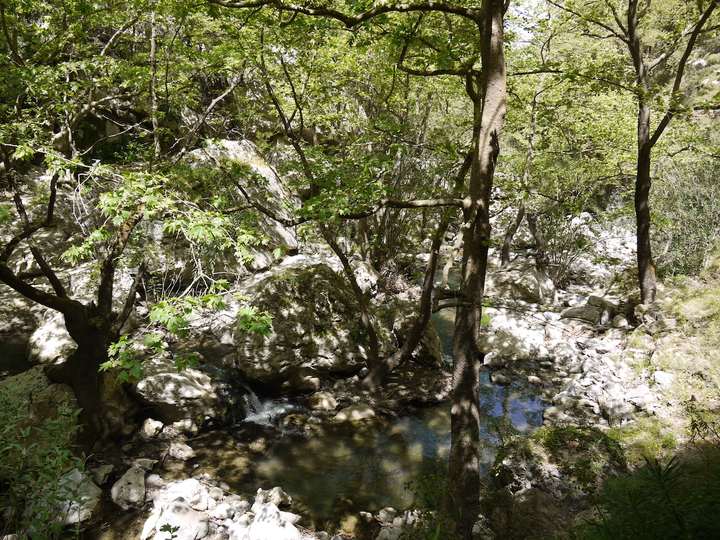
The Patsos gorge, tucked into the western slopes of Psiloritis in Crete’s Amari region, offers a shaded escape into a green ravine where history and nature intertwine. Known also as the Agios Antonios gorge, this short walk leads through plane trees and past a cave-church carved into the cliff, a site sacred since antiquity. Wooden walkways, ladders and bridges guide visitors up through the gorge alongside a stream, past small waterfalls and pools. The route suits families and walkers seeking a cool, easy half-day in the hills without the crowds of western Crete’s famous gorges. Discover this tranquil corner with My Greece Tours.
Patsos village sits above the gorge entrance in the Rethymno district, close to the pastoral landscapes of the Amari valley and the town of Spili. Picnic areas and a taverna welcome visitors near the trailhead, where the path begins its gentle ascent through lush vegetation rich in birdlife. The cave-church of Saint Anthony marks the spiritual heart of the gorge, a place where ancient worshippers once left votive offerings to Hermes. The sections below cover the gorge’s history, walking route, natural features and practical visitor information. For broader island context, consult our Crete travel guide.
What makes Patsos gorge significant in Crete’s religious and ancient history?
The cave-church of Saint Anthony occupies a cliff site sacred since ancient times, when worshippers dedicated votive offerings to Hermes. This continuity of devotion spans millennia, linking pagan and Christian traditions in one sheltered rock sanctuary within the gorge.
The cave-church carved into the gorge wall represents a rare continuity of sacred use stretching back to antiquity. Ancient Greeks venerated this spot as a shrine to Hermes, leaving votive offerings in the rock niches. The transition to Christian worship preserved the site’s spiritual significance, with the cave dedicated to Saint Anthony, a hermit saint whose association with remote, contemplative places made the setting ideal. Pilgrims and locals still visit the chapel, lighting candles in the cool, shadowed interior where centuries of devotion have left their mark. The modest iconostasis and simple furnishings contrast with the natural grandeur of the stone walls, creating an atmosphere of quiet reverence.
This layering of belief systems illustrates how sacred geography endures across cultural shifts, anchoring communities to place through shared ritual and memory.
The votive offerings left for Hermes in ancient times testify to the gorge’s role as a threshold space, a liminal zone between human settlement and wild mountain. Hermes, god of travellers, boundaries and transitions, suited a site where paths converged and water flowed from the heights of Psiloritis. The choice of Saint Anthony for the Christian chapel echoes this theme, as the saint’s life in the Egyptian desert resonated with those seeking solitude and spiritual challenge in Crete’s rugged interior. Visitors exploring things to do in Crete often overlook such sites, yet they offer profound insight into how landscape shapes belief.
The cave-church remains an active place of worship, its feast day drawing villagers from Patsos and beyond to celebrate continuity in a changing world.
How does the walking route through Patsos gorge unfold for visitors?
The trail begins near the taverna and picnic areas, following a stream up through plane trees on wooden walkways, ladders and bridges. Small waterfalls and pools lead to the cave-church set in the cliff, the gorge’s turnaround point.
The entrance to Patsos gorge lies just below the village, where parking and facilities mark the start of the walk. The path follows the stream bed, shaded by tall plane trees whose broad leaves filter the sunlight into dappled patterns on the rock. Wooden walkways and bridges cross the water at intervals, allowing walkers to navigate the uneven terrain without difficulty. The route climbs gently, using ladders and steps to ascend steeper sections where the gorge narrows. Small waterfalls tumble over moss-covered stones, feeding pools that reflect the greenery overhead. Birdlife thrives in this sheltered corridor, with calls echoing off the rock walls.
The walk requires no special equipment or fitness, making it accessible to children and older visitors seeking a taste of Crete’s natural beauty without the commitment of longer treks.
The cave-church of Saint Anthony appears partway up the gorge, set into the cliff face on the right. Visitors can enter the chapel, cool and dim after the bright walk, to see the icons and candles that mark its continued use. Beyond the church, the gorge continues for a short distance before the path ends, offering a natural turnaround point. The entire walk takes less than an hour at a leisurely pace, allowing time to linger at the waterfalls or explore the chapel. The return journey retraces the same route, descending past the same features with fresh perspectives. The Amari valley spreads below, its villages and orchards visible through gaps in the trees.
The taverna near the entrance provides refreshment after the walk, completing a half-day excursion that balances exercise, nature and cultural discovery.
What natural features distinguish Patsos gorge in Crete from other walking destinations?
Patsos gorge offers dense shade from plane trees, a year-round stream with waterfalls and pools, and rich birdlife in a compact ravine. Its cool, green microclimate contrasts with Crete’s arid summer landscape, without the scale of the western gorges.
The gorge’s microclimate supports vegetation uncommon in the drier lowlands of Crete. Plane trees dominate the canopy, their roots anchored in the stream banks and their branches forming a continuous shade over the path. Ferns, mosses and flowering plants thrive in the moist air, creating a lushness that surprises visitors expecting the island’s typical maquis scrub. The stream flows year-round, fed by springs higher on Psiloritis, ensuring that even in late summer the waterfalls and pools retain water. This permanence attracts birds, including warblers, finches and occasional raptors hunting along the gorge. The rock walls rise steeply on either side, their stratified limestone marked by erosion and the passage of millennia.
The compact scale of the gorge concentrates these features into a short walk, delivering variety and interest without the endurance required by longer routes.
The waterfalls, though modest in height, create focal points along the trail where visitors pause to photograph the cascades or simply enjoy the sound of falling water. Pools collect below the falls, their clarity revealing the pebbled bottoms and occasional aquatic life. The cool air rising from the water provides relief on hot days, making the gorge a popular escape for locals and travellers alike. The greenery and shade distinguish Patsos from the exposed, sun-baked trails of Spili and the surrounding hills. The gorge’s natural beauty complements the cultural interest of the cave-church, offering a balanced experience that appeals to nature lovers and history enthusiasts equally.
Its quiet atmosphere, far from the tourist circuits of the coast, preserves a sense of discovery and intimacy with the landscape.
Where does Patsos gorge sit within the Amari region and Rethymno district?
Patsos gorge lies below Patsos village on the western flank of Psiloritis, within the Amari region of the Rethymno district. It sits close to the Amari valley villages and the town of Spili, accessible by mountain roads threading through central Crete’s interior.
Patsos village perches on the slopes of Psiloritis, the mountain range dominating central Crete and home to the island’s highest peak. The gorge descends westward from the village, cutting through the limestone that characterizes the Amari region’s geology. The Amari valley stretches to the south and west, a fertile basin dotted with traditional villages, olive groves and vineyards. The town of Spili lies a short drive to the southwest, offering additional services and accommodation for visitors exploring the area. The Rethymno district encompasses this entire zone, linking the coast to the mountain interior through a network of winding roads.
The location places Patsos gorge within reach of both coastal resorts and inland cultural sites, making it a viable day trip for those based in Rethymno town or the Amari valley itself.
The drive to Patsos from the coast involves climbing through terraced hillsides and small settlements, each turn revealing new vistas of the valley and mountains. The roads are narrow but well-maintained, suitable for careful drivers willing to navigate the switchbacks. The gorge’s position on Psiloritis’s western flank means it catches afternoon shade earlier than east-facing slopes, enhancing its appeal during the heat of summer. Visitors interested in hiking in Crete often combine Patsos with other Amari attractions, creating multi-day itineraries that explore the region’s villages, monasteries and natural sites. The proximity to Spili allows for lunch or overnight stays in that charming town, while the Amari valley’s wineries and olive presses offer cultural diversions.
The gorge’s central location makes it a hub for exploring Crete’s less-visited interior, away from the crowded beaches and commercialized attractions of the north coast.
Who should visit Patsos gorge and what practical considerations apply?
Patsos gorge suits families, casual walkers and anyone seeking a short, shaded nature walk with cultural interest. The easy terrain, facilities at the entrance and cool microclimate make it ideal for half-day excursions, particularly in summer when longer hikes prove too strenuous.
The gorge’s accessibility makes it appropriate for children, older visitors and those without extensive hiking experience. The wooden walkways and bridges eliminate the need to scramble over rocks or ford the stream, while the ladders and steps are sturdy and well-placed. The short duration means families can complete the walk without tiring young legs, and the waterfalls and pools provide natural entertainment along the way. The taverna and picnic areas near the entrance allow for meals before or after the walk, turning the visit into a relaxed outing rather than a demanding expedition. The shade and water make summer visits comfortable, a contrast to exposed trails where heat becomes a limiting factor.
The gorge’s status as one of the hidden gems in Crete means it rarely suffers from overcrowding, preserving a peaceful atmosphere even during peak tourist months.
Practical considerations include wearing sturdy footwear with good grip, as the walkways can be slippery near the water. Bringing water, snacks and a camera enhances the experience, though the taverna provides refreshments for those who prefer to travel light. The gorge is open year-round, but spring and autumn offer the most pleasant temperatures and the fullest flow in the stream. Winter visits are possible but may encounter muddy conditions or swollen water levels after rain. Parking is available near the entrance, and a small fee supports maintenance of the paths and facilities. The drive from Rethymno takes roughly an hour, making the gorge a feasible day trip from the coast.
Combining the visit with exploration of Patsos village, the Amari valley or Spili creates a full day of varied experiences, balancing natural beauty, cultural heritage and the slower rhythms of rural Crete.
Frequently Asked Questions
How long does it take to walk through Patsos gorge?
The walk through Patsos gorge typically takes forty-five minutes to an hour at a relaxed pace, allowing time to pause at the waterfalls, explore the cave-church and enjoy the natural surroundings. The path climbs gently from the entrance to the chapel and continues a short distance beyond before reaching a natural endpoint. Visitors often spend additional time at the cave-church, lighting candles or simply absorbing the atmosphere of the sacred site. The return journey follows the same route downward, offering fresh perspectives on the features passed earlier. The compact nature of the gorge means the entire excursion, including time at the entrance facilities and the chapel, fits comfortably into a half-day.
Families with young children or those who linger to photograph the scenery may extend the visit to two hours. The short duration makes Patsos an ideal addition to a broader itinerary exploring the Amari region, leaving time for lunch in Spili or visits to nearby villages and cultural sites without the fatigue of longer mountain treks.
Can Patsos gorge be visited year-round or only in certain seasons?
Patsos gorge remains accessible throughout the year, though each season offers distinct advantages and considerations. Spring brings the fullest flow to the stream and waterfalls, with wildflowers adding colour to the greenery and migrant birds passing through the gorge. Summer provides the coolest refuge from coastal heat, as the shade and water create a microclimate that contrasts sharply with the arid lowlands. Autumn offers pleasant temperatures and fewer visitors, making it ideal for those seeking solitude. Winter visits are possible but may encounter muddy paths and higher water levels after rain, requiring extra caution on the walkways and bridges. Snow rarely affects the gorge itself, though higher elevations of Psiloritis may be snow-covered.
The cave-church remains open year-round, and the taverna near the entrance typically operates during daylight hours in all seasons. Checking local conditions before winter visits ensures safe passage, particularly after storms. The gorge’s year-round appeal reflects its status as a reliable natural attraction, adaptable to different visitor preferences and weather patterns while maintaining its essential character across the seasons.
What other attractions lie near Patsos gorge in the Amari region?
The Amari valley surrounding Patsos gorge contains traditional villages, Byzantine churches, monasteries and agricultural landscapes that reward exploration. Thronos village preserves a mosaic-floored basilica, while Moni Asomaton monastery sits amid olive groves with frescoed interiors. The town of Spili, known for its Venetian fountain and relaxed atmosphere, lies a short drive southwest, offering tavernas and accommodation. The valley’s wineries produce local varieties, with tastings available at estates that welcome visitors. Olive oil producers demonstrate traditional pressing methods, connecting modern travellers to agricultural practices unchanged for generations. The villages of Gerakari, Kardaki and Ano Meros each preserve distinct architectural character and local traditions.
Mount Psiloritis itself offers higher-elevation hikes for experienced walkers, including routes to the summit and the Ideon Cave, mythical birthplace of Zeus. The combination of natural beauty, cultural heritage and rural authenticity makes the Amari region a microcosm of inland Crete, rewarding those who venture beyond the coast to discover landscapes and communities shaped by centuries of continuity and adaptation.