
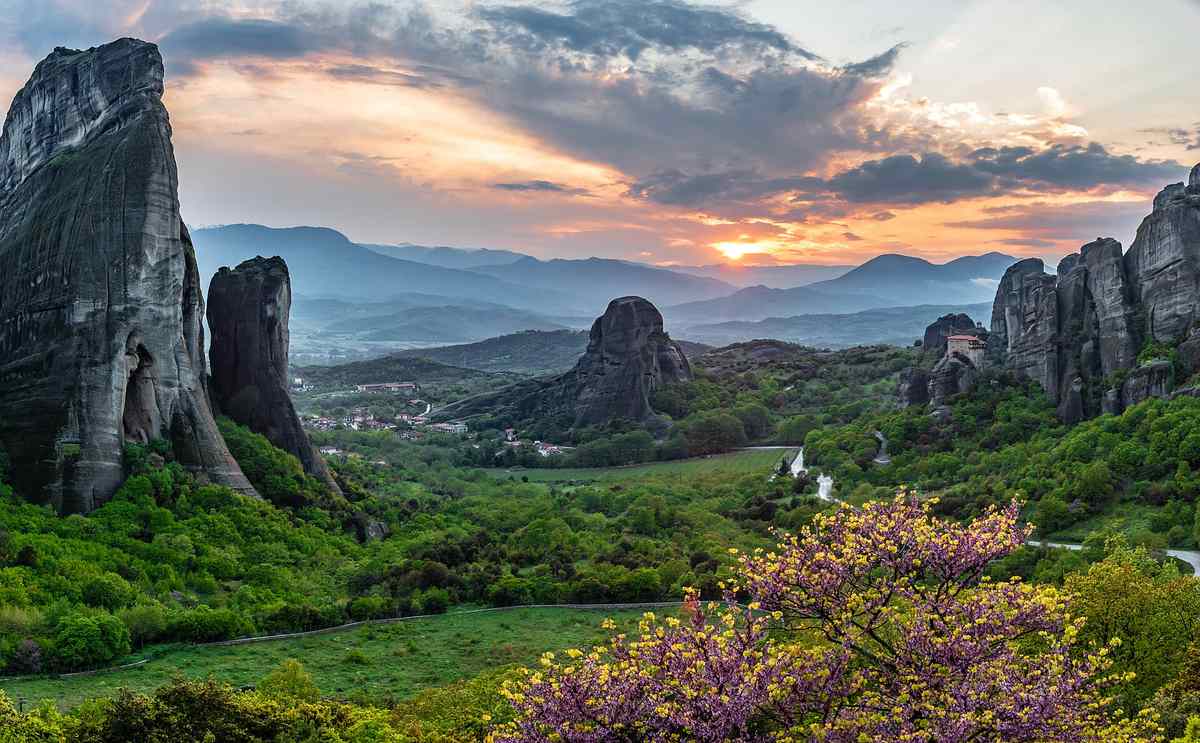
Meteora rewards travellers who stay for the last hour of daylight. Low golden light warms the grey sandstone pillars, and the clifftop monasteries turn to dark silhouettes above the plain of Thessaly. The viewpoints along the monastery road fill with visitors who came for exactly this moment, cameras ready and jackets on for the cooling air. Kalabaka and Kastraki sit at the foot of the rocks, so the drive up takes only minutes. The monasteries close their gates before the sun drops, which makes the evening an outdoor event built around wide western views. You can arrange the whole experience, from viewpoint timing to transport, with My Greece Tours.
This page focuses on the sunset itself: where to stand, whether a guided run suits you, and how to reach the terraces on your own. For wider planning, opening hours and dress rules across the site, pair it with our full Meteora travel guide. The sections below cover why sunset here is worth the extra hour, the strongest viewpoints along the ridge, what a sunset tour includes, how independent visitors reach the spots by car or on foot, and the photography and practical details that decide whether your evening runs smoothly. Read each part in order or jump to the question you need answered first.
Why is the Meteora sunset such a special experience?
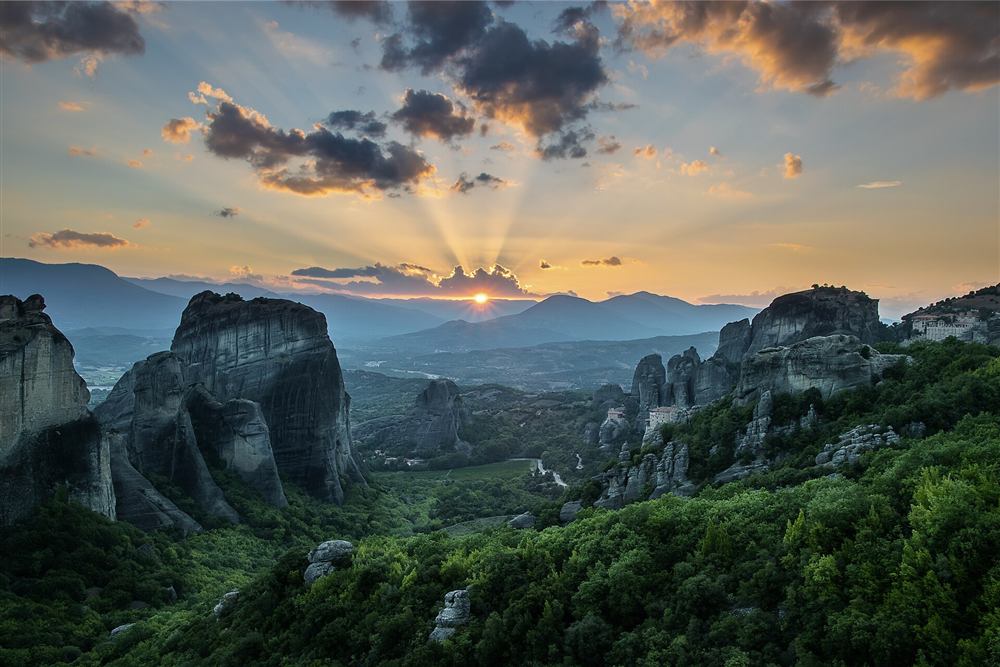
Sunset is the signature Meteora moment. Low western light warms the sandstone pillars to gold and turns the clifftop monasteries into silhouettes over the Thessalian plain, giving the rocks depth and colour that midday flatness never delivers.
The rocks change character in the final hour of daylight. Midday sun sits high and washes the sandstone into a flat grey, hiding the texture that makes these pillars remarkable. Evening light arrives from the west at a low angle, so it rakes across the stone and picks out every crack, ledge and rounded shoulder. The colour warms from grey to honey and then to a deeper amber before the sun drops behind the ridge. The monasteries, perched on the highest columns, read as dark shapes against a bright sky. This shift is the reason so many Meteora tours save their best viewpoint for the closing part of the itinerary rather than the busy middle of the day.
The setting adds to the effect. Meteora means suspended in the air, and the low light exaggerates that height by throwing long shadows across the plain below. Birds circle the columns as the temperature drops, and the noise of the day fades once the tour coaches leave. The monastery buildings, which visitors explore earlier when the gates are open, become part of the skyline rather than the destination. Many people who came to see the Meteora monasteries up close find that the evening view from below leaves the stronger memory. The combination of scale, warm colour and quiet makes the sunset the most photographed hour of any Meteora visit.
Where are the best Meteora sunset viewpoints?
The strongest spots line the monastery road above Kastraki. The large Psaropetra rock viewpoint and the terrace near the Holy Trinity and Rousanou monasteries both look west over the pillars toward the plain, giving open, unobstructed sunset angles.
Psaropetra is the best-known viewpoint and the natural first choice. It sits on a broad rock platform beside the road, with a low railing and space for a crowd, and it faces west across the whole cluster of pillars. The sun sets over the plain of Thessaly in front of you, so the light falls onto the rocks rather than into your eyes. A short distance along the same road, the terrace near the Holy Trinity and Rousanou monasteries offers a tighter frame, with the monastery buildings closer and higher in the shot. Both points appear on most walking routes, so travellers combining sunset with hiking in Meteora can reach them on foot from the trails below.
Choosing between the viewpoints depends on the picture you want. Psaropetra gives the widest sweep and the most sky, which suits panoramas and time-lapse work. The Holy Trinity terrace puts a single monastery in the foreground, better for a classic postcard silhouette. A smaller pull-off near the Great Meteoron catches a different angle if the main spots are full. Arriving early matters at all of them, because parking is limited and the best railings fill first. Visitors basing themselves nearby can scout the road in daylight before committing to a spot; our notes on where to stay in Meteora cover which villages leave the shortest evening drive up to these viewpoints.
What do Meteora sunset tours include?
Sunset tours run from Kalabaka and Kastraki and drive guests to the prime viewpoints for the golden hour. A guide handles timing, positioning and photo tips, and the route usually stops at two or three of the best western-facing terraces.
A typical sunset tour collects guests from Kalabaka or Kastraki in the late afternoon and drives up the monastery road as the light softens. The guide knows the timing for the day, so the group reaches each viewpoint when the colour is at its best rather than too early or too late. Stops usually include Psaropetra and one of the monastery terraces, with the driver handling the awkward parking that catches out independent visitors. Guides point out the best angles, explain which monastery sits on which pillar, and share photo settings for the low light.
Booking through a provider such as My Greece Tours means the operator tracks the sunset time and adjusts pick-up, so guests spend the hour looking at the rocks rather than watching the clock.
Tours differ in length and focus, so it helps to check what each one covers. Some pair the sunset with an earlier monastery visit, using the open gates in the afternoon and saving the viewpoints for last. Others run as a short, dedicated evening outing aimed at photographers. A small-group format keeps the pace flexible and gives everyone room at the railing. The transport element is the main practical benefit, since it removes the parking scramble and the risk of missing the light on an unfamiliar road. Travellers who want the monasteries and the sunset in one arrangement often combine a daytime tour of the Meteora monasteries with an evening viewpoint run booked as a single package.
How can you reach the Meteora sunset viewpoints independently?
Reach the viewpoints by car or on foot. The monastery road climbs from Kastraki in minutes, and marked footpaths link the villages to the rocks. Arrive early for parking and check the day’s sunset time before you set out.
Driving is the simplest independent option. The monastery road loops up from Kastraki and passes every major viewpoint, with small pull-offs and a larger area at Psaropetra. Cars fill these spaces quickly in the last hour, so leaving your base forty to sixty minutes before sunset gives room to park and settle. Check the exact sunset time for the date, since it shifts by more than three hours between summer and winter. A jacket matters even in warm months, because the exposed rock terraces cool fast once the sun drops and the wind picks up.
Drivers should note that the road is narrow and shared with departing coaches, so an early arrival avoids both the traffic and the competition for the railing at each stop.
Walking to the viewpoints is a strong alternative for those who enjoy the trails. Old stone paths connect Kastraki and Kalabaka to the monasteries and to several of the western terraces, and these routes are the same ones used for hiking in Meteora during the day. Allow enough daylight for the climb, carry a torch for the descent, and start back before full dark since the paths are uneven. The monasteries themselves close their gates before sunset, so an evening plan should treat them as landmarks in the view rather than places to enter. Independent visitors get the same light as the tours; they simply take on the timing, the parking and the route-finding themselves.
What photography and practical tips help at a Meteora sunset?
Arrive early for parking and a railing spot, bring a jacket for the cooling terraces, and remember the monasteries close before sunset. A tripod, a wide lens and a spare battery cover most photographers at the western viewpoints.
Photographers get the most from a little preparation. A tripod steadies the camera as the light fades and lets you catch the deep colour after the sun drops, which is often stronger than the moment of sunset itself. A wide lens frames the full spread of pillars from Psaropetra, while a longer lens isolates a single monastery on its column from the Holy Trinity terrace. Spare batteries help, since cold air drains them faster on the exposed rock. Shooting toward the west means the sky is bright and the rocks are dark, so exposing for the highlights and lifting the shadows later gives the cleanest result.
Many Meteora tours that focus on the evening build in extra time at one viewpoint precisely so photographers can work through this fading light.
The practical basics decide how the evening feels. Parking is the main pressure point, so arrive with time in hand rather than racing the light up a crowded road. Warm layers matter on every date, because the terraces sit high and open and the temperature falls quickly once the sun is gone. Water and steady shoes suit anyone walking a section of path to reach a spot. The monastery gates shut in the late afternoon, which means the sunset is an outdoor event and there is no shelter at the viewpoints.
Travellers who want a warm meal and a short drive home afterward should weigh their base carefully; our guidance on where to stay in Meteora sets out which villages keep that evening return short.
What are the rocks of Meteora, and why is it a UNESCO site?
The rocks of Meteora are pillars of sandstone and conglomerate rising up to 400 metres above the plain of Thessaly. They carry six active monasteries, and UNESCO listed Meteora in 1988 as both a cultural and a natural World Heritage site.
The rock formed as a river delta about 60 million years ago. Tectonic uplift raised it, and water, wind and frost cut it into towers along vertical cracks.
Rounded pebbles, from gravel to boulders, are visible in every rock face. Softer layers weathered into caves, and these caves drew the first hermits.
The name Meteora means suspended in the air. The same rock now holds hundreds of bolted climbing routes; our Meteora geology page covers the formation.
Which monasteries do you see at a Meteora sunset?
A Meteora sunset takes in all six active monasteries from the road: Great Meteoron, Varlaam, Roussanou, Saint Nicholas Anapafsas, Holy Trinity and Saint Stephen. The sunset tour enters none of them, because they close in the afternoon.
Great Meteoron is the largest and oldest. Athanasios the Meteorite founded it in the fourteenth century.
Varlaam keeps its old windlass tower and the net that once lifted monks and supplies up the rock. Roussanou sits on a low pillar reached by a bridge and is a convent.
Holy Trinity stands alone on its pinnacle and appears in the Bond film For Your Eyes Only. Saint Stephen, also a convent, is reached across a short bridge from the road.
What time does a Meteora sunset tour run?
A Meteora sunset tour picks up about two and a half hours before sunset and returns 30 to 45 minutes after it. Sunset over the plain moves from about 20:50 in late June to about 17:20 in December, so the pickup time moves with the season.
The best light starts about 40 minutes before the sun touches the horizon and lasts about 20 minutes after it sets.
Guides time the last stop for the afterglow, not for the sun itself. The blue hour after sunset is the strongest part of the evening.
The tour is the last activity of the day, and dinner in Kalabaka or Kastraki follows it. Winter departures run on clear evenings only.
Where do you stay for a Meteora sunset?
Stay in Kalabaka, the town at the foot of the rocks, or in Kastraki, the small village right under them. Kastraki is quieter and closer to the viewpoints; Kalabaka has the train station and more restaurants.
Kastraki lies about ten minutes on foot from Kalabaka, under the Adrachti pillar. Rooms with a view of the rocks sell first.
Two nights cover a sunset tour, a morning in the monasteries and a hike.
Both places are small enough to walk end to end in fifteen minutes. Our Kastraki page covers the village.
What are the hermit caves of Meteora?
The hermit caves are rock shelters and timber platforms in the cliffs below the monasteries. Ascetic monks lived in them from the eleventh century, before any monastery stood on the summits, and wooden balconies and ladders are still visible above Kastraki.
The hermits came first and the monasteries followed. Monks built on the summits from the 1340s.
The cliffs of Badovas above Kastraki hold the clearest remains of the platforms. A few caves stayed in use into the twentieth century.
A sunset tour views the caves from the road. A guided hiking tour reaches them on foot in two to three hours from the village.
How does a Meteora sunset tour compare with a monastery tour?
A monastery tour runs in the morning and enters two or three monasteries, with a dress code inside. A Meteora sunset tour runs in the evening, stays outdoors at the viewpoints and needs no dress code.
Inside the monasteries, the frescoes, the refectories and the winch towers are the highlights. Each monastery charges a small entry fee and closes one day a week, on rotating days.
Inside, shoulders and knees must be covered, and women wear a skirt. Wrap skirts are lent free at every door.
Doing both on the same day is the standard plan, and operators sell the two as a pair. Our Meteora monasteries page covers each house.
How were the Meteora monasteries built?
The Meteora monasteries were built by hauling stone, timber and water up the rock with ropes, nets and hand-turned windlasses from platforms at the foot of each pillar. Monks went up the same way, in nets and baskets.
The ropes were replaced, in the abbots’ phrase, only when the Lord let them break.
Steps were cut into the rock in the 1920s, and the windlasses became freight lifts. Varlaam’s original windlass tower still stands.
At their peak, 24 monasteries stood on the rocks. Six remain in use today.
What is the weather like for a Meteora sunset?
Meteora is hot and still in summer at 33 to 38 degrees, cool and clear in spring and autumn, and wet and foggy from November to February. Sunset tours run all year and cancel only for rain or heavy cloud.
Winter fog in the valley makes the pillars appear and disappear, and photographers come for exactly that.
Spring turns the plain green and fills the gaps between the rocks with wildflowers. Autumn gives the warmest light of the year on the rock faces.
The temperature on the terraces falls by about ten degrees within half an hour of sunset. Bring a layer even in August. Snow falls a few times each winter.
How do you get to Meteora for the sunset?
Trains run from Athens to Kalabaka in about four and a half to five hours, and from Thessaloniki in about three. By road, Meteora is about 350 kilometres from Athens and 230 kilometres from Thessaloniki.
Day trips by coach from Athens leave Meteora by mid-afternoon, so they never see the sunset. An overnight stay makes the sunset possible.
Ioannina lies about two hours west through the Egnatia motorway tunnels. Buses from Trikala run to Kalabaka through the day.
A hire car reaches the viewpoints without a tour. The sunset tour serves travellers without one. Our Athens to Meteora page covers the routes.
Is a Meteora sunset tour suitable for everyone?
Yes. A Meteora sunset tour uses a minibus, with short, flat walks of 50 to 100 metres at each stop and no climbing. Anyone who can leave a vehicle and stand for fifteen minutes can take it.
Wheelchair users travel on private tours, with a suitable vehicle arranged in advance.
Children manage the two hours well, and the rocks hold their attention. Older visitors choose it over the monastery stairs, which run to 150 steps or more.
The viewing platforms have railings, and no part of the tour is exposed.
How do you book a Meteora sunset tour?
Book a Meteora sunset tour a day or two ahead from June to September, and on the same morning out of season. Minibuses take eight to eighteen guests, and the photography departures fill first.
Operators confirm the pickup time by message, because it moves with the sunset through the season. Hotel pickup from Kalabaka and Kastraki is part of almost every tour.
Free cancellation up to 24 hours before is standard on the booking platforms. Weather cancellations are decided in the afternoon and refunded automatically.
A sunset tour and a morning monastery tour can be booked together as one package.
What are the common mistakes at a Meteora sunset?
The common mistakes at a Meteora sunset are booking a cloudy evening, visiting Meteora as a day trip and leaving before dark, expecting the monasteries to be open, and arriving in autumn without a jacket.
The monasteries close in the afternoon, earlier in winter. Plan them for the morning.
The light moves through the evening, so one viewpoint is not as good as another at every minute. Guides change viewpoints as the light changes.
Skipping the blue hour is the last mistake; it is the best twenty minutes of the evening. A night in Kalabaka or Kastraki avoids all of these mistakes.
Frequently Asked Questions
What is the best sunset spot in Meteora?
Psaropetra is the most popular sunset spot in Meteora. It sits on a broad rock platform beside the monastery road above Kastraki, faces west across the full cluster of pillars, and gives an open view over the plain of Thessaly with plenty of room at the railing. The wide angle suits panoramas and captures the warm light falling across the whole rock formation. The terrace near the Holy Trinity and Rousanou monasteries is a strong second choice for a tighter frame, placing a single monastery high in the shot as a silhouette. Both points face the setting sun, so the light lands on the rocks rather than into your lens.
Parking at each fills fast in the final hour, so arriving forty to sixty minutes early secures a good position. The choice comes down to whether you want the widest sweep of pillars or a single monastery framed against the colour.
Are Meteora sunset tours worth it?
Sunset tours suit travellers who want the timing and driving handled for them. A guide tracks the exact sunset time for the day, adjusts pick-up from Kalabaka or Kastraki, and drives the group to two or three prime viewpoints along the narrow monastery road. That removes the parking scramble that catches out independent visitors in the busy final hour. Guides also point out which monastery sits on which pillar and share camera settings for the low light, which helps first-time photographers. The tours are less essential for confident drivers who have scouted the road in daylight and know the viewpoints, since the light is free and the terraces are public.
A tour earns its value through convenience, local timing knowledge and the transport, rather than access, because anyone can reach the same spots alone. Small-group and photography-focused options give extra time at one viewpoint, which suits people who care about the deeper colour after the sun drops.
Can you watch the sunset from inside a Meteora monastery?
No. The Meteora monasteries close their gates before sunset, so the evening light is an outdoor experience viewed from the road and the rock terraces rather than from inside the buildings. Opening hours vary by monastery and by season, and each one shuts in the late afternoon well ahead of the sun dropping behind the ridge. Plan a monastery visit for earlier in the day when the gates are open, then move to a western-facing viewpoint such as Psaropetra or the Holy Trinity terrace for the sunset itself. The monasteries still shape the evening view, standing as dark silhouettes on their pillars against the bright sky, which is the classic Meteora sunset image.
There is no shelter at the viewpoints, so bring a jacket for the cooling air and a torch if you plan to walk back after dark. Treat the monasteries as landmarks in the frame during the golden hour rather than places you can enter at that time.