
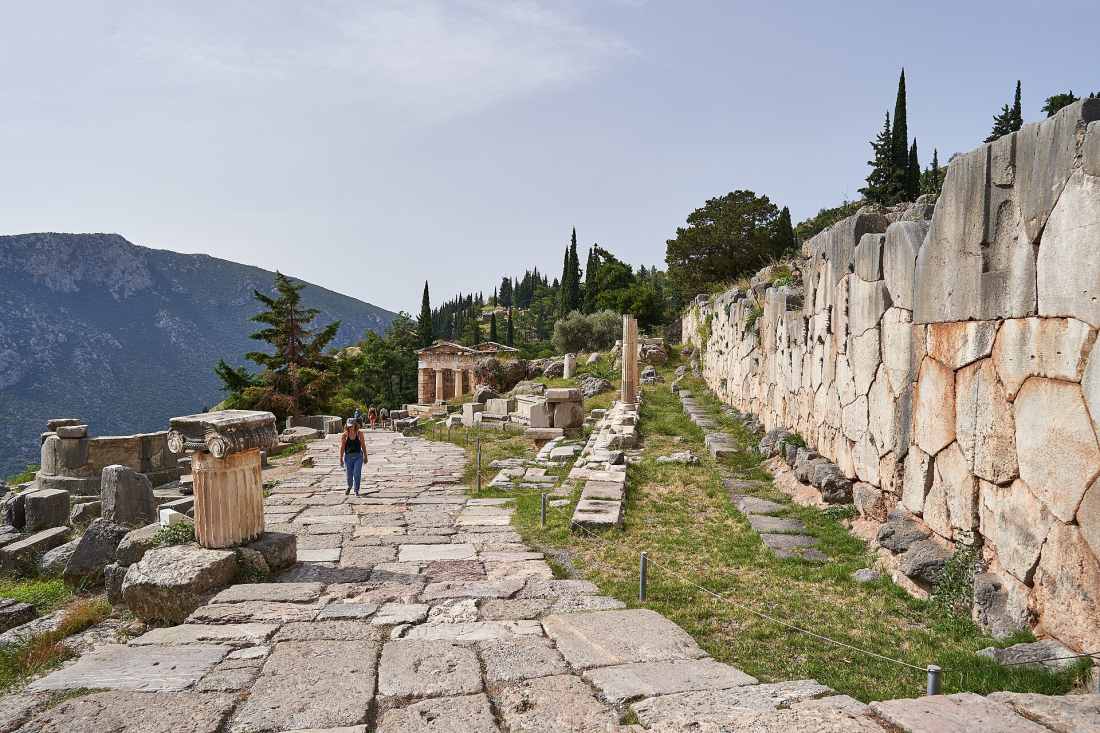
The Sacred Way at Delphi is the winding paved path that carries you up through the sanctuary of Apollo, climbing from the entrance to the terrace of the great temple. It was the processional spine of the whole site, the route every pilgrim, envoy and festival procession followed on the way to the oracle. Along its bends stood treasuries, bronze and marble statues, tripods and votive monuments dedicated by cities across the Greek world, turning the walk into an open-air gallery of offerings. Today you climb the same slabs on the slopes of Mount Parnassus, tracing that ancient ascent step by step, and it makes the perfect centrepiece for a guided tour arranged through My Greece Tours. Plan the whole trip with Greece Tours.
Reading the Sacred Way in sequence turns a scatter of ruins into a single, legible story of ascent, rivalry and worship, and it pairs naturally with the wider context in our Delphi travel guide. The sections below cover what the Sacred Way was, the route it follows uphill, the monuments that line it, its ritual and processional role, and how visitors walk the path today.
What is the Sacred Way at Delphi?
The Sacred Way is the main paved processional path through the sanctuary of Apollo at Delphi. It climbs from the south-east entrance up to the Temple of Apollo, lined with treasuries and votive offerings, and was the route pilgrims and processions followed to reach the oracle.
The Sacred Way is best understood as the organising axis of the whole sanctuary rather than a single ruin among many. Everything of importance at Delphi was arranged along it or reached from it, so the path functions as both a road and a spine. It begins at the lower, south-eastern gate of the sacred enclosure, the point where visitors crossed from the ordinary world into ground belonging to the god. From there it rises steadily through the terraced hillside, threading between monuments set on either side. The route was deliberately theatrical, because as you climbed, new offerings and inscriptions came into view, building anticipation with each turn until the temple itself appeared above. Purpose and geography are inseparable here, since the path exists to lead people directly to Apollo.
As a piece of sacred architecture, the Sacred Way did far more than connect two points. Its paving, retaining walls and monument bases were maintained by the sanctuary and its patron cities, and the space along it was contested ground where states competed to place their dedications closest to the temple. The path also defined how the sanctuary was seen and remembered, since almost every famous offering was described by its position along the climb. Knowing where the Sacred Way starts and ends gives you the frame for everything else at Delphi, and the natural next question is exactly what route it takes as it winds uphill.
What route does the Sacred Way follow?
The Sacred Way enters the sanctuary at the south-east corner and zigzags uphill in a series of sharp bends. It climbs past the treasuries to the terrace of the Temple of Apollo, and the sacred landscape continues conceptually above toward the theatre and stadium higher on the slope.
The route is defined by the steep terrain of Mount Parnassus, and its designers worked with the slope rather than against it. Instead of driving a straight ramp up the hillside, the Sacred Way switches back on itself in a series of hairpin bends, easing the gradient and stretching the walk so that more monuments could line it. From the entrance at the south-east, the path climbs westward, turns back, and climbs again, each leg raising you toward the sanctuary’s heart. The surface is paved with irregular stone slabs, worn smooth by long use, and the terracing on either side holds back the mountain while creating level platforms for offerings. The zigzag is not decorative, but the practical solution that made a very steep sacred hillside walkable for processions and pilgrims alike.
Following the bends upward, the Sacred Way arrives at the broad terrace that supports the Temple of Apollo at Delphi, the destination that gives the whole climb its meaning. This terrace is the effective summit of the processional route, the place where offerings gave way to the house of the god himself. Above it the sacred landscape keeps rising, and in the visitor’s mind the ascent continues toward the theatre and, higher still, the stadium on the upper slope. The route therefore reads as one long, staged climb from gate to god and beyond. Having traced where the path goes, the obvious question is what stood along its edges, and the monuments come next.
What monuments line the Sacred Way?
The Sacred Way is lined with votive statue bases, rival city dedications, a row of treasuries, the base of the Serpent Column, the Sphinx of the Naxians, and the great polygonal retaining wall covered in inscriptions, up to the rock of the Sibyl near the temple.
The first stretch inside the gate is crowded with the bases of votive statues, and much of it reads like a running argument in bronze and marble. Rival dedications faced off here, with monuments set up by the Athenians answered directly opposite by offerings of the Spartans, each commemorating victories and claiming prestige at the most visible spot in the Greek world. Higher up begins the famous row of city treasuries, small temple-like buildings that stored precious offerings, and among them stands the reconstructed Treasury of the Athenians. Together these dedications turned the lower Sacred Way into a dense, competitive gallery where cities advertised their power and piety to every pilgrim who climbed past on the way up.
Beyond the treasuries the path passes a sequence of celebrated landmarks that mark the approach to the temple. Near the temple terrace stood the base of the Serpent Column, the twisted bronze tripod dedicated after a great victory, and earlier along the climb rose the tall column that carried the Sphinx of the Naxians, a marble guardian perched high above the route. The climb also runs alongside the great polygonal retaining wall, its curved masonry famously covered with inscriptions recording decrees and manumissions, effectively a public archive in stone. Nearby lies the rock of the Sibyl, linked to Delphi’s earliest prophetic traditions. The whole ascent is an open-air museum of offerings, which explains why the path mattered so much in ritual, the theme that follows.
Why was the Sacred Way so important in ritual?
The Sacred Way was the route every pilgrim and sacred procession took to reach the oracle and temple. Great festival processions climbed it during the Pythian games, and the staged ascent moved worshippers from the ordinary world up toward the god, making the walk itself an act of devotion.
The ritual weight of the Sacred Way came from its role as the single approach to the heart of the sanctuary. Anyone seeking a response from the Oracle of Delphi had to climb this path to reach the Temple of Apollo at Delphi, where the priestess delivered the god’s words. The ascent was not incidental, but a form of preparation, a slow rise past reminders of piety and power that separated the worshipper from daily life. Envoys from cities, private pilgrims with questions, and delegations bearing offerings all moved along the same slabs, and the shared route bound the scattered Greek world into a single audience before Apollo. In this way the path staged devotion as a physical climb up toward the divine.
The Sacred Way also carried the great processions of the Pythian festival, the games and rites held in Apollo’s honour that drew crowds from across the Greek world. On these occasions the path filled with music, sacrificial animals and celebrants making their way up to the altar and temple, and the monuments lining the route became a backdrop to communal ceremony. The ordered ascent, from the gate through the gallery of offerings to the temple terrace, mirrored the worshipper’s inner movement from the everyday toward the sacred. Understanding this ritual charge changes how the ruins feel underfoot, and it naturally raises the practical question of how you can walk the same route today.
How do visitors walk the Sacred Way today?
Visitors follow the marked route from the entrance uphill, climbing the same paved bends past the treasuries to the Temple of Apollo. The surface is uneven marble and stone, so sturdy shoes help, and the walk pairs naturally with the temple, the theatre above and the museum nearby.
Today the Sacred Way is the signposted spine of the archaeological site, and walking it is the natural way to experience Delphi. From the entrance you follow the marked path uphill, and information panels help you place the treasuries, statue bases and inscribed walls as you climb. The paving is genuinely uneven, a mix of worn marble and rough stone on a steep slope, so comfortable, grippy shoes and a slow pace make the ascent far more enjoyable. Aim to walk it earlier when the light is kinder and the crowds thinner. After the ruins, the finds themselves, including the sphinx and column sculptures, are displayed in the Delphi Archaeological Museum, which brings the empty bases back to life. Many travellers reach the site on a Delphi day trip from Athens.
To get the most from the climb, treat the Sacred Way as a sequence rather than a checklist and let each bend reveal its monuments in turn. Start at the votive bases inside the gate, read the rival dedications, then move up through the treasuries to the polygonal wall and the temple terrace, and continue conceptually toward the theatre and stadium higher on the slope. Carry water, wear a hat in summer, and budget a couple of unhurried hours so the ascent tells its story properly. Combining the walk with the temple and the museum gives you the complete picture of what pilgrims once saw here. Plan your visit and tours through our Delphi travel guide.
Frequently Asked Questions
How long does it take to walk the Sacred Way at Delphi?
Walking the Sacred Way itself, from the entrance up to the terrace of the Temple of Apollo, takes only about fifteen to twenty minutes if you climb steadily without stopping. In practice, almost no one does that, because the whole point of the path is the sequence of monuments lining it. Allowing an hour to an hour and a half lets you pause at the votive bases, the treasuries and the polygonal wall, read the panels, and take in the views over the valley below. If you continue upward to the theatre and stadium above the temple terrace, add another thirty to forty-five minutes. Factoring in the nearby museum, most visitors spend a comfortable half day at the site overall. The gradient is steep and the surface uneven, so a slower pace is wise; rushing the climb both tires you and robs the ascent of the staged, unfolding effect that made it so powerful for ancient pilgrims.
Is the Sacred Way accessible for visitors with limited mobility?
The Sacred Way is a steep, ancient processional path paved with irregular, worn stone slabs, so it presents real challenges for anyone with limited mobility. The route climbs the flank of Mount Parnassus in a series of bends, and there are uneven steps, slick marble in places and no smooth modern surface for most of the ascent. Visitors who use wheelchairs, or who find steep, rough ground difficult, will not be able to follow the full path to the temple terrace comfortably. That said, the lower portion near the entrance is more manageable, and it is worth speaking with staff at the site about which sections can be reached. Sturdy, closed shoes with good grip help everyone, and a walking pole can steady the descent. The nearby museum is far more accessible and lets those who cannot manage the climb still see the sphinx, the column sculptures and other treasures that once stood along the route.
What should I look for first when walking the Sacred Way?
Begin by reading the ground just inside the entrance, where the bases of votive statues cluster thickly. This lower stretch staged a rivalry between cities, with monuments set up by the Athenians answered by dedications of the Spartans directly across the path, so the first thing to notice is how states competed for the most visible ground. As you climb, watch for the row of treasuries, especially the reconstructed one built by the Athenians, and then look up for the tall column that once carried the Sphinx of the Naxians. Do not miss the great polygonal retaining wall, whose curved blocks are covered in inscriptions, and the base of the twisted Serpent Column near the temple. Finally, let your eye follow the bends upward to the temple terrace, the destination that gives the whole climb its meaning. Reading the path as a sequence, from gate to god, is the key to understanding what you are seeing.