
The Castalian Spring is one of the most atmospheric places at Delphi, a source of clear, cold water that rises deep in the ravine between the towering Phaedriades cliffs on the slopes of Mount Parnassus. For the ancient Greeks this was no ordinary spring. Its waters carried a sacred charge, and every person who climbed to the sanctuary to consult the famous oracle stopped here first to wash and purify themselves before approaching the god Apollo. Pilgrims, priests, athletes and the Pythia herself all drew on its waters. Standing in the shaded gorge today, you can still feel why the place inspired awe. You can visit it on a guided tour with My Greece Tours. Plan the whole trip with Greece Tours.
The Castalian Spring belongs to the wider sacred landscape you can explore with our Delphi travel guide, which links the spring to the temples, the theatre and the stadium above it. Understanding the spring helps you read the whole site. The sections below cover what the Castalian Spring is, the myth of the nymph Castalia behind it, how its waters were used in purification rituals, what survives of the two fountain structures, and how visitors experience the spring today.
What is the Castalian Spring at Delphi?
The Castalian Spring is the sacred fountain at Delphi where clear, cold water flows from the Phaedriades cliffs into the deep ravine between them. Every pilgrim, priest and the Pythia washed here to purify themselves before consulting Apollo’s oracle at the sanctuary above.
The Castalian Spring sits in the narrow gorge that cuts down between the two great cliffs known as the Phaedriades, the “shining rocks” that catch the sun above Delphi. Water gathers from the heights of Mount Parnassus and emerges here as a steady, icy stream that once fed channels and basins carved into the living rock. To the ancient mind, the spring marked a threshold. On one side lay the ordinary world of the traveller who had journeyed far to reach the sanctuary; on the other lay the sacred precinct of Apollo, which no one entered unclean. The spring was therefore both a physical and a spiritual boundary, the gateway to the god.
Because of this role, the Castalian Spring was woven into every visit to Delphi. Its waters supplied the sanctuary for washing, for ritual cleansing and for the daily needs of the priests who lived and worked there. The setting itself, hemmed in by sheer rock and cooled by the running water, gave the spring a hushed and solemn character that impressed ancient writers and still impresses visitors. It was praised as the purest of waters, fit for a god’s own precinct. Yet the spring was more than a practical water source: it carried a story, and that story begins with a nymph whose name the spring still bears.
What is the myth behind the Castalian Spring?
The spring is named after Castalia, a nymph who, according to myth, leapt into its waters to escape the pursuing god Apollo and was transformed into the spring itself. Its waters became linked with Apollo, the Muses and the gift of poetic inspiration.
In the myth most often told, Castalia was a beautiful nymph of the region who caught the attention of Apollo, the god of prophecy, music and poetry. Fleeing his pursuit, she is said to have thrown herself into the waters of the gorge and become one with the spring, which afterwards took her name. Through this transformation the spring passed permanently into Apollo’s world. Because Apollo led the Muses, the goddesses of the arts, the Castalian Spring came to be associated with them as well. Poets imagined that its waters were touched by divine favour and that to drink from the spring, or even to hear its flow, awakened the creative fire within a mortal.
This is why the Castalian Spring appears again and again in later literature as a symbol of poetic inspiration. Writers spoke of “drinking from Castalia” as a way of claiming the blessing of the Muses, and the spring became a poetic shorthand for the wellspring of art itself. The idea persisted long after the ancient sanctuary fell silent, carried forward by poets who never saw Parnassus but knew its legend. Standing beside the real water, cold and clear against the grey rock, it is easy to understand how such a place gathered these meanings. Yet inspiration was only one of the spring’s roles, for its most constant use at Delphi was practical and sacred: purification.
How was the spring used in purification rituals?
Everyone approaching Delphi’s oracle washed at the Castalian Spring first. The Pythia bathed and washed her hair before prophesying, priests purified the sanctuary with its water, ordinary pilgrims cleansed their hands and hair, and those guilty of bloodshed underwent a fuller ritual cleansing.
Purity was essential at Delphi, and the Castalian Spring was where it began. Before anyone approached the Oracle of Delphi and put a question to Apollo, they had to cleanse themselves in the spring’s water. For most pilgrims this meant washing the hands and sprinkling or rinsing the hair, a simple act that symbolised leaving the dust of the road and the impurities of ordinary life behind. The priests who served the sanctuary also drew water from the spring to purify the sacred precinct and its altars. In this way the flowing water of Castalia touched every part of the ritual life of Delphi, from the humblest visitor to the most solemn ceremony performed on behalf of the god.
The Pythia, the priestess who spoke the oracle’s words, prepared for prophecy by bathing in the Castalian Spring and washing her hair in its waters, a cleansing that readied her to serve as Apollo’s voice. The requirements grew stricter according to what a person carried with them. A traveller with an ordinary request needed only the light washing of hands and hair, but someone stained by bloodshed or serious pollution faced a fuller and more demanding purification before they were admitted. The spring thus functioned as a moral as well as a physical filter. This sacred water fed real fountains built into the gorge, and remarkably, parts of those fountains still survive to be seen today.
What can still be seen of the Castalian Spring fountains?
Two fountain structures survive: an earlier archaic fountain with a paved court and a stone basin fed by spouts, and a later Roman fountain cut directly into the rock face, with carved niches once used for offerings. Both sit along the path within the ravine.
The earlier of the two surviving structures is the archaic fountain, set lower in the gorge. It consisted of a paved court enclosed by walls, with the water arriving through channels and pouring from spouts into a long stone basin where visitors collected it or washed. This is the older arrangement, the one that served pilgrims across the centuries when Delphi was at the height of its fame. Its simple, functional design reflects the practical heart of the spring’s purpose: to deliver clean running water to everyone who needed it before entering the sanctuary. Even in its ruined state, the paved court and basin let you picture the crowds who once queued here in the shadow of the cliffs.
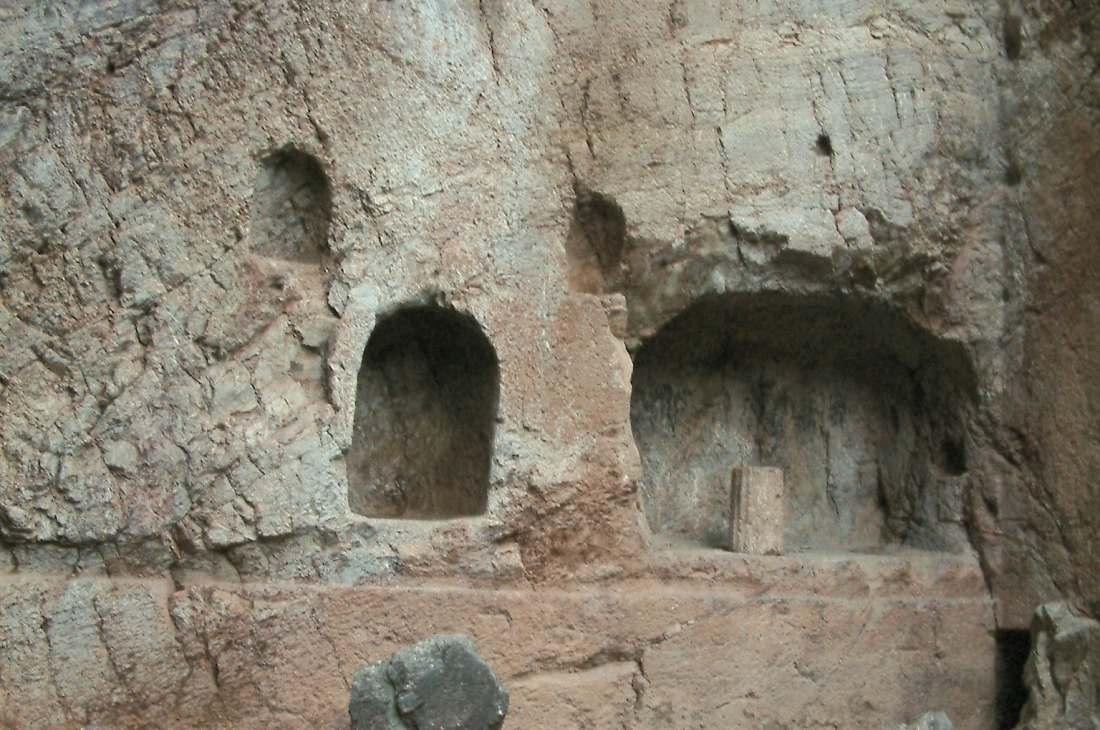
Higher up and cut dramatically into the sheer rock face is the later Roman fountain, a more monumental work. Here the builders carved a broad niche into the cliff, framed by a series of smaller rectangular niches set into the stone. These little niches are thought to have held votive offerings and small statues left by grateful or hopeful visitors, turning the fountain into a shrine as well as a water source. Facing the fountain, you can still read the marks of the chisels in the rock and the sockets where fittings were once fixed. Together the two fountains span the long life of Delphi, and seeing them in place raises the practical question of how you actually reach the spring on a visit today.
How do visitors experience the Castalian Spring today?
The Castalian Spring lies beside the road between Delphi’s two sanctuaries, a short walk from the main archaeological site. It is often fenced off for rockfall safety, but visitors can still view the fountains and the dramatic cliff setting from the path and the roadside.
The Castalian Spring is easy to fit into a visit because it sits right beside the road that runs between the two sanctuaries of Delphi, only a short walk uphill from the main entrance and the Temple of Apollo at Delphi. As you follow the road from the sanctuary of Athena Pronaia towards the great temple terrace, the gorge of the Phaedriades opens on your left and the fountains appear tucked into the rock. Many travellers reach it as part of a Delphi day trip from Athens, pausing at the spring on the way between the site’s two halves. Even a brief stop rewards you with the sound of water and the sheer scale of the cliffs pressing in overhead.
For safety reasons the immediate area of the fountains is frequently fenced off, because loose rock can fall from the towering Phaedriades above, so visitors do not walk right up to the basins or touch the water. Even so, the spring is fully visible from the roadside and the path, and the dramatic setting between the cliffs is the real reward. Wear sturdy shoes, bring water and a hat in the warmer months, and take a moment to look up at the shining rocks that gave the Phaedriades their name. Plan your visit and tours through our Delphi travel guide.
What is the geological setting of the Castalian Spring?
The Castalian Spring rises in the Kastalia gorge, the steep ravine that splits the twin Phaedriades cliffs on the eastern edge of Delphi. Karst limestone inside Mount Parnassus feeds the flow, and the water drains south toward the Pleistos valley below.
The two Phaedriades stand over the sanctuary as a natural gateway, and the name translates as the “shining rocks” for the way the limestone faces reflect the sun. The northeastern cliff carries the name Hyampeia; the southwestern cliff bears the names Rhodini and Flemboukos. The gorge between them, the Kastalia, channels the winter torrents that pour off the upper slopes of Mount Parnassus straight past the mouth of the spring.
Rain and snowmelt sink into the fractured karst limestone of Parnassus, travel through underground fissures, and resurface at the foot of the Phaedriades as the Castalian Spring. From the outlet the water runs down the Kastalia gorge into the Pleistos river, which threads the valley floor beneath Delphi and carries the flow west toward the olive plain of Amfissa and the Gulf of Corinth. The geological setting joins four elements:
- the twin Phaedriades cliffs, Hyampeia and Rhodini/Flemboukos, that frame the eastern approach;
- the Kastalia gorge, which funnels the Parnassus torrents down to the spring;
- the karst limestone aquifer that stores and releases the water;
- the Pleistos valley, the drainage line that carries the outflow to the sea.
Why is the Castalian Spring linked to poetic inspiration and the Muses?
The Castalian Spring stood sacred to Apollo and the Muses, and Greek tradition held that its water granted poetic gift. To drink from Castalia became a fixed phrase for the arrival of inspiration, and the spring entered the vocabulary of poets as the source of song itself.
At Delphi, Apollo presided as the god of music and prophecy, and the Muses attached to his cult as the patrons of poetry, dance, and the arts. The spring that fed his sanctuary drew the same associations, so that the name Castalia stood in for the creative charge of the sacred site. Ancient writers described the water as the fount that quickened verse, and the image of the poet who drinks at Castalia before composing passed from Greek into Latin literature as a settled convention.
Later European poets inherited the figure and invoked the spring by name to mark the ambition of their own work. Milton reaches for the Castalian and Aonian springs of Parnassus when he sets his verse against the classical tradition, and Byron names Castalia in his lines on Delphi and the Greek landscape. In each case the spring functions as shorthand: a writer who calls on Castalia claims descent from the Apollonian source of poetry and stakes a place in the line that runs back to the sanctuary beneath the Phaedriades.
What happened to the Castalian Spring in later history?
The Castalian Spring stayed in use through the Roman and Byzantine centuries. A Christian chapel rose beside it, the rock-cut niches took on new functions, and modern excavation cleared the archaic and Roman fountains before fencing shut the site against rockfall.
Roman visitors kept the spring in service, and the second fountain, cut back into the cliff with a paved court and stone basins, dates to the Roman reworking of the sacred way. After the sanctuary of Delphi closed as an oracle in the fourth century AD, the water remained a fixed resource for the settlement that persisted on the site. In the Byzantine period a small Christian chapel dedicated to Saint John stood by the spring, and the niches carved into the rock face for votive offerings passed into Christian reuse. The village that grew over the ruins carried the name Kastri, taken from the fortified character of the gorge, until the population moved to make way for excavation.
Archaeologists of the French School at Athens cleared the spring during the great campaign at Delphi in the late nineteenth and early twentieth centuries AD, and the digging exposed both the archaic fountain house at the roadside and the Roman fountain set deeper into the rock. Conservation later closed public access to the immediate basin, because the base of the Phaedriades sheds stone, and the fence that rings the spring today guards against rockfall while it protects the ancient masonry from wear.
How does the Castalian Spring connect to the Corycian Cave above Delphi?
The Castalian Spring marks the start of the path that climbs Mount Parnassus to the Corycian Cave, the high sanctuary of Pan and the Corycian nymphs. Pilgrims and the Thyiades passed the spring on their ascent to the upland rites above Delphi.
The old track to the cave leaves the gorge near the spring and rises through the pines and the folds of Parnassus to a plateau above the sanctuary. The Corycian Cave opens high on that plateau, a deep chamber sacred to Pan and to the nymphs the Greeks called Corycian after the cave itself. Worshippers left votive gifts in the cave, and excavators recovered lamps, figurines, and knucklebones from its floor.
The women of the Dionysiac cult, the Thyiades of Delphi and Athens, climbed this route in winter to hold their torchlit dances for Dionysus on the heights. The spring at the foot of the climb and the cave at its head framed the sacred landscape that rose from the sanctuary of Apollo into the mountain, and the water of Castalia opened the way to the wild upper ground of Parnassus above Delphi.
Frequently Asked Questions
Where exactly is the Castalian Spring at Delphi?
The Castalian Spring lies in the deep ravine between the two Phaedriades cliffs on the slopes of Mount Parnassus, right beside the road that connects the two sanctuaries of Delphi. It sits a short walk uphill from the main archaeological site and the sanctuary of Apollo, and just along the road from the sanctuary of Athena Pronaia. Because it is located directly on the roadside, most visitors pass it naturally as they move between the different parts of the ancient site. The spring is easy to identify by the sheer grey cliffs that rise on either side and by the two fountain structures carved into and built against the rock. Its position in the gorge, where cool water meets towering stone, is a large part of what made the place feel sacred to the ancient Greeks who came to consult the oracle.
Can you drink the water from the Castalian Spring?
In ancient times the water of the Castalian Spring was drawn for washing, ritual purification and everyday use at the sanctuary, and pilgrims cleansed their hands and hair in it before approaching the oracle. Today, however, the fountains are archaeological monuments rather than a working water supply, and the immediate area is usually fenced off for safety. Visitors are not able to walk up to the basins and drink, both because the structures are protected and because loose rock can fall from the high cliffs above. The best way to appreciate the spring now is to view it and its historic fountains from the path and the roadside, taking in the setting and the story rather than the water itself. If you want to stay hydrated during your visit, bring your own bottled water, especially in the hot summer months.
Why was the Castalian Spring so important to the oracle at Delphi?
The spring mattered because purity was a strict condition for approaching Apollo at Delphi. No one entered the sacred precinct or put a question to the oracle without first cleansing themselves, and the Castalian Spring was the source of that cleansing. Its clear, cold water washed away the impurities of travel and ordinary life, marking the boundary between the everyday world and the sacred ground of the god. The Pythia herself bathed and washed her hair in the spring before delivering prophecies, and the priests used its water to purify the sanctuary. Beyond ritual, the spring carried a powerful mythical and poetic charge through its links to the nymph Castalia, to Apollo and to the Muses of inspiration. For all these reasons the spring was not a mere convenience but an essential and sacred stage in the experience of consulting the oracle of Delphi.