
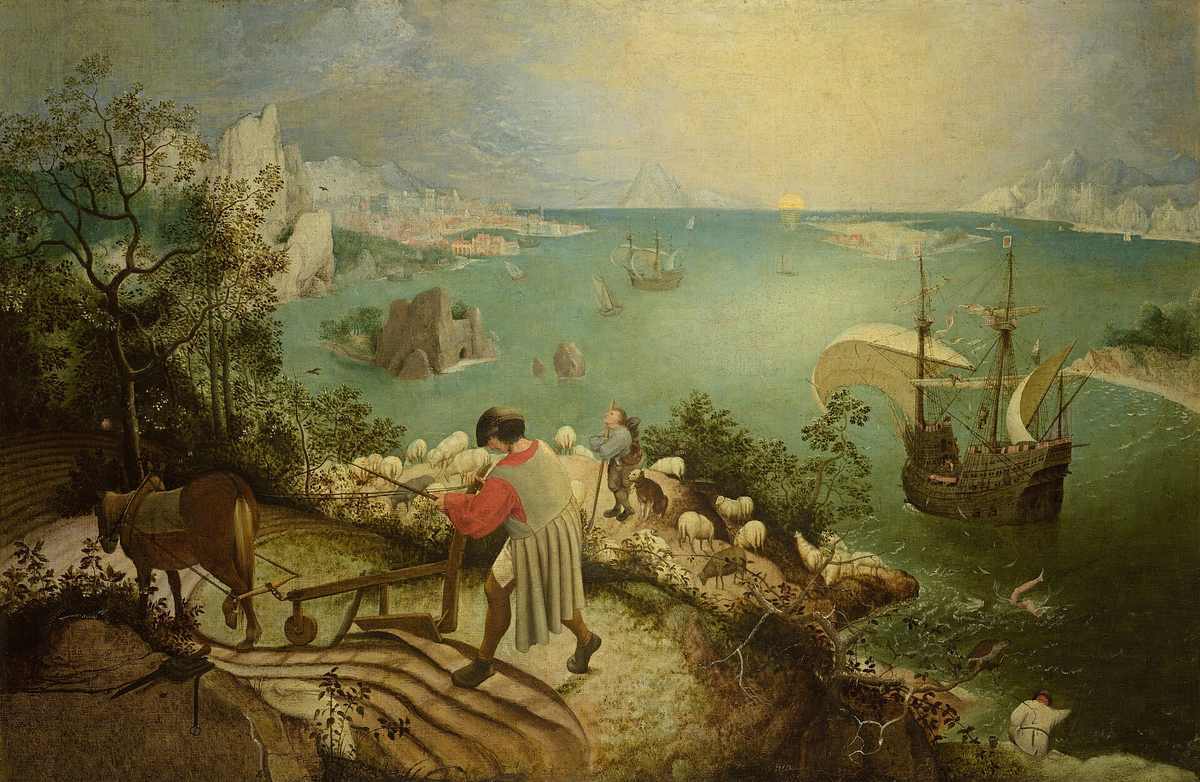
Daedalus and Icarus are the famous myth tied to Knossos, where the master craftsman built the labyrinth and his son fell flying too near the sun. Plan tickets and tours through My Greece Tours.
The legend connects to the very fabric of the Palace of Knossos. The sections below cover the myth, who Daedalus was, his work at Knossos, the flight and fall of Icarus, and the meaning of the story.
What is the myth of Daedalus and Icarus?
The myth tells how Daedalus, a master craftsman serving King Minos at Knossos, was imprisoned with his son Icarus. To escape, Daedalus made wings of feathers and wax and the pair flew from Crete.
The myth of Daedalus and Icarus ranks among the most famous and poignant in Greek mythology, and it is set at Knossos. Daedalus was a brilliant inventor and craftsman who served King Minos of Crete. He fell out of favour, and Minos imprisoned him along with his young son Icarus. The king wanted to stop the secrets of Daedalus’s work, including the labyrinth, from ever leaving the island. In the tale, knowledge itself became a prison, and the craftsman who could build anything found himself unable to buy back his freedom with the one gift he possessed.
Daedalus could not leave by land or sea, both of which Minos controlled with his fleet. The craftsman therefore devised an escape by air, fashioning two pairs of wings from feathers held together with wax. He warned Icarus to follow a middle course, neither too low, where the sea spray would dampen the wings, nor too high, where the sun would melt the wax. Icarus, exhilarated by flight, rose too high. The sun melted the wax, his wings fell apart, and he plunged into the sea and drowned. The grieving Daedalus flew on to safety.
The story survives in ancient sources rather than a single fixed text, which is why its details shift from one telling to another. The Roman poet Ovid gave the fullest surviving version in his Metamorphoses, written near the turn of the first millennium. Earlier Greek writers and later commentators added strands about Daedalus’s crimes, his exile, and his wanderings after Crete. Our guide to the Minotaur and the labyrinth covers the related legend, and the next section covers who Daedalus was.
Who was Daedalus?
Daedalus was the legendary master craftsman, inventor and architect of Greek myth. Born in Athens, he served King Minos at Knossos, and his name came to stand for skilfully made things.
Daedalus is the archetypal master craftsman and inventor of Greek mythology, a figure of extraordinary skill, ingenuity and cunning. His very name came to stand for cleverly made objects, and ancient writers used the adjective daidalos to describe anything wrought with rare artistry. In the myths he was an architect, a sculptor and an inventor of unmatched ability. He served at the court of King Minos at Knossos, where his talents were prized and, in the end, feared. The stories present him as a genius whose cleverness could not always be trusted.
His most famous creation was the labyrinth, the vast and inescapable maze he designed to hold the monstrous Minotaur. He is also credited in the legends with other ingenious works on Crete and, later, in Sicily. His reputation as a brilliant but dangerous mind runs through the stories, because his skill served whoever held him, whether that was Minos, Pasiphae, or the king who later sheltered him. His relationship with Minos turned from honoured service to imprisonment, and that turn set the stage for the tragic flight of Daedalus and Icarus.
Daedalus is woven directly into the legend of Knossos as the supposed builder of the labyrinth, yet his story reaches far beyond it. He was said to have descended from the royal house of Athens, and his craft was matched by a temper that led to exile and, in the end, to Crete. Our guide to King Minos covers the king he served, and the next section covers where he came from before Crete.
Where did Daedalus come from before Crete?
Daedalus was an Athenian of royal descent. He fled Athens after killing his young nephew and apprentice, and that exile eventually brought him to the court of King Minos on Crete.
The tradition preserved by Ovid and other ancient writers makes Daedalus a native of Athens, descended from the old royal line of the city. He worked there as a craftsman and teacher, and he took his sister’s son as his apprentice. This boy is named Perdix in certain accounts and Talos or Calos in others, and he showed a gift that rivalled his uncle’s from the start. The relationship began in trust, with Daedalus passing on his craft, and it ended in murder, driven by the master’s jealousy of the pupil.
The nephew is credited with inventing the saw, which the boy is said to have devised after studying the backbone of a fish or the jaw of a serpent. He also invented the compass, two arms of iron joined at a point for drawing circles, and the potter’s wheel in certain tellings. Daedalus, envious that a child had matched and even surpassed his own genius, threw the boy from the height of the Athenian Acropolis. In Ovid’s account the goddess Athena caught the falling child and changed him into a partridge, the bird the Greeks called perdix, which keeps low to the ground and never nests high, as if remembering the fall.
The murder was discovered, and Daedalus was tried, condemned, or forced to flee, depending on the version. His exile carried him across the sea to Crete, where his reputation as a craftsman won him a place at the palace of Knossos under King Minos. The crime that began his wandering is important to the myth, because it shows Daedalus as a man whose brilliance was shadowed by pride long before Icarus ever took to the air. The next section covers the deed that tied him most closely to the labyrinth.
What was Daedalus’s role in the birth of the Minotaur?
Daedalus built the hollow wooden cow that let Queen Pasiphae mate with the Cretan Bull. That union produced the Minotaur, so his craft stands at the very origin of the creature the labyrinth was built to hold.
The origin of the Minotaur begins with a broken promise. King Minos prayed to Poseidon for a sign of favour, and the god sent a shining white bull from the sea on the understanding that Minos would sacrifice it back to him. Minos found the animal too fine to kill and kept it, offering a lesser beast instead. Poseidon, angered by the deceit, cursed Minos’s wife Pasiphae with an unnatural desire for the bull. The queen was consumed by a passion she could neither explain nor resist, and she turned to the one man at Knossos whose skill could serve her.
Daedalus built a hollow cow of wood, framed and jointed with care, and covered it in a real cowhide so that it looked alive. He set it on hidden wheels and left it in the meadow where the bull grazed. Pasiphae hid inside the wooden frame, and by this device she mated with the Cretan Bull. The child of that union was the Minotaur, a creature with the body of a man and the head of a bull, named Asterion in the older tradition. Daedalus’s invention therefore stands at the root of the whole legend, because without the wooden cow there would have been no Minotaur, and without the Minotaur there would have been no labyrinth.
This deed also helps explain why Minos later turned on Daedalus with such force. The craftsman knew the shameful secret of the queen, and he had built the labyrinth that hid the shame away. A man who holds a king’s deepest secret is dangerous, and the myth uses that danger to justify the imprisonment that followed. The bull itself was later captured by Heracles as one of his labours and carried off to the mainland. Our guide to the Palace of Knossos sets the scene of the court where these events unfolded, and the next section covers the labyrinth itself.
What did Daedalus build at Knossos?
At Knossos, Daedalus is said to have built the labyrinth that held the Minotaur. It was his most famous work, a maze so cunning that no one who entered could find the way out.
The work that ties Daedalus most firmly to Knossos is the labyrinth, the great maze he is said to have designed and built for King Minos to imprison the Minotaur. According to the myth, the labyrinth was so cunningly and intricately constructed, with winding passages folded back upon themselves, that no one who entered it could find the way out again. It made the perfect prison for the monstrous creature born to Pasiphae, a place from which escape was as good as impossible. Minos fed the maze with tribute from Athens, sending young men and women into its corridors to be lost and devoured.
This legendary feat connects Daedalus directly to the maze-like reality of the palace of Knossos. The excavated palace has a vast, complex plan of hundreds of interconnected rooms, corridors, staircases and light-wells arranged on more than one level. Scholars have long thought this dense, folded layout is widely thought to have inspired the very idea of the labyrinth in Greek imagination. The word labyrinth itself may derive from labrys, the double axe whose sign appears carved throughout the palace, so the House of the Double Axe and the House of the Maze may be one and the same in memory.
The myths also credit Daedalus with other ingenious creations during his time on Crete. He is said to have made a dancing floor for the princess Ariadne, a smooth marked pavement where the young could dance in winding lines that echoed the labyrinth’s own paths. He fashioned statues so lifelike that they seemed ready to move, and tools and mechanisms that astonished the court. As the supposed architect of the labyrinth, Daedalus stands at the heart of the legends surrounding the palace. Our guide to the key features of Knossos Palace covers the maze-like layout, and the next section covers how Daedalus fell from favour.
How did Daedalus help Ariadne and Theseus, and why did Minos imprison him?
Daedalus gave Ariadne the thread trick that let Theseus escape the labyrinth after killing the Minotaur. Minos, enraged that his craftsman had undone the maze, imprisoned Daedalus and Icarus on Crete.
The Athenian hero Theseus came to Crete among the tribute sent to feed the Minotaur. The king’s daughter Ariadne fell in love with him and resolved to save his life. She turned for help to Daedalus, the one mind that understood the maze he had built. Daedalus gave her the answer: a ball of thread, or clew, that Theseus should tie at the entrance and unwind as he went in. Theseus killed the Minotaur in the heart of the labyrinth, then followed the thread back to the door and led the other young Athenians out to safety.
Theseus fled Crete with Ariadne, and the loss enraged Minos beyond measure. The king understood that his own craftsman had handed the enemy the key to the inescapable prison, and that the secret of the maze had been turned against him. Minos rounded on Daedalus, and in one strong tradition he shut the craftsman and his son Icarus inside the labyrinth itself, sealing them within the very walls that Daedalus had raised. In other versions Minos held them under close guard on the island, watching every harbour so that no ship could carry them away.
The imprisonment sets up the flight that gives the myth its name. Minos ruled the sea with the strongest fleet of the age, and he ruled the land of Crete as its king, so neither road nor ship was open to the prisoner. The craftsman who had helped others escape now had to escape himself, and the only route left was the empty air above the island. This closing of every earthly door forces the leap of imagination that follows. The next section covers the flight and fall of Icarus.
What happened in the flight and fall of Icarus?
Escaping Knossos by air on wings of feathers and wax, Icarus ignored his father’s warning not to fly too high. Thrilled by flight, he soared toward the sun, which melted the wax, and he fell into the sea.
The most dramatic and memorable part of the myth is the flight itself and the fall of Icarus. Having made the wings of feathers and wax to escape from Crete by air, Daedalus carefully instructed his son to fly a moderate, middle course. He warned the boy not to fly too low, where the dampness of the sea would weigh down the wings, and not too high, where the heat of the sun would melt the wax holding the feathers together. In Ovid’s account the father wept as he fitted the wings to the boy’s shoulders and kissed him, sensing a danger he could not name.
At first the flight went well, and the two rose from Crete and passed island after island below them. Fishermen, shepherds and ploughmen looked up and took the flying pair for gods. Icarus, young and intoxicated by the thrill and freedom of flight, forgot his father’s warning and climbed higher and higher toward the sun. The wax in his wings softened and melted in the heat, the feathers came loose and scattered on the wind, and the boy beat bare arms that caught no air. Icarus fell from the sky into the sea and drowned, still calling his father’s name as the water closed over him.
Daedalus, helpless to save his son, flew on alone in grief, and when he looked back and saw only feathers floating on the waves, he cursed his own craft. He recovered the body and buried Icarus on a nearby island, later called Ikaria in the boy’s memory, and the surrounding waters became the Icarian Sea. In one tradition the hero Heracles, who was passing that way, found the body and gave it burial. The place-names carried the loss into the geography of the Aegean, so that a sea and an island remembered the fall. The next section covers where Daedalus went after the flight.
What happened to Daedalus after the flight?
Daedalus flew on to Sicily and took refuge at the court of King Cocalus. Minos pursued him with a cunning riddle, but Cocalus’s daughters killed Minos to protect their guest, scalding him in his bath.
Daedalus completed his flight and came at last to Sicily, to the city of Camicus, where King Cocalus welcomed the famous craftsman and gave him shelter. There Daedalus went on working, building for Cocalus and for the towns of the island. Minos, unwilling to let his prize escape, set out with a fleet to hunt the fugitive across the Greek world. The king carried with him a clever test, a spiral seashell and a thread, and he offered a rich reward to anyone who could pass the thread through all the twisting chambers of the shell. He knew that only Daedalus was subtle enough to solve it.
Minos reached Sicily and set the riddle before Cocalus, who took it away and brought it to Daedalus in secret. The craftsman tied the thread to an ant, bored a small hole at the tip of the shell, and let the ant carry the thread through the spiral. Cocalus returned the threaded shell, and Minos knew at once that Daedalus was hidden in the city, for no other mind could have done it. Minos demanded that Cocalus surrender the fugitive. The Sicilian king, unwilling to give up so useful a guest, agreed to hand him over only after offering his visitor a bath.
The daughters of Cocalus, who had grown fond of Daedalus and the wonders he made for them, killed Minos while he bathed. In the common version they poured boiling water, or hot pitch, down onto the king through pipes above the bath, and Minos died scalded in the tub. So the pursuit ended with the death of the pursuer rather than the prey, and Daedalus lived on in Sicily under the protection of Cocalus. Minos was later honoured as a judge of the dead in the underworld, a grim reward for a king undone by his own relentless chase. The next section covers the other works credited to Daedalus.
What other works did Daedalus create?
Beyond the labyrinth and the wings, Daedalus was credited with lifelike moving statues, a golden honeycomb, temples in Sicily and Sardinia, the folding chair, and tools such as the axe and the drill in certain accounts.
Ancient writers gave Daedalus a long list of marvels beyond the wings and the labyrinth. He was said to have carved statues so lifelike that they seemed to breathe and move, with eyes that opened and limbs that could walk. Legend claimed his figures had to be chained or tied down to stop them wandering off, and this idea of the animated statue made him a patron of sculptors for centuries. Greek craftsmen who worked in the old rigid style before the sculptors of the classical age were sometimes said to belong to the school of Daedalus, and his name marked the moment when statues first seemed to come alive.
Among his finer works stood a honeycomb wrought in gold, made with cells so fine and true that they matched the work of real bees, which he is said to have dedicated at a temple of Aphrodite in Sicily. He built temples and public structures across the island, including works near the city of Agrigentum and a fortified reservoir, and tradition placed buildings of his in Sardinia as well. He was credited with the invention of the folding stool or chair, of the ship’s mast and sail in certain tellings, and of carpentry tools such as the axe, the awl, the plumb line and the glue used to join wood.
These attributions grew over the ages as the Greeks assigned any object of striking cleverness to the first great craftsman of their myths. The pattern reveals how the figure of Daedalus worked in the ancient mind: he was less a single person than the personification of skill itself, a name to hang inventions on. Temples, statues, tools and machines gathered around him the way great deeds gather around a hero. His inventions were dangerous as well as clever, from the wooden cow to the wax wings, and that double edge kept the character human rather than merely admirable. The next section covers how the myth reached us through ancient and later art.
How has the myth appeared in ancient sources and later art?
Ovid’s Metamorphoses gives the fullest ancient telling. The fall of Icarus later inspired painters such as Bruegel and Matisse and poets who used the boy as a symbol of doomed ambition and lost youth.
The story comes down to us through Greek and Roman writers rather than one authoritative scripture. The Roman poet Ovid told it at length in his Metamorphoses, composed around the turn of the first millennium, and returned to it in another of his poems on exile and loss. Earlier Greek authors, mythographers and travel-writers recorded the strands about Perdix, the wooden cow, and the death of Minos in Sicily. Because these sources disagree, the myth reaches us as a family of related tellings rather than a fixed account, and any careful retelling must weigh one version against another.
The fall of Icarus took a strong hold on later painters. A famous work long attributed to the Flemish master Pieter Bruegel the Elder, Landscape with the Fall of Icarus, painted in the sixteenth century, hides the drowning boy in a corner of a wide farming scene while a ploughman, a shepherd and a ship carry on unmoved. The picture inspired poems in the twentieth century that used this indifference to speak about how the world ignores private suffering. In the mid twentieth century the French artist Henri Matisse made a bold cut-paper image titled Icarus, a dark falling figure against blue with a red spot for the heart, for his book of coloured cut-outs.
Poets returned to the boy again and again as a figure of ambition, youth and grief. The image of a young man who flew too near the sun became shorthand in the languages of Europe for a bright, reckless overreacher destroyed by his own daring. Daedalus, by contrast, became a symbol of the skilled maker and, in later fiction, of the artist who fashions the means of escape. The pairing of the careful father and the soaring son gave writers a ready emblem for the tension between craft and passion, and that emblem still runs through art and everyday speech. The next section covers what the myth is understood to mean.
What is the meaning of the Daedalus and Icarus myth?
The myth is read as a warning against hubris and the danger of ignoring wise advice. Daedalus’s middle course stands for balance and moderation, while Icarus’s fall stands for the ruin of overreaching.
The myth of Daedalus and Icarus has endured across ages largely because of its powerful moral meaning, most commonly read as a warning against hubris, recklessness and overreaching ambition. The fatal mistake of Icarus was to ignore his father’s wise counsel and, carried away by the exhilaration of flight, to climb too high, too close to the sun. That act of youthful pride and excess brought about his destruction. In the Greek moral imagination, hubris was the arrogance that forgot human limits and drew down ruin, and the fall of the boy gives that idea a clear and unforgettable shape.
Daedalus’s advice to fly a middle course, neither too low nor too high, has come to stand for wisdom, balance and the value of avoiding extremes. The Greeks prized this idea of the mean, the sound middle path between deficiency and excess, and the myth turns it into a matter of life and death played out in the open sky. Modern writers coined the phrase the Icarus paradox to describe how the very qualities that lift a person, a company, or a project can carry it past the point of safety into collapse. Success itself can tempt the successful to overreach, and the wings that raise them can melt in the same heat that they sought.
The story is also, at its heart, a tale of a father and his son, and of grief. Daedalus built the means of escape and yet could not save the child who used it, and his triumph and his loss arrive in the same flight. That knot of skill and sorrow gives the myth a weight beyond its lesson, and it speaks to the limits of technology as well as of pride, since the cleverest invention could not defeat the sun or bring the boy back. Set against the backdrop of Knossos and the labyrinth, the tragic flight of Icarus remains one of the most resonant of all Greek myths. Plan your visit and tours through our Palace of Knossos guide.
How does the myth connect to visiting Knossos today?
The excavated Palace of Knossos, with its dense plan of rooms and corridors, is widely thought to have inspired the labyrinth. Visitors can walk the site that gave the myth of Daedalus and Icarus its setting.
The Palace of Knossos still stands near Heraklion on Crete, and its ruins give the myth a real place to inhabit. The site spreads across a low hill in a broad plan of chambers, storerooms, corridors, staircases and open courts arranged on more than one storey. A visitor moving through the remains can sense how the ancient Greeks, hearing travellers’ tales of this vast and folded building, might have imagined a maze from which no one returned. The palace is the physical anchor of the legend, the House of the Double Axe that memory turned into the House of the Minotaur.
Walking the site brings the story into focus in a way no retelling can. The winding approach, the deep magazines lined with storage jars, and the ceremonial rooms all reward a visitor who knows the myth of Daedalus, Minos and the labyrinth. The signs of the double axe carved into the stone, the throne room, and the restored colour of the frescoes connect the ruins to the world of Minos and Pasiphae in which Daedalus worked. Reading the myth before a visit, and carrying it through the rooms, turns a walk among old walls into a journey through the setting of the tale.
Planning ahead makes the visit smoother, since Knossos draws steady crowds through the warm season and a guided tour or a timed ticket saves waiting. Our Palace of Knossos guide covers tickets, tours and how to reach the site, and our guide to the key features of Knossos Palace points out the rooms and details worth finding. For the connected legend of the beast at the heart of the maze, our guide to the Minotaur and the labyrinth carries the story on. The next section answers common questions about the myth.
How was the labyrinth designed, and why could no one escape it?
Daedalus designed the labyrinth as a single winding path folded back on itself, or as a tangle of branching corridors, so that a person inside lost all sense of direction and could not retrace the way to the door.
Ancient descriptions of the labyrinth vary, and the difference matters for how the maze worked. The older idea, echoed in art and on coins from Knossos, shows a unicursal design: one long path that coils back and forth without branching, leading inevitably to the centre and out again. Later writers, including Ovid, describe something closer to a puzzle-maze of forking passages that trick and confuse the walker. Both traditions agree on the effect, which was total disorientation, a place where a person could wander until strength failed.
The genius credited to Daedalus lay in turning simple corridors into a trap for the mind. Ovid compares the maze to the winding river Maeander in Asia Minor, whose waters double back so often that they seem to flow both toward the sea and away from it. The passages of the labyrinth, in that image, loop and cross until the builder himself could scarcely find the exit. This detail, that even Daedalus almost lost his way in his own creation, appears in the ancient telling and underlines how complete the confusion was meant to be.
The maze served a purpose beyond mere containment, since it hid the Minotaur and the shame of its birth from the eyes of the court and the world. The beast lived at the heart of the design, fed on the tribute of young Athenians, while the winding walls kept the horror out of sight. The labyrinth therefore worked on two levels at once, as a prison for a body and as a screen for a secret. Our guide to the Minotaur and the labyrinth follows the creature and the maze in full, and the next section covers the wider legacy of the myth.
What is the lasting legacy of the myth in language and thought?
The myth gave lasting words and images to European thought. The name Daedalus means the skilled maker, a labyrinth means a confusing maze, and to fly too close to the sun means to overreach and fall.
The story left its mark on everyday language long after the ancient world faded. The word labyrinth passed from Greek into the languages of Europe as the common name for a confusing maze, whether of stone, of hedges, or of ideas. The image of the winding maze appears on the reverse of ancient coins struck at Knossos, proof that the city itself claimed the legend as its own. To be caught in a labyrinth came to mean to be lost in a problem with no clear way out, a figure of speech still in daily use.
The pairing of father and son gave writers a ready pair of opposites: the careful maker and the reckless flier. Daedalus stands for craft, patience and the hard-won cunning that solves problems, while Icarus stands for youth, daring and the pride that ignores good counsel. Poets, philosophers and, later, novelists reached for this pair whenever they wished to weigh caution against ambition. The very phrase to fly too close to the sun became a warning understood without any need to name the boy who first spoke it with his fall.
The myth also carried a quieter theme about the maker and the machine. Daedalus invented the means of flight and yet could not control what it did in the hands of his son, and that tension speaks to every age that fashions a new power it cannot fully master. The wings, the wooden cow and the labyrinth are all inventions that escape their maker’s intent and turn on the people around them. Read against the ruins of Knossos, the story of Daedalus and Icarus endures as a meditation on skill, pride and the limits of human making. Plan your visit through our Palace of Knossos guide. The next section answers common questions about the myth.
Who was Icarus, and how is he remembered in the Aegean?
Icarus was the young son of Daedalus, born on Crete during his father’s exile. He gave his name to the island of Ikaria and the surrounding Icarian Sea after he fell from the sky and drowned.
Icarus appears in the myth as a boy on the edge of manhood, old enough to fly beside his father yet young enough to be swept away by the thrill of it. The tradition names his mother as Naucrate, a servant in the household of Minos, which makes Icarus a child of Daedalus’s years at Knossos. He has no adventures of his own before the flight, and his whole story is bound up in the single moment of rising too high. That narrow focus is part of his power as a figure, since he stands for one clear idea rather than a full life.
The Aegean kept his memory in its map long after the tale was first told. The island where his body came to rest, west of Samos, took the name Ikaria, and the waters around it became the Icarian Sea, both of which carry his name into the present day. Ancient writers pointed to a tomb said to hold him, and travellers repeated the story as they sailed those waters. The place-names turn a myth into geography, so that the fall of the boy is written into the very names of the sea and the land.
Icarus also lives on as an emblem far from the Aegean, in art, poetry and speech across the ages. His name attaches to the pattern of the bright overreacher who climbs beyond safety and falls, a figure invoked in warnings about pride and ambition. The image of feathers scattering on the wind and a boy dropping into a calm sea has drawn painters and poets back to the story again and again. Through them, Icarus remains one of the most recognised figures of Greek myth, forever caught in the instant between flight and fall. The boy who reached for the sun has outlived the palace, the king and the maze that framed his story.
Frequently Asked Questions
How is the myth of Daedalus and Icarus connected to Knossos?
The myth of Daedalus and Icarus is connected to Knossos because Daedalus was the master craftsman who served King Minos at the palace and is said to have built the labyrinth there to imprison the Minotaur. When Daedalus fell out of favour, Minos imprisoned him and his son Icarus on Crete to keep the secrets of his work from escaping. To flee, Daedalus made wings of feathers and wax, and the pair escaped by air, but Icarus flew too close to the sun, the wax melted, and he fell into the sea and drowned. As the supposed builder of the labyrinth, Daedalus links the famous flight myth directly to the maze-like palace of Knossos.
Why did Icarus fall into the sea?
Icarus fell into the sea because he flew too close to the sun, ignoring his father Daedalus’s warning. Escaping from Crete by air on wings of feathers held together with wax, Daedalus had instructed Icarus to fly a moderate middle course, neither too low, where the sea would dampen the wings, nor too high, where the sun’s heat would melt the wax. Icarus, young and intoxicated by the thrill of flight, soared higher and higher toward the sun. The heat melted the wax in his wings, the feathers came loose, and he plunged into the sea and drowned. The story is read as a warning against hubris and the dangers of ignoring wise advice.
Who built the labyrinth at Knossos in the myth?
In the myth, the labyrinth at Knossos was built by Daedalus, the legendary master craftsman, inventor and architect who served King Minos of Crete. Minos commissioned the labyrinth to imprison the Minotaur, the monstrous creature half-man and half-bull, and Daedalus designed it so cunningly and intricately, with winding passages, that no one who entered could find the way out. This made it the perfect prison for the beast. The legendary feat connects Daedalus directly to the maze-like reality of the palace of Knossos, whose vast, complex plan of hundreds of interconnected rooms is widely thought to have inspired the idea of the labyrinth in the first place.
What happened to Daedalus after Icarus died?
Daedalus flew on alone in grief after Icarus died, and he reached Sicily, where King Cocalus of Camicus took him in and protected him. Minos pursued the craftsman with a clever riddle, challenging anyone to thread a spiral seashell, knowing only Daedalus could solve it. Daedalus solved the riddle by tying a thread to an ant, which exposed his hiding place, but the daughters of Cocalus killed Minos to keep their guest, scalding the king to death in his bath. Daedalus lived on in Sicily and went on building temples and works for his host. He first buried Icarus on the island later called Ikaria, and the sea nearby became the Icarian Sea in the boy’s memory.
Why did Daedalus flee Athens before coming to Crete?
Daedalus fled Athens because he murdered his young nephew and apprentice, named Perdix in certain accounts and Talos in others. The boy was gifted and is credited with inventing the saw, said to be inspired by the spine of a fish, and the compass for drawing circles. Daedalus, jealous that a child had rivalled his own genius, threw him from the Athenian Acropolis. In Ovid’s telling the goddess Athena caught the falling boy and turned him into a partridge. Condemned or forced to flee for the killing, Daedalus went into exile across the sea, and his skill won him a place at the court of King Minos at Knossos on Crete.
What does the myth of Daedalus and Icarus mean?
The myth of Daedalus and Icarus is most often read as a warning against hubris, recklessness and overreaching ambition. Icarus ignored his father’s counsel and flew too high, too near the sun, and his pride destroyed him, while Daedalus’s advice to hold a middle course stands for balance, wisdom and moderation. Modern writers use the phrase the Icarus paradox to describe how the strengths that raise a person or a project can push it past safety into collapse. At its heart the story is also a tale of a father and son, and of grief, since Daedalus built the wings that freed him yet could not save the child who wore them.