
Bull-leaping at Knossos was a daring Minoan ritual in which acrobats vaulted over charging bulls, immortalised in the famous fresco. Plan tickets and tours through My Greece Tours.
Bull-leaping is one of the defining images of the Palace of Knossos. The sections below cover what it was, the famous fresco, how it worked, its meaning, the importance of the bull, the scholarly debate and how to see it today.
What was bull-leaping at Knossos?
Bull-leaping was a Minoan ritual sport in which athletes vaulted over the back of a charging bull, grasping its horns and somersaulting across it.
Bull-leaping was a remarkable ritual sport central to Minoan culture, in which trained athletes confronted a charging bull and vaulted over its back in an acrobatic display of courage and skill. It is one of the most distinctive customs associated with Knossos, depicted in painting, sculpture and seal-stones, and apparently performed in the great central court of the palace, which would have provided an arena for such spectacles. Unlike the later bullfighting of other cultures, the Minoan ritual did not involve killing the bull; the aim was to master the animal, not to destroy it.
Far from a simple game, bull-leaping combined athletic daring, performance and deep religious significance. It reflected the central importance of the bull in Minoan belief and ceremony. The image of a slender figure somersaulting over the horns of a powerful bull has come to symbolise the elegance, athleticism and ritual life of the Minoans. It captures the imagination precisely because it is so daring and strange, a moment of human grace set against raw animal power.
The custom appears across the Minoan world and beyond, from Crete to the wider Aegean and even into Egyptian and Near Eastern art, which shows how far the idea travelled. Bull-leaping scenes survive not only in wall painting but on carved seal-stones, on gold rings, in bronze and ivory figurines, and on stone vessels, so the ritual was a shared theme that Minoan artists returned to again and again over centuries.
The chronology matters for understanding the ritual. Bull imagery appears at Knossos from the early palace period, and bull-leaping scenes become prominent in the later palace period, in the centuries around and after fifteen hundred before the common era. This was the height of Minoan power and wealth, when the palaces were at their largest and the art at its most confident. The prominence of bull-leaping in exactly this era suggests it was tied to the flourishing of Minoan society, a public expression of a culture at its peak. Our guide to the Minoan civilization at Knossos covers the wider culture, and the next section covers the famous fresco.
What is the bull-leaping fresco at Knossos?
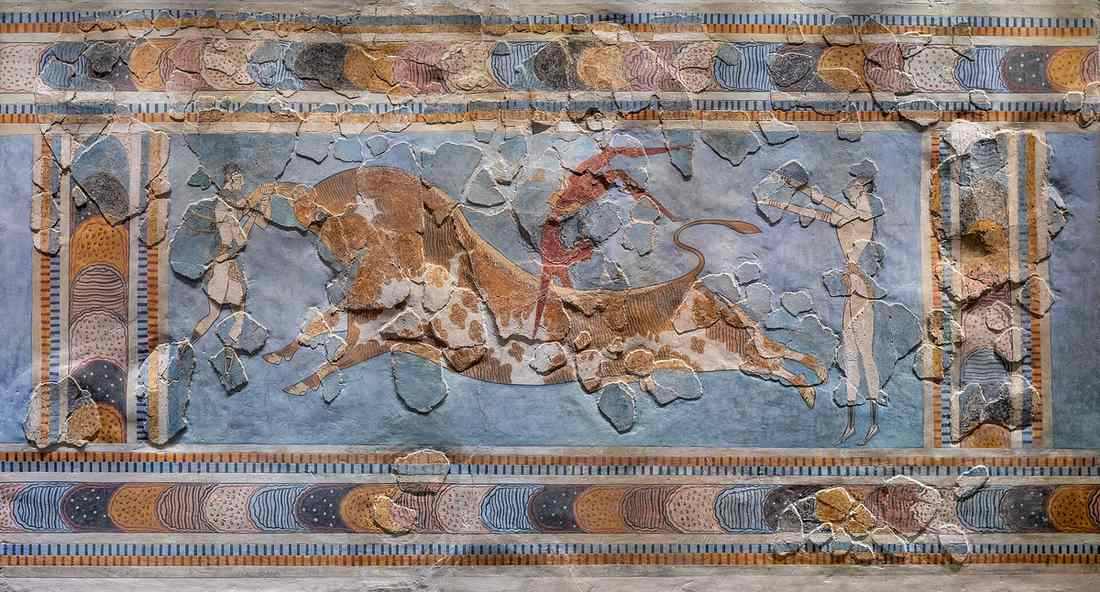
The bull-leaping fresco, also called the Toreador fresco, is the most famous wall painting from Knossos, showing acrobats vaulting over a charging bull.
The bull-leaping fresco, sometimes known as the Toreador fresco, is the most celebrated of all the Knossos wall paintings and an icon of Minoan art. It dates to roughly the fifteenth century before the common era, in the Late Bronze Age, and was found on the upper floor of the east wing of the palace. It depicts the ritual in dynamic detail: a great bull shown in mid-charge, with athletic figures around it, one apparently grasping the horns, one somersaulting over the bull’s back, and one positioned behind, perhaps to catch the leaper. The composition brilliantly conveys the movement, danger and grace of the sport.
The panel follows a distinctive Minoan artistic convention. Figures with pale, white skin and darker, red-brown skin appear together, and many scholars read this as the Minoan code for female and male bodies, which would make the scene a mixed team of leapers rather than a single repeated athlete. The painting sits within a decorative border of coloured bands, a common Minoan frame. What survives is a composite of genuine fragments and careful modern restoration, so the smooth, complete image seen today includes reconstructed passages filled in by the excavators.
Painted in the bright Minoan palette of red, blue, yellow and white, the fresco captures the energy and elegance the Minoans prized. The bull is stretched into the flying-gallop pose, all four legs off the ground, a convention that reads instantly as speed and force. The slim, wasp-waisted figures, with their long curls and light dress, match the Minoan ideal of the body seen throughout the palace art. Together these choices make the panel less a snapshot than a distilled image of danger, poise and control.
The name Toreador fresco was coined by the excavators, who saw a loose parallel with Spanish bullfighting, though the comparison is misleading, since the Minoan ritual did not kill the animal. The painting was uncovered during the excavations of Sir Arthur Evans in the early twentieth century, and it was he who commissioned the restorations that completed the fragmentary scene. Understanding that the visible image blends ancient and modern work is essential to reading it honestly, and it is a theme that runs through the whole reconstructed palace.
Like the other famous frescoes at Knossos, the original is conserved and displayed in the Heraklion Archaeological Museum, while a replica is shown at the site in the position where it was found. Seeing both the replica in context and the original up close gives the fullest appreciation of this masterpiece. Our guide to the Knossos frescoes covers the wall paintings, and the next section covers how bull-leaping worked.
How did Minoan bull-leaping work?
The art suggests that Minoan bull-leaping involved an athlete grasping the horns of a charging bull and using its movement to vault and somersault over its back, landing behind it, with others assisting.
Exactly how Minoan bull-leaping worked is a matter of debate, since the only evidence is the art, and the feat depicted is extraordinarily difficult. The frescoes and figurines suggest a sequence in which the leaper approached or met a charging bull, grasped its horns, and used the animal’s upward toss of the head and its momentum to swing or somersault over its back, landing behind it. Companions helped to control the bull or catch the athlete, so the ritual reads as a team effort rather than a solo stunt.
Scholars have proposed several reconstructions of the technique. One holds that the leaper grabbed the horns and rode the toss of the head into a somersault, the version the Toreador fresco seems to show. Another argues that a direct forward vault over charging horns is physically impossible, and that the artist compressed several moments, or an approach from the side, into a single idealised image. A third suggests the leaper dived over the bull without touching the horns at all. Modern acrobats and rodeo experts have judged the frescoed pose to be at the very edge of what a human body could achieve.
Whatever the precise reality, it clearly required immense skill, training and courage, and carried real risk of injury or death. The uncertainty is part of the fascination, and it is one reason the scene has drawn so much scholarly attention.
Other Minoan objects fill in the picture of the ritual. A famous ivory figurine from Knossos, the so-called leaping acrobat, captures a leaper frozen in mid-air with arms outstretched, showing that sculptors as well as painters studied the pose. Bronze groups show a leaper and a bull together, and seal-stones compress the moment into tiny, precise images. These works, made in different materials by different hands, agree on the essentials: a charging bull, an airborne human, and the split second of contact. That agreement across media strengthens the case that a real ritual lay behind the art, even if the exact move is uncertain.
The staging would also have needed preparation. A charging bull in an enclosed court implies handlers to drive and control the animal, a trained team of leapers, and spectators kept at a safe distance. None of this survives directly, but the art implies an organised event rather than an impromptu display. Our guide to the key features of Knossos Palace covers the central court where it may have happened, and the next section covers its meaning.
What did bull-leaping mean to the Minoans?
Bull-leaping held deep religious and cultural meaning for the Minoans, reflecting the sacred power of the bull and perhaps serving as a ritual of skill, courage and connection with the divine.
Bull-leaping was far more than a sport or spectacle to the Minoans; it carried deep religious and cultural significance. The bull was a sacred and powerful animal in Minoan religion, associated with strength, fertility and the divine, and seen across the art and architecture of Knossos. A ritual centred on confronting and vaulting a bull was therefore almost certainly bound up with belief and ceremony rather than mere amusement, and its setting in the palace, the ceremonial heart of Minoan society, points the same way.
Scholars suggest bull-leaping may have been a religious rite, a ceremony of initiation, a display of skill and courage that proved or honoured the participants, or a symbolic act of harmony between humans and the powerful natural and divine forces the bull represented. Some read it as an affirmation of social order, a public demonstration that the community could master the wild through skill and ritual. Performed at significant occasions, probably in the central court before the community, it would have reinforced Minoan identity and values and linked the palace elite to the sacred.
The setting reinforces the religious reading. Bull-leaping scenes cluster in the palace, the same space that held the throne room, the shrines and the storerooms of ritual goods. A sport for pure entertainment need not be tied to such a place, but a rite that bound the community to the sacred bull belongs exactly there. Many scholars therefore see bull-leaping as part of the seasonal or festival calendar of the palace, staged at moments when the whole community gathered.
Some interpretations go further and connect the leap to ideas of death and renewal, reading the vault over the horns as a symbolic passage through danger and back to safety, a theme common in early religion. Others stress the social message, that the ritual displayed the courage and discipline of the young and confirmed the standing of the elite who staged it. These readings are not exclusive, and a single ritual could carry several meanings at once, religious, social and political.
Like much of Minoan religion, its exact meaning is uncertain, because the Minoans left no readable literature explaining their beliefs. What survives is the imagery, which is rich but silent. The consistency of the theme across the art, though, tells us the ritual mattered greatly. The next section covers the importance of the bull in Minoan culture.
Why was the bull important in Minoan culture?
The bull was a central sacred symbol in Minoan culture, representing power, fertility and the divine, and its image recurs across the art and architecture of Knossos.
The bull was one of the most important symbols in the entire Minoan culture, charged with religious and symbolic meaning. It represented power, strength, fertility and the divine, and its image recurs throughout Knossos and the Minoan world. It appears in the bull-leaping frescoes, in the great sculpted stone horns known as the horns of consecration that crowned parts of the palace, in rhyton vessels shaped as bulls’ heads carved from stone, and in countless ritual and artistic objects, from seal-stones to gold cups such as the famous Vapheio cups.
This reverence had practical roots as well as spiritual ones. Cattle were a measure of wealth and a source of food, hide and labour in the Bronze Age, so the bull naturally stood for prosperity and life. In Minoan hands that everyday importance was raised to the sacred, and the bull became a bridge between the human and the divine. The horns of consecration, set along rooftops and shrines, turned the whole palace into a landscape marked by the sign of the bull, so a visitor moving through Knossos met the symbol again and again.
The bull also appears in Minoan myth-history as the animal of Poseidon and of Zeus. In the later Greek stories, Zeus took the form of a bull to carry Europa to Crete, and a great bull sent from the sea fathered the Minotaur on the wife of King Minos. These tales were shaped by Greeks centuries after the Minoans, yet they keep circling back to Crete and to the bull, which suggests they preserve a faint memory of the animal’s real importance on the island. The bull-leaping ritual and these myths are two expressions of the same deep-rooted reverence.
This deep reverence for the bull lies behind both the ritual of bull-leaping and, later, the famous Greek legend of the Minotaur, the bull-headed creature whose name means the bull of Minos, kept in the labyrinth at Knossos. The myth, which arose long after the Minoan period, preserved a memory of the central importance of the bull at the palace. Our guide to the Minotaur and the labyrinth covers the legend, and the next section covers the scholarly debate.
Why do scholars debate the bull-leaping scenes?
Scholars debate whether the bull-leaping scenes show a literal, practised technique or an idealised, partly symbolic image, because the feat is so dangerous and the only evidence is the art itself.
The debate over bull-leaping turns on a simple problem: the paintings are vivid, but they are the only evidence we have, and the act they show is barely possible. There are no Minoan texts describing the ritual, no arena clearly built for it, and no bones or equipment that prove how it was staged. Everything rests on interpreting images that were made as art and religion, not as instruction manuals, and that the excavators partly restored.
One school reads the scenes literally, as a record of a real, practised sport performed by trained athletes before a crowd. Another treats them as idealised or symbolic, arguing that the frescoes compress the ritual into a single heroic pose that no leaper could hold, much as later art idealises its subjects. A middle view accepts a genuine ritual of engaging bulls while doubting that the exact forward somersault over the horns was ever the standard move. The question of the pale and dark figures adds another layer, since it bears on whether women took part in the ritual alongside men.
These debates matter because they shape how we picture Minoan society, its athletes, its religion and the role of women within it. They also warn against reading the frescoes as simple photographs of daily life. The honest answer is that bull-leaping was real and important, but its precise form is unknown, and the art both reveals and conceals it. The next section covers how to see the bull-leaping fresco and its setting today.
How can you see bull-leaping at Knossos today?
You can see a replica of the bull-leaping fresco at the Knossos site and the original in the Heraklion Archaeological Museum, and stand in the central court where the ritual may have taken place.
Seeing bull-leaping today means visiting two linked places. At the Knossos site, a replica of the fresco is displayed on the upper level of the east wing, near where the original was found, so you can view it in its architectural setting. From there you can look down over the great central court, the open space that many believe served as the arena, and picture how spectators might have watched from the surrounding wings and upper storeys. Standing at this spot joins the image to the place in a way no book can.
The original fresco is kept in the Heraklion Archaeological Museum in the city centre, a short transfer from the site. There, in the Minoan galleries, you can study the genuine painting up close, see which passages are original and which are restored, and compare it with the many other bull images the Minoans left, from rhyta to seal-stones. Pairing the site with the museum is the fullest way to understand the ritual, which is why so many guided tours combine the two on a single day.
A guide or audio guide adds greatly to the visit, explaining the technique, the interpretations and the symbolism as you stand in front of the fresco and the court. It is also worth seeking out the other bull imagery on display, from the great bull’s-head rhyton to the horns of consecration, which together show how thoroughly the animal ran through Minoan life. Seen as a group, these objects turn the single famous fresco into one thread in a much larger story of the sacred bull. Plan your visit and tours through our Palace of Knossos guide.
Frequently Asked Questions
What was bull-leaping in Minoan Crete?
Bull-leaping was a daring ritual sport central to Minoan culture, in which trained athletes confronted a charging bull and vaulted over its back, apparently grasping the horns and somersaulting across, with others assisting. It is one of the most famous customs associated with Knossos, depicted in the celebrated bull-leaping fresco and apparently performed in the great central court of the palace. Far from a simple game, it combined athletic daring, performance and deep religious meaning, reflecting the sacred power of the bull in Minoan belief. Unlike later bullfighting, it did not kill the bull. The exact technique is debated, as the feat is extraordinarily difficult and the art may be partly stylised, but it clearly required immense skill and courage.
What does the bull-leaping fresco show?
The bull-leaping fresco, also called the Toreador fresco, is the most famous wall painting from Knossos and shows the ritual of bull-leaping in vivid colour and movement. It depicts a great bull in mid-charge with three athletic figures around it: one apparently grasping the bull’s horns, one somersaulting over its back, and one positioned behind, perhaps to catch the leaper. The pale and dark skin tones may distinguish female and male athletes, following a Minoan artistic convention. The composition brilliantly conveys the danger, skill and grace of the sport. The original, a composite of genuine fragments and modern restoration, is displayed in the Heraklion Archaeological Museum, while a replica is shown at the Knossos site where it was found.
Why was the bull important to the Minoans?
The bull was a central sacred symbol in Minoan culture, representing power, strength, fertility and the divine. Its image recurs throughout Knossos and the Minoan world, in the bull-leaping frescoes, in the great sculpted stone horns of consecration that crowned the palace, in vessels shaped as bulls’ heads, and in many ritual objects. Cattle were also a measure of wealth in the Bronze Age, which reinforced the animal’s link to prosperity and life. This deep reverence for the bull lies behind both the ritual sport of bull-leaping and, later, the Greek legend of the Minotaur, the bull-headed creature whose name means the bull of Minos, kept in the labyrinth at Knossos. The myth preserved a memory of the central importance of the bull at the palace.
Where can you see the bull-leaping fresco?
You can see the original bull-leaping fresco in the Heraklion Archaeological Museum on Crete, where it is displayed among the Minoan wall paintings in the ground-floor galleries. A faithful replica is shown at the Knossos site itself, on the upper level of the east wing, near the spot where the original was excavated, so you can view it in its architectural context. Seeing both gives the fullest appreciation: the replica shows how the painting related to the palace, while the original lets you study the genuine colours and brushwork and see which parts were restored. Many guided tours combine the site and the museum on the same day, which is the ideal way to follow the ritual from its setting to its surviving art.