
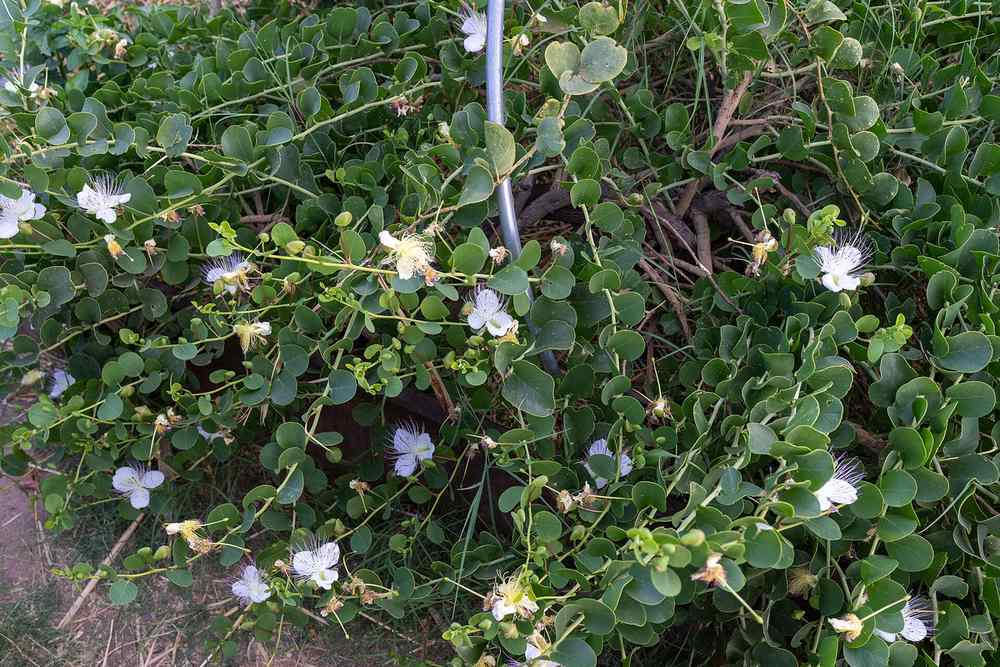
Milos capers and caper leaves are a signature local ingredient, picked wild from the volcanic rocks and woven through the island cuisine. Plan food trips and tours through My Greece Tours.
Capers are a flavour cornerstone of the Milos travel guide. The sections below cover what makes Milos capers special, the dishes that use them, how they are harvested and cured, where to buy them and where to taste them.
What are Milos capers and why are they special?
Milos capers are the pickled flower buds and tender leaves of the wild caper bush that grows on the island’s volcanic rocks.
Capers grow wild on Milos. The bush clings to the rocks. The volcanic soil feeds it. The flavour intensifies.
Both buds and leaves are used. The buds give the classic caper. The leaves add a tangier note. Both star in the kitchen.
The taste is bold. Salt and tang dominate. A bitter edge lingers. The punch defines dishes.
Tradition prizes them. Locals pick them each summer. Recipes pass down. The flavour endures.
Capers are one of the most distinctive flavours of Milos, a wild ingredient deeply tied to the island’s volcanic landscape and culinary identity. The caper, known in Greek as kapari, is the unopened flower bud of a hardy bush that thrives in poor, rocky and salty ground, clinging to the volcanic cliffs, dry-stone walls and bare hillsides where little else grows. On Milos it flourishes, drawing flavour from the mineral-rich soil.
What makes Milos capers special is both their quality and the way the whole plant is used. As well as the familiar pickled buds, the tender young caper leaves, kaparofylla, are harvested and cured, giving a softer, tangy ingredient prized across the Cyclades. The intense, salty, sharp taste that results is unmistakable and adds character to a wide range of island dishes. Our Milos food guide covers the wider cuisine, and the next section covers the dishes that use them.
What dishes on Milos use capers?
On Milos capers and caper leaves feature in the local caper salad, in the island speciality ladenia flatbread, in fava and tomato dishes, with grilled fish and in rusk-based salads.
Capers thread through Milos cooking. Salads showcase them. Flatbreads carry them. Fish welcomes them.
The caper salad stars. Leaves and buds dress the plate. Onion and herbs join. The tang refreshes.
Ladenia loves them. The local flatbread holds tomato and onion. Capers sharpen it. The bite delights.
Fish pairs naturally. The brine cuts the richness. The salt lifts the catch. The match works.
Capers and caper leaves appear across the everyday cooking of Milos, their salty tang used to lift and season a range of dishes. A classic is the local caper salad, in which cured caper leaves and buds are tossed with onion, herbs and a little oil and vinegar into a refreshing, intensely flavoured side. They also star in the island’s signature ladenia, a tomato-and-onion flatbread sometimes scattered with capers for an extra sharp bite.
Beyond these, capers turn up with creamy fava, in tomato-based dishes, in rusk salads with tomato and local cheese, and as a natural partner to grilled fish, where their brine cuts through the richness of the catch. They are also simply served as a meze with bread and a drink. This versatility makes them a quiet workhorse of the island’s kitchen. Our Milos seafood guide covers the fish they accompany, and the next section covers how capers are harvested and cured.
How are Milos capers harvested and cured?
Milos capers are hand-picked wild from the rocks in summer, when the bushes flower, then cured in salt or brine to tame their natural bitterness. The young leaves are gathered and pickled too, a labour-intensive traditional process passed down through island families.
Harvest comes in summer. The bushes flower then. Pickers comb the rocks. The buds are gathered by hand.
Hand-picking is slow work. The buds hide among leaves. The bushes grow on cliffs. Patience fills the basket.
Curing tames the bitterness. Salt or brine draws it out. Days of soaking follow. The flavour mellows.
Leaves are cured too. The tender shoots are picked. Brine softens them. The tang remains.
Harvesting capers on Milos is a traditional, labour-intensive task carried out through the summer, when the caper bushes come into flower. The unopened buds must be hand-picked one by one from the spiny, sprawling plants that grow wild on the rocks, cliffs and walls, a slow and fiddly job, while the tender young leaves are gathered separately. It is work that island families have done for generations, often for their own kitchens.
Fresh capers and caper leaves are too bitter to eat raw, so they are cured to draw out the bitterness and develop their characteristic flavour. Traditionally this is done by packing them in coarse sea salt or steeping them in brine, sometimes with vinegar, over a period of days, with the water changed to soften the sharpness. The result is the intensely savoury, tangy ingredient that defines so much of the island’s cooking. The next section covers where to buy Milos capers.
Where can you buy Milos capers?
You can buy Milos capers and caper leaves in local grocery shops, delis and markets in Adamas, Plaka, Pollonia and the villages, often jarred by small island producers.
Capers fill the local shops. Delis stock the jars. Markets sell them loose. The villages supply them.
Adamas leads the search. Grocery shops line the port. Jars crowd the shelves. The choice runs wide.
Small producers jar them. Family labels appear. The capers travel well. The quality shows.
They make a fine souvenir. The jar packs easily. The flavour lasts. The taste of Milos travels home.
Buying capers is easy on Milos, where they are sold as a local speciality in grocery shops, delicatessens and markets across the island. The port town of Adamas has the widest choice, with shops stocking jars of capers and caper leaves alongside other island products, while the villages of Plaka, Pollonia and Triovasalos also have stores selling them, often produced by small local makers.
Jarred capers and caper leaves cured in salt or brine are the most practical form to buy, sealing in the flavour and travelling well, which makes them a popular and authentic souvenir, an easy way to carry a genuine taste of Milos home. Buying from a small local producer supports the island’s traditional food culture and usually means a better product. Look out for caper leaves in particular, which are harder to find elsewhere. Our Milos shopping guide covers local products, and the next section covers where to taste capers on the island.
Where can you taste Milos capers on the island?
You can taste Milos capers at tavernas across the island, especially in the fishing villages, where the local caper salad, ladenia and caper-dressed dishes feature on the menus.
Tavernas serve the capers daily. Village kitchens favour them. Menus list the salads. The flavour shines.
The caper salad is the start. Order it as a meze. The leaves and buds arrive. The tang refreshes.
Fishing villages do them best. Klima and Mandrakia cook traditionally. The capers meet the catch. The pairing sings.
Asking rewards the curious. Each taverna has its dish. The cook explains it. The taste surprises.
The best way to experience Milos capers is to taste them where they belong, at the island’s tavernas. Caper salads, ladenia and caper-seasoned dishes feature widely on local menus, particularly at the traditional, family-run tavernas in the fishing villages and the inland settlements, where the cooking leans on authentic island ingredients. Ordering a caper salad as a meze is the simplest and most rewarding introduction.
The waterside tavernas of villages like Klima, Mandrakia and Pollonia are ideal places to try capers alongside fresh fish, pairing the island’s signature flavour with its seafood in a beautiful setting. It is always worth asking the staff what caper dish they recommend that day, as recipes vary from kitchen to kitchen. A cooking class is another way to learn how capers are used. Our where to eat in Milos guide covers the tavernas, and rounds out a flavour-led visit to the island.
Few things capture the spirit of Milos as well as its capers. They are a wild ingredient in the truest sense, drawing their bold, salty flavour straight from the volcanic rocks that give the island its drama, then transformed by generations of patient hand-picking and curing into something unmistakably local. To order a caper salad at a village taverna, or to carry a jar of caper leaves home, is to taste the landscape itself. For travellers who like their holidays seasoned with a real sense of place, the humble caper offers one of the most authentic and memorable flavours the island has to give, a small wild treasure rooted in the rock.
What is the difference between caper buds and caper leaves on Milos?
Caper buds are the small, firm, unopened flower buds of the caper bush with a concentrated peppery tang, while caper leaves, kaparofylla, are the flat young leaves of the same plant, larger and softer with a milder, herbier version of the same flavour once cured.
Both come from the wild caper bush that clings to the volcanic rocks and dry-stone walls of Milos, and the whole plant is edible. The buds are the familiar caper, picked before they open, dense and salty with an intense mustard-and-lemon sharpness that a little goes a long way. Left to their own accord the buds would bloom into a white-and-pink flower and then set fruit, the elongated caper berry, which is also pickled and eaten.
Caper leaves are the island speciality that visitors most often overlook. Picked young and tender, roughly the size of a small coin, they are cured in salt or brine until their bitterness fades into a soft, tangy, slightly crunchy leaf. Cooks fold them through the local caper salad, scatter them over a rusk with tomato and cheese, or serve them as a meze with bread and ouzo. Because the leaves are fiddly to harvest and rarely exported, tasting them is one of the more distinctive food experiences of a trip covered in our Milos food guide.
How do you prepare and cook with Milos capers at home?
To cook with Milos capers, first soak salted capers or leaves in cool water and rinse them to draw out the excess salt, then add them late to a dish, and skip adding any extra salt because the capers already carry plenty.
Capers and caper leaves reach the kitchen packed in dry salt or in brine, so a short soak and rinse tempers their saltiness to taste. Rinsing more mellows the flavour, while a lighter rinse keeps the sharp, briny hit that defines them, so the amount is a matter of preference. Because the cure has already seasoned them heavily, the golden rule is to hold back on salt in any dish that carries capers, then adjust only at the end.
Their tang lifts simple food. Chopped capers finish a Greek salad, sharpen a fava dip, and cut through the richness of grilled fish, tomato sauces for pasta and slow-cooked kapari yiachni. Cooks fry caper leaves and buds into fritters, the kaparokeftedes, fold them through egg and potato salads, and pile them on a barley rusk with grated tomato and cheese for a Cycladic meze. Adding them near the end of cooking keeps their texture and flavour bright, since long heat dulls the punch that makes them worth using. Pair them with the island’s cheeses in our Milos food guide.
Frequently Asked Questions
What are capers from Milos?
Capers from Milos are the pickled, unopened flower buds of the wild caper bush, a hardy plant that grows on the island’s volcanic rocks, cliffs and dry-stone walls. Known in Greek as kapari, they are prized for their intense, salty, tangy flavour and are a defining local ingredient. On Milos the tender young caper leaves, kaparofylla, are also harvested and cured, giving a softer but equally tangy ingredient. Both are hand-picked wild in summer and cured in salt or brine to remove their natural bitterness. Capers feature across the island’s cuisine, from caper salads to the local ladenia flatbread and grilled fish.
What do you eat capers with on Milos?
On Milos, capers and caper leaves are eaten in a range of traditional dishes. The classic is the local caper salad, where cured leaves and buds are tossed with onion, herbs, oil and vinegar. Capers also feature in the island’s signature ladenia, a tomato-and-onion flatbread, in rusk salads with tomato and local cheese, with creamy fava, and as a natural partner to grilled fresh fish, their brine cutting through the richness. They are also served simply as a meze with bread. Ordering a caper salad at a village taverna is the best way to taste this signature island flavour.
Can you buy capers as a souvenir from Milos?
Yes, capers make one of the best and most authentic souvenirs from Milos. They are sold as a local speciality in grocery shops, delicatessens and markets across the island, especially in Adamas, often jarred in salt or brine by small local producers. Jarred capers and caper leaves seal in the flavour and travel well, making them an easy and genuine taste of Milos to take home. Caper leaves in particular are harder to find elsewhere and worth seeking out. Buying from a small local maker supports the island’s traditional food culture and usually means a higher-quality product.
Do you need to rinse Milos capers before eating them?
Rinsing Milos capers before eating them is a matter of taste rather than a strict rule. Capers cured in dry salt or brine carry a heavy saltiness, so a quick soak and rinse in cool water mellows them and suits milder dishes. Cooks who want the full sharp, briny punch use them straight from the jar with only a light rinse. Either way, hold back on adding salt to any dish that includes capers, because the cure has already seasoned them well and a second dose of salt easily overwhelms the plate.
What does a Milos caper salad taste like?
A Milos caper salad tastes bright, tangy and savoury, built around cured caper leaves and buds tossed with onion, herbs, olive oil and vinegar. The capers bring a salty, peppery sharpness, the onion adds bite, and the oil rounds it into a fresh, appetising meze. Served with bread and often alongside grilled fish or local cheese, it is one of the most characteristic flavours of the island. Ordering it at a village taverna in Plaka or Adamas is the simplest way to understand why capers define the Milos table and why locals treat the salad as a summer staple.
When are capers harvested on Milos?
Capers on Milos are harvested through the summer, when the wild bush is in bud and leaf on the island’s rocks and dry-stone walls. Pickers gather the tender buds before they open into flower, along with the young caper leaves, working by hand across the hot, dry terrain. The fresh harvest is then cured in salt or brine over the following weeks to remove its natural bitterness. This summer picking and curing keeps jars of Milos capers and caper leaves on shop shelves year-round, so a jar bought on a spring or autumn visit still carries the previous season’s wild harvest from the island’s rocks.