
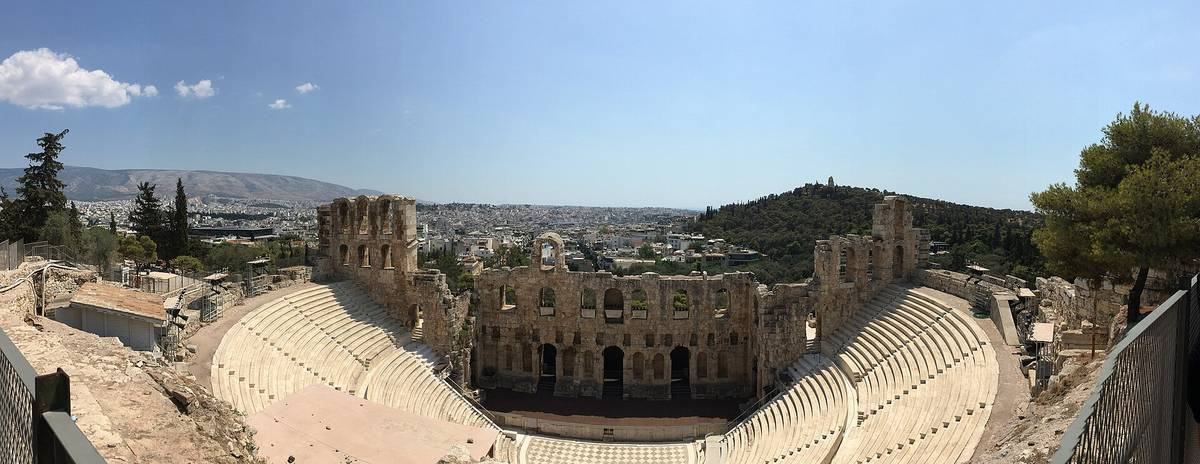
On the south slope of the Acropolis, the Theatre of Dionysus is the world’s oldest theatre and the birthplace of Greek drama, where the tragedies of Aeschylus, Sophocles and Euripides premiered before audiences of up to 17,000. Explore it on your way to the summit with skip-the-line tickets and guided tours from My Greece Tours for a richer, queue-free visit. Plan the whole trip with Greece Tours.
The Theatre of Dionysus is a highlight of the south slope in the Acropolis tickets and tours guide. The sections below cover its history, significance and how to see it in full.
What is the Theatre of Dionysus?
Carved into the south slope of the Acropolis and dedicated to the god Dionysus, the Theatre of Dionysus is an ancient open-air theatre. The oldest known theatre in the world and the birthplace of Greek drama, it hosted the great City Dionysia festival, where Classical tragedies and comedies premiered, and eventually seated up to 17,000 spectators.
The Theatre of Dionysus is one of the most historically important monuments on the Acropolis, even though it sits below the famous summit on the south slope. Built into the natural hillside beneath the sacred rock, it was part of the Sanctuary of Dionysus Eleuthereus and dedicated to Dionysus, the Greek god of wine, fertility and theatre. It holds a unique place in cultural history as the oldest known theatre in the world and, above all, as the very birthplace of Greek drama and therefore of Western theatre. Here, at the great religious festival called the City Dionysia, the citizens of Athens gathered to watch the first performances of the plays that founded the dramatic tradition. From humble beginnings as a simple performance space, the theatre grew over centuries into a substantial stone auditorium that could hold many thousands of spectators. For anyone interested in the origins of drama, it is a profoundly moving place to stand, set out alongside the guide to the Acropolis monuments. Its role in the birth of drama is its greatest claim to fame.
Why is the Theatre of Dionysus the birthplace of Greek drama?
The Theatre of Dionysus is the birthplace of Greek drama because it is where the City Dionysia festival was held, at which the tragedies and comedies of the great playwrights Aeschylus, Sophocles, Euripides and Aristophanes were first performed in competition. These works founded Western theatre, so the genres of tragedy and comedy were born on this very slope.
The Theatre of Dionysus earns its title as the birthplace of Greek drama because the foundational works of Western theatre were first staged on this spot. During the City Dionysia, a major annual religious festival honouring the god Dionysus, dramatic competitions were held in which playwrights presented new works before the Athenian public and judges. It was here that the masterpieces of the great tragedians Aeschylus, Sophocles and Euripides, and the biting comedies of Aristophanes, received their premieres, many of them performed for the very first time in this theatre. These plays, dealing with myth, fate, the gods, politics and the human condition, created the dramatic forms of tragedy and comedy that have shaped theatre, literature and storytelling ever since. The festival was a civic and religious event of huge importance, with the whole city attending, and winning the dramatic competition was a great honour. To stand in the Theatre of Dionysus is to stand at the origin of an art form that endures worldwide. This makes it one of the most significant cultural sites on Earth, set out alongside the guide to the history. Its physical development spanned centuries.
When was the Theatre of Dionysus built and how did it develop?
The Theatre of Dionysus began as a simple orchestra with wooden benches in the 6th century BC, when it first hosted the City Dionysia. Over time it grew into a great marble auditorium seating around 15,000 to 17,000, reaching its fullest extent in the 4th century BC under Lycurgus. The Romans later added a stage, with Nero modifying it in the 1st century AD.
The Theatre of Dionysus developed gradually over many centuries, evolving from a modest space into a monumental stone theatre. Its origins lie in the mid- to late-6th century BC, when a simple circular performance area, the orchestra, was laid out on the south slope with rows of wooden benches for spectators, and the City Dionysia festival was established here. As Athenian drama flourished in the 5th century BC, the golden age of the great tragedians, the theatre was enlarged and improved. Its grandest phase came in the 4th century BC under the statesman Lycurgus, who rebuilt it in stone and marble into a magnificent permanent auditorium, with tiered seating that could hold a vast audience, estimated at around 15,000 to 17,000 and possibly up to 25,000 spectators at its peak. The theatre remained in use into the Roman period, when further changes were made: it was damaged during the Roman general Sulla’s attack on Athens in 86 BC and later restored, and in the 1st century AD the emperor Nero added a monumental Roman stage building, giving the stage area its semi-circular form still visible today. This long evolution is visible in its ruins, set out alongside the guide to the Odeon of Herodes Atticus. There is much to see on site.
What can you see at the Theatre of Dionysus today?
Today you can see the curved tiers of stone seating carved into the slope, the marble thrones of honour in the front row, including the elaborately carved seat reserved for the priest of Dionysus, the remains of the orchestra where the chorus performed, and the carved figures decorating the Roman stage front. The setting beneath the Acropolis is atmospheric.
Although ruined, the Theatre of Dionysus still offers plenty to see and imagine, rewarding a visit on the way up the south slope. You can see the sweeping curved rows of stone seating cut into the hillside, giving a clear sense of the theatre’s huge scale and the experience of the ancient audience. The most striking surviving features are the marble seats of honour in the front rows, the prohedria, reserved for important citizens, priests and officials; among them is the beautifully carved central throne of the priest of Dionysus Eleuthereus, decorated with relief sculpture, which would have held the place of greatest honour. You can also make out the orchestra, the circular or semi-circular space where the chorus sang and danced and the action unfolded, and the remains of the stage building, the skene. The front of the Roman stage is decorated with carved relief figures from mythology, including scenes relating to Dionysus. All of this lies in an atmospheric setting directly beneath the towering rock of the Acropolis. Lingering here brings the ancient performances to life, set out alongside the guide to the Acropolis Museum highlights. Visiting it is simple and included.
How do you visit the Theatre of Dionysus?
Set on the south slope of the Acropolis, the Theatre of Dionysus is included in your standard Acropolis ticket. Enter from the south slope entrance near the Acropolis Museum and you reach the theatre on your way up to the summit. Allow extra time to explore it and the south slope, and go early or late to avoid crowds and heat.
Visiting the Theatre of Dionysus is easy and rewarding, and it is best combined with the climb to the Acropolis summit. The theatre lies on the south slope of the rock, within the Acropolis archaeological site, and crucially it is included in your standard Acropolis ticket at no extra cost, along with the other south-slope monuments. The most convenient way to see it is to enter the site from the south slope entrance, located near the Acropolis Museum and the Acropoli metro station, which leads you straight onto the south slope; from there you pass the theatre as you make your way up toward the Propylaea and the summit, so it fits naturally into your route. Allow some extra time to explore the theatre and the rest of the south slope properly rather than rushing past on the way up. As with the whole site, the exposed slope can be hot and busy, so visiting early at opening or in the late afternoon is most comfortable, and a guide greatly enriches the experience by explaining the birth of drama here. The Theatre of Dionysus is a moving, must-see part of any Acropolis visit, set out alongside the guides to getting to the Acropolis and a one-day itinerary. The questions below cover the points visitors ask most.
What was the City Dionysia festival?
The City Dionysia was the great annual festival of Dionysus held in Athens each spring, centred on the Theatre of Dionysus. It featured grand processions, sacrifices and, above all, dramatic competitions in which playwrights presented new tragedies and comedies before the whole city. Winning was a high honour, and the festival gave birth to Western theatre.
To understand the Theatre of Dionysus, it helps to know about the City Dionysia, the festival for which it was the stage and the engine of ancient Greek drama. Held each spring in honour of Dionysus, the god of wine, fertility and theatre, the City Dionysia, also called the Great Dionysia, was one of the most important events in the Athenian calendar, a grand civic and religious celebration that drew the whole city and visitors from across the Greek world. It opened with solemn processions carrying the statue of the god, sacrifices and ceremonies, but its heart was the dramatic competition: over several days, leading playwrights presented their new works in the theatre, with tragedies performed in sets of three plus a satyr play, and comedies on their own days, all judged by a panel, with prizes awarded to the best playwrights, sponsors and actors. It was here that the masterpieces of Aeschylus, Sophocles, Euripides and Aristophanes premiered before audiences of many thousands. The festival combined worship, civic pride, spectacle and artistic competition, and in doing so it created and nurtured the dramatic forms that became the foundation of Western theatre. Knowing the festival brings the ruined theatre to life, set out alongside the guide to the history. The questions below cover the points visitors ask most.
How did drama begin at the Theatre of Dionysus?
Drama began at the Theatre of Dionysus when choral hymns to the god, called dithyrambs, gained a solo speaker. Tradition names Thespis as that first actor. He won the first tragedy contest at the City Dionysia around 534 BC.
A dithyramb was a hymn sung and danced by a chorus of fifty men. Aristotle traced tragedy back to the leaders of these choruses. The word “thespian” for an actor comes from the name of Thespis.
The tyrant Pisistratus set up the City Dionysia in its classical form at about the same time. The festival fell in the month of Elaphebolion, in late March or early April. The sailing season had reopened by then, so visitors from across the Greek world filled Athens.
Aeschylus added a second actor to the stage. Sophocles added a third. With three actors and a chorus, the form of Greek tragedy was complete.
Which famous plays premiered at the Theatre of Dionysus?
The Theatre of Dionysus in Athens saw the premieres of Aeschylus’s Oresteia, Sophocles’s Oedipus Rex and Antigone, Euripides’s Medea and The Bacchae, and Aristophanes’s comedy The Clouds. Theatres across the world still stage these plays today.
Aeschylus won first prize with the Oresteia in 458 BC. It is the only complete trilogy of Greek tragedy to survive.
Sophocles’s Oedipus Rex took second prize, around 429 BC. Euripides’s Medea placed third in 431 BC. The Bacchae premiered after the death of Euripides and won first prize.
Aristophanes staged The Clouds in 423 BC, with the philosopher Socrates as a character. The ancient theatre of Epidaurus stages Greek tragedies and comedies each summer during the Athens Epidaurus Festival.
What else stands in the Sanctuary of Dionysus beside the theatre?
The Sanctuary of Dionysus Eleuthereus holds the foundations of two temples of the god, one from the 6th century BC and one from the 4th century BC. Above the seats rise two Corinthian columns and the cave of the Choragic Monument of Thrasyllus.
The cult statue of the god came from Eleutherae, a town on the border of Attica and Boeotia. Each year a procession re-enacted its arrival in Athens.
Thrasyllus won a chorus contest in 320 BC and set up his monument in the rock face above the theatre, below the Parthenon. The cave later became the chapel of Panagia Chrysospiliotissa. The two columns once held bronze tripods, the prizes of winning choruses.
The theatre lay buried under earth for centuries after antiquity. Excavation began in the 1830s. The seats, the orchestra and the sanctuary came to light over the following decades.
How long does a visit to the Theatre of Dionysus take?
A visit to the Theatre of Dionysus takes 20 to 30 minutes. That covers the seats, the priest’s throne and the stage reliefs. The Peripatos path then leads west past the Stoa of Eumenes to the Odeon of Herodes Atticus.
The Stoa of Eumenes was a long portico built by King Eumenes II of Pergamon in the 2nd century BC. It gave theatre audiences shelter from sun and rain. The Asklepieion, a healing sanctuary, sits on the terrace above it.
The combined Acropolis ticket covers the Acropolis and its slopes, including this theatre, plus six other ancient sites in the city. The south slope has little shade. Sturdy shoes, a hat and water make the walk easier in summer, and the quiet hours at the Acropolis suit the climb.
Frequently Asked Questions
What is the Theatre of Dionysus?
Set on the south slope of the Acropolis and dedicated to the god Dionysus, the Theatre of Dionysus is an ancient open-air theatre. The oldest known theatre in the world and the birthplace of Greek drama, it hosted the City Dionysia festival, where Classical tragedies and comedies premiered, and eventually seated up to 17,000 spectators.
Why is the Theatre of Dionysus important?
The theatre is important as the birthplace of Greek drama and Western theatre. It is where the City Dionysia festival was held, at which the tragedies of Aeschylus, Sophocles and Euripides and the comedies of Aristophanes were first performed, founding the dramatic forms of tragedy and comedy that endure worldwide today.
Is the Theatre of Dionysus included in the Acropolis ticket?
Yes, the Theatre of Dionysus is included in your standard Acropolis ticket, along with the other south-slope monuments. Enter from the south slope entrance near the Acropolis Museum and you reach the theatre on your way up to the summit, so it fits naturally into your route at no extra cost.