
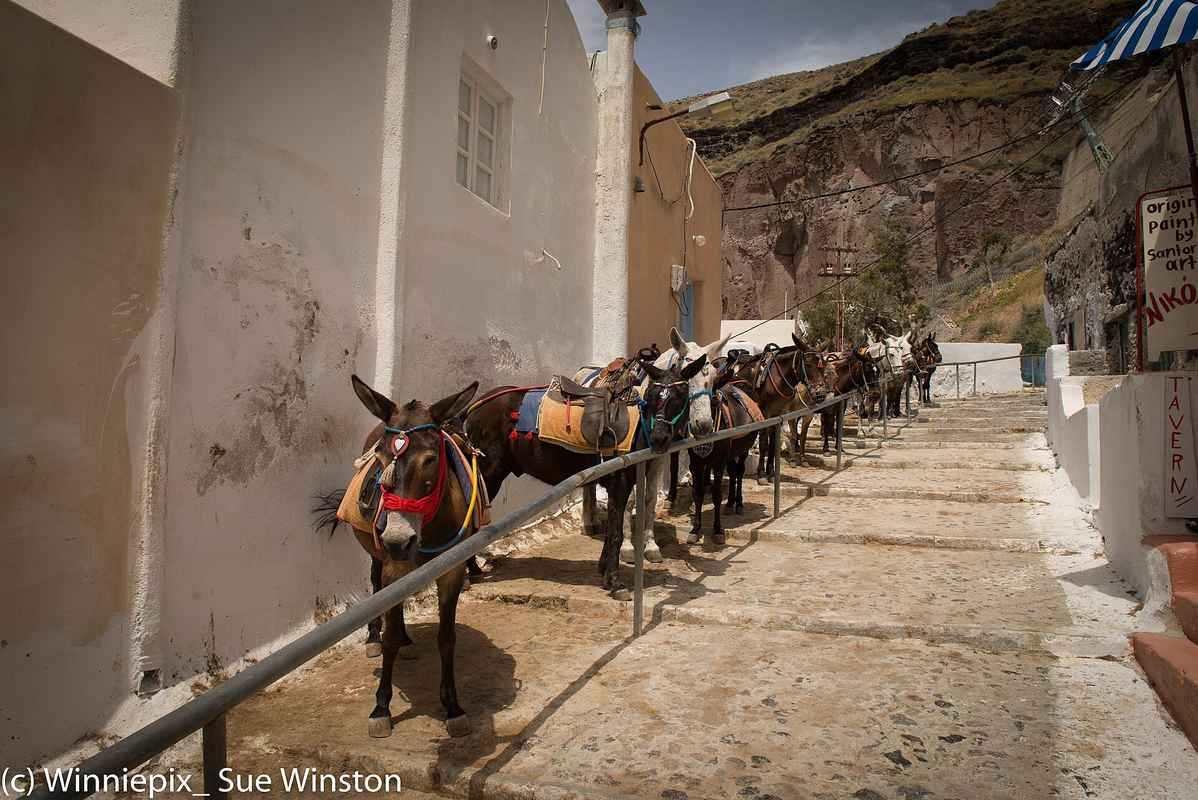
Santorini donkeys have long carried visitors up the steep 588 steps between the Old Port and Fira, a centuries-old tradition now shadowed by serious animal-welfare concerns. This guide covers the history, the ride, the welfare issues, the weight rules and the kinder alternatives to a donkey ride.
The donkeys are a famous but contentious sight in the wider Santorini travel guide. They work the caldera steps. The sections below cover the donkeys.
What are the Santorini donkeys?
The Santorini donkeys are working donkeys and mules that carry tourists up and down the steep 588 stone steps linking the Old Port with clifftop Fira. Once vital transport before the cable car, they remain a famous tradition, though welfare concerns now make riding controversial.
The donkeys are one of Santorini’s oldest images. For generations, before roads and the cable car, donkeys and mules were the only way to haul people and goods up the sheer caldera cliff between the Old Port, where boats arrived, and the town of Fira 300 metres above, climbing the zig-zag of 588 stone steps. Today there are three ways up and down that cliff: walking the steps on foot, riding the cable car, or taking a donkey. The donkey ride survives as a tradition and a tourist draw, but it has become deeply controversial on animal-welfare grounds, so many visitors now choose to admire the animals rather than ride them, set within the wider Santorini cruise port. The ride itself is short but steep.
What is the donkey ride like?
The donkey ride climbs the 588 steep, often slippery steps between the Old Port and Fira in around 15 to 20 minutes. The path is shared with walkers, hot and messy underfoot, and the ride can feel precarious. Many travellers avoid it on welfare grounds.
The ride covers the steep cliff path between sea and town. A donkey or mule carries you up the 588 stone steps from the Old Port to Fira, a climb of around 15 to 20 minutes up the exposed zig-zag, with sweeping views over the caldera. In practice the experience is rougher than it looks: the steps are steep, often slippery and shared with crowds of walkers, the path is hot and frequently fouled by the animals, and the ride can feel uncomfortable or precarious, especially going downhill. These realities, combined with the welfare questions, lead a great many visitors to decide against it and take the cable car or walk instead, set out alongside the guide to the Santorini cable car. The welfare issues are serious.
What are the welfare concerns?
The welfare concerns are serious: around 100 donkeys and mules carry tourists up and down hundreds of steep steps all day in the heat, with accounts of back injuries, sores and exhaustion. A national rule limits their loads, but enforcement stays inconsistent.
The treatment of the donkeys has drawn sustained criticism. Animal-welfare organisations report that roughly 100 donkeys and mules are made to haul visitors up and down over 500 steep, slippery steps all day long in the summer heat, often without adequate rest, water or shade, leading to back injuries, persistent sores and exhaustion. In response, Greek authorities introduced a national regulation limiting how much weight each animal may carry, intended to protect the larger donkeys from oversized loads, but enforcement has been patchy, particularly in high-volume spots like Santorini, and welfare groups continue to document violations and mistreatment. These concerns are the main reason ethical travellers now avoid the rides, set out alongside the guide to things to do. Kinder choices exist.
What are the alternatives?
The kinder alternatives are the cable car, which glides between the Old Port and Fira in three minutes for around 10 euros, or walking the 588 steps on foot. Both spare the animals, and you can still see and photograph the donkeys without riding them.
You can enjoy the cliff and the tradition without riding. The simplest, kindest option is the cable car, which carries you between the Old Port and Fira in just three minutes for around 10 euros, with fine caldera views and no impact on the animals, though queues build when cruise ships are in. Alternatively, walking the 588 steps on foot is free and rewarding, if steep, hot and shared with the donkeys, so wear good shoes and watch your step. Either way, you can still admire and photograph the donkeys at the bottom and top without adding to their burden, the choice welfare campaigners urge visitors to make, set out alongside the guides to getting around and Fira. The questions below cover the points travellers ask most.
Why are the donkeys part of Santorini history?
The donkeys and mules climb the 588 stone steps that zig-zag up the caldera cliff between the Old Port and Fira. Before the road and the cable car, this steep path was the only link between arriving boats and the clifftop town.
The donkeys carry centuries of island life on their backs. For generations, every visitor, sack of goods and barrel of water that reached Fira came up the cliff on a donkey or mule, since the harbour sat far below the town and no road crossed the sheer volcanic rock. Islanders bred hardy animals suited to the heat and the steps, and the caravans of donkeys became one of the defining images of Santorini alongside the blue domes and the caldera. The cable car and the modern port road ended that necessity, yet the animals stayed on as a tourist attraction. That heritage is part of why the tradition endures even as attitudes shift, set out alongside the guide to Santorini history.
How can you see the donkeys ethically?
You can see the donkeys without riding by watching them at the foot and top of the steps, where they rest between trips. Photographing them from the cable car or the walking path lets you honour the tradition while sparing the animals.
Seeing the donkeys does not have to mean adding to their load. The animals gather at the base of the steps by the Old Port and again at the top near Fira, so you get a close, unhurried view at either end without climbing aboard. The cable car runs parallel to the donkey path, giving a clear vantage over the caravans as it glides up the cliff. Walkers on the steps pass the animals too, though the path is steep and shared, so keep to the side and let them by. Choosing the cable car or your own feet is the option welfare campaigners recommend, and it still leaves you with the photographs and the story, set out alongside the guide to the Santorini cruise port.
Frequently Asked Questions
What are the Santorini donkeys?
The Santorini donkeys are working donkeys and mules that carry tourists up the steep 588 steps between the Old Port and Fira. Once vital transport before the cable car, they remain a famous tradition, though serious animal-welfare concerns now make riding them controversial.
How many steps do the Santorini donkeys climb?
There are 588 steps on the zig-zag path between the Old Port and Fira. The climb rises about 300 metres up the caldera cliff and takes most walkers around 20 to 30 minutes on foot.
Should you ride a donkey in Santorini?
Many travellers and welfare groups advise against riding a donkey in Santorini, due to accounts of injuries, sores and exhaustion among the animals working the steep steps all day in the heat. The cable car or walking the 588 steps are the kinder alternatives.
What is the alternative to the Santorini donkeys?
The alternatives are the cable car, which links the Old Port and Fira in three minutes for around 10 euros, or walking the 588 steps on foot. Both avoid burdening the animals, and you can still see and photograph the donkeys without riding them.