
Santorini history runs from the thriving Bronze Age town of Akrotiri, through the colossal Minoan eruption around 1600 BC that formed the caldera, to ancient Thera, Venetian rule and the modern age of tourism. This guide covers the prehistory, the eruption, the ancient and medieval island and Santorini today.
The island’s dramatic past underpins the wider Santorini travel guide. Its scenery is the work of a volcano. The sections below cover the history.
What is the early history of Santorini?
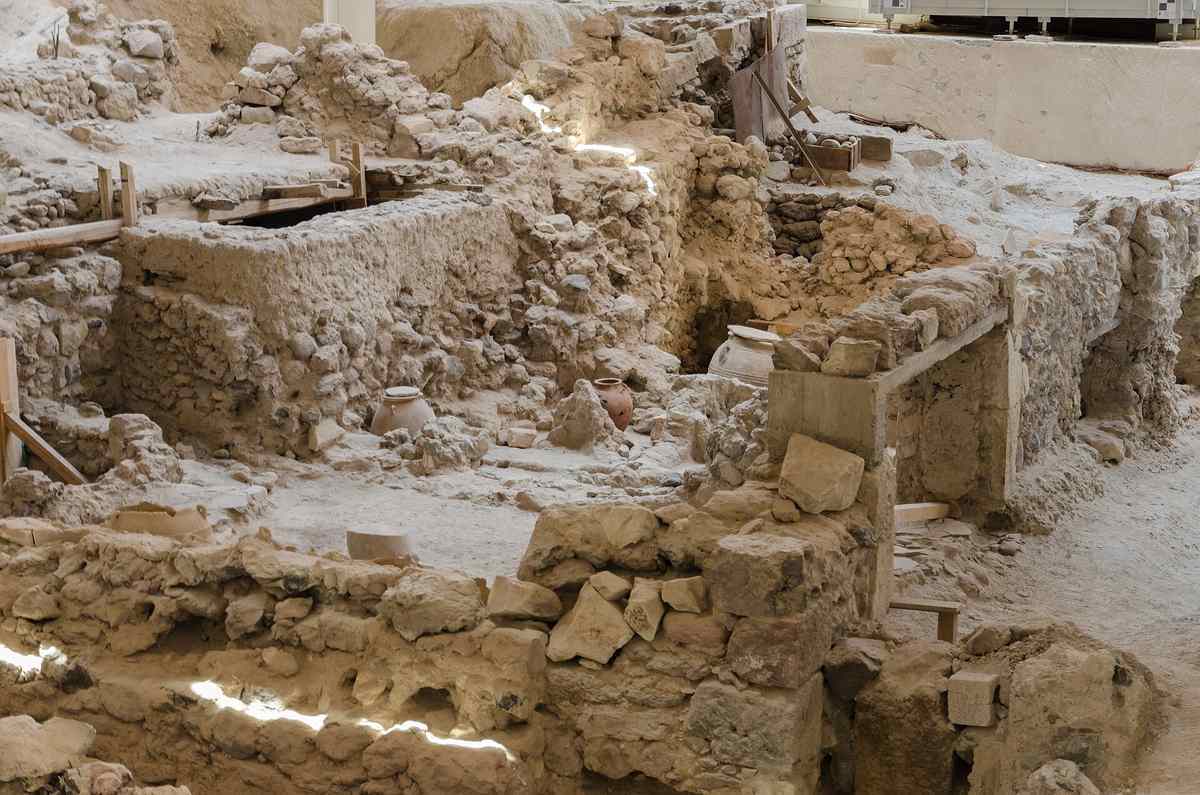
The early history of Santorini centres on Akrotiri, a Bronze Age town that flourished around two thousand to 1650 BC as a major Aegean port. It traded with Crete, Cyprus and Egypt, and had multi-storey houses, drainage and fine frescoes before the eruption.
Santorini’s story begins long before the famous villages. The island was settled in prehistory, and by around two thousand to 1650 BC the town of Akrotiri had grown into one of the Aegean’s major Bronze Age ports, closely linked to Minoan Crete. Excavations reveal an advanced settlement, with multi-storey buildings, paved streets, an elaborate drainage system and vivid wall frescoes. Finds from Crete, Anatolia, Cyprus, Syria and Egypt show its far-reaching trade. Crucially, no human remains have been found there, which suggests the inhabitants fled when warning tremors began, just before catastrophe struck the island, set within the wider Akrotiri story. The eruption changed everything.
How was Santorini formed?
Santorini formed through repeated volcanic activity over hundreds of thousands of years, building a large circular island. The Minoan eruption around 1600 BC then collapsed its centre into the sea, leaving the caldera, the cliffs and the surrounding islands you see today.
The shape of Santorini is the direct work of its volcano. Long before human settlement, layers of lava and ash from many eruptions built up a large, roughly round island in the southern Aegean. The island sits on the Hellenic volcanic arc, where the African tectonic plate slides beneath the Aegean plate and feeds the magma below. When the Minoan eruption emptied that magma chamber, the centre of the round island fell into the sea and flooded, forming the deep caldera bay. What remains is a crescent of steep cliffs, the smaller island of Thirasia across the water, and the dark volcanic islets of Nea Kameni and Palea Kameni at the bay’s heart, tied into the guide to the Santorini caldera. The eruption itself defines the island.
What was the Minoan eruption?
The Minoan eruption around 1600 BC was one of the largest volcanic events in human history, rated VEI 7. It ejected some thirty to forty cubic kilometres of rock and ash, collapsed the island’s centre to form the caldera, and buried Akrotiri.
The eruption is the defining event of Santorini’s past. Around 1600 BC the volcano detonated in a colossal blast, rated seven on the Volcanic Explosivity Index, ejecting an estimated thirty to forty cubic kilometres of dense rock and ash over roughly two weeks. It ranks among the greatest eruptions in recorded human history. The emptied magma chamber caused the centre of the then-circular island to collapse into the sea, creating the vast flooded caldera that gives Santorini its crescent shape and dramatic cliffs. It buried Akrotiri under metres of pumice, preserving it like a Greek Pompeii. It also unleashed tsunamis and ashfall that struck Minoan Crete, possibly hastening that civilisation’s decline. Antiquity followed.
What happened in ancient and medieval times?
In antiquity the island was resettled, and the Dorians founded ancient Thera on a high ridge in the ninth century BC, later a Greek, Hellenistic and Roman town. In 1204 AD the Venetians took the island and named it Santorini after Santa Irini.
Life returned to the island after the eruption. By the ninth century BC, Dorian Greek colonists had founded the city of ancient Thera high on the Mesa Vouno ridge above Kamari and Perissa. It grew through the Archaic, Classical, Hellenistic and Roman periods into a substantial town whose ruins survive today. After the Byzantine era, the island passed in 1204 AD to the Venetians, who gave it the name Santorini, a corruption of Santa Irini, the church of Saint Irene. Its official Greek name remains Thira. The Venetians built fortified settlements and castles and, importantly, developed the systematic cultivation of the island’s wine, set out alongside the guide to ancient Thera. The modern era transformed it again.
What are the myths of Santorini?
Santorini’s myths link it to the birth of the island Kalliste from a clod of earth given to the Argonauts, and to lost Atlantis. Many scholars connect Plato’s Atlantis account with a memory of the Minoan eruption.
Myth and history intertwine on Santorini. An ancient legend tells that the island rose from the sea when the hero Euphemus, sailing with the Argonauts, dropped a magical clod of earth given to him by the sea god Triton. From it grew the island the Greeks first called Kalliste, meaning the most beautiful. The most famous connection is with Atlantis. Plato described a wealthy island civilisation swallowed by the sea in a single day and night, and many researchers see in that story a distant memory of the Minoan eruption, which destroyed the advanced culture of Akrotiri and drowned much of the island. The tale keeps drawing visitors, tied to the guide on the Santorini volcano. The modern era reshaped daily life.
How did modern Santorini develop?
Modern Santorini was shaped by the destructive earthquake of nineteen fifty-six, which damaged the villages and prompted emigration. From the late twentieth century a tourism boom then turned the island into one of the world’s most famous destinations. The volcano remains active.
The island’s recent past saw both hardship and reinvention. A powerful earthquake in nineteen fifty-six caused widespread damage to the clifftop villages and triggered emigration, as many islanders left to rebuild their lives elsewhere. For a time Santorini was relatively quiet and poor.
From the late twentieth century, however, its extraordinary caldera scenery, sunsets and cave architecture fuelled a tourism boom. That boom has made it one of the most visited and photographed destinations on Earth. The volcano that created the island is dormant but still active, having last erupted in the mid twentieth century and continuing to build the islets at the caldera’s heart, set out alongside the guides to the Santorini volcano and things to do. The rulers between the Venetians and independence left their own marks.
Who ruled Santorini after the Venetians?
The Ottomans ruled Santorini from the late sixteenth century until the Greek War of Independence in the eighteen twenties, when the island joined the new Greek state. Catholic and Orthodox communities lived side by side, a mix still visible in Fira.
Foreign rule shaped Santorini for centuries. The Venetians held the island as part of the Duchy of the Aegean until the Ottomans took control late in the sixteenth century. Ottoman rule was relatively light, and the island prospered from its merchant fleet and its wine, which it exported across the Black Sea and beyond.
A distinctive legacy of the Venetian centuries is the sizeable Catholic community that grew up alongside the Orthodox majority, and Fira still has its Catholic quarter, cathedral and monastery beside the Orthodox cathedral. When the Greek War of Independence broke out in the eighteen twenties, Santorini and its ships joined the struggle, and the island became part of the new Greek state. That heritage of trade and faith feeds directly into the guide to Fira. The questions below cover the points travellers ask most.
Frequently Asked Questions
What is Santorini’s history?
Santorini’s history runs from the Bronze Age town of Akrotiri, through the colossal Minoan eruption around 1600 BC that formed the caldera, to ancient Thera founded by the Dorians, Venetian rule from 1204 AD, the mid-twentieth-century earthquake and the tourism boom that made the island world famous.
What was the Minoan eruption of Santorini?
The Minoan eruption around 1600 BC was one of the largest in human history, rated VEI 7, ejecting some thirty to forty cubic kilometres of rock and ash. It collapsed the island’s centre into the sea to form the caldera, buried the town of Akrotiri, and sent tsunamis and ashfall onto Crete.
How did Santorini get its name?
Santorini got its name from the Venetians, who took the island in 1204 AD and called it after Santa Irini, the church of Saint Irene. The name is a corruption of Santa Irini, though the island’s official Greek name remains Thira, after the Dorian founder of ancient Thera.
Why is Santorini linked to Atlantis?
Santorini is linked to Atlantis because Plato described a rich island civilisation lost to the sea in a day and a night. Many scholars see in that account a memory of the Minoan eruption, which destroyed the advanced town of Akrotiri and drowned the centre of the island.
When was Santorini first inhabited?
Santorini was first inhabited in prehistory, well before the Bronze Age. By around two thousand to 1650 BC the town of Akrotiri had grown into a major Aegean port trading with Crete, Cyprus and Egypt, until the Minoan eruption buried it and the island had to be resettled centuries later.
Is the Santorini volcano still active?
The Santorini volcano is still active, though it is currently dormant. It last erupted in the mid twentieth century and continues to shape the dark islets of Nea Kameni and Palea Kameni at the centre of the caldera, where boat trips visit the crater and the warm springs.
What is ancient Thera?
Ancient Thera is the ruined classical city founded by Dorian Greeks in the ninth century BC, high on the Mesa Vouno ridge above Kamari and Perissa. It grew through the Archaic, Classical, Hellenistic and Roman periods, and its stone streets, temples and houses can still be explored today.