
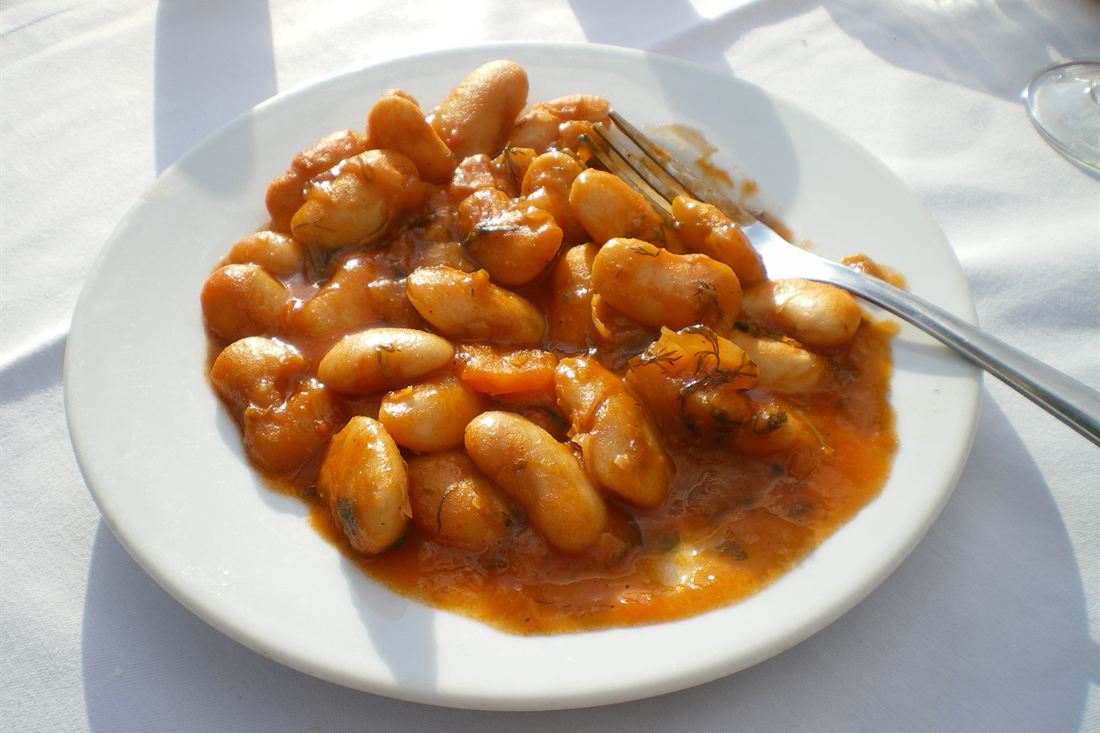
An Ithaca food tour sets out the cooking of the Ionian island of Odysseus: slow-baked island dishes, thyme honey, fresh fish from small harbours and sweets made in village kitchens. For more trips across the country, start at our Greece Tours homepage.
Read on for the food tours you can book, what the full-day tour includes, the dishes and products, the role of the sea, the village food stops, what Homer’s heroes ate, planning tips and the questions guests ask.
What is an Ithaca food tour?
It is a guided trip on Ithaca that puts a meal or a tasting into a day of sights. The food always comes with a story or a swim: mythology, legends, beaches or bays.
Ithaca, also called Ithaki, is a Greek island in the Ionian Sea, off the northeast coast of Kefalonia. The Strait of Ithaca separates the two islands. The main island is 23 kilometres long and 6 kilometres wide at its widest point. Wikipedia calls it mountainous and rocky, with limited arable land.
An Ithaca food tour on a booking site is a trip with more than one stop. One plan is a guided day on the island. A second adds a night there. A third sails from Kefalonia. Food is one part of each plan, next to a visit or a swim.
The titles show the mix. The first sets food beside mythology, culture and a beach. The second sets flavours beside legends. The third sets food beside hidden bays. Each plan puts a table next to a story or a stretch of sea.
Each GetYourGuide listing for an Ithaca food tour carries the same labels. They show the duration, any pickup, free cancellation and a booking cut-off. Read those four first, because they decide whether a trip fits your days on the island.
Local businesses use the same words. The travel site My Ithaca titles its Taste Local page “Ithaca food tour, gastronomy”. The page says its food tour will take visitors around Ithaca to enjoy local recipes. For the island itself, see Ithaca.
My Ithaca also explains the cooking behind that tour. It calls the cuisine of Ithaca minimalist, built on fresh seasonal ingredients and a model of the Mediterranean diet. Its page header reads “Food tells a tale of culture”. The site adds that terrain and a short water supply made farming hard.
Wikipedia links modern Ithaca to Homer’s Ithaca, the home of Odysseus in the Odyssey. That link explains why mythology appears in the titles. A traveller on an Ithaca food tour gets a meal and a legend in the same outing.
Booking pages sort each Ithaca food tour by length. Of the three listings below, the shortest is 8.5 hours and the longest is two days. A ten-hour tour sits between them. Pick the length first, because it decides how much of the island you see around the meal.
Which Ithaca food tours can you book?
Three GetYourGuide listings offer an Ithaca food tour. They are a 10-hour guided tour, a two-day overnight trip and an 8.5-hour small-group cruise. Two local businesses, My Ithaca and Ambrosia Cooking Class, add food programmes of their own.
- Ithaca: Full-Day Mythology, Culture, Food & Beach Tour lasts 10 hours. This Ithaca food tour is filed as a guided tour under Stavros, Ithaca on GetYourGuide. The next section sets out its details.
- Overnight in Ithaca: 2-Day Escape among Legends & Flavours lasts two days and counts as a multi-day trip. The summary names the School of Homer and a traditional meal. It adds a sunrise over Vathy Bay from the Monastery of Kathara.
- That overnight trip carries a pickup label and free cancellation. English is the only language offered. The booking form counts guests aged 18 to 99 as adults and guests aged 17 or younger as children.
- Exclusive Small-Group Ithaca Cruise with Food & Hidden Bays lasts 8.5 hours. It leaves from Agia Efimia harbor on Kefalonia aboard a modern sailing yacht. The summary promises swim stops at Ithaca beaches, Gidaki Beach among them, and food on board.
- GetYourGuide labels the cruise as a small group and files it under Kefalonia. Cancellation is free.
Each Ithaca food tour listing sets a booking cut-off. The full-day tour needs a booking at least 2 hours ahead. The overnight trip needs at least 40 minutes and the cruise at least 50 minutes. Book before the limit passes.
Viator lists a day cruise under Cephalonia that names food in its title. The title reads Luxury Day Cruises to Ithaca and adds swimming, snorkeling, food and more. Cephalonia is the name Viator uses for Kefalonia.
My Ithaca sells more than the Taste Local page. Its menu lists accommodation, packages, daily trips and rentals. Its activities fall into five groups: Taste Local, strolls around Ithaca, boating around the island, walking paths and workshops. A guest can pair a food day with a walk or a boat day.
The Taste Local page describes an Ithaca food tour but gives no stops, length or group size. It says only that the tour takes visitors around the island. Ask the business for the plan before you commit, because the page leaves those details out.
Ambrosia Cooking Class teaches hands-on group classes on Ithaca. Guests make a starter, a main course and a dessert, then taste the result. All utensils are provided, and guests take the recipes home. The page says the classes use herbs and seasonal products from island growers.
Ambrosia offers a class rather than an Ithaca food tour, and it runs from June to mid-October. Its page also lists olive oil soap making and boutique stays. It pitches hiking, scuba diving and sea kayaking for the rest of the visit. The page announces one year without classes, so confirm the schedule first.


What does the full-day Ithaca food tour include?
The full-day Ithaca food tour lasts 10 hours. It includes a guided visit to ancient sites and villages, a local tasting and a swim in the Ionian Sea. The title adds mythology, culture and a beach.
The summary adds coastal scenery to that list. Together the parts make a day that mixes history, sea and food. The tasting sits beside the sights, so the meal is part of the route and not a separate stop.
GetYourGuide marks this Ithaca food tour as a guided tour and files it under Stavros, Ithaca. The listing carries a pickup label and offers English only. Check the pickup point on the listing before you book.
Cancellation is free. The booking form counts guests aged 13 to 99 as adults and guests aged 12 or younger as children. Read the full listing for the stop order, the meeting point and the exclusions. Those details decide whether the day fits your plans.
The title promises culture, and an Ithaca food tour on this island has a record to back it. Wikipedia says coins from Ithaca frequently show Odysseus. It adds that a third-century BC inscription mentions a local hero-shrine of Odysseus. The same inscription names games called the Odysseia.
Ancient sites tie to Odysseus as well. Wikipedia names the School of Homer, an archaeological site on the island. It lies near royal remains. Greek archaeologists later found the remains of an eighth-century BC palace in the area of Agios Athanasios. Reports linked the find to Odysseus.
The Polis Cave near Stavros adds a second legend. Heinrich Schliemann identified it as a cave that Odysseus visited. Later research showed that people worshipped nymphs there, from the early Bronze Age to the Roman period. Both stories belong to the ancient sites of Ithaca.
The food side of the full-day Ithaca food tour is the tasting of authentic local delicacies. The summary does not name the dishes. It pairs the tasting with a swim in the Ionian Sea. That keeps the day a mix of table and shore.
Compare it with the other two trips before you pay. The cruise gives 8.5 hours on a yacht with food on board. The overnight trip gives two days with a traditional meal and a sunrise. The full-day Ithaca food tour sits between them in length and stays on land.
Which dishes does an Ithaca food tour serve?
Chicken tserepa, savoro fish, handmade pies and rovani, a honey and rice cake, anchor an Ithaca food tour menu. Each dish pairs island produce with a set method, from a sealed clay pan to a vinegar bath.
On an Ithaca food tour, chicken tserepa is chicken cooked with potatoes in a tightly closed baking pan. Traditional houses put that pan in a stone oven. The dish takes its name from the pan. The municipal tourism site names chicken tserepa as a characteristic Ithacan dish.
Chicken is not the only meat in the pot. Travel.gr says meat dishes on the island cook in the tserepa, an earthenware dish. Its restaurant guide also describes saucy lamb baked in a clay pot, just like the chicken. An Ithaca food tour can show both.
Rago is a ragu of lamb or goat in tomato sauce, with a whole head of garlic added. Jeria is goat or lamb liver cooked in a pan with eggs. Travel.gr lists both among the island’s meat dishes, and both suit an Ithaca food tour menu.
Two kinds of handmade pie sit on Ithacan tables. The meat pie holds mixed local meat, rice, handmade yeast and extra virgin olive oil. The green pie holds greens from the surrounding fields and local herbs, and can also hold local cheese. Both pies belong on an Ithaca food tour plate.
The municipality names the greens in the vegetable pies. They are artichokes, wild greens both sweet and bitter, sorrel, chicory and Swiss chard. Cooks find them in allotments, in gardens and on the surrounding hillsides.
Bambanada is dry bread soaked in a sauce of legumes. Travel.gr counts it among the dishes of the “poor cuisine”. Rignando is Ithaca’s version of bruschetta. Bread is dipped in water, then topped with oregano, olive oil, tomato and white local cheese.
Savoro begins with white fish. The cook cleans and scales it, salts it and leaves it for one hour. The fish gets a dusting of flour and goes into the frying pan until cooked.
Then comes the sauce. Sliced garlic fries in clean oil. Vinegar and black raisins join it and simmer for 5 to 10 minutes. The hot mixture covers the fish in a tray, and the ingredient list adds rosemary. Savoro is a dish to ask about on an Ithaca food tour.
The vinegar works as a preservative. A tray of savoro keeps for weeks if the cook turns the fish to coat every side. The same recipe adds that other parts of Greece use tomato paste in place of raisins.
A second local guide describes savoro as a local fish, such as barbouni, cooked with fresh tomato and local herbs. It says the dish began when homes had no refrigerator. Cooks pickled the fish in vinegar and olive oil with herbs and stored it in a clay vessel.
The Venetians influenced the cooking of the seven Ionian islands. The municipality notes that dishes such as savoro, poulenta, sofigado and polpette keep their Italian names today. Savoro carries that Venetian past onto an Ithaca food tour menu.
Rovani is the festive sweet of an Ithaca food tour. The ithacagreece.com recipe boils honey, sugar, oil and water, then adds ground rice slowly so the mixture stays smooth. The cook stirs with a wooden spoon until the colour matches honey. The cake bakes for about one hour.
A syrup of water, sugar and honey simmers for three minutes. The cook pours it over the rovani while the cake is still hot, then waits until it cools before slicing. The municipality describes rovani as a sweet of honey, rice and oil.
Three more sweets appear in the travel.gr article. Troufes come with almond or chocolate, sprinkled with chocolate. Hourmades are fried, syrupy honey cookies sprinkled with walnuts and cinnamon. Poutinga is a white bread pudding, a remnant of the English occupation. Each one can end an Ithaca food tour.
Which local products can you taste on an Ithaca food tour?
Olive oil, sage honey, feta from reddish sheep, fruit preserves and island herbs head the list. Small producers make them, and the municipality calls the island’s farming, livestock and fishing small scale. An Ithaca food tour can taste all of them.
The native olive tree is called thiakia. The municipality gives two more names, Anoisana and Plexidenia, and Travel.gr adds dopia. The tree grows up to eight metres tall and spreads long side branches. It gives fruit every other year.
The fruit is small, yet the oil is tasty, with an oil content of 20 to 22 percent. Marmakas, in the north, has the densest stands of the tree. The municipality says the larger part of the island’s oil is produced there. Every olive oil tasting on an Ithaca food tour starts from this tree.
The harvest starts the day after the feast of Agios Gerasimos. Pickers once climbed ladders and gathered olives by hand. Later they used combs called grampaounes, which threw the olives onto canvases spread around the tree.
Hand work still counts today. Pickers comb the large branches and make the first selection of fruit by hand. The press, called litrouvio in local speech, does the rest. The municipality gives the yield as 100 kilos of oil from 500 kilos of fruit.
Ithacan oil was once a barter item, traded for other products and for animals. In the kitchen, cooks use it liberally in hot dishes and on salads. Soups and vegetable dishes take it too. Skastes, or tsakistes, are unripe olives thrashed over a stone, a table olive of the island.
Ithaca honey stands out for its aroma. The municipality traces it to the wide range of pollen sources open to the bees, above all sage. It calls sage the queen of herbs. Local groceries and the summer bazaars in the square of Vathy sell sage honey. An Ithaca food tour shelf starts there.
Beekeeping is growing on the island, and an Ithaca food tour honey stop rests on it. The Beekeepers Association of Kefallonia and Ithaca runs seminars in Argostoli, supervised by the University of Athens. Old beekeepers, young people and food professionals attend them, according to the municipality.
The municipality names the Agricultural Association of Perachori as the island’s expert in sweet fruit preserves. The association also handles standardisation and production of local products such as honey. Grated quince, bitter orange, fig and berry preserves are the main kinds. Cranberry and pear preserves and quince jams follow. They are the sweet end of an Ithaca food tour.
A local breed, the reddish sheep, gives milk for a small feta production that follows a traditional process. The municipality compares the breed to the Syrian sheep. That breed is the common ancestor of sheep breeds across south-eastern Europe and the Middle East. Grocery stores sell the feta seasonally, and restaurants serve it, particularly in northern Ithaca.
A traditional cheese factory makes gruyere from local sheep milk. It also makes Tsemberi, a cheese that matures in a cave, and Katseno, a white cheese formed in a basket. The Book Ithaca site says the milk is limited in amount but of exceptional quality. It credits the island’s flora and fauna.
Breeders supply local restaurants with meat, and their animals graze on the mountains and fields. The same site says visitors can buy meat or cheese directly from breeders after making contact first. An Ithaca food tour can add that stop.
The stony, mountainous soil and the microclimate suit herbs. The municipality names sage, thyme, rosemary, chamomile, lemon balm, mint and sapsychos as standouts for quality and fragrance. Barbaroza grows in every garden and flavours the domestic spoon sweets.
Sage seasons local recipes, especially the meat pie on an Ithaca food tour. Cooks mainly use thyme dried, to flavour spicy dishes. Rosemary gives aroma, preserves meat and fish dishes and goes into sweets. Sapsychos is closely related to oregano, and cooks grow it in backyard pots all year.
When an Ithacan says “chamomile”, the cup holds a blend of chamomile, sage and dried cloves, the municipality notes. Ask whether a drink is the local blend before you order it on an Ithaca food tour.
How does the sea shape an Ithaca food tour?
Small-scale fishing off Ithaca’s shores supplies the island with fish and seafood. Certain fishermen sell straight from their boats early in the morning. Cooks turn the catch into savoro, grilled smelt, squid in ink and octopus pie.
Travel.gr states that fishing, prevalent off the island’s shores, and livestock farming give Ithaca self-sufficiency, even on a small scale. Fish sits in the same food supply as the island’s meat and vegetables. That link is what an Ithaca food tour follows.
The Book Ithaca site says restaurants in the seaside villages serve fresh fish and seafood with special recipes. It adds that certain fishermen sell fish straight from their boats early in the morning. Buyers get it as it comes out of the sea.
Travel.gr lists the fish dishes of the island:
- Gana, squid cooked in a pot with its ink.
- Sberna, grilled smelt.
- Maridaki cooked in the pan.
- Fried cod with a garlic sauce.
- Savoro mullet, with a sauce of vinegar, flour, oil and garlic.
Octopus has the widest range. The same article names octopus with short pasta, octopus pie, octopus kapamas and octopus on a skewer. That makes four ways to cook one catch. A seafood stop on an Ithaca food tour can serve any of them.
One restaurant in the travel.gr guide serves savoro with slices of tuna. It also serves a yellowfin tuna fillet with sauteed greens and a drizzle of fresh onion oil. The sea gives the main plate, and the garden gives the greens. An Ithaca food tour menu can pair them the same way.
Frikes, in the north-east, is described as a fishing village. Its small harbour fills with boats in the summer months, according to the Greek travel site travelgo.gr.
The municipality says Ithacan cooking uses oil from unripe olives, meat and fish reared and caught locally. Wild greens from gardens and hillsides join them. It adds that the recipes are simple and gain their character from the quality of the ingredients. The Ithaca food tour table holds fish and land produce side by side.
A boat can carry the meal out to sea. The sailing-yacht cruise listed as tour 358025 promises food on board, and its web address names lunch. That is the Ithaca food tour at sea.
Which villages and harbours set the table on an Ithaca food tour?
Vathy, Kioni, Frikes, Stavros and Anogi give an Ithaca food tour five stops of different scale. Vathy, Kioni and Frikes offer cafés and restaurants. Stavros has eateries around a shaded square, and Anogi has a single café-store.
An Ithaca food tour can start in Vathy, the island capital with the greatest tourist development. The municipal guide says it offers good food and entertainment, friendly people and a pleasant walk known as the soulatso. A travel.gr guide lists a seaside bar in Vathy that serves afternoon coffee.
Kioni lies 24 kilometres from Vathy. At the water’s edge, the municipal guide says, you can choose from a variety of cafés and restaurants. In the evening the three windmills at the entrance to the bay are lit up. From late spring to October the bay fills with sailing boats.
Frikes lies in the north-west of Ithaca, 19 kilometres from Vathy. On an Ithaca food tour it offers seaside fish restaurants, according to the municipal guide. Others stop for a drink or a sweet at one of the cafés. Two windmills above the harbour are lit at night.
Stavros, 17 kilometres from Vathy, is the main village of north Ithaca. Restaurants and coffee shops around its central square stand among pine and eucalyptus trees that give shade. The municipal guide says visitors sample traditional sweets and Ithacan cuisine there. It is a seated stop on an Ithaca food tour.
Anogi, 830 metres above sea level on Mount Niritos, has about 45 permanent residents. The municipal guide names one café-store in the village. A guardian who keeps the village church key is found in that café-store. On an Ithaca food tour, Anogi is one short café stop, not a meal.
Frikes lies 3 kilometres from Stavros and 5 kilometres from Kioni. Those three stops of an Ithaca food tour fit one short northern stretch. The bus line to the northern villages starts in Vathy. For a guided day for one group, see the Ithaca private tour page.
What did Homer’s heroes eat on Ithaca?
Homer’s heroes eat roast pork, barley meal, bread and meat in the Odyssey. The swineherd Eumaeus roasts pigs for the disguised Odysseus, and the suitors feast in the palace. An Ithaca food tour can use these scenes as reading, not as a menu.
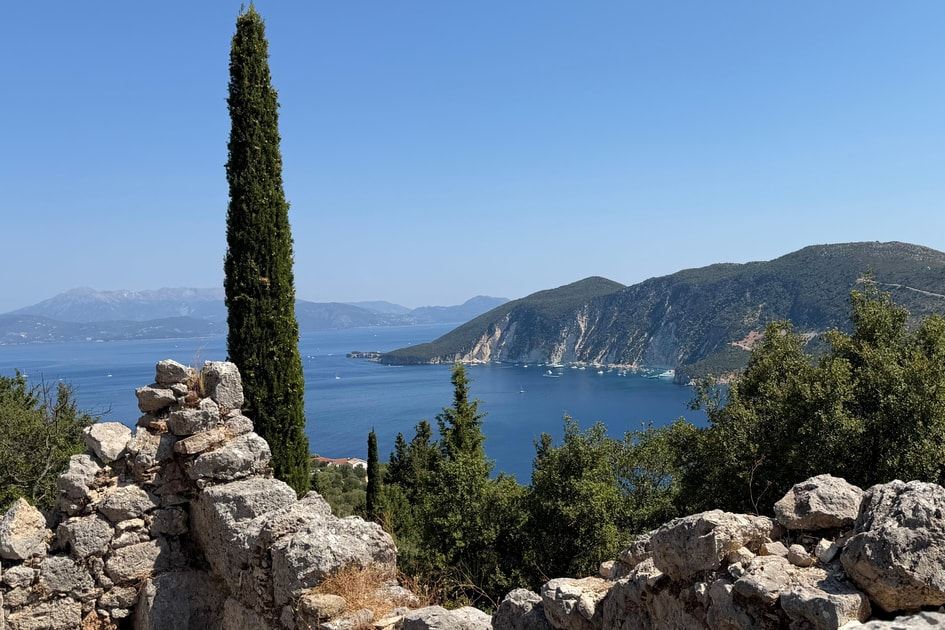
In A. S. Kline’s translation of Book 14, Eumaeus keeps twelve sties, with fifty breeding sows penned in each. The boars sleep outside, three hundred and sixty of them. The suitors have thinned the boars with their feasting, and Eumaeus sends them the pick of the fatted hogs.
Eumaeus then picks two pigs from the sties, slaughters and singes them, and cuts them into joints. He spits and roasts the meat. He serves it to Odysseus piping hot on the skewers, sprinkled with white barley meal. In his own words, he calls it sucking pig.
Supper at the hut is a larger meal. The herdsmen drag a fat five-year-old hog to the hearth. Eumaeus throws its bristles into the fire as a first offering. The men butcher it, roast the joints on spits and pile the meat on platters.
Eumaeus divides the meat into seven portions and sets one aside for the Nymphs and Hermes. Odysseus receives the boar’s long chine, which he calls the prime cut. A slave named Mesaulius serves out the bread, and everyone reaches for the food set before them.
In Book 1, the suitors sit on ox hides from beasts they slaughtered themselves. Servants set out plentiful servings of meat. For Telemachus and his guest, a housekeeper brings bread and a carver lifts plates of different meats. Maids pile bread in baskets beside the suitors.
In Book 17, Telemachus brings his guest Theoclymenus home. After their baths, the housekeeper sets bread and dishes of meat before them. Odysseus, still in his beggar’s disguise, goes round the suitors one by one. He fills his leather pouch with scraps of bread and meat.
The meals in these scenes are pork, barley meal, bread and meat. Kline’s Book 14 holds the herd at lines 1 to 47 and the first meal at lines 48 to 108. The supper is at lines 409 to 456.
The palace tables are in Book 1 at lines 96 to 155. Book 17 has them at lines 61 to 106 and 396 to 461. Read these passages before an Ithaca food tour begins.
How do you plan an Ithaca food tour?
Start at Vathy, the island capital, where the bus line to the northern villages begins. Ithaca is 23 kilometres long and up to 6 kilometres wide. An Ithaca food tour needs the route, the weather and your dietary needs settled before the day.
Ithaca has two parts of about equal size, joined by a narrow isthmus. The two parts enclose the bay of Molos, and Vathy stands on its southern branch. Stavros, in the northern part, is the second largest village on the island.
Pick one meeting point in Vathy and confirm it with the organizer. The KTEL bus starts very close to the central square. The bus links virtually all villages of northern Ithaca, and taxis run twenty-four hours.
Agencies in Vathy rent cars, motorbikes and bicycles for an Ithaca food tour by road. The municipality calls the road network good and tarred, apart from sections leading to remote beaches, which need a 4×4.
August on Ithaca has an average high of 29.3°C and one day of rain. July has an average high of 28.6°C and one rainy day. In summer, Frikes is the coolest seaside area and Vathy the warmest.
Midday heat waves can reach 40 degrees, but the municipal weather page calls that exceptional. Schedule the walking of an Ithaca food tour before midday.
Three village festivals fall in summer. Frikes honours the Holy Apostles on 30 June. Kioni celebrates the Prophet Elias on 20 July. Stavros holds the island’s largest festival on 5 and 6 August. Check your Ithaca food tour date against these. The Kioni evening celebration lasts throughout the night.
Greeka says restaurants in Greece are busiest between 8 p.m. and 10 p.m. It strongly recommends booking ahead at that hour for a specific restaurant. That includes a dinner stop on an Ithaca food tour. On the islands outside Santorini and Mykonos, Greeka says calling the restaurant in advance works fine.
Send your dietary needs to the organizer of the Ithaca food tour before the day. Greeka says animal products star in the majority of dishes at a typical Greek restaurant or tavern.
For celiac disease, ask the waiter to confirm there is no cross-contamination. People in remote rural regions can be unaware of what gluten is, so name the foods you avoid.


What do travellers ask about an Ithaca food tour?
Five questions come up before an Ithaca food tour: children, vegetarian food, allergies, meal times and tipping. Each answer below rests on a published source on Greek dining. Confirm the details with the organizer before the day.
Can children join an Ithaca food tour?
Greeka reports that a kids’ meal is rare in a Greek restaurant. Ask each stop for a small portion of an ordinary dish. Ask the organizer for seating and pauses that fit the children.
Can vegetarians join an Ithaca food tour?
Greeka says vegetarians and pescetarians are not as limited as vegans. Animal by-products, fish and shellfish appear in a plethora of dishes. Tell the organizer your diet in advance and ask which stops serve a meat-free meal.
How are food allergies handled on an Ithaca food tour?
The European Commission states the rule for the European Union. Non-prepacked food sold to the final consumer must come with information on allergy-causing substances. Ask for that information at every stop, and name your allergy to the organizer before the day.
What time do people eat in Greece?
Greeka puts lunch between noon and 5 p.m. and dinner between 6 p.m. and 11 p.m. On average, lunch is served around 2 p.m. and dinner around 9 p.m. People in northern Europe dine around 6 p.m., Greeka says, so a Greek dinner starts later.
Do you tip on an Ithaca food tour?
Tipping is not obligatory in Greece. A travel guide calls it customary but modest in a regular restaurant or taverna. The figure is 5 to 10 percent of the bill, or a round-up. For a paid guided tour, it names around 10 percent of the tour cost as a baseline.