
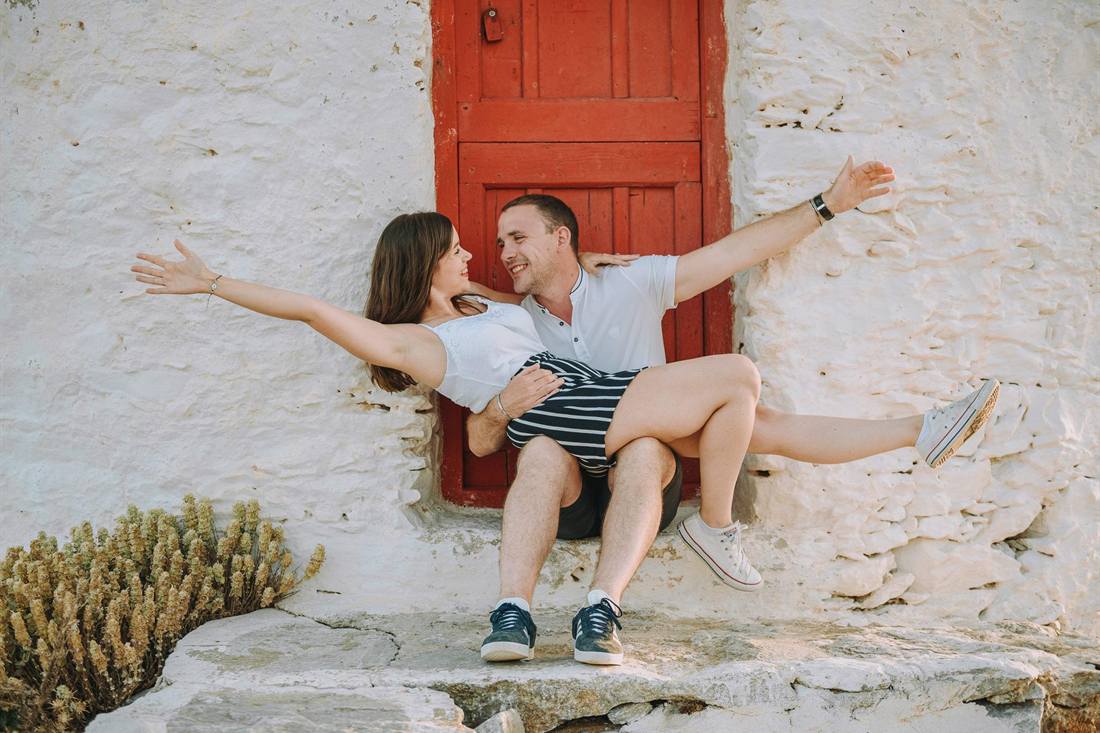
An Amorgos photoshoot pairs you with a local photographer for portraits in the white lanes of Chora and on the cliffs and coves of the easternmost Cyclades island. Line up the rest of the island trip on Greece Tours.
The answers below walk an Amorgos photoshoot through the booking, the backdrops of Chora, the monastery, the beaches and the villages, then the light, the wind, the clothes, the rules and the paths.
What is an Amorgos photoshoot?
A booked outing in which a local photographer guides you around the island and takes the pictures of you. Nobody in your group holds the camera. You leave with a set of photos taken at the island’s photo spots.
The idea is simple. A phone snapshot shows where you were. An Amorgos photoshoot hands the camera to a professional who knows the island. The whole group stays in the frame. For the island itself, see our guide to Amorgos.
The Cyclades group ends in the east with Amorgos, the island nearest to the Dodecanese. Wikipedia states that its geographical features prevent mass tourism. That sets the scene for an Amorgos photoshoot on a remote Aegean island, not a crowded one.
The word local carries weight here. One photography business lists its base as Athens and Amorgos island. Its site says the team knows the area and the light. It works across the Cyclades, Astypalaia and all of Greece.
A photo tour works in another way. The jeep tour on Paros drives guests to see landscapes and panoramic views of the Cyclades. The camera follows the scenery. In an Amorgos photoshoot, the camera follows you.
Booking sites state the goal in one short line. The Amorgos listing on GetYourGuide says guests explore the island with a local photographer. They take home natural photos and memories. The Paros listing says a professional photographer guides you through and takes pictures of you at the spots.
Which Amorgos photoshoot can you book?
GetYourGuide lists one: “Amorgos – Photography Experience”, a one-hour private session in Chora. A local photographer leads it for a group of up to four people, and the card shows free cancellation.
The booking card gives the facts below. Each one is read from the GetYourGuide widget for this listing.
- Location: Chora, Amorgos.
- Length: 1 hour.
- Group: private group, up to 4 people.
- Languages: English and Greek.
- Labels: Free cancellation and New activity.
- Booking cut-off: you must book at least 8 hours in advance.
Guests can book in English or in Greek. Plan the Amorgos photoshoot a day ahead, not on the morning itself. The cut-off means a same-day request needs a start time more than eight hours away. Free cancellation is on the card, but read the exact window in the full listing.
The card leaves out three points. It does not show the exact meeting point, the number of photos or the delivery date. It also shows no reviews yet. Open the inclusions on the full listing before you pay. Send any open question to the operator.
Three more Cyclades photo gigs sit on other islands, not on Amorgos. Each gets one line here.
- Private Vacation Photoshoot with Photographer in Paros: a private group, with a professional photographer taking the pictures.
- Naxos Flying Dress Photoshoot: a 50-minute session with pickup available.
- Paros: Jeep Photo Tour: a 6-hour off-road drive, for a group of up to 8.
The lengths differ widely. The Amorgos session lasts 1 hour, the flying dress session 50 minutes and the jeep tour 6 hours. For an Amorgos photoshoot on the island itself, the Chora session is the only gig on the list. Pick it when you want a short, private hour with a local photographer.
Which Chora lanes and windmills suit an Amorgos photoshoot?
Two settings carry Chora: the stone-paved alleys and the whitewashed windmills above town. Alleys give close frames between white walls and colored shutters. The windmill ridge gives wide frames, with the castle rock across from it.
Greeka describes Chora as a labyrinth of stone-paved streets and outspread white houses. The Amorgos municipality adds narrow winding alleys. For an Amorgos photoshoot, those plain white walls work as a clean backdrop that keeps the eye on you.
Greeka also lists colorful shutters on the whitewashed houses and flowers along the narrow alleys. A shutter adds a second color to a white frame. A flower pot adds a third. Your photographer can place you beside either one.
The town sits 400 meters above sea level, in the middle of the island, among rocky hills. Our page on the Chora of Amorgos covers the town itself. This part of the Amorgos photoshoot guide covers where to stand with a camera.
Greeka says the eleven windmills still standing are whitewashed with red roofs. Its text adds that the majority face the castle and the village. That shared direction gives every windmill frame in an Amorgos photoshoot the same view behind it.
Greeka gives the wall thickness as more than one meter. A thick white tower makes a solid shape in a photo. A pose beside one reads clearly, even from far away.
Wikipedia says a group of windmills stands on a hill above Chora. A couple can be visited, while others are locked or in ruins. There is no admission to enter the area. Reach it by car or on foot through Chora.
Greeka names the Troulos neighborhood as the way in and calls the walk an easy hike. Miles With Vibes adds a free public parking spot. From there, a short dirt path of no more than five minutes leads to the windmills. Check the route before your Amorgos photoshoot begins.
One windmill has stairs to a second floor and no roof. Miles With Vibes places it facing the castle, second from the end on the right. A roofless tower opens a frame to the open sky.
Which viewpoints over Chora suit an Amorgos photoshoot?
Four points look over Chora: the windmill ridge, the Kastro rock, the Prophet Elias chapel and Loza Square. The first three sit above the town. The square sits inside it, in the shade of tall trees.
Miles With Vibes calls the windmill ridge an ideal place to watch the sunset. The sun drops into the sea behind the castle and Chora. An Amorgos photoshoot on the ridge puts the castle rock in the background of every frame.
The same site warns that the ridge gets really windy. Its advice is to stay off the edges and not to go too far. Keep every pose close to the path. It also says a morning visit is more peaceful.
Greeka says the Kastro rock stands aloft out of the village like a guard. It gives the height as 210 feet. In an Amorgos photoshoot, a frame shot from the lanes, looking up, shows the rock above the white roofs.
Greeka says the castle offers a view of the entire village and beyond. The walls have tapered openings, wider inside than outside, and the low entrance gate is still visible. Both work as frames inside the frame.
Greeka puts the Church of Prophet Elias at about 700 meters above sea level. It calls the approach from Chora a difficult hike and the spot very windy. From the chapel you can see Chora, Katapola, the Minoa village and the Aegean Sea.
A difficult climb does not suit a short Amorgos photoshoot. Plan the chapel as a separate walk with the photographer if you want the far view of the town.
Greeka describes Loza Square as the main square of Chora, with small cafes under huge eucalyptus trees. Wikivoyage says one cafe there sits under a large tree with views of the Venetian castle.
The square is a viewpoint at ground level. It needs no climb and has shade. For an Amorgos photoshoot, it suits a rest between the lanes and the ridge.
Can an Amorgos photoshoot include the Hozoviotissa Monastery?
Yes, as an outdoor backdrop. Wikipedia lists the monastery at an altitude of 300 meters. The building is 40 meters long and 5 meters wide at its widest. The listing for the Amorgos photography experience names Chora and no monastery stop, so ask your photographer first.
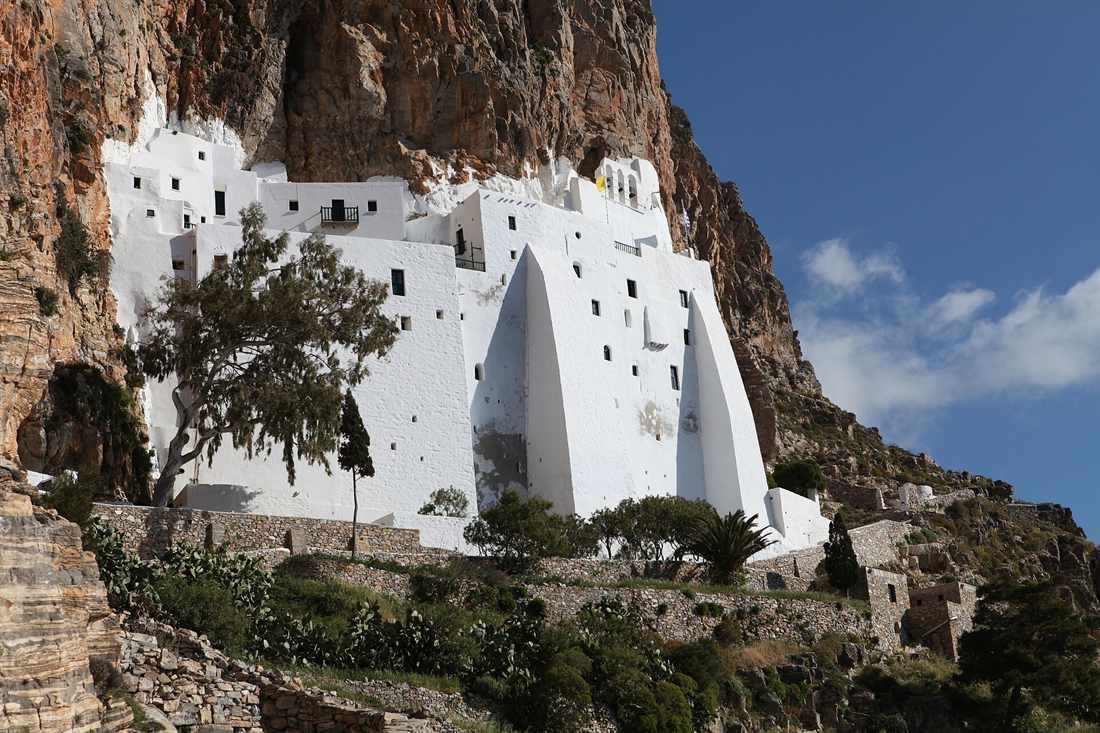
The charter site Medgulets says the monastery is easiest to read from below, not from the path above it. From the water it looks like a white seam in a grey wall. The wide frame for an Amorgos photoshoot therefore belongs under the cliff.
Kalispera shows the building from three places. These are the road down to Agia Anna, the parking lot and Agia Anna itself. Each photo gives an Amorgos photoshoot a different angle on the same cliff.
Associated Press photographers shot the monastery at night in March with a slow shutter speed. Their report calls the complex a speck about half-way up the mountain. Small chapels among the rocks are the only other structures in sight. One white building stands alone on the slope.
Kalispera compares the monastery from a distance to a giant sugar cube riveted to the cliff. Greeka points to the mismatched windows that line its face. Both are details of the outer wall, so neither needs a step through the door.
Our guide to the Hozoviotissa Monastery covers the building’s story and the climb. An Amorgos photoshoot needs only the outside view.
Kalispera states that photos are not allowed inside the monastery, so every frame of an Amorgos photoshoot happens outdoors. A visit through the door has its own dress code. Wikipedia says men wear long trousers and women a skirt or wrap down to the knee.
A local guide to the monastery adds that shoulders stay covered. Two guides disagree on loaned cover-ups: Medgulets says the door offers wraps, and Kalispera says it no longer lends clothes. Pack your own.
Which beaches suit an Amorgos photoshoot?
Four beaches give an Amorgos photoshoot four looks. Agia Anna offers rock coves under the monastery, and Mouros has two caves behind its rocks. Kalotaritissa has a sheltered bay with anchored fishing boats, and Aegiali has a kilometer of sand under tall pines.
Agia Anna is a set of small rock coves with clear water, not a sandy beach, according to Medgulets. Greeka lists its water as deep blue and crystal clear. One Kalispera photo needs an arrow to point out the monastery from this shore. An Amorgos photoshoot here keeps the cliff in the background.
Greeka calls the turquoise water the main mark of Mouros. Rock formations stand around the shore, and two small caves sit behind the rocks. The beach lies 15 km southeast of Chora, and a 10-minute path leads down from the end of the road. Rock and water give an Amorgos photoshoot strong colour here.
Kalotaritissa lies at the southern tip of Amorgos. The travel blog Miles with Vibes tells drivers to pull over on the road above. From there you look down at the bay. The blog describes crystal clear turquoise water over sand with pebbles in places.
The same blog writes that fishing boats drop anchor in the sheltered inlet. The name comes from the Greek word kalotaria, which means good weather. A calm bay and moored boats suit an Amorgos photoshoot that wants a quiet sea.
Aegiali Beach lies 20 km from Chora and runs for one kilometer, according to Greeka. The sand is soft, and tall pine trees stand along it. Greeka adds that the beach does not look crowded despite its popularity. It praises the clear water and the green landscape.
Which villages add a backdrop to an Amorgos photoshoot?
Langada and Tholaria give an Amorgos photoshoot a mountain-village setting. Both stand on the slopes above Aegiali bay. Narrow lanes, white houses and a view down to the water fit into one frame.
The municipality’s guide puts Langada on the east side of Aegiali bay, 5 km from the port. It stands on the edge of the Araklos canyon, with the island’s highest mountains around it. In an Amorgos photoshoot, that mountain wall sits behind the white houses.
Greeka says a network of narrow lanes joins every corner of Langada to the main road. Small churches and windmills stand in and around the village. A short walk gives three kinds of subject: lane, church and windmill.
Tholaria sits on a hill 3.5 km north of the port, 182 m above the sea. Greeka lists views of Kampos and Gialos from the village. Wikipedia calls the bay below a large sweeping bay.
Greeka adds that Tholaria, Langada and Potamos are built amphitheatrically on the slopes of Mount Krikelos, overlooking the bay. The rows of houses step down toward the water. Pose your group at a terrace edge and shoot toward the bay, so roofs, water and sky share one frame.
The hill of Vigla lies opposite Tholaria. Greeka calls it the acropolis of early Aegiali, with remains of an ancient wall. Use that hill as the far layer of a wide frame. Wikipedia counts 154 residents in the Tholaria community.
Each place has its own history, food and festivals. Read our guide to the villages of Amorgos for those, and use this page for the frames. Greeka puts Langada 20 km north of Chora and Tholaria 18 km northeast of the capital. Ask where your Amorgos photoshoot starts before you book.
Which harbour scenes suit an Amorgos photoshoot?
Katapola and Aegiali give an Amorgos photoshoot two working-harbour scenes. Both ports keep fishing boats at the quay. Both have cafes and tavernas close to the water, so people, boats and white walls share one frame.
Katapola is the main port of Amorgos. Its waterfront is lined with cafes and taverns, and the municipality’s guide adds moorings for visiting sailing boats. Wikipedia places the port at the foot of a hill. Stand on the quay, with the boats in front and the hill behind you.
Greeka says Katapola fills a large bay in the greenest part of the island. The same page lists an old lighthouse among its sights. Xilokeratidi lies opposite the port, with narrow streets and traditional tavernas. It gives a second scene on the same bay.
Aegiali is the second port of Amorgos and spreads around a bay. Greeka says its people work mainly in fishing and tourism. The municipality’s guide describes fishing boats lying side by side in the port. For an Amorgos photoshoot, that row of hulls makes a strong line along the quay.
The same guide notes moorings for visiting sailing boats at Aegiali, so masts can join the hulls in the frame. Wikipedia notes frequent ferries to Piraeus and a daily ferry to Naxos. A ferry at the pier adds a large moving subject.
The lead photo of the Wikipedia article on the port is captioned Aegiali at sunset. Ask the photographer which quay suits your Amorgos photoshoot.
When is the light right for an Amorgos photoshoot?
An Amorgos photoshoot looks softest in the first and last hour of sun. Wikipedia defines the golden hour as the time shortly after sunrise or before sunset. Then daylight is redder and softer than with the sun high.
Use these sun times to plan an Amorgos photoshoot. They come from the sunrise-sunset.org calculator, set to the coordinates of the island. They are local clock times, rounded to the minute. Wikipedia sets Greek summer time at UTC+3 and winter time at UTC+2.
- 21 June: sunrise 05:57, solar noon 13:18, sunset 20:39.
- 21 September: sunrise 07:03, solar noon 13:09, sunset 19:16.
- 21 December: sunrise 07:25, solar noon 12:14, sunset 17:04.
Wikipedia says the golden hour has no fixed length and changes with the season and the latitude. So the sunset time sets the clock. An Amorgos photoshoot in the evening follows 20:39 in June, 19:16 in September and 17:04 in December.
Travel.gr describes the Cyclades golden hour in plain terms. The sun’s low angle softens direct glare, deepens colour and draws out long shadows. Wikipedia adds that contrast is lower then. Shadows are less dark and highlights overexpose less.
Midday is the hard hour for an Amorgos photoshoot. On 21 June the sun stands highest at 13:18. Wikipedia says the bright overhead sun creates strong highlights and dark shadows in the middle of the day. A white wall is the strongest highlight in the frame.
Travel.gr says Cycladic whitewash reflected heat. Wikipedia notes that overexposure depends on the dynamic range of the camera. For an Amorgos photoshoot at noon, wait for the low sun or choose a spot in shade.
The blue hour follows the golden hour. Wikipedia calls it the twilight when the sun sits well below the horizon. The remaining light takes a blue shade. Wikipedia gives a span of about 20 to 96 minutes after sunset.
On 21 June, nautical twilight on Amorgos ends at 21:48, which is 69 minutes after sunset. In December it ends at 18:05, which is 61 minutes after sunset. Wikipedia adds that photographers use the blue hour for the tranquil mood it sets.
How does the meltemi wind affect an Amorgos photoshoot?
The meltemi is the strong, dry north wind of the Aegean, and it blows from about late spring to mid-September. Wikipedia says the winds peak in the afternoon. An Amorgos photoshoot in those months plans for gusts.
Wikipedia says the wind can blow at force 7 to 8 on the Beaufort scale. Force 7 is 50 to 61 km/h, and force 8 is 62 to 74 km/h. At force 7, the scale notes inconvenience when walking against the wind.
A yacht-charter blog puts the meltemi at force 5 to 8, strongest in July and August. Greeka, a Greek travel site, writes that Amorgos has hot summers with cooling north winds in August. It adds that winters bring really strong winds.
Wind direction decides what happens to hair. Shotkit says wind blowing toward the camera pushes hair and loose fabric forward, which can hide the face. Wind from behind the camera lifts hair away from the face. Ask which way it runs before the first frame of your Amorgos photoshoot.
A wedding-photography teaching site turns the subject so the wind hits the face first. Then it carries the hair away from the eyes. A hat cuts the wind, and a hand holding the hair back looks natural. If the wind changes direction, the subject turns with it.
Dresses on an Amorgos photoshoot follow the same rule. The same site says a long skirt makes strong shots when it swishes out in the direction of the wind. If the wind clings the fabric to the body, turn the subject so the fabric flows away from it.
Gusts come and go during an Amorgos photoshoot. Shotkit says wind rarely blows at one constant strength, so shoot in bursts and wait out a lull. Digital Photography School says a fast shutter speed freezes the motion the wind creates. The wedding site keeps one pose for the gust and one for the lull.
Props feel the wind too. The Beaufort scale lists umbrellas as hard to use at force 6, which is 39 to 49 km/h. Travel.gr says the meltemi is the reason a hat ends up in the Aegean. Shotkit lists scarves among the things that give the wind something to work with.
Travel.gr says narrow alleys in the main towns of Folegandros, Serifos and Ios cut wind and create shade. It adds that locals head for sheltered coves. Wikipedia calls etesian weather ordinarily fine and clear, with the north winds tempering the fierce summer heat. That is the setting for an Amorgos photoshoot in July.
What do you wear for an Amorgos photoshoot?
Pick linen, cotton or gauze in blue, white, earth tones or one bold colour. Add flat shoes that grip stone and a scarf for church doors. Whitewashed walls reward those colours in an Amorgos photoshoot, and the fabrics stay cool in the sun.
Aza Fashions’ Greece guide says a blue-and-white palette mirrors the islands. It adds warm earth tones, crisp whites and bold prints that stand out in photos. The Municipality of Amorgos describes Chora as a village of whitewashed houses. Those colours repeat the walls around you.
Colour decides how an Amorgos photoshoot looks on screen. A Santorini style guide names sage green, dusty rose and lavender as pastels that suit whitewashed walls. It says they do not compete with the walls. For a bold pop, the guide names red, cobalt blue and sunflower yellow.
The same guide warns about all-white outfits. White glares in direct sunlight and shows every splash of food or drink. Keep white to one piece, such as a shirt, and pair it with a colour from the list above.
- Wear linen, gauze and breathable cotton. Aza Fashions says they keep you cool and pack easily.
- Skip denim, thick cotton and wool. The Santorini guide says they leave you miserable by midday.
- Skip tight synthetic fabrics. The guide says they trap heat and moisture against the skin.
- Pick clothes you have worn before. The guide advises that you know how each piece moves.
Shoes decide how far an Amorgos photoshoot can walk. Aza Fashions says cobblestone streets mean flats win and tells readers to skip the heels. The Santorini guide calls heels risky on uneven steps and narrow paths. Greeka lists stone-paved streets in Chora. Flat leather sandals with ankle support, or clean sneakers, suit that ground.
Churches and monasteries set one firm rule. Aza Fashions notes that Greece has thousands of them. Visitors cover shoulders and knees to enter. A lightweight scarf or a silky pashmina handles that in seconds. Pack one in the bag for your Amorgos photoshoot and put it on at the door.
What happens during an Amorgos photoshoot, step by step?
You book ahead, send your date and plan, meet the photographer, walk and pose, then take the photos home. This Amorgos photoshoot runs as a private one-hour session with a local photographer, in English or Greek.
- Book ahead. The Amorgos card sets an 8-hour lead time. The Paros listing asks for 10 hours, and the Naxos flying dress listing asks for 4.
- Send your plan. The request form of M.Theol.Photography, a studio based in Amorgos and Athens, asks for your date, location and type of session. It also has a message box.
- Find the start. The Naxos listing carries a “Pickup available” label. The Amorgos card carries none, so confirm the start spot with the operator.
- Walk and pose. A client review on the studio’s home page praises “a superb combo of posed and candid shots”.
- Take the photos home. The same review praises a fast turnaround. Ask for the delivery date when you book.
Each step of an Amorgos photoshoot is simple to plan. Message the photographer with your outfit colours, your group size and any limit on walking. Ask for the meeting spot and the delivery date before the day.
The review sits on the home page of M.Theol.Photography. The client hired the studio for retreat photos and shots for a business website, not for a holiday session. The Municipality of Amorgos names the same studio as the photo credit in the footer of its tourism site.
Lead times differ by operator, so check the cut-off before you pick a day for your Amorgos photoshoot. An 8-hour lead time works for a booking made the evening before a morning start. A 4-hour lead time, as on Naxos, allows a morning booking for an afternoon slot.
Which camera and drone rules apply to an Amorgos photoshoot?
Photos in open public spaces need no prior authorization when two conditions are met. Monasteries, monuments and archaeological sites need a special permit. Drones add a second layer: an airspace check on the DAGR platform before every flight.
The Greek Ministry of Foreign Affairs sets the terms that apply to an Amorgos photoshoot in any open public space. The photography must not offend public decency. It must not block pedestrians or vehicles. Photographers also respect privacy and intellectual property rights and follow the instructions of the competent authorities.
The same Ministry page lists the places that need a special permit for filming or photography:
- military and port facilities;
- archaeological sites, museums and monuments;
- places of worship, such as churches and monasteries;
- environmentally protected areas, including national parks.
The Hozoviotissa Monastery stands on a cliffside northeast of Chora, and monasteries are on that list. Katapola is a small port village, and port facilities are on the list as well. Ask the photographer which frames each place allows before the day starts.
Commercial shoots have their own route. The Ministry of Culture and Sports issues the filming permits for archaeological sites, museums and monuments. Those permits cover cinematic and other audio-visual productions. The Acropolis Museum in Athens allows personal photography without flash, lights or a tripod. Professional photography there needs prior written consent.
Outside restricted zones, a drone for an Amorgos photoshoot follows the open category of the European rules. Wikipedia lists three categories of drone operation in the European Union: open, special and certified. In the open category a drone flies no higher than 120 metres above ground. The pilot keeps it in sight, and flights over gatherings of people are forbidden.
The Hellenic Civil Aviation Authority calls the DAGR check mandatory before any drone flight in Greece. DAGR is the airspace platform of the Hellenic Aviation Service Provider. Yellow and magenta zones, such as airports and archaeological sites, either allow flights under conditions or ban them. Outside those zones, flights need no special approval when the open category rules are followed.
Certain places need prior authorization from the Hellenic Civil Aviation Authority for any flight over them. The list names ports, hospitals, archaeological sites, and military or government installations. A flight in a yellow or magenta zone starts with a form. The Drone Flight Notification Form goes in at least 5 working days ahead.
Registration for an Amorgos photoshoot drone comes first. An operator not registered in another EASA member state must register in Greece before flying. An operator registered in another EASA country needs no extra registration. Under European rules, even a drone under 250 grams needs a registered operator when it carries a camera.
Paid aerial work for an Amorgos photoshoot needs a Commercial Operation License UAS. The licence covers aerial filming and photography for professional purposes. The Hellenic Film Commission names the Hellenic Civil Aviation Authority as the body that gives it.
Who suits an Amorgos photoshoot?
Couples, families and solo travellers all fit an Amorgos photoshoot. The booking is a private group that starts at one participant. A photographer from the island also lists engagement, proposal, vacation and yoga sessions.
The GetYourGuide listing for the Amorgos photoshoot experience books a private group. Its participant category runs from age 0 to age 99, so children join the booking. The price label reads “per group up to 4”, so a family of four shares one booking. A solo traveller books the same slot, because the form starts at one participant.
Photographer sites show the same mix. The Photo Session menu on mtheol-photography.com reads “Couples, Engagements, Proposal, Family, Vacation and Yoga”. The site belongs to a photographer from Amorgos who works across the Cyclades, Astypalaia and the rest of Greece. An Amorgos photoshoot of that kind suits anyone who wants the island in the background of a portrait.
A client review on the same site describes a couple who eloped on Amorgos. They hired the photographer for the day. They wrote that they wanted memories of their special day, even though it was only the two of them.
The listing summary promises a local photographer, alleys, views and natural photos. A drone shot is not part of that summary. The same photographer site also sells work for hotels, villas, Airbnb hosts and brands. That is commercial work, not a holiday shoot.
Which hiking paths give an Amorgos photoshoot wilder scenery?
Three marked paths lead an Amorgos photoshoot beyond the villages: the Old Strata, the Melania path and the Pan path. The official island site rates the Old Strata and the Pan path as hard, and the Melania path as easy.
An Amorgos photoshoot on the Old Strata starts in Chora and passes the Hozoviotissa Monastery. The path ends in Langada. The official island site gives a length of 14.5 km and a time of about four to five hours.
Kapsala comes next, with the church of the Virgin Mary Theoskepasti and a small Byzantine monastery of St. John Chrysostom. Asfontilitis follows, about two hours and twenty minutes from Chora. The official page lists an old rural settlement there, with wells, rock paintings and the church of St. Nicholas.
The Melania path is the gentler choice for an Amorgos photoshoot. It runs from the port of Aegiali through Langada, Stroumbos and Panagia of Epanochoriani to Tholaria. It ends at Fokiotripa, at the end of Aegiali beach. The official site gives 7.6 km and about two hours.
The same page names the views to frame. It lists the old windmills and the ravine of Araklis near Langada, and the bay of Aegiali below. Its photo titles also list a view towards Langada and a view towards Panagia of Epanochoriani.
The Pan path is the wild one. It leads from Langada to the monastery of Agios Ioannis Theologos. It also leads to the chapel of Stavros, above the old bauxite mine. Topoguide describes a mountain path built among the cliffs on the north-east side of Krikelos.
The official site calls the Pan path full of wild beauty with dramatic mountains. It rates the path hard and gives about two to two and a half hours. An Amorgos photoshoot here swaps village lanes for rock, cliff and open sea.
The guide to Amorgos hiking holds the full trail list, maps and difficulty notes for every route named here.
Which quick questions does an Amorgos photoshoot raise?
An Amorgos photoshoot on the paths raises five quick questions. They cover signs, an easy walk, the Langada windmills, the height of Krikelos and the count of marked paths.
Will path signs appear in the photos?
Wooden signboards stand at every start and finish, says Topoguide. Metal marks in white and red carry the route number along each path. Topoguide rates the marking as mediocre, with plates that have faded or worn out.
Which path suits an easy Amorgos photoshoot walk?
The Fotodotis path, number two, links Chora with Katapola in about one hour, and the official site rates it easy. Greeka lists an arid spring, the vegetation and the chapel of Agia Irini on the way.
Where do the windmills above Langada stand?
Greeka lists a path to old windmills above the mountain village of Langada, with a view of the Aegiali villages. The listing gives 5 km and 50 minutes. It warns of strong winds and a steep uphill road.
How high is Krikelos?
The official island site gives 821 metres and calls Krikelos, also spelled Kroukelos, the highest point of Amorgos. Its view takes in the whole island and the blue Aegean Sea.
Does Amorgos have seven or eight marked paths?
The official island site says the seven main paths are marked with signs. Topoguide counts a network of eight hiking routes, each with a numbered marker.