
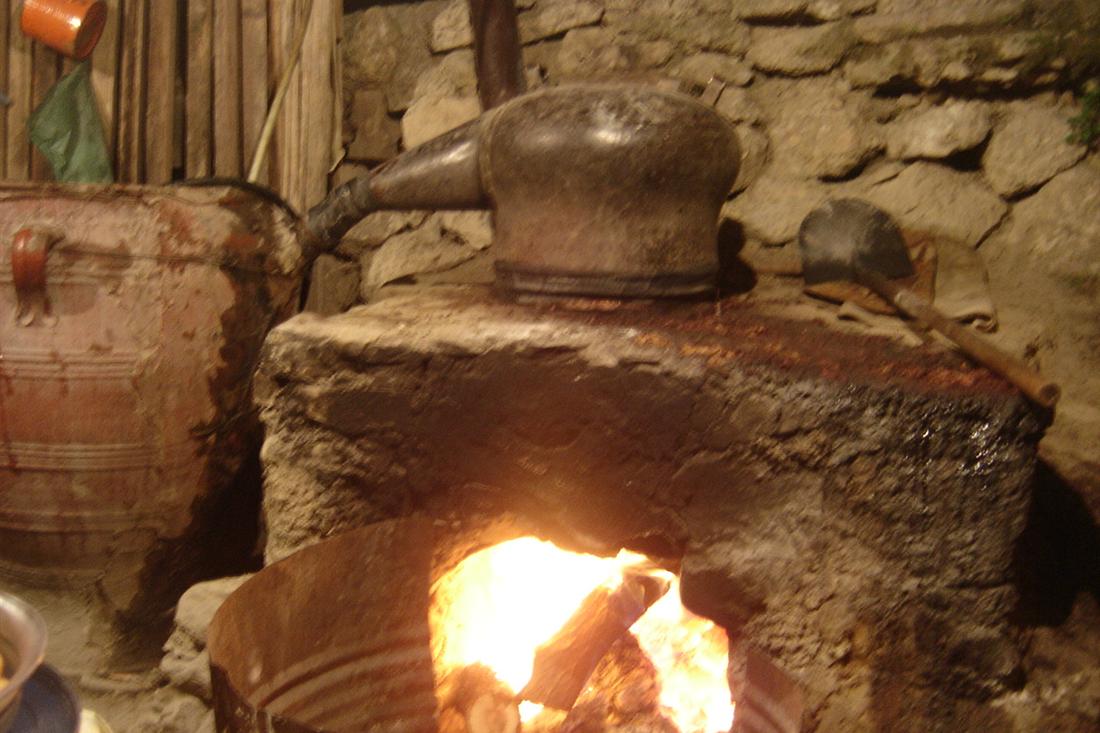
A Crete raki tour visits the farms, stills and villages where tsikoudia, the grape spirit of the island, is made and poured. Tours across the rest of the country are listed on Greece Tours.
The sections below cover the tours you can book, tsikoudia, the kazani, the distilling season, serving, rakomelo, related spirits, the rules, tastings, places, tour lengths and booking for a Crete raki tour, with links into the Crete pages. The tours shown are checked on GetYourGuide and Viator.
What is a Crete raki tour?
A Crete raki tour takes you to a distillery, farm or village to taste tsikoudia. You see how Cretans turn grape leftovers into a strong drink. Each tour pairs the tasting with food, crafts, farm animals or a village ride.
Raki in Crete is a grape spirit of 40% to 65% alcohol by volume. Home-made raki varies in strength from one producer to the next. A Crete raki tour lets you taste that difference at the source.
The raki stop sits inside a wider outing with other island produce. A tasting at a farm or distillery puts the spirit next to the people who make it. For the full Cretan table, a Crete food tour covers more dishes and drinks.
Which Crete raki tours can you book?
You can book a Crete raki tour through GetYourGuide or Viator. Options include a full-day food tour, a farm visit, a tuk tuk ride and producer tours. Each one includes a raki tasting at a farm, distillery or village stop.
GetYourGuide lists four options that work as a Crete raki tour. All four name raki in the title:
- Crete: Full-Day Food Tour – Cretan Wines, Olive Oil & Raki. This 8-hour day includes an olive mill with fresh olive oil and an organic winery. You also taste raki at a distillery and try pottery making in a traditional village.
- Rethymno: Farm Life Experience with Raki and Cheese Making. This 2-hour visit explains the process behind Cretan raki and cheese making. You meet the farm animals and share a Cretan meal with handmade cheese pies and house raki.
- Malia: Sissi and Beyond Tuk Tuk Tour with Raki and Honey. This 2-hour ride covers Sissi village, Malia old town and the Stalis beach road. It includes a raki and honey tasting.
- Soap, Wine, Raki, Olive Oil, Meet the local Producers Tour. On this 6.5-hour Heraklion tour, you meet the makers of handmade soap and fresh olive oil. It also includes local wine and raki tastings.
Viator sells three more options for a Crete raki tour. One is a culinary tour in Crete with olive oil, soap, wine and raki. Another is a private tour with wine, raki and olive oil tasting plus pottery. The third is a culinary tour in Elounda with soap, olive, wine and raki.
All seven tours put raki next to another Cretan product, craft or place. None of them is a raki-only tasting.
What is tsikoudia, the raki of Crete?
Tsikoudia is the drink you taste on a Crete raki tour, and it is the island’s own raki. It is a grape-based pomace brandy of Cretan origin. Distillers make it from pomace, which is what remains of grapes pressed in winemaking.
The name tsikoudia comes from tsikouda, the island dialect word for grape pomace. Tsikouda is mainly a Cretan word. In eastern Crete, people call the same drink raki.
The name raki comes from the Turkish word “raki”. That word traces back to the Arabic “arak”, which means “distilled”. The name points to the method, not to the fruit.
Tsikoudia is the geographical indication for grape-pomace raki from Crete. It goes through a single distillation and gets no added flavourings. That keeps more of the grape flavour in each glass you try on a Crete raki tour.
How is raki made in a Cretan kazani?
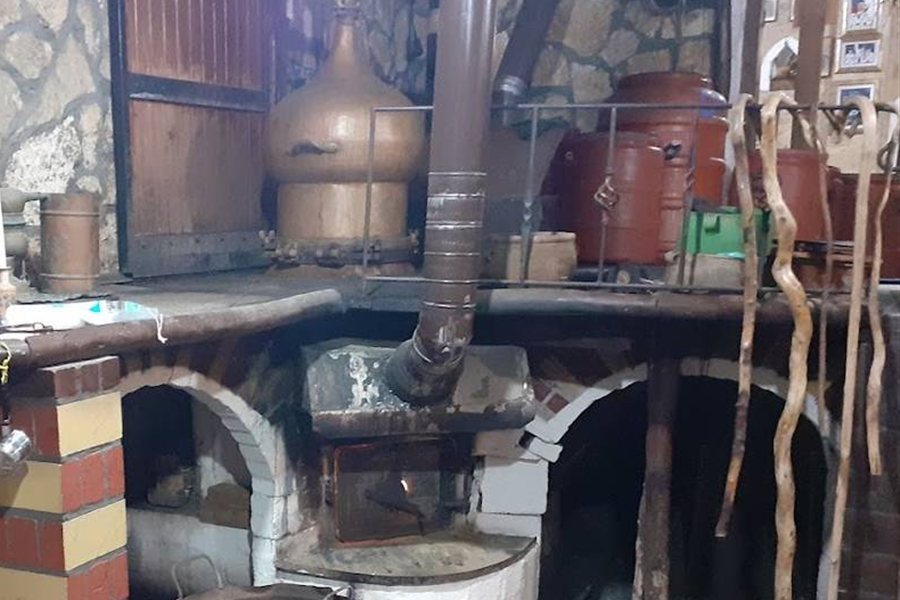
At a distillery on a Crete raki tour, you see the kazani, a copper kettle for raki. First, grape pomace ferments for about six weeks in a tightly sealed barrel. Then the distiller loads the fermented pomace into the kettle.
Each alembic-type still has four parts, and they work in order from the pot to the receiver:
- A pot heated by fire, which holds the fermented pomace.
- A head that collects the vapour rising from the pot.
- A tube where that vapour cools and condenses back into liquid.
- A receiver at the end of the tube that catches the finished tsikoudia.
A common method is to lay olive-wood branches on the kettle floor. The branches keep the mash from burning during distilling.
When does the raki distilling season run in Crete?
The raki distilling season in Crete runs in autumn, after the grape harvest and pressing. Tsikoudia is produced non-stop for two to three weeks in late October and early November. A Crete raki tour in those weeks can include a working kazani.
Each Cretan village has one or two residents licensed to distill. Commercial distillers work nearly around the clock in the season.
Licences come from the state, and their number is limited. As a result, only a small group of family businesses distill legally.
Eleftherios Venizelos set up the rakokazano custom as an institution in the early 20th century. Special licences went to farmers to support their income through tsikoudia. The custom still shapes who distills in each village today.
How is raki served on a Crete raki tour?
On a Crete raki tour, tsikoudia comes in shot glasses at each greeting, each farewell and after meals. It is drunk neat, or with water or ice. Small plates of meze come to the table with each round.
The bottle nearly always comes out of the freezer, so the spirit is served chilled. Cretan restaurants commonly give it free as a digestif, a drink taken after the meal. Fruit and sweets arrive with the glass.
Neat means straight from the glass, with nothing added. Water or an ice cube lowers the strength of each sip. Visitors on a Crete raki tour can try it both ways.
Grape spirits in Greece are drunk at social gatherings, around shared plates. The meze that goes with tsikoudia includes:
- Nuts, raisins and dried fruit
- Cheese, the focus of cheese tasting in Crete
- Olives and seafood
- Halva
- Paximadi, the Greek rusk
What is rakomelo, the honey version of raki?
Rakomelo is the honeyed version of the spirit poured on a Crete raki tour. The name joins raki with meli, the Greek word for honey. It is raki or tsipouro mixed with honey and spices, drunk warm mainly in winter.
Typical spices are cinnamon, cardamom, clove or regional herbs. Rakomelo is made in Crete, on other Aegean islands and on the mainland. For island raki beyond Crete, read about raki on Tinos.
At home, households use rakomelo as a remedy for a sore throat or a cough. It is also sold bottled, ready to serve, so no mixing is needed.
A simple recipe suits anyone back home from a Crete raki tour. Mix 1-2 teaspoons of honey per 4 shots of raki. Add one clove and about 1 teaspoon of cinnamon, then warm them together. Heat helps the honey dissolve into the spirit.
Psimeni, or baked raki, is the regional drink of Amorgos. It mixes raki, sugar and more spices than rakomelo. Unlike rakomelo, it is served at room temperature.
How does Cretan raki differ from tsipouro, ouzo and Turkish raki?
On a Crete raki tour, the glass holds tsikoudia, a pomace spirit distilled once with no flavourings. Turkish raki is anise-flavoured, while Cretan tsikoudia contains none. Tsipouro is normally double-distilled, and ouzo starts from a different, neutral base.
Tsipouro is the mainland cousin of tsikoudia. It is an un-aged grape brandy from Thessaly, Epirus and Macedonia, at 40-45% alcohol. Certain producers flavour it with anise. Tradition credits Orthodox monks on Mount Athos with the first tsipouro, in the 14th century. Tsipouro holds protected designation of origin (PDO) status.
Ouzo is made from 96% rectified spirit, a near-pure alcohol. That base keeps none of the flavour of the first distillate. Tsipouro and tsikoudia, by contrast, keep the aroma of the pomace.
Anise is the quickest test for a Cretan glass. A glass with a clear pomace aroma and no anise fits the tsikoudia of a Crete raki tour. A glass that tastes of anise was not made as tsikoudia.
Which Mediterranean spirits are cousins of Cretan raki?
Tsikoudia, the drink at the heart of a Crete raki tour, belongs to the pomace spirit family. Its cousins are distilled from grape pomace, the leftovers of wine making. They are normally double-distilled, and certain ones add anise.
Anyone who knows grappa or marc has a reference point for a Crete raki tour. Pomace brandies are normally neither aged nor coloured, so they reach the glass clear. The family includes:
- Grappa from Italy
- Marc from France
- Orujo from Spain
- Bagaceira from Portugal
- Chacha from Georgia
- Zivania from Cyprus
- Komovica from Serbia and the Balkans
- Terkelica from Slovakia
Pomace comes in three types, grouped by the wine that leaves it behind. Fermented pomace from red wine making suits brandy above the other two. Semi-fermented pomace comes from rosé wine. Virgin, unfermented pomace comes from white wine.
Crete also has a home-grown cousin. Mournoraki, from western Crete, is distilled from mulberries. It shows that Cretan distillers work with fruit beyond the grape.
Which rules protect Cretan tsikoudia?
Two layers of rules protect the spirit on a Crete raki tour. EU rules define how any grape-marc spirit must be made. On top of that, tsikoudia is the geographical indication for this spirit from Crete.
Under EU rules, a grape-marc spirit comes only from fermenting and distilling grape pomace. Distillation happens in the presence of the pomace, at under 86% alcohol. The finished spirit holds at least 37.5% alcohol.
Producers can add wine lees, the sediment left after wine making. The limit is 25 kg of lees per 100 kg of pomace. No outside alcohol can go into the spirit. All the alcohol comes from the pomace and the lees.
The name tsikoudia on a bottle tells a Crete raki tour guest the spirit comes from Crete. A grape-marc spirit made elsewhere cannot use that name. The EU rules fix the method, and the geographical indication fixes the place.
What else do you taste on a Crete raki tour?
A Crete raki tour pairs the spirit with fresh olive oil, local wine and Cretan cheese. The table also carries small appetisers from the island kitchen. Each item belongs to the traditional Cretan diet that the tours present.
Cretan cuisine is built on plant foods. Olive oil is the main fat, used in salads and in cooking. Red wine goes with meals in moderation. Honey-based pastries are traditional. Tsikoudia, rakomelo and Cretan wine are the island’s own drinks.
Cretan cheese and small plates sit beside the raki glass. Look for these names on the table:
- Cheeses: graviera, xynomizithra, xygalo and pichtogalo
- Appetisers: dakos, kalitsounia and paximadi
- Sarikopita, a twisted cheese pie
On the full-day food tour, guests taste fresh olive oil at an olive mill. The stop suits travellers who also plan olive oil tasting in Crete. The same tour visits an organic winery. The island has more Crete wineries for other days.
The farm tour adds cheese making and a Cretan meal of handmade cheese pies and house raki. On the tuk tuk Crete raki tour, the raki comes with a honey tasting. The producers tour adds handmade soap to its wine and raki tastings.


Where do Crete raki tours run?
A Crete raki tour runs near Rethymno, in the Heraklion area, in Malia or from Elounda. Other Viator listings cover Crete without naming a town. The base decides the scenery, from a farm to a beach road and an old town.
The tuk tuk tour is based in Malia and visits the old town. It also stops in Sissi village and drives the Stalis beach road. The Rethymno farm tour adds time with the farm animals.
The producers tour runs in the Heraklion area, with a morning of hands-on visits to local producers. The full-day food tour pours raki at a distillery. It also includes pottery making in a traditional village.
On Viator, one soap, olive, wine and raki tour runs from Elounda. A second listing with the same four themes runs on Crete. Viator also lists a wine, raki, olive oil and pottery tour on the island.
How long does a Crete raki tour last?
A Crete raki tour lasts between 2 hours and 8 hours on GetYourGuide. The length depends on the number of stops on the route. Farm and tuk tuk tours stay short, while four-stop food tours fill the day.
- Full-day food tour with wine, olive oil and raki: 8 hours
- Soap, wine, raki and olive oil producers tour: 6.5 hours
- Rethymno farm tour with raki and cheese making: 2 hours
- Malia and Sissi tuk tuk tour with raki and honey: 2 hours
Keep a free day for the 8-hour food tour. The 6.5-hour producers tour also needs a clear schedule. Check the start time on the listing before you plan the rest of the day.
A two-hour Crete raki tour fits around a beach day or an evening out.
How do you book a Crete raki tour?
Book a Crete raki tour on GetYourGuide or Viator in three steps. Choose the date, set the number of travellers and pay online. Every tour named on this page sells on one of those two sites.
The confirmation arrives by email. It carries the meeting point or the pickup details for your tour. Keep the email on your phone for the day.
GetYourGuide offers free cancellation up to 24 hours before the start on listings that show it. Read the terms on each listing before you pay.
The Viator wine, raki, olive oil and pottery tour is private. Choose it when you want a Crete raki tour for your own group only.
Frequently Asked Questions
Is Cretan raki the same as ouzo?
No, they are separate drinks. Ouzo is made from 96% rectified spirit and flavoured with anise. Cretan raki is a single-distilled grape-pomace spirit with no anise. On a tasting table in Crete, the glass holds raki, not ouzo.
Why do Cretan tavernas serve free raki?
Free tsikoudia is a local custom. Cretan restaurants commonly serve it as a digestif after the meal, with fruit and sweets. Hosts also offer it at greetings and farewells. Accept the glass as part of the meal, not as an extra on the bill.
What is a rakokazano?
A rakokazano is the raki-distilling gathering of Crete. It takes place in late October and early November. Licensed villagers distill pomace in copper kettles for two to three weeks. Outside that season, raki tastings happen at farms and distilleries.
Can you drive after a Crete raki tour?
No. Tsikoudia is 40% to 65% alcohol, so small tastings add up. Plan a sober driver before the day starts, or use the tour’s own transport. Never drink and drive after the tasting, on any road in Crete.