
A Nemea day trip from Corinth drives south into the vineyards of Corinthia to the sanctuary of Zeus at Ancient Nemea, its stadium and its museum, with time for a wine tasting before the return. Tours across the rest of the country are listed on Greece Tours.
The sections below cover the tours you can book, the road, timing, the Temple of Zeus, the stadium tunnel, the Nemean Games, the museum, the lion myth, the Agiorgitiko grape, the wineries, the season, packing and booking for a Nemea day trip from Corinth, with links into the Nemea pages. The tours shown are checked on GetYourGuide and Viator.
What is a Nemea day trip from Corinth?
Travellers leave Corinth by road for the ruins of Ancient Nemea. A Nemea day trip from Corinth covers the Temple of Zeus, the ancient stadium and its vaulted tunnel. The return to Corinth falls on the same day, with no overnight stay.
The destination of a Nemea day trip from Corinth is a sanctuary of Zeus in the northeast Peloponnese. Today the site sits in the regional unit of Corinthia. Its position on the borders of Achaea, Arcadia, Argolis and Corinth made it neutral ground. That neutral ground suited a religious centre shared by all Greek cities.
The small village of Archaia Nemea lies immediately southwest of the archaeological site. The modern town of Nemea stands further west. A Nemea day trip from Corinth heads for the ruins beside the village, not for the modern town. A 1-kilometre aqueduct once carried spring water to the baths of the sanctuary.
Which Nemea day trips from Corinth can you book?
Four bookable tours cover a Nemea day trip from Corinth, with three on GetYourGuide and one on Viator. Each includes the ancient site of Nemea. Three of the four run as private tours, and the extra stops differ between them.
- From Corinth: Ancient Corinth & Nemea 5-Hour Private Tour
- Ancient Nemea & Wine Tasting – Hercules & the Lion revealed
- Private Luxury Tour: Nemea’s Ancient Sites & Wine Tasting
- Mycenae and Ancient Nemea Private Tour from Corinth
The Ancient Corinth and Nemea tour runs in a private van from the city. Its stops are the Temple of Apollo, Acrocorinth and the ancient track of the Nemean stadium. Only this Nemea day trip from Corinth includes the old city itself.
At Ancient Corinth, the Doric Temple of Apollo dates to the 6th century BC. Seven of its 38 columns still stand. Acrocorinth served as the acropolis of the ancient city. This monolithic rock stayed occupied from archaic times to the early 19th century. The same ruins anchor the Corinth day trip from Nafplio.
The Viator private tour pairs Ancient Nemea with Mycenae. A Nemea day trip from Corinth on this tour covers both sites in one day. More time at Mycenae alone comes with the Mycenae day trip from Corinth.

How far is Nemea from Corinth by road?
The Nemea area lies about 30 kilometres from Corinth. A Nemea day trip from Corinth heads south from the city on the A7 motorway. Drivers then leave the motorway and take local roads to the ancient sanctuary.
Two of the bookable tours carry “From Corinth” in their titles and start in the city. On these, a Nemea day trip from Corinth needs no rental car and no motorway driving. A driver handles the whole route.
Self-drivers set the map to Archaia Nemea, the village beside the ruins, not to the modern town. Ancient Nemea lies in a basin about 360 metres above sea level. This basin sits east of the larger one around the modern town. Both basins drain through their own valleys into the Gulf of Corinth.
The modern city of Corinth lies northeast of the ruins of Ancient Corinth. A Nemea day trip from Corinth that includes both sites visits the old ruins before the motorway leg. Self-drivers who want both sites in one day follow the same order.
How long does a Nemea day trip from Corinth take?
Guided tours for a Nemea day trip from Corinth last between five and eight hours. The length depends on the number of stops along the route. The five-hour private tour adds Ancient Corinth to the outing.
The ancient site has two parts. The sanctuary holds the Temple of Zeus, and the stadium stands apart from it. Plan a Nemea day trip from Corinth with time to walk between the two. Start at the temple, then walk on to the stadium and its tunnel.
The six-hour tour stays in the Nemea area and includes the athletes’ tunnel at the stadium. The eight-hour private tour spreads Nemea’s ancient sites across a full day. Both leave Ancient Corinth out of the plan, and neither lists Mycenae as a stop.
Visitors with an evening ferry or flight pick the five-hour tour for their Nemea day trip from Corinth. Those who want more time at the temple and the stadium pick the six-hour tour. Those who want a whole day at an easy pace pick the eight-hour private tour.
What stands at the Temple of Zeus at Ancient Nemea?
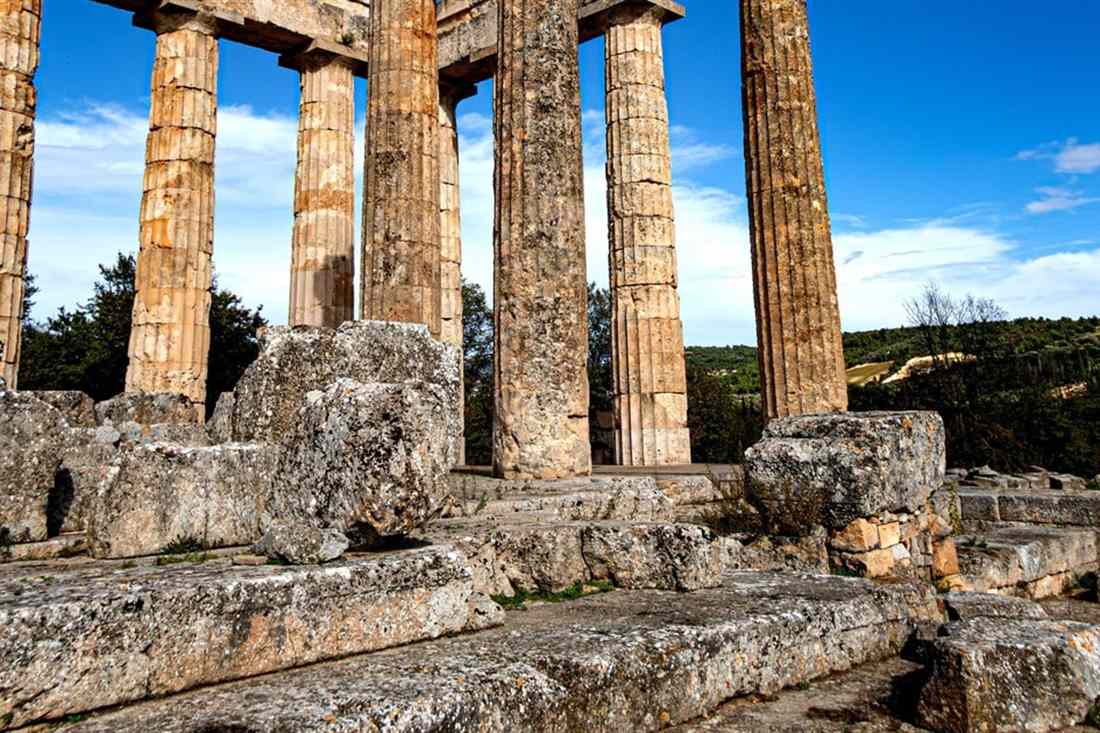
The Temple of Zeus at Ancient Nemea dates to the 4th century BC. It mixed Doric, Corinthian and Ionic orders in one building. On a Nemea day trip from Corinth, nine of its 32 limestone columns stand upright.
Argos built the temple during a wave of new monuments at Nemea. It rose over an older 6th-century BC temple that fire destroyed. Only a foundation wall of that first building remains in view. The ancient traveller Pausanias later found the roof fallen in and no cult image inside.
Visitors on a Nemea day trip from Corinth see Doric columns on the outside of the temple. Corinthian and Ionic elements stood inside the building. The outer Doric columns are slender, each rising to 6.34 times its own diameter. Farming and the theft of building stone after the classical period damaged the wider site.
- Columns on each short end: 6
- Columns on each long side: 12
- Columns upright since construction: 3
- Columns re-erected early in the 21st century: 2
- Columns re-erected after that: 4
- Sculpted decoration on the finished temple: none
South of the temple lie nine poorly preserved buildings known as oikoi. Three of them date to the first half of the 5th century BC. The eighth later became a bronze sculpting workshop. The ninth served as a kitchen for a dining hall with room for eleven couches. Four kilns at the site produced roof tiles.
How did athletes reach the Nemean stadium through the vaulted tunnel?
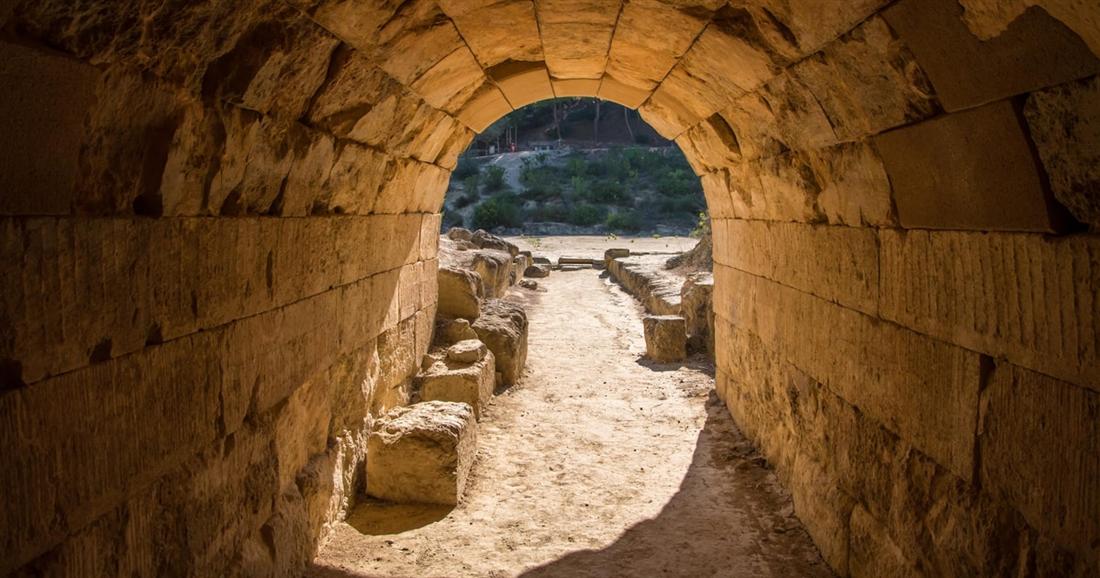
Athletes prepared in a changing building east of the stadium. They then walked through a barrel-vaulted tunnel 36 metres long onto the track. A Nemea day trip from Corinth follows the same passage on foot, from end to end.
The changing building, called the apodyterion, sat in a natural depression next to the stadium. Its Greek name means a room for undressing. It was a rectangular building with a portico around it. Stamps on its roof tiles name its architect, Sosikles.
The tunnel dates to the late 4th century BC, and excavators uncovered it only in recent decades. Its walls carry ancient graffiti, including the name Telestas, a known Olympic victor. On a Nemea day trip from Corinth, the walk ends where the tunnel opens onto the track.
The stadium itself lies southeast of the sanctuary, in a natural hollow between two ridges. Earth embankments on those slopes held the crowds. Spectators took their places on the slopes, while athletes used the tunnel. This stadium replaced an older one near the temple.
- Track length: 600 feet
- Starting line: stone blocks with grooves for the runners’ toes
- Starting gate: holes for a hysplex starting mechanism
- Water supply: a stone channel with basins, fed from a spring
- Seating: stone seats in places, earth banks elsewhere
What were the Nemean Games, and who ran them?
The Nemean Games were one of the four Panhellenic games, held every two years in honour of Zeus. Winners received a crown of wild celery. The stadium on a Nemea day trip from Corinth hosted their later footraces.
The other three Panhellenic games took place at Olympia, Delphi and Isthmia. The Nemean Games fell in the year before and the year after each Olympic Games. A sacred truce halted all wars for a month beforehand, so athletes travelled in safety.
- Footraces: the stadion, diaulos, hippios and dolichos
- Combat events: wrestling, boxing and pankration
- Combined event: the pentathlon
- Armoured race: the hoplitodromos
- Horse events: the tethrippon, synoris and keles
- Arts: musical contests
Nemea once lay in the territory of Kleonai, in ancient Argolis. Control of the Games passed between Kleonai, Corinth and Argos over time. A Nemea day trip from Corinth crosses land that changed hands between those cities.
The Games are recorded from the 6th century BC or earlier. The Society for the Revival of the Nemean Games formed in the late 20th century. The first modern Games followed two years later. Modern Nemeads run every four years, and winners receive crowns of wild celery and palm, not medals.
Which finds fill the Archaeological Museum of Nemea?
The museum at the entrance to Ancient Nemea displays finds from the sanctuary and the surrounding district. A Nemea day trip from Corinth reaches objects from the Copper Age to the early Byzantine era. Mycenaean gold jewellery from Aidonia leads the collection.
The University of California built the museum during its excavations at the site. The university then handed the building to the Greek State. Its teams have dug at Nemea in yearly campaigns for decades. They have uncovered a great open-air altar, baths and lodgings for ancient visitors.
The gold jewellery from the Mycenaean cemetery at Aidonia dates to the 15th century BC. The cases also show pottery from that cemetery and from the settlement of Aghia Eirene. Further finds come from Cleonae and Phlius.
- Coins spent by ancient visitors to the sanctuary
- Objects linked to athletic contests at Nemea
- Prehistoric pottery, tools and weapons from the district
- Inscriptions from Nemea, Phlius and Petri
- Images of Nemea made by travellers between the 18th and 20th centuries
A guided tour of Nemea pairs the museum cases with the excavated sanctuary next door. The Aidonia gold and the athletic finds suit a Nemea day trip from Corinth focused on history. The inscriptions from Petri tie the collection to one of today’s wine villages.
What is the myth of Heracles and the Nemean lion?
Heracles killed the Nemean lion as the first of his twelve labours, set by King Eurystheus. Its golden fur resisted every mortal weapon, so he strangled it and wore its coat. A Nemea day trip from Corinth crosses the hills where the story is set.
In Hesiod’s account, Hera raised the lion and sent it to terrorise the hills of Nemea. Heracles reached the town of Cleonae while hunting it. The village of Archaies Kleones keeps that name within the Nemea municipal unit. In another version, he met Molorchos, a shepherd whose son the lion had killed.
His arrows bounced off the beast’s thigh. The lion’s cave had two entrances, so Heracles blocked one and walked in through the other. He stunned the lion with his club and then strangled it with bare hands. Eurystheus later barred him from entering the city again. Zeus set the lion among the stars as the constellation Leo.
A second myth explains the Games at the sanctuary of Zeus. The infant Opheltes lay on a bed of parsley. His nurse Hypsipyle had gone to fetch water for the Seven against Thebes. A serpent killed the child, and the Seven founded the Games in his memory. The victors’ parsley crown and the judges’ black robes mark that mourning.
Why does Nemea grow the Agiorgitiko grape?
Agiorgitiko is native to Nemea and is the only variety permitted in the Nemea appellation. Its name means St George’s grape. Each Nemea red tasted on a Nemea day trip from Corinth comes from this one grape.
Nemea ranks as the leading red wine appellation of southern Greece. Its vineyards form the biggest vineyard area in the Balkans. Another name for the grape is Mavro Nemeas, meaning black of Nemea.
The vines climb from a warm valley floor to hills around Koutsi at 500 to 600 metres. The Asprokampos plateau holds vineyards up to 900 metres. Grapes from the valley floor turn jammy, while those near the hilltops turn too acidic. The middle slopes give the finest wines.
- Deep ruby colour in the glass
- Plum and red fruit aromas with a spicy edge
- Tannins from soft to firm, set by grower and winemaker
- Thick skins that handle oak ageing well
Carbonic maceration turns Agiorgitiko into lighter, fruity reds similar to Beaujolais Nouveau. Unlike that French wine, Nemea wine ages well for about five years. Beyond Nemea, the grape grows mainly across the Peloponnese. A Nemea day trip from Corinth tastes it in its home valley.
Which wineries open for tastings around Nemea?
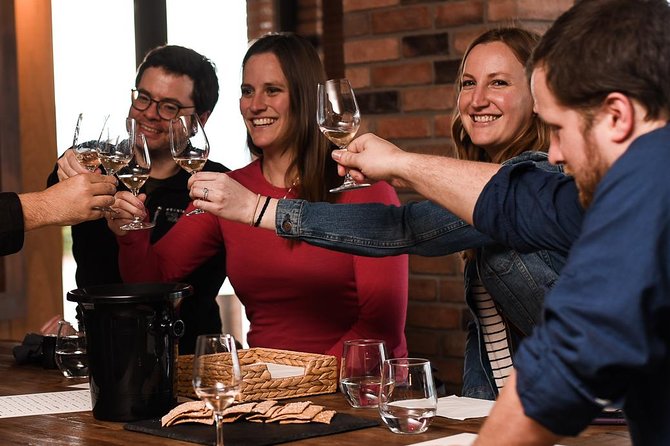
Wineries across the Nemea zone host tastings of Agiorgitiko in the valley and the hill villages. A Nemea day trip from Corinth reaches them on a booked wine tour with a driver. Koutsi, Petri and Leriza sit among the vineyards near the town of Nemea.
Archaia Nemea, once called Iraklion, lies just southwest of the ancient site. The modern town of Nemea lies to the west. Wine estates stand in Archaia Nemea too, so the ruins and the tastings share one valley. Glasses of Nemea red show a long, velvety palate and a complex aroma.
The GetYourGuide tour “Nemea: Wine Tasting Tour with Local Dishes” pairs Agiorgitiko with local food over five hours. The Viator tour “Wine Tasting Tour Ancient Nemea – Argos” adds Argos to the route. Athens-based travellers pick the Nemea wine day trip from Athens over a Nemea day trip from Corinth.


Which months suit a Nemea day trip from Corinth?
Late spring and early autumn suit a Nemea day trip from Corinth, with mild weather for walking. Autumn adds the harvest, because Agiorgitiko buds late and ripens after mid-September. Summer sun stays strong on the open ruins and the vineyards.
The vines follow the seasons, so the landscape changes with each month of travel. A Nemea day trip from Corinth in each season shows the vineyards at a different stage. After the harvest, autumn turns the vine leaves yellow and red.
- Late spring: fresh leaves and young shoots on the vines
- Summer: green bunches that darken as they ripen
- Early autumn: ripe dark grapes and the harvest
Ancient Nemea sits at about 360 metres above sea level, and the town at about 320 metres. That height keeps the air a little cooler than on the Corinth coast. Winter brings short days and bare, pruned vines across the slopes.
What do you wear and bring on a Nemea day trip from Corinth?
Walking shoes, a hat and sun protection cover a Nemea day trip from Corinth. Carry water for the open site. Leave the driving to a tour or a designated driver when the day includes wine tastings.
- Walking shoes with good grip
- A wide-brimmed hat and sunglasses
- Sunscreen for the open ruins
- A refillable water bottle
- A light layer for the cooler hill air
Wine and strong sun both dehydrate the body. Water between tastings keeps the head clear on a Nemea day trip from Corinth. Food between glasses slows the effect of the alcohol.
Closed shoes protect feet on loose stones and uneven ground across the excavated area. Sandals slip on gravel, and dust from dry paths coats open toes. Sunglasses cut the glare off pale stone in strong light.
How do you book and cancel a Nemea day trip from Corinth?
Book a Nemea day trip from Corinth online through GetYourGuide or Viator, picking a date and group size. Each listing states its cancellation terms. GetYourGuide’s free cancellation runs up to 24 hours before the start on listings that offer it.
Each listing shows the tour length, the meeting point and the inclusions before payment. Listings also name the guide’s languages. Read the inclusions line to check whether tastings, food and site tickets come with the tour. The confirmation then arrives by email with the voucher.
A cancellation inside the final 24 hours loses the free refund on GetYourGuide. Viator shows its own cancellation rules on each product page before checkout. Checking both terms before payment protects a Nemea day trip from Corinth against a change of plans.
Frequently Asked Questions
Does a Nemea day trip from Corinth work by bus?
Regional buses serve Corinthia, but current times need checking with the operator before travel. Wine tastings in the hill villages suit a booked tour better, since its driver handles the roads.
Does a Nemea day trip from Corinth include wine tasting?
Yes, on the wine tours. The six-hour “Ancient Nemea & Wine Tasting – Hercules & the Lion revealed” combines the site with tastings. Tours without wine in their title name any tasting in their inclusions.
Is a Nemea day trip from Corinth private?
Private versions run for one group only. “Private Luxury Tour: Nemea’s Ancient Sites & Wine Tasting” lasts eight hours on GetYourGuide. Viator lists “Mycenae and Ancient Nemea Private Tour from Corinth” as well. Other listings state the group type on their pages.
Can a Nemea day trip from Corinth add Ancient Corinth?
Yes. The GetYourGuide “From Corinth: Ancient Corinth & Nemea 5-Hour Private Tour” covers both sites in one outing. Ancient Corinth adds its own site museum, the Temple of Apollo and Roman-era ruins.
How far ahead does a booking need to be made?
Book as soon as the travel date is fixed. A private tour ties one guide to one group, which limits the places on each date. Early booking carries little risk on listings with free cancellation.