
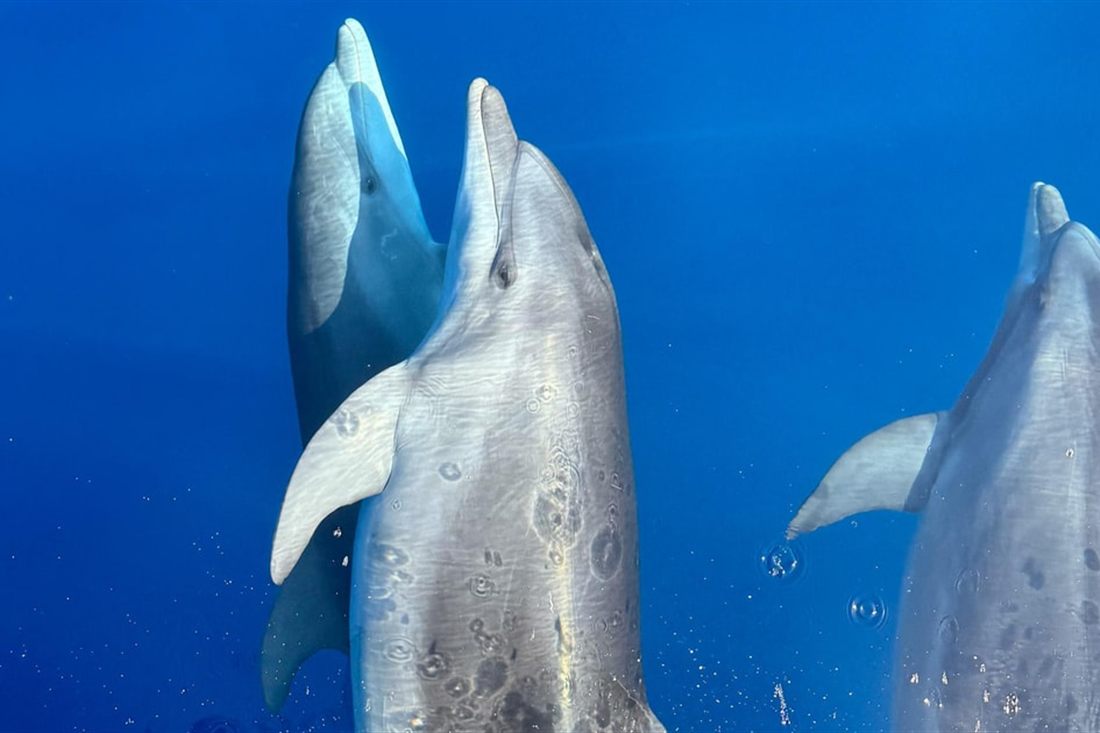
Rhodes dolphin watching is a boat trip from Kamiros Skala on the west coast of the island to the open sea near the islets of Makri and Stroggyli to look for wild dolphins, with a marine biologist on board and a snorkel stop. Tours across the rest of the country are listed on Greece Tours.
The sections below cover the cruises you can book, the start point, the sea area, the species, the snorkel stop, the Alimia island day, the chances, the rules, who it suits and booking, with links into the Rhodes pages. The tours shown are checked on GetYourGuide.
What is Rhodes dolphin watching?
Rhodes dolphin watching is a boat trip from Kamiros Skala on the west coast of Rhodes. A marine biologist guides the group to the sea near Makri islet, where wild bottlenose dolphins swim. Both Kamiros Skala cruises add a guided snorkel stop at Stroggyli islet.
The dolphins are wild animals that live free in the open sea. Nobody keeps them in a pool or a pen. The boat travels out to the waters where the operator finds them.
Blutopia, a diving centre at the port of Kamiros Skala, runs Rhodes dolphin watching from the harbour. Its team of marine biologists also leads daily snorkel and scuba trips. The centre hosts students and researchers in marine biology from across Europe.
Each trip mixes three parts: a dolphin search, a talk on local sea life and a guided snorkel. Guides speak English and Greek, and Dutch and German guiding is offered too.
Which Rhodes dolphin watching cruises can you book?
Two Rhodes dolphin watching cruises are listed on GetYourGuide, and both leave Kamiros Skala. One is a 3-hour dolphin and snorkel cruise with a marine biologist. The other is a 7-hour day that adds Alimia island and a beachside barbecue lunch.
The short trip is the Dolphin Watching & Marine Biologist Snorkel Cruise. It visits Makri for dolphins and Stroggyli for snorkelling, then passes Makri again on the way back. Hotel pickup is available, and the tour is listed as wheelchair accessible.
The long trip follows the same route, then adds free time on uninhabited Alimia. Lunch is locally farmed fish, grilled by the sea and served with drinks. Both Rhodes dolphin watching trips come from Blutopia and run on fixed days.
- Short cruise days: Monday, Wednesday, Friday and Saturday
- Short cruise times: 10:00 to 13:00, or 14:00 to 17:00
- Alimia day: Tuesday, Thursday and Sunday
- Alimia day times: 10:00 to about 17:00
A third option leaves Mandraki Harbour in Rhodes Town. Rhodes Sea Lines runs a 7-hour fast-boat day to Chalki, with a swim stop at Alimia. Its route passes the Makri islets, where the operator states dolphins appear near the fish farms.
Where does Rhodes dolphin watching start?
Rhodes dolphin watching starts at Kamiros Skala, a small fishing harbour on the west coast of Rhodes. The harbour lies about 50 km from Rhodes Town. Guests meet at the Blutopia office, which stands at the entrance to the port.
Kamiros Skala sits at the foot of the mountain village of Kritinia. Fishing boats shelter in its port all year round. Tavernas on the waterfront serve fresh fish, and a small pebble beach lies beside the port.
With the drive both ways, a 3-hour Rhodes dolphin watching cruise fills about five hours of the day.
The ruins of Ancient Kamiros lie about 10 km from the harbour. The same port runs summer boats to Chalki, a crossing of about one hour.
Where do the boats find dolphins on Rhodes dolphin watching?
On Rhodes dolphin watching, the boats search the sea around Makri islet, off the west coast. The operator names Makri as one of the top dolphin areas on Rhodes. The boat passes the islet twice, once going out and once coming back.
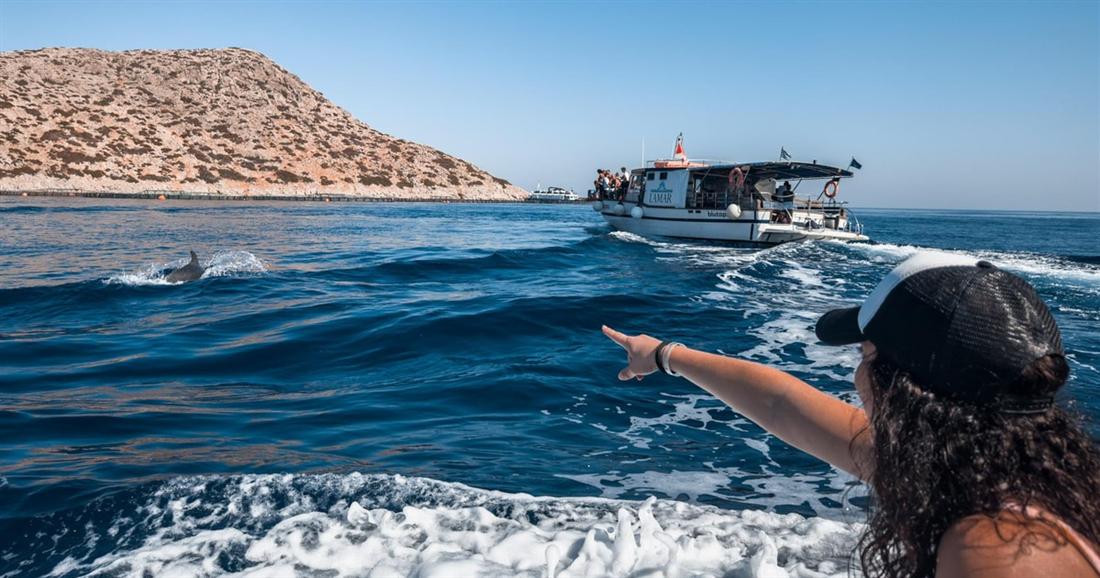
Makri is an uninhabited islet in the sea between Rhodes and Chalki. It belongs to the municipality of Chalki. Stroggyli, the snorkel islet, is in view from Kritinia Castle on the hill above the coast.
Floating fish farms sit in this stretch of sea, close to Stroggyli. The marine biologist explains them later in the trip.
Fish farms draw wild fish, mainly through uneaten feed that falls from the cages. Studies in the Ionian Sea saw bottlenose dolphins more near farms than away from them. Rhodes dolphin watching crews place their sightings near Makri and these farms.
- Kamiros Skala harbour: departure and return
- Makri islet: first dolphin search
- Stroggyli islet: guided snorkel stop
- Makri islet: second dolphin search
Which dolphins can you see on Rhodes dolphin watching?
Rhodes dolphin watching targets the common bottlenose dolphin, the species the operator finds around Makri islet. Greek research lists four dolphins that live in Greek seas all year: striped, common bottlenose, short-beaked common and Risso’s dolphin.
The Pelagos Cetacean Research Institute helped compile that Greek list. It counts twelve whale and dolphin species recorded in Greek waters. Seven of them live there all year, including the four dolphins named above.
The bottlenose dolphin carries the scientific name Tursiops truncatus. Marine researchers in the Aegean describe it as a coastal species. That habit suits Rhodes dolphin watching near the shore. Risso’s dolphins travel in small pods over deep water.
Whales share these seas too. Cuvier’s beaked whale, a deep-diving whale, has stranded along the Hellenic Trench, including on Rhodes. The sperm whale and the fin whale complete the list of Greek resident whales.
What does the marine biologist explain on Rhodes dolphin watching?
On Rhodes dolphin watching, the marine biologist explains the sea life of the west coast. The guide also shows how fish farming works. The talk starts near Makri and covers aquaculture. Aquaculture means farming fish, here in floating sea pens.
The fish farm in the Rhodes dolphin watching talk belongs to Lamar, a company based on Rhodes. Its floating pens sit north of Stroggyli, inside a Natura 2000 protected zone. Natura 2000 is the European Union network of protected nature sites.
The farm raises about 300 tonnes of fish each year. The species are sea bass, gilthead sea bream, red sea bream and meagre. Talks by the farm and its diving partner cover these subjects:
- Farming practices on the pens
- The need for more aquaculture in Europe
- The link between fish farms and the sea
- Biodiversity, meaning the range of wild species
- Protection of the marine environment
Wild animals visit the farm waters too, including tuna, dolphins and seals. The farm logs salinity, or saltiness, plus oxygen and temperature every hour. It collects this data with the Hellenic Centre for Marine Research.
How does the snorkel stop at Stroggyli work on Rhodes dolphin watching?
The snorkel stop on Rhodes dolphin watching takes place at Stroggyli, an islet inside the protected zone. The marine biologist leads the swim in the water. The crew hands out the snorkelling gear. Underwater photos of the swim come with the trip.
No snorkelling experience is needed for this stop. Guests swim beside the Lamar fish farm, among thousands of fish. The guided swim is part of both the 3-hour and the 7-hour trips.
- Snorkelling gear handed out on board
- A swim led by the marine biologist
- Thousands of fish around the farm pens
- Underwater photos taken during the swim
- Clear water inside a Natura 2000 zone
Both Rhodes dolphin watching trips include underwater photos of the swim. On the 7-hour day, guests collect their photos back at Kamiros Skala. Other snorkel spots around the island are covered under snorkelling in Rhodes.
What does the Alimia island day add to Rhodes dolphin watching?
The Alimia day adds about four hours to Rhodes dolphin watching. After the dolphins and the snorkel, the boat sails on to Alimia for free time. A beachside barbecue lunch with locally farmed fish and drinks follows.
This Rhodes dolphin watching day leaves Kamiros Skala at 10:00 and reaches Stroggyli by 11:00. Free time on Alimia, for swimming and walking, runs from 12:30 until lunch at 14:30. A second pass of Makri at 16:30 gives another look for dolphins.
The barbecue plate holds farmed fish, Mediterranean salad and seasonal fruit. Soft drinks and light alcoholic drinks come with it. Chicken souvlaki, or grilled meat on skewers, replaces the fish on request.
Alimia lies close to Chalki, and nobody lives there today. Its main village has stood empty since the middle of the last century. Chalki itself is a separate outing, covered by the Halki day trip from Rhodes.
How long does Rhodes dolphin watching last, and what is included?
Rhodes dolphin watching lasts 3 hours on the short cruise and 7 hours on the Alimia day. Both include the marine biologist, the Stroggyli snorkel, snorkel gear and underwater photos. The longer day adds the barbecue lunch and drinks.
The 3-hour cruise serves snacks and refreshments on board. Both trips share these inclusions:
- A marine biologist guide who speaks English and Greek
- A boat cruise past Makri and on to Stroggyli
- A guided snorkel with snorkelling equipment
- Underwater photos of the swim
- Optional hotel pickup and drop-off
Pickup is available on the 3-hour cruise, with details sent one day before. Hotels in the southern areas of the island need an extra arrangement and cost.
The 3-hour Rhodes dolphin watching cruise is listed as wheelchair accessible. It offers free cancellation up to 24 hours before the start.
How do you get to Kamiros Skala for Rhodes dolphin watching?
Kamiros Skala lies on the west coast, 44 to 50 km by road from Rhodes Town. Rhodes dolphin watching guests arrive by hotel pickup, by car or taxi, or on the RODA public bus. The airport sits about 32 km away.
The drive follows the west coast road out of Rhodes Town, through Ialysos and past the airport. A transfer from Rhodes Town takes about 50 to 70 minutes. From the airport, the drive takes about 30 minutes.
RODA, the Rhodes municipal bus company, runs lines 67 and 68 to Skala Kamirou, the port’s Greek name. Both lines link it with Rhodes Town and stop at the airport on the way. The buses run infrequently, so the RODA timetable sets the day.
Hotel pickup suits Rhodes dolphin watching guests without a car. Taxi users book a radio taxi or a private transfer in advance. Visitors flying in can book Rhodes airport transfers to reach their hotel first.
What are the chances of seeing dolphins on Rhodes dolphin watching?
The cruise listing for Rhodes dolphin watching calls the chance of a sighting high but not guaranteed. The dolphins are wild and free to roam, so no boat can promise to find them. A missed sighting still leaves the snorkel and the talk.
The boat looks for bottlenose dolphins around Makri on the way out. The return leg passes the islet again on the way back to Kamiros Skala, a second chance to spot fins.
Wild dolphins keep no timetable. Sightings on Rhodes dolphin watching depend on where the pod travels that day.
What are the rules for watching dolphins near Rhodes?
Greece is a party to ACCOBAMS, the treaty that protects whales and dolphins in the Mediterranean. Its guidelines cover Rhodes dolphin watching too: boats keep at least 100 metres away, slow down near dolphins and never feed them.
The guidelines set a slow zone of 300 metres around the animals. Inside it, a boat holds a steady speed of no more than 5 knots, about 9 km/h. It never goes faster than the slowest dolphin nearby.
No boat goes closer than 100 metres on purpose. It approaches only at an angle from the side and never cuts across the dolphins’ path. When it stops, the engine goes into neutral.
- No food or rubbish thrown into the sea near them.
- No swimming with them, which the guidelines ban or tightly control.
- No sudden changes in boat speed or direction.
- No fast exit: the boat stays slow until it is 300 metres away.
Who suits Rhodes dolphin watching, and what do you bring?
Rhodes dolphin watching suits families, couples and first-time snorkellers. Both cruise listings are marked wheelchair accessible. One listing says the trip does not suit people prone to seasickness. Pack swimwear, sun cream and a towel for the day.
Children aged 12 and younger book in the child category on both GetYourGuide listings. Guests from 13 count as adults. For more family days out, see Rhodes with kids.
The west coast faces the summer wind, so the sea can turn choppy. Guests with a weak stomach take a motion sickness tablet before Rhodes dolphin watching begins. A hat and a dry change of clothes help after the swim.
How does Rhodes dolphin watching compare with other boat trips on Rhodes and in Greece?
Rhodes dolphin watching sails the west coast from Kamiros Skala with a marine biologist on board. In Rhodes Town, the day cruises and the semi-submarine leave Mandraki harbour. A mainland dolphin cruise runs in the Amvrakikos Gulf near Preveza.
Rhodes boat trips head to east coast swim stops such as Anthony Quinn Bay, or across to Symi. The Rhodes submarine cruise is a 45-minute ride with underwater windows.
The Preveza dolphin watching cruise looks for about 150 resident bottlenose dolphins in an enclosed gulf. Rhodes dolphin watching adds a snorkel stop in open sea.
How do you book Rhodes dolphin watching, and which months suit it?
Book Rhodes dolphin watching on GetYourGuide at least 10 hours before departure, and both listings offer free cancellation. Late spring and October bring lighter winds. From July to September, the strong meltemi wind blows onto the west coast.
The 10-hour cut-off applies to both Rhodes dolphin watching listings: the 3-hour cruise and the 7-hour Alimia day. Free cancellation lets guests drop a date when the forecast turns windy. For island-wide weather month by month, see when to visit Rhodes.
The meltemi is a dry northwest wind that starts in June. It peaks from July to September at force 4 to 6, and at times force 7.
- Late spring: sea about 20°C, before the meltemi starts
- June: sea about 23.5°C, as the meltemi begins
- July and August: sea about 26 to 27°C, with the strongest wind
- September: sea about 27°C, with the wind still strong
- October: sea about 24°C, as the wind eases
Frequently Asked Questions
Can you try scuba diving on the dolphin trip?
One listing for the 7-hour Alimia day offers an optional scuba introduction at an extra charge. The operator, Blutopia, is a dive centre at the entrance of Kamiros Skala port. It runs daily snorkelling and scuba trips from the same harbour.
What is not allowed on board?
One cruise listing bans high-heeled shoes and fishing on the trip. Flat shoes with a good grip suit a wet deck. Leave fishing rods at the hotel, because the Rhodes dolphin watching route visits Stroggyli, a protected sea area.
How long can a boat stay beside the dolphins?
ACCOBAMS guidance limits each visit to around 15 minutes, above all when other boats wait their turn. Only one boat at a time stays in the watching area. On Rhodes dolphin watching, that means a short, calm encounter with no chasing.
What happens if the dolphins look disturbed?
The ACCOBAMS guidelines say the boat ends the encounter at any stage if dolphins show signs of alarm. No dolphin is ever split from its group or blocked from leaving. Boats run so they do not change the animals’ normal movement.
Does EU law protect dolphins around Rhodes?
Yes. The EU Habitats Directive lists every whale and dolphin species for strict protection. Greece applies it in Greek waters. The directive bans the deliberate capture, killing and disturbance of these animals. That covers the bottlenose dolphins seen on Rhodes dolphin watching.
Does it rain during the cruise season?
Rhodes stays dry in summer: one climate table lists zero rainy days from June to August. April and late spring have about 3 rainy days each. December and January bring 13 to 14 rainy days. July gets about 13 hours of sunshine a day.